If you need a compact thermal viewer for hunting, nighttime observation, or adverse-weather work, this GOYOJO G215 Thermal Imaging Monocular review focuses on its practical feature set.
The 256×192 sensor, 4X zoom, six display palettes, WiFi, and weather-resistant housing make it a versatile option on paper, although buyers should understand what its listing does—and does not—promise.
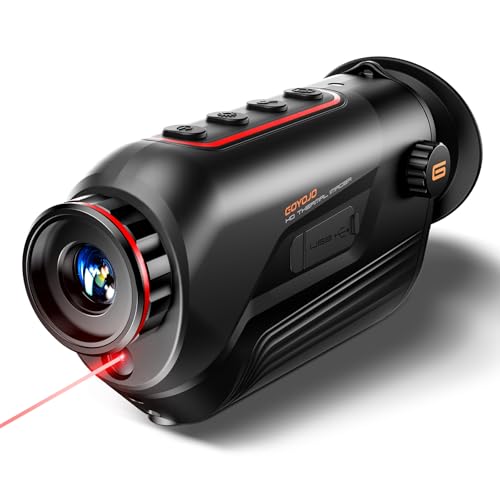
GOYOJO G215 Review Summary
The GOYOJO G215 Thermal Imaging Monocular is designed for people who want a handheld thermal camera rather than a conventional low-light telescope.
Its 256×192 thermal imaging sensor and 12 μm infrared detector are intended to produce a clearer view of heat signatures in low-light conditions, while six color modes let you adapt the display to the scene.
That combination suits hunters, outdoor users, search-and-rescue teams, and anyone who needs to inspect a dark or weather-affected environment.
The strongest reason to buy it is flexibility: you get 4X zoom, 16GB of image storage, WiFi-connected app viewing, replaceable batteries, and an IP65 rating in one portable monocular.
The main caution is that the supplied evidence gives no detailed field-of-view, detection-range, refresh-rate, or display-resolution information beyond the 256×192 sensor and the product title’s 50Hz reference.
This is therefore best judged as a feature-rich general-purpose thermal viewer, not as a fully documented professional imaging system.
Review Scorecard
| Category | Score | Editorial assessment |
|---|---|---|
| Thermal imaging | 8/10 | A 256×192 sensor and 12 μm infrared detector provide a solid stated foundation for low-light thermal viewing. |
| Viewing flexibility | 8/10 | Six palettes and 4X zoom give users useful ways to interpret and inspect a scene. |
| Outdoor readiness | 8/10 | The replaceable-battery design, claimed 6-plus-hour operation, and IP65 weather resistance support field use. |
| Image management | 7/10 | 16GB storage and WiFi app sharing are practical, though the record does not specify file formats or transfer controls. |
| Portability | 8/10 | The handheld monocular format is suited to mobile observation and quick checks outdoors. |
| Documentation confidence | 6/10 | Several important optical details are not supplied, so buyers should avoid assuming a specific range or professional-grade performance. |
Overall, the G215 looks most compelling for buyers who value a broad set of useful functions over a narrowly specified specialist instrument.
It is a sensible candidate for observing animals, checking outdoor areas at night, or sharing thermal views with another person through the app.
Its limitations are mainly about missing specifications rather than an obviously weak feature list.
Key Features and Specifications of GOYOJO G215
The central component is a 256×192 thermal imaging camera sensor paired with a 12 μm infrared detector.
According to the listing, this combination is intended to provide detailed thermal imagery in low-light conditions.
Thermal imaging is useful because it displays temperature differences rather than relying on visible illumination, but the supplied record does not establish how far the G215 can detect or identify a target.
The monocular offers six selectable display palettes:
- White-Hot
- Black-Hot
- Red-Hot
- Rainbow
- Iron-Red
- Glimmer
This variety matters because different palettes can make edges, warm objects, or contrast easier to interpret in different scenes.
It also makes the G215 more adaptable than a viewer limited to one presentation mode.
The listing includes 4X zoom, giving users additional magnification when inspecting a thermal image.
Since no details are supplied about whether that zoom is optical, digital, or hybrid, buyers should treat it as a useful viewing feature rather than assume it preserves the same detail at every level.
For recording, the G215 includes 16GB of image storage.
That is enough space for keeping captured thermal visuals for later review or sharing, although the evidence does not specify the number of images supported, video capability, or the available file formats.
The monocular also supports WiFi connectivity to a dedicated app, allowing real-time viewing and sharing of thermal images.
This can be valuable when a second person needs to follow the observation without looking through the eyepiece.
Power comes from replaceable batteries, with the listing claiming more than six hours of continuous outdoor operation.
Replaceable cells are a practical choice for extended trips because users can carry spares instead of depending entirely on a charging point.
Actual runtime will depend on use, display settings, WiFi activity, and environmental conditions, so the stated figure is best understood as a manufacturer claim rather than a guarantee for every outing.
The body is described as weather-resistant and rated IP65.
That rating is presented as protection against heavy rain, dust, and impacts in the product listing.
It makes the G215 more suitable for challenging outdoor conditions than an unprotected electronic viewer, but weather resistance should not be confused with unlimited exposure or underwater operation.
The handheld design also supports use by hunters, outdoor enthusiasts, search-and-rescue personnel, law enforcement, and people concerned with nighttime personal or family safety.
Pros and Cons of GOYOJO G215
Pros
- High-value core specification: The 256×192 sensor and 12 μm detector provide a clearly stated thermal-imaging basis.
- Six display palettes: White-Hot, Black-Hot, Red-Hot, Rainbow, Iron-Red, and Glimmer offer useful visual flexibility.
- Practical magnification: 4X zoom can help inspect a thermal scene without changing equipment.
- Useful field endurance: Replaceable batteries and a claimed 6-plus-hour operating time are well suited to outdoor sessions.
- Built for weather: The stated IP65 rating supports use around dust and rain.
- Connected viewing: WiFi and app support make real-time sharing possible.
- Onboard storage: 16GB provides room to retain captured thermal images.
Cons
- Key optical details are absent: The supplied specifications do not include detection range, field of view, or identification range.
- Zoom behavior is unclear: The record does not explain whether 4X zoom is optical, digital, or a combination.
- Battery figure is conditional: The more-than-six-hour claim may vary with settings and WiFi use.
- App details are limited: The evidence confirms WiFi connectivity but does not describe compatibility, controls, or transfer formats.
- Not enough evidence for specialist conclusions: Buyers needing documented performance for professional operations should seek a model with a fuller technical sheet.
Who Should Buy GOYOJO G215?
The G215 is a good match for hunters and outdoor observers who want to scan dark areas and adjust the thermal presentation to their preference.
The six palettes can be useful when one color scheme makes a warm subject easier to distinguish from the background.
The 4X zoom and handheld format also make it convenient for checking a scene without carrying a larger system.
It may also suit search-and-rescue or security-minded users who value quick nighttime awareness, image storage, and the ability to share a live thermal view.
The IP65 rating and replaceable batteries add practical value when the device may be used outside for extended periods.
Choose something else if you need a fully documented long-range instrument, a confirmed video workflow, or detailed app and compatibility information before buying.
The evidence supports a versatile outdoor monocular, but it does not provide enough data to promise a particular detection distance or professional identification capability.
How the G215’s Thermal Features Affect Real-World Use
Palette choice is more than a cosmetic setting
White-Hot and Black-Hot are familiar high-contrast approaches, while Red-Hot, Rainbow, Iron-Red, and Glimmer offer other ways to separate heat patterns.
Having six choices gives users room to select the view that is easiest to interpret in a particular scene.
WiFi changes the viewing experience
The dedicated app connection means the G215 is not limited to a single person looking through the monocular.
Real-time viewing and sharing can help when one user operates the device while another watches the thermal image.
Replaceable batteries favor longer outings
A claimed runtime of more than six hours is useful for outdoor sessions, and replaceable batteries make it possible to extend an outing with spares.
The tradeoff is that final endurance depends on how heavily the display, zoom, storage, and WiFi features are used.
Weather resistance supports, but does not eliminate, caution
The stated IP65 protection is a meaningful advantage for dust and rain.
Even so, buyers should still treat the monocular as electronic equipment and follow sensible precautions in severe weather.
Alternatives to GOYOJO G215
Buyers comparing thermal monoculars may also want to research the FLIR Scout TK, a compact thermal viewer line associated with straightforward handheld observation.
Those prioritizing a more hunting-focused product family can compare the AGM Global Vision Taipan line.
Another recognizable option is the Pulsar Axion range, which is worth investigating when a buyer wants to compare thermal monocular designs and published specifications.
These alternatives should be compared by sensor resolution, detection and identification range, refresh rate, battery system, weather protection, recording features, and app support.
The right choice depends less on the number of headline features than on whether the manufacturer documents the specific performance needed for your use.
Is GOYOJO G215 Worth It?
The GOYOJO G215 Thermal Imaging Monocular is worth considering when you want a portable thermal viewer with a strong mix of practical features: 256×192 imaging, six palettes, 4X zoom, 16GB storage, WiFi sharing, replaceable batteries, and stated IP65 protection.
It is best suited to hunters, outdoor observers, and general nighttime users who value flexibility and portability.
The buying decision becomes less clear for professional or long-range applications because the supplied evidence does not give detection range, field of view, or detailed app and zoom specifications.
If those figures are not essential, the G215 presents a well-rounded feature set for its category.
If they are essential, verify them before purchase and compare against a more fully documented thermal monocular.