If you want a robot mower for a large or uneven lawn, this Segway Navimow X430 review focuses on the features that matter most: wire-free setup, steep-slope traction, turf-safe turning, and obstacle handling.
The Segway Navimow X430 is designed for up to one acre, but its strongest case is a complex lawn where ordinary robot mowers may struggle.
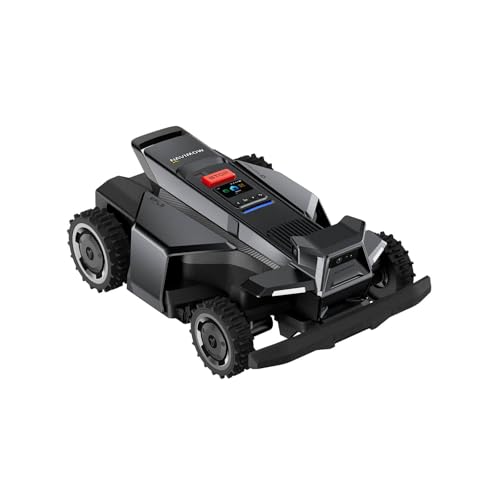
Segway Navimow X430 Review Summary
The Segway Navimow X430 is a compelling option for buyers who want autonomous mowing without installing a boundary wire.
Its combination of all-wheel drive, a dual-suspension design, centimeter-level positioning, and vision-based obstacle avoidance is aimed at lawns with slopes, uneven ground, fences, trees, and other interruptions.
The listing says it can climb slopes up to 84% or 40 degrees and cross obstacles up to 2.8 inches, which gives it a more capable specification than a basic flat-lawn robot.
It suits homeowners who value reduced trimming and automated scheduling, and who are prepared to spend time setting up maps and configuring a smart mower.
It is less attractive if your lawn is small, mostly flat, or already easy to maintain with a conventional mower.
Because the available evidence is manufacturer listing information rather than hands-on testing, the performance claims should be treated as targets that depend on lawn conditions, traction, satellite visibility, and setup quality.
Review Scorecard
| Category | Score | Buyer assessment |
|---|---|---|
| Wire-free setup | 9/10 | One-tap Auto Mapping and GeoSketch editing reduce the need for physical boundary-wire installation. |
| Slope and terrain ability | 9/10 | AWD, dual suspension, and the claimed 84% slope capability target demanding terrain. |
| Turf protection | 8/10 | Xero-Turn steering and traction control are designed to reduce scuffing during tight turns. |
| Cutting performance | 8/10 | Dual discs, 12 blades, dual 180W motors, and a 17-inch width promise efficient coverage. |
| Navigation and safety | 9/10 | Network RTK, 360-degree Vision, VIO, and VisionFence provide a sophisticated positioning and avoidance system. |
| Smart-home control | 8/10 | GPS tracking, alerts, and Alexa or Google Home voice control add useful convenience. |
The editorial verdict is strongest for large, complicated lawns.
The Segway Navimow X430 pros and cons are easier to weigh when you view it as a terrain-focused autonomous mower, not simply a cheaper replacement for a push mower.
Key Features and Specifications of Segway Navimow X430
The most important design choice is the X430’s all-wheel-drive platform.
Segway says its ORV-tuned dual suspension helps the mower remain stable across uneven terrain, while the system is rated for slopes up to 84% and obstacles up to 2.8 inches.
Those figures are particularly relevant for lawns with banks, ruts, transitions, or irregular landscaping.
Actual results will still depend on surface condition and available traction.
The mower uses Xero-Turn AWD with eccentric front-wheel steering and smart traction control.
The purpose is practical: allow tight, zero-turn-style maneuvers while limiting the turf tearing or circular scuffing that can happen when a heavy machine pivots in place.
This should be useful around beds and tight corners, though no steering system eliminates every risk on wet or soft ground.
For cutting, the X430 combines dual 180W motors with two cutting discs and 12 blades.
Its stated 17-inch cutting width should help it cover more ground per pass than a compact robot mower.
Adaptive blade control is intended to handle tall or dense grass efficiently.
EdgeSense is specified to reduce the uncut margin to under two inches, potentially reducing the hand-trimming work along boundaries.
Setup is wire-free.
One-tap Auto Mapping creates the initial map, and GeoSketch lets you edit maps afterward.
There is no antenna requirement listed for the mapping process.
That makes the installation conceptually simpler than burying perimeter cable, although careful map editing and boundary checks remain important before leaving the mower unattended.
Navigation combines EFLS tri-frequency Network RTK with 360-degree Vision and visual-inertial odometry, or VIO.
Segway describes the result as centimeter-level accuracy, including under trees or beside fences.
AI-powered VisionFence is said to identify more than 200 obstacle types.
In buyer terms, the X430 is built around multiple positioning and perception systems rather than relying on a single navigation method.
The smart features extend beyond navigation.
GPS tracking, GeoFence alerts, and lift alerts can help you monitor the mower and receive warnings when it moves outside a defined area or is lifted.
Alexa and Google Home voice control add hands-free interaction for users who already use those ecosystems.
Pros and Cons of Segway Navimow X430
Pros
- Wire-free mapping avoids the labor and permanence of installing a physical boundary wire.
- All-wheel drive and dual suspension are well matched to slopes and uneven lawns.
- Zero-turn steering with traction control is designed to protect turf during tight maneuvers.
- A 17-inch cutting width and dual-disc, 12-blade system should support efficient coverage.
- RTK, Vision, and VIO navigation provide several layers of positioning support.
- VisionFence obstacle recognition targets safer operation around varied lawn objects.
- GPS, GeoFence, lift alerts, and voice control make remote oversight more convenient.
Cons
- The feature set may be excessive for a small, flat lawn. Simpler robot mowers can be easier to justify for straightforward yards.
- Wire-free does not mean setup-free. Accurate mapping and boundary editing still require attention.
- Terrain claims are not the same as guaranteed results. Wet grass, loose soil, sharp transitions, and local conditions can affect traction.
- More advanced navigation creates more decisions. Buyers may need to learn mapping, zones, alerts, and smart-home controls.
- The listing does not provide a fuller specification set here. Details such as runtime, charging behavior, weather protection, and noise are not available in the supplied evidence.
Who Should Buy Segway Navimow X430?
The best match is a homeowner with a large lawn that is difficult rather than merely spacious.
Slopes, uneven ground, trees, fences, and obstacles are precisely the conditions addressed by the AWD chassis, suspension, RTK positioning, and VisionFence system.
Buyers who dislike digging in boundary wire should also find the Auto Mapping and GeoSketch workflow appealing.
It is also a good fit for people who want oversight from a phone or smart-home environment.
GPS tracking and GeoFence or lift alerts matter more when the mower operates across a broad property, while Alexa and Google Home support can make routine commands easier.
You should skip the X430 if your yard is tiny, flat, and uncomplicated, or if you prefer a conventional mower that gives immediate manual control.
It may also be a poor fit if you are unwilling to verify maps, maintain a safe operating area, or accept that advertised slope and obstacle capabilities depend on real-world conditions.
The supplied information also does not establish runtime or charging details, so buyers with unusually large mowing areas should confirm those specifications before purchasing.
How Segway Navimow X430 Handles Difficult Lawns
AWD traction on slopes
The X430’s dual-motor all-wheel-drive approach is intended to keep power available across uneven terrain.
Combined with the claimed 84% slope rating, it gives the mower a clear advantage on lawns where a basic two-wheel robot may lose confidence.
Treat the rating as a manufacturer claim and assess your own slopes, surfaces, and drainage before relying on it.
Zero-turn maneuvering near turf
Eccentric front-wheel steering lets the mower turn tightly, while smart traction control is designed to avoid unnecessary tearing.
This is a meaningful detail for lawns with narrow passages or planted edges: maneuverability matters, but leaving circular marks would undermine the convenience of automation.
Multi-layer navigation under obstacles
Network RTK, 360-degree Vision, and VIO give the X430 several ways to understand its position.
The listing specifically highlights performance under trees and along fences, two places where satellite-based positioning can be more challenging.
VisionFence adds object recognition, with the manufacturer claiming detection of more than 200 obstacle types.
Edge coverage and dense grass
The dual 180W motors, dual cutting discs, 12 blades, and 17-inch width are aimed at productive mowing rather than light trimming alone.
Adaptive blade control should help when grass becomes taller or denser, while EdgeSense’s stated under-two-inch trimming margin could reduce the amount of finishing work around borders.
Alternatives to Segway Navimow X430
For a direct alternative, compare the Husqvarna Automower robotic lawn mower.
Automower is a well-known product line worth considering if you prefer an established robotic-mower ecosystem and want to compare available models for your yard size and terrain.
The Worx Landroid robotic lawn mower is another credible line to investigate.
It can make sense for buyers who want a broad range of mower configurations and are comfortable comparing installation and boundary requirements model by model.
You can also compare the Mammotion LUBA AWD robotic lawn mower if all-wheel-drive terrain handling and wire-free operation are central to your decision.
Check the exact model’s coverage, mapping, and obstacle-avoidance specifications rather than assuming every LUBA variant matches the X430.
Is Segway Navimow X430 Worth It?
The Segway Navimow X430 is worth considering when your lawn’s main problem is complexity.
Its published combination of AWD, dual suspension, zero-turn steering, wire-free mapping, RTK navigation, VisionFence, and a wide multi-blade cutting system is unusually focused on uneven terrain and reduced setup friction.
Buy it if you have a large, challenging lawn and value automated mowing with remote monitoring.
Before committing, confirm the missing practical specifications—especially runtime, charging, weather operation, and local installation requirements—and test the planned map carefully.
If your lawn is flat and simple, a less elaborate robot mower may be the more sensible choice; for demanding ground, the X430’s capabilities make a persuasive case.