The right servo can make an RC model feel precise, responsive, and dependable. Whether you are replacing a worn unit, upgrading steering power, or building a robot from scratch, matching the servo to the model matters.
This roundup compares 10 popular options across micro, metal-gear, digital, high-torque, and multi-pack designs, helping you narrow the choices by size, power, durability, and intended use.
Best 10 Rc Servos for Hobbyists Picks for 2026
Compact Starter Pick

- Four lightweight micro servos
- 4.8–6V operation
- For small models and robotics
Best For: Multi-servo beginner projects
High-Torque Upgrade
20KG 270° Metal Gear Digital Servo

- Up to 22.8 kg·cm torque
- 270° digital control
- Protection and metal construction
Best For: Large RC cars and high-load projects
Bulk Metal-Gear Value

- Twelve compact servos
- Metal gears and double bearings
- 2.0 kg/cm stall torque
Best For: Multiple small-model builds
Arduino-Friendly Multipack

- Ten 180° micro servos
- JR and Futaba compatible
- 4.8–6V operation
Best For: Arduino, Raspberry Pi, and DIY projects
Multi-Pack Builder

- Includes 10 compact micro servos
- 1.9 kg.cm torque and 0.08s speed
- Metal motor gear and shaft
Best For: Arduino projects, robots, and DIY models
Heavy-Duty Steering
20KG Waterproof Metal-Gear Servo

- 20 kg.cm torque at 7.4V
- IP67 water resistance
- Metal gears with aluminum housing
Best For: Larger RC cars, robots, boats, and steering systems
Best Budget Micro Servo
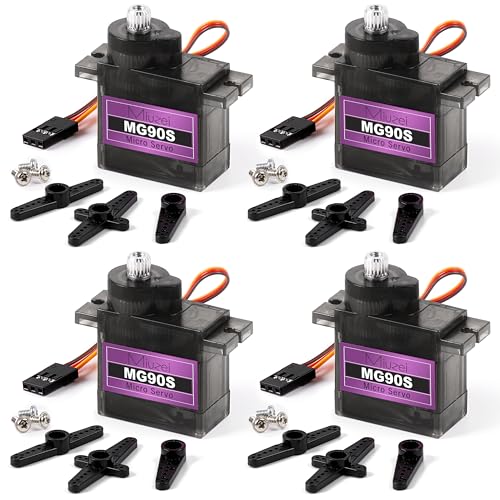
- 2.0 kg·cm torque at 6V
- 180° rotation and 0.08s/60° speed
- Lightweight 9g design for small builds
Best For: Lightweight RC models, Arduino projects, and small robots
Best Heavy-Duty Steering Servo

- Up to 27.5 kg·cm torque at 8.4V
- 270° control with dual ball bearings
- IP66 splash-resistant housing
Best For: 1/10 and 1/8 RC crawlers, trucks, and off-road steering
Best Standard-Size Multipack
MG996R Digital Metal Gear 4-Pack

- 12 kg·cm at 6V and 13 kg·cm at 7.2V
- 180° digital servo operation
- Metal gears with coreless motor
Best For: RC vehicles, aircraft, boats, robots, and mechanical arms
Compact Starter Pick – SG90 9g Micro Servos 4-Pack
Beffkkip 4Pcs SG90 9g Micro Servos for RC Robot Helicopter Airplane Controls Car Boat
Check Price On AmazonFor hobbyists building lightweight models, these four SG90 micro servos offer a practical entry point into rc servos for hobbyists. They operate at 4.8–6V, weigh very little, and are rated for 0.1 second per 60 degrees at 4.8V with no load.
Best For: Small fixed-wing aircraft, helicopters, gliders, boats, robots, and robotic arms.
Pros:
- Four-servos-per-pack value for multi-servo projects
- Small, lightweight design suits compact models
- Works across a 4.8–6V operating range
- Listed for aircraft, boats, cars, and robotics
Cons:
- Specifications are oriented toward small models rather than high-torque applications
- Operating speed is listed at no load
This is a sensible economical choice when size, weight, and quantity matter more than heavy-duty torque.
High-Torque Upgrade – 20KG 270° Metal Gear Digital Servo
Hobbyists seeking stronger rc servos for hobbyists should consider this digital metal-gear model. It provides up to 22.8 kg·cm of torque at 6.8V, uses a 500–2500 μsec pulse range for 0–270-degree control, and includes overload, rotor-blocking, and overheat protection.
Best For: 1/8 and 1/10 RC cars, crawlers, boats, robots, rigid-wing aircraft, and helicopters.
Pros:
- High maximum torque for demanding steering and control tasks
- 270-degree digital positioning range
- Aluminum gears and double ball bearings support stable operation
- Includes overload, stall, and 70°C overheat protection
Cons:
- Single-servo pack may cost more per project than multipacks
- Larger and heavier than 9g micro-servo options
- Rated torque is specified at 6.8V
Its combination of torque, extended travel, metal construction, and protective features makes it the most capable option here for larger or higher-load builds.
Bulk Metal-Gear Value – MG90S 9g Micro Servos 12-Pack
For builders who need several compact rc servos for hobbyists, this 12-pack of MG90S units is a useful bulk option. Each servo uses metal gears, a coreless motor, and double ball bearings, with 2.0 kg/cm stall torque and 0.11 second per 60 degrees operation at 4.8V.
Best For: RC aircraft, helicopters, quadcopters, boats, cars, robotics, and electronics DIY projects.
Pros:
- Twelve servos support larger builds or replacement stock
- Metal gears are designed for quieter operation
- Double ball bearings and a coreless motor are included
- Compact 9g format suits space-conscious models
Cons:
- Lower torque than the listed 20KG digital servo
- Operating speed is specified at 4.8V
- Temperature range is listed as 0–55°C
This pack is especially appealing for hobbyists assembling multiple small models or wanting inexpensive spares with metal-gear construction.
Arduino-Friendly Multipack – SG90 9g Servos 10-Pack
This 10-pack is aimed at hobbyists combining RC control with Arduino, Raspberry Pi, and DIY projects. The SG90 servos run on 4.8–6V, provide 180-degree movement, and are rated at 0.09 second per 60 degrees at 4.8V with no load.
Best For: Arduino and Raspberry Pi projects, RC cars, drones, aircraft, boats, robots, and robotic arms.
Pros:
- Ten units provide useful project and replacement capacity
- Compatible with JR and Futaba interfaces
- 180-degree running angle suits common positioning tasks
- Compact 9g design works in small models
Cons:
- Analog servos require a continuously provided PWM signal
- Starting current should be over 1A
- Stall torque is limited to 1.4 kg/cm at 4.8V
Choose this pack when controller compatibility, quantity, and straightforward DIY integration are priorities; plan the power supply around its stated current requirement.
Micro Torque Upgrade – PTK 9497 MG-D Coreless Servo
For hobbyists comparing rc servos for hobbyists, the PTK 9497 is a compact, programmable option for lightweight models that need quick, precise movement. Its coreless motor, metal gears, dual bearings, and broad 4.8V–8.4V operating range suit micro crawlers, aircraft, and robots in dry environments.
Best For: Micro RC cars, mini aircraft, and compact robot joints requiring strong torque response in a small package.
Pros:
- Coreless motor delivers up to 13.2 kg.cm at 8.4V with fast 0.066s/60° response.
- Stainless steel gears, CNC housing, and dual ball bearings support smooth, stable transmission.
- Lightweight 19.2g design, 250mm JR harness, and programmable adjustment compatibility.
Cons:
- The servo is non-waterproof and intended for dry environments.
- The included metal servo arm may require a compatible replacement for installation.
- The programmer is sold separately.
This is a specialized micro servo rather than a general-purpose waterproof unit. Choose it when compact dimensions, rapid response, and programmable performance matter most.
Multi-Pack Builder – SG90 9G Metal-Gear Servo Kit
For hobbyists seeking rc servos for hobbyists in quantity, this 10-pack offers an economical way to equip multiple small projects. The SG90 servos use metal motor pinion gears and shafts, support 180° movement, and connect through a simple three-pin PWM interface.
Best For: Arduino and Raspberry Pi projects, micro robots, robot arms, small aircraft, and other compact DIY builds.
Pros:
- Ten servos provide useful spares or enough units for multi-servo projects.
- Metal motor gear and shaft resist tooth breakage and heat deformation associated with plastic parts.
- Offers 1.9 kg.cm stall torque, 0.08s/60° speed, and 180° operation at 4.8V–6V.
- Includes servo arms and 24.5mm leads for compact wiring.
Cons:
- Requires a continuous PWM signal and a power supply capable of more than 1A starting current.
- The 1.9 kg.cm torque rating is intended for small mechanisms, not high-load applications.
This kit makes sense for experimentation, classroom-style builds, and projects where having several compact servos is more valuable than maximum torque.
Heavy-Duty Steering – 20KG Waterproof Metal-Gear Servo
For rc servos for hobbyists who need substantial steering force, this digital servo combines 20 kg.cm torque at 7.4V with a full-metal gear train and IP67 water resistance. Its aluminum case helps with heat dissipation, while dual ball bearings support stable, low-noise operation.
Best For: 1/6 to 1/12 RC cars, robots, boats, aircraft models, and DIY mechanisms needing high torque and splash protection.
Pros:
- High 20 kg.cm torque at 7.4V supports demanding steering and mechanical loads.
- Metal gears, dual ball bearings, and a high-precision potentiometer promote durability and control accuracy.
- IP67 water resistance helps protect against water splashes.
- Anodized aluminum housing assists heat dissipation and includes a metal servo arm.
Cons:
- At 68g, it is considerably heavier than micro servos.
- Its 40 × 20 × 40.5mm size may not fit compact models.
- Its high-torque design is more than many lightweight hobby projects require.
This is the strongest choice of the three for larger models and exposed steering duties. Verify the available mounting space and power requirements before selecting it for a build.
Best Budget Micro Servo – MG90S 9G Metal Gear 4-Pack
For hobbyists choosing rc servos for hobbyists projects, this MG90S 4-pack is a compact option for lightweight builds. It offers 2.0 kg·cm of torque at 6V, 180-degree rotation, and a small 9-gram form factor for Arduino projects, RC aircraft, boats, robots, and similar applications.
Best For: Lightweight RC models, Arduino builds, small robots, drones, and multi-servo DIY projects.
Pros:
- Four servos per pack for multi-servo projects or spares.
- Aluminum metal gears and a coreless motor support strength and durability.
- Compact 9-gram design with 0.08-second/60-degree speed at 6V.
Cons:
- Its 2.0 kg·cm torque is intended for small, lightweight applications.
- A stable 5V power supply is recommended, and multi-servo setups may need an external supply.
This is a practical starter pack when size and quantity matter more than heavy-duty steering force. Confirm that your receiver or controller provides the required 4.8–6V operating range.
Best Heavy-Duty Steering Servo – 25KG 270° Metal Gear 2-Pack
For hobbyists who need strong steering performance, this 25KG servo pair is designed for 1/10 and 1/8 RC crawlers, trucks, and bashers. It provides up to 27.5 kg·cm of torque at 8.4V, full-metal gearing, dual ball bearings, and a splash-resistant housing.
Best For: High-load RC crawler and truck steering, off-road builds, robot projects, and demanding DIY applications.
Pros:
- High torque output helps handle heavy-duty tire steering.
- 270-degree range, 3μs dead band, and 25T spline support precise control.
- IP66 splash-resistant housing and protection against overheating, stall, and burnout.
- Two-pack format provides a matching spare or supports dual-servo projects.
Cons:
- Requires a 500–2500μs PWM signal for the full 270-degree range.
- Its 40 × 20 × 40.5mm standard-size body may require mounting modifications in some models.
- Splash-resistant construction is not intended for prolonged submersion.
This is the strongest choice here for rugged, torque-intensive RC steering, provided your receiver supports the stated PWM range and the mounting space is sufficient. Check voltage compatibility from 4.8–8.4V before installation.
Best Standard-Size Multipack – MG996R Digital Metal Gear 4-Pack
This MG996R 4-pack suits hobbyists looking for standard-size rc servos for hobbyists projects that require more torque than small micro servos. The digital servo delivers 12 kg·cm at 6V or 13 kg·cm at 7.2V, with 180-degree rotation and compatibility with common receiver connectors.
Best For: RC cars, boats, helicopters, fixed-wing aircraft, biped robots, and mechanical arms.
Pros:
- Four standard servos offer useful project coverage and replacements.
- Metal gears and a coreless motor support durability and anti-vibration performance.
- 12–13 kg·cm torque provides a substantial step up from SG90 and MG90S micro servos.
- Compatible with many Futaba, Hitec, Sanwa, and GWS-style receiver connectors.
Cons:
- The servos weigh about 55g each, making them less suitable for weight-sensitive models.
- A stable external power supply is recommended, with current use listed at 3A.
- Rotation is limited to 180 degrees rather than the wider range of some specialty servos.
Choose this pack when you want multiple conventional servos for larger models or robot mechanisms. Pay particular attention to the 5V recommended operating point, voltage range, and power requirements during installation.
How We Picked These Rc Servos for Hobbyists
We selected products that represent the main servo categories used in hobby projects: lightweight 9g micro servos, metal-gear replacements, high-torque digital models, waterproof steering servos, and multi-packs for larger builds or spare parts. We considered stated torque, gear construction, size, compatibility claims, pack value, and the types of RC vehicles or projects each servo is intended to support.
Because specifications can vary by voltage, manufacturer, and listing, confirm the seller’s torque, dimensions, connector, operating voltage, and mounting details before ordering. Compatibility with a model’s receiver or control board is just as important as headline torque.
Quick Comparison
| Servo Type | Best For | Main Advantage | Watch For |
|---|---|---|---|
| 9g plastic-gear micro | Small planes, robots, and light mechanisms | Low weight and low cost | Limited durability and torque |
| 9g metal-gear micro | Compact models needing extra toughness | Better gear durability | May draw more current |
| 13kg coreless digital | Small crawler upgrades | Fast, strong, precise response | Requires careful fit and power planning |
| 20–25kg digital metal gear | Medium and large RC cars | High steering force | Higher current demand and larger size |
| MG996R-style servo | Robots, boats, and larger DIY builds | Useful torque at a low per-unit cost | Check dimensions and centering quality |
Key Buying Factors for Rc Servos for Hobbyists
Torque and Speed
Torque determines how much load the servo can move or hold, while speed affects response. High torque is useful for crawler steering, heavy wheels, and mechanical arms; smaller aircraft controls and lightweight robots usually need less. Do not choose by torque alone: a powerful servo may be unnecessary weight for a small model.
Size, Weight, and Mounting
Micro servos are suited to tight spaces and lightweight builds, but their mounting tabs, spline count, and case dimensions still vary. Larger 20kg and 25kg units may not fit stock brackets. Compare measurements with the original servo before buying.
Gear Material and Electronics
Metal gears generally tolerate impacts and repeated load better than plastic gears, although they can add weight and transmit shock to other components. Digital servos can offer stronger holding and more precise control, but they may require a capable battery, regulator, and receiver.
Water Resistance and Power Requirements
For crawlers, boats, and outdoor vehicles, a waterproof or sealed design is preferable, but “waterproof” claims vary. Verify the rated voltage and current capacity of the BEC or power supply. A servo that stalls under load can overheat wiring or cause receiver resets.
Who Should Buy Which Rc Servos for Hobbyists?
- Choose a 9g plastic micro servo for budget Arduino projects, lightweight planes, small robots, and simple replacement jobs.
- Choose a 9g metal-gear pack when you need several compact servos or want more resistance to stripped gears.
- Choose the 13kg crawler-oriented servo for compact SCX24-, TRX4M-, and similar-scale upgrades, provided the mounting and spline specifications match.
- Choose a 20kg or 25kg metal-gear digital servo for demanding steering in 1/10 or larger RC cars and other high-load mechanisms.
- Choose an MG996R-style multi-pack for larger robots, boats, and DIY projects where affordable torque and readily available replacements matter.
For the best result, match the servo to the model’s physical space, voltage, connector, required torque, and available power rather than relying on the largest rating.