The best physics experiment sets turn abstract formulas into hands-on lessons. With the right kit, students can build circuits, measure forces, explore motion, and observe optics concepts directly.
This roundup compares 10 physics experiment sets across electricity, mechanics, magnetism, dynamics, forces, and light, helping teachers, parents, and students choose a kit that matches their learning goals.
Best 10 Physics Experiment Sets Picks for 2026
Best Electricity & Magnetism Kit
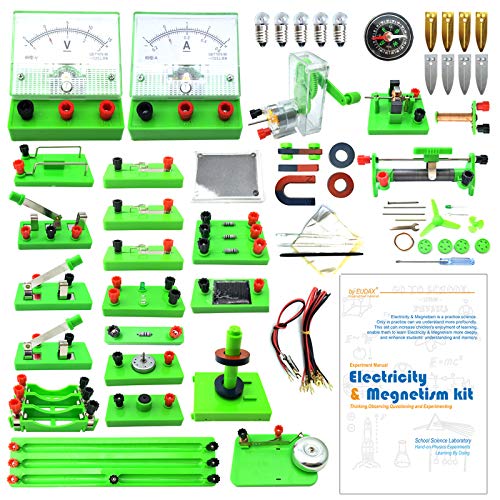
- Covers circuits, electromagnetism, and magnetic models
- Includes 79 items, tools, storage bag, and color manual
- Supports projects such as fruit batteries and electric bells
Best For: Grades 9–11 students and introductory STEM exploration
Best Simple Machines Set

- Builds models using all six classic simple machines
- Includes a spring scale for measuring force
- Provides 26 exercises and a 32-page illustrated manual
Best For: Ages 8+ learning introductory mechanics
Best Mechanics Lab Kit

- Covers Newton’s laws, kinematics, gravity, pressure, and buoyancy
- Includes pulleys, balance, force gauge, trolley, and ramp
- Comes with a detailed manual and organized storage box
Best For: Ages 14+ and structured classroom mechanics labs
Best Optics Experiment Set
Multifunction Physics Light Lab

- Demonstrates refraction, reflection, lenses, mirrors, and prisms
- Includes multiple lenses, a prism, reflector, and light source
- Compact kit with an English color manual
Best For: Ages 14+ and indoor optics demonstrations
Motion Lab Starter

- Explores velocity, acceleration, friction, and momentum
- Includes two carts with steel and rubber bumpers
- Designed for classroom or home motion experiments
Best For: Hands-on Newton’s laws and collision studies
Physics Fundamentals Pick

- Includes 20 hands-on physics experiments
- Covers forces, energy, motion, and Newton’s laws
- Comes with an NGSS-aligned lesson plan
Best For: Ages 8+ and structured introductory STEM learning
Electricity Builder

- Builds series and parallel circuits
- Includes English instructions and storage box
- Supports introductory electricity and STEM activities
Best For: Grades 7–9 circuit projects and classroom labs
Best All-Around Mechanics Kit
Junior Physics Mechanics Lab Kit

- Supports 30+ mechanics experiments
- Includes measurement, pulley, pressure, and motion tools
- Manual and organized storage included
Best For: Junior-school mechanics lessons and laboratory practice
Best Magnetism Demonstration Set

- Contains 53 magnetism and circuit components
- Supports 14+ guided experiments
- Includes levitation, field, and electromagnet activities
Best For: Magnetism and electromagnetism classroom demonstrations
Best for Circuit Building
EUDAX Electricity Experiment Kit

- Builds simple, series, and parallel circuits
- Includes lights, switches, wires, and LEDs
- Supports generator, electromagnet, and traffic-light projects
Best For: Grades 7–11 electricity and magnetism activities
Best Electricity & Magnetism Kit – EUDAX Basic Circuit Lab
For students comparing physics experiment sets, the EUDAX kit offers a broad introduction to electricity and magnetism through hands-on builds. Its color manual and collection of circuit and electromagnetism projects make it a practical option for guided STEM exploration.
Best For: Students in grades 9–11, homeschool labs, and beginners exploring basic electricity and magnetism.
Pros:
- Supports series circuits, parallel circuits, fruit batteries, electromagnets, electric bells, and more.
- Includes 79 total items, including electricity and magnetism components, tools, a storage bag, and manual.
- Encourages students to build models while learning foundational principles.
Cons:
- Requires three AA batteries, which are not included.
- The wide range of parts may require careful organization between experiments.
This is a versatile choice when you want one kit to cover both basic circuits and introductory magnetism. It is especially useful for learners who benefit from structured instructions and multiple project options.
Best Simple Machines Set – T&K Physics & Engineering Kit
Among physics experiment sets for younger learners, the T&K Simple Machines set focuses on building and testing practical mechanical models. Its modular pieces, force-measuring spring scale, and illustrated manual connect familiar machines to core physics concepts.
Best For: Children ages 8 and up learning about levers, pulleys, gears, and other simple machines.
Pros:
- Includes 26 model-building exercises covering all six classic simple machines.
- Spring scale lets learners measure changes in force direction and magnitude.
- Modular construction pieces are compatible with other Thames & Kosmos building systems.
- The 32-page color manual provides step-by-step guidance and scientific explanations.
Cons:
- Its scope is concentrated on simple machines rather than broad physics topics.
- Plastic components may be less suitable for advanced laboratory work.
This set is a strong starting point for introducing mechanical advantage in a tangible way. It combines construction, measurement, and familiar real-world examples without requiring batteries.
Best Mechanics Lab Kit – 26-Experiment Physics Set
For buyers seeking physics experiment sets with a more laboratory-oriented focus, this mechanics kit provides equipment for forces, motion, pressure, and buoyancy. Its metal and plastic components, professional-style manual, and storage box suit structured classroom or independent study.
Best For: Middle and high school students ages 14 and up, classroom demonstrations, and home mechanics labs.
Pros:
- Includes 26 experiments involving Newton’s laws, kinematics, gravity, friction, pressure, and buoyancy.
- Provides varied equipment such as pulleys, a balance, force gauge, trolley, ramp, and U-tube pressure gauge.
- Detailed operating steps and principle analysis support systematic experimentation.
- Portable storage helps organize the included accessories and small parts.
Cons:
- Recommended for ages 14 and up, so it may be too advanced for younger children.
- Its 4.6-pound weight and larger dimensions make it less portable than compact kits.
This is the most comprehensive mechanics-focused option in the group. Choose it when measurement equipment and coverage of classical mechanics matter more than simple model building.
Best Optics Experiment Set – Multifunction Physics Light Lab
This optical physics set is a focused choice among physics experiment sets for demonstrating how light behaves. It combines lenses, mirrors, a triangular prism, a reflector, and an adjustable linear light source for practical refraction and reflection activities.
Best For: Students ages 14 and up, teachers, and indoor demonstrations of introductory optics.
Pros:
- Supports experiments with refraction, reflection, convex and concave lenses, mirrors, and prisms.
- Includes three biconvex lenses, concave and convex lenses, a prism, reflector, and acrylic tile.
- Three-way linear light source can be adjusted to change the light direction.
- Compact package includes a color manual and storage box.
Cons:
- Requires two AAA batteries, which are not included.
- It focuses on optical physics rather than covering a broad range of physics topics.
- The acrylic components are intended for demonstrations rather than professional optical measurement.
This set makes optics easier to visualize because learners can directly observe light paths through multiple lenses, mirrors, and a prism. It is a practical fit for indoor teaching demonstrations and guided student experiments.
Motion Lab Starter – Dynamics Carts
For hands-on physics experiment sets focused on motion, this two-cart kit offers a straightforward way to investigate velocity, acceleration, friction, and collisions. The included bumpers and experiment suggestions support both classroom lessons and home lab activities.
Best For: Students and educators exploring Newton’s laws, momentum, and collision dynamics.
Pros:
- Supports experiments with velocity, acceleration, friction, and conservation of momentum.
- Includes two carts, steel bumpers, rubber bumpers, and experiment suggestions.
- Low-friction snap-in wheels and deep weight wells allow varied setups.
- Suitable for structured classroom curricula or independent study at home.
Cons:
- Its focus is primarily motion dynamics rather than a broad range of physics topics.
- The kit does not list additional weights or measuring instruments among the included components.
This is a focused choice for learning mechanics through repeated cart experiments. Choose it when collision and motion demonstrations are more important than a wide survey of physics concepts.
Physics Fundamentals Pick – Forces, Motion & Energy Set
This physics experiment set is built as a broader introduction to forces, motion, and energy, with 20 hands-on experiments and model-building activities. It covers concepts such as mass, gravity, inertia, work, impact, and Newton’s laws in a format intended to make abstract ideas easier to visualize.
Best For: Learners ages 8+ and educators seeking a structured introductory physics and engineering set.
Pros:
- Offers 20 experiments spanning forces, energy, motion, and related concepts.
- Uses hands-on models and real-time experiments to support visual learning.
- Includes a ready-to-use lesson plan aligned to NGSS standards.
- Includes components such as a spring scale, plastic building parts, and rubber bands.
Cons:
- The supplied information does not specify the individual contents of all 20 experiments.
- Its plastic construction may be less suitable for learners seeking advanced laboratory equipment.
Among these physics experiment sets, this is the most comprehensive option for a general introduction to mechanics and energy. The lesson plan also makes it convenient for organized educational use.
Electricity Builder – Basic Circuit Lab Kit
For physics experiment sets centered on electricity, this introductory circuit kit lets students build basic series and parallel circuits. English instructions and a storage box make it practical for school projects, science clubs, home learning, and other hands-on STEM settings.
Best For: Students in approximately grades 7–9 learning basic current and circuit rules.
Pros:
- Supports construction of series and parallel circuits.
- Includes English instructions to guide assembly and experiments.
- Designed to reinforce textbook knowledge while developing hands-on and problem-solving skills.
- Accessories are packed in a plastic storage box for organization.
Cons:
- Two AA batteries are not included.
- The kit is focused on introductory electricity rather than broader physics topics.
- The supplied age information is inconsistent, so adult or educator guidance may be useful.
This is a practical basic circuit option for learners who need a contained introduction to electricity. Factor in the need to supply two AA batteries before starting the experiments.
Best All-Around Mechanics Kit – Junior Physics Mechanics Lab Kit
For buyers seeking versatile physics experiment sets, this mechanics lab kit covers measurement, motion, pressure, buoyancy, pulleys, levers, and energy concepts. Its broad accessory selection and included manual make it suitable for structured classroom demonstrations and student practice.
Best For: Junior-school mechanics lessons, laboratory activities, and guided hands-on physics practice.
Pros:
- Supports more than 30 listed mechanics experiments.
- Includes balances, pulleys, a spring scale, graduated cylinder, ramp, trolley, and other core tools.
- Comes with operating steps and explanations of the related physics principles.
- Compact storage design helps keep small components organized.
Cons:
- Its broad focus is on mechanics rather than electricity or magnetism.
- The detailed assortment may require sorting and setup before activities.
This is the strongest choice when you want one organized set for a wide range of introductory mechanics topics. It is particularly practical for schools that need repeatable demonstrations and textbook-linked experiments.
Best Magnetism Demonstration Set – 53-Piece Electromagnet Kit
This magnet-focused option among physics experiment sets gives teachers and students a substantial collection for exploring magnetic fields, attraction and repulsion, electromagnets, levitation, and simple circuits. The illustrated instructions are designed to guide more than 14 activities.
Best For: Classroom demonstrations and student exploration of magnetism and introductory electromagnetism.
Pros:
- Includes 53 pieces, including magnets, magnetic needles, carts, an electromagnet, compass, bulbs, and wires.
- Supports more than 14 listed magnetism and electromagnetism experiments.
- Covers magnetic fields, levitation, simple circuits, attraction, and repulsion.
- Includes illustrated instructions for step-by-step activities.
Cons:
- Its subject coverage centers on magnetism and electromagnetism rather than general physics.
- The manufacturer recommends it for ages 15 and up.
- Some experiments require careful handling and organized storage of many small parts.
Choose this set if magnetic-field demonstrations are your priority. Its varied magnets and supporting components offer more visual exploration than a basic magnet collection, while the instructions help teachers structure lessons.
Best for Circuit Building – EUDAX Electricity Experiment Kit
For students learning how circuits work, this EUDAX kit offers a practical entry point within the physics experiment sets category. It provides components for building series and parallel circuits, switches, lights, electromagnets, and several applied projects, with batteries supplied separately.
Best For: Grades 7–11 students and teachers introducing electricity and magnetism through buildable projects.
Pros:
- Supports simple, series, parallel, and double-switch circuits.
- Includes switches, wires, bulbs, LEDs, and parts for electromagnet and generator projects.
- Offers projects such as a wind-power car, traffic light, and hand-crank generator.
- Transparent storage box keeps the components together.
Cons:
- Two AA batteries are required but not included.
- Its strongest focus is electricity and magnetism, not mechanics or broader physics topics.
- The manufacturer recommends it for ages 14–17.
This is a useful pick for hands-on circuit lessons where students should build, test, and modify working models. The project variety helps extend learning beyond a single basic circuit, although buyers should plan for the missing batteries.
How We Picked These Physics Experiment Sets
We selected kits that support practical experimentation rather than relying only on demonstrations or worksheets. The lineup covers several major physics topics, including electrical circuits, electromagnetism, simple machines, Newton’s laws, force and motion, pulleys, balance measurements, reflection, refraction, and lenses.
We also considered the likely needs of different users: classroom teachers, homeschool families, science clubs, and students working independently. A useful set should include purpose-built components, offer repeatable activities, and provide enough variety to support more than one lesson. Because product contents and instructions can vary, confirm the included parts, age guidance, and documentation before buying.
Quick Comparison
| Kit focus | Best suited to | Typical activities |
|---|---|---|
| Electricity and circuits | Beginners, classrooms, homeschoolers | Building circuits, switches, current and voltage concepts |
| Mechanics and simple machines | Middle and high school learners | Pulleys, force measurement, balance, mechanical advantage |
| Forces, motion, and dynamics | Newton’s laws lessons | Carts, collisions, acceleration, friction, and momentum |
| Optics | Students studying light | Reflection, refraction, lenses, mirrors, and ray paths |
| Magnetism and electromagnetism | STEM classes and demonstrations | Magnetic fields, coils, magnets, and electromagnetic effects |
Key Buying Factors for Physics Experiment Sets
Choose the Right Physics Topic
Start with the curriculum or concepts you want to teach. Circuit kits are appropriate for electrical fundamentals, while dynamics carts and force gauges are better for Newton’s laws and motion. Optical sets are more specialized and may be unnecessary if your priority is mechanics.
Check the Component Range
Look for kits with enough parts to perform multiple experiments. For electricity sets, useful components may include wires, holders, switches, lamps, motors, and magnets. Mechanics kits should be evaluated for pulley hardware, masses, scales, tracks, or force gauges. Confirm whether batteries, power supplies, stands, or other consumables are included.
Match Complexity to the Learner
Simple circuit and magnet activities can suit younger students, while force calculations, optics measurements, and dynamics investigations may require stronger math and lab skills. Teacher-led kits can be more suitable for younger learners than sets designed for independent work.
Prioritize Safety and Organization
Choose sturdy components with clearly labeled parts and storage that reduces the chance of losing small pieces. Review electrical limits, sharp edges, magnets, glass or fragile optics, and required supervision. A clear experiment guide can save preparation time and improve lesson consistency.
Who Should Buy Which Physics Experiment Sets?
For a broad introduction, choose a general forces, motion, and energy set. For a focused electricity unit, an EUDAX circuit kit offers a more targeted starting point. Mechanics kits are a practical choice for lessons involving pulleys, balance, and force measurement, while dynamics carts are better for visible Newton’s law demonstrations. Choose an optics set when reflection and refraction are central to the course, and select a magnetism kit for electromagnetic experiments or teacher-led demonstrations.
Before ordering, compare the included equipment, experiment instructions, learner age, and classroom quantity. The best Physics Experiment Sets are not necessarily the largest; they are the ones that align closely with the concepts students need to investigate.