Choosing the right support system can make or break your night-sky images. The best astrophotography mounts for DSLR cameras help you track stars smoothly, reduce blur, and get more detail from long exposures.
In this roundup, we focus on portable, practical options for beginners and experienced shooters alike, from lightweight star trackers to telescope and camera mounting adapters.
Best 10 Astrophotography Mounts for Dslr Cameras Picks for 2026
Portable Tracking Platform
Sky-Watcher Star Adventurer 2i Pro Pack
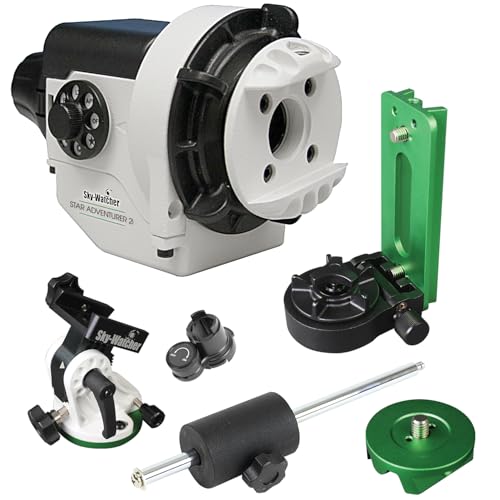
- Motorized tracking for Milky Way and eclipse shots
- Modular design works with existing photo tripods
- Wi-Fi control via free SAM Console app
Best For: DSLR shooters who want a portable tracker for wide-field sky imaging
Compact Stability Pick
iOptron SkyGuider Pro Full Package

- All-metal body for stable, low-vibration tracking
- Weighs just 2.2 lbs for easy travel
- Illuminated polar scope and adjustable base help alignment
Best For: DSLR photographers who want a lightweight mount with accurate polar alignment
Camera-to-Telescope Adapter
Celestron Universal 1.25" T-Adapter

- Connects DSLR/SLR cameras to a telescope at prime focus
- Fits 1.25" focusers and standard T-threads
- Includes 2-year US warranty and support
Best For: DSLR owners who want a simple telescope adapter for prime focus imaging
Full GoTo Portable Mount
Sky-Watcher Star Adventurer GTi Head Kit

- Compact GoTo equatorial mount for portable use
- Built-in Wi-Fi and illuminated polar scope
- Includes counterweight bar and 5 lb counterweight
Best For: DSLR users who want a compact GoTo mount with built-in alignment tools
Best for Easy Setup
Astromania Canon EOS T Ring & 1.25" Adapter

- Fits Canon EOS and Rebel EF-mount DSLR/SLR cameras
- Connects to standard 1.25-inch telescope focusers
- All-metal build with included hex wrench
Best For: Canon EOS DSLR users attaching a camera to a telescope
Mounting Plate
Yueoct 230mm Vixen-Style Dovetail Rail

- Vixen-style plate for compatible saddles
- Multiple slots and holes for balancing gear
- Anti-slip pads plus safety stop screws
Best For: Astrophotographers needing an adjustable dovetail mounting plate
Piggyback Camera Mount
Celestron SCT & EdgeHD Piggyback Mount

- Uses the telescope as a platform for wide-angle shots
- Fits compatible Schmidt Cassegrain and EdgeHD scopes
- Durable metal design with 2-year warranty
Best For: Wide-field DSLR astrophotography on compatible SCT and EdgeHD telescopes
Prime Focus Adapter

- Manual control and manual exposure
- Durable alloy with matte black finish
- Built for prime focus telescope imaging
Best For: Canon DSLR users attaching a telescope at prime focus
Finder Base Camera Holder
Telescope Dovetail Camera Mount

- Fits standard 33-36 mm finder bases
- Uses a 1/4-inch camera mounting screw
- Rubber pads add grip and protection
Best For: Users mounting a camera from a telescope finder dovetail base
Hotshoe Dovetail Adapter
Camera Flash Shoe to Dovetail Mount

- Fits most camera hotshoe or coldshoe mounts
- Top dovetail works with guide scopes and finders
- Hand-tight locking ring with rubber padding
Best For: DSLR users mounting accessories through a camera shoe
Portable Tracking Platform – Sky-Watcher Star Adventurer 2i Pro Pack
If you want astrophotography mounts for dslr cameras that travel easily and still track the sky well, the Sky-Watcher Star Adventurer 2i Pro Pack is built around wide-field nightscape work. Its modular design works with existing photographic tripods, and the upgraded Wi-Fi control adds convenient smartphone operation through the free SAM Console app.
Best For: DSLR shooters who want a portable tracker for Milky Way, eclipse, and wide-field imaging.
Pros:
- Motorized portable tracking platform for Milky Way, eclipses, and other astronomical objects
- Modular design integrates with existing photographic tripods
- Wi-Fi enabled for smartphone control with the SAM Console app
- Deluxe equatorial base helps with polar alignment
Cons:
- Geared toward wide-field astrophotography rather than heavier telescope setups
- Lithium metal batteries are required and included
This is a practical pick if portability matters most and you want a compact way to improve long exposures with a DSLR. The equatorial base and app control make it especially friendly for getting aligned quickly in the field.
Compact Stability Pick – iOptron SkyGuider Pro Full Package
For astrophotography mounts for dslr cameras, the iOptron SkyGuider Pro Full Package focuses on stability in a compact body. It uses an all-metal construction, a built-in illuminated polar scope, and an adjustable base to help you set up accurately for long-exposure camera work.
Best For: DSLR photographers who want a lightweight mount with precise polar alignment and strong load support.
Pros:
- All-metal body construction helps reduce vibration
- Compact and lightweight at 2.2 lbs for easy transport
- Supports up to 11 lbs when balanced
- AccuAlign illuminated polar scope simplifies alignment in low light
Cons:
- Latitude adjustment is limited to the stated range
- Designed for balanced loads, so setup matters for best results
This model makes sense if you want a portable camera tracker that still feels robust in the field. Its combination of load capacity, battery life, and alignment aids is well suited to long DSLR sessions.
Camera-to-Telescope Adapter – Celestron Universal 1.25" T-Adapter
If your astrophotography mounts for dslr cameras setup involves a telescope, this Celestron Universal 1.25″ T-Adapter is the straightforward way to connect a DSLR or SLR at prime focus. It slides into compatible 1.25″ focusers and works with a separate brand-specific T-ring to complete the connection.
Best For: DSLR owners who want to attach a camera directly to a telescope for prime focus astroimaging.
Pros:
- Connects a DSLR or SLR camera to a telescope for prime focus photography
- Fits any focuser that accepts 1.25″ accessories
- Uses standard T-threads with a separate T-ring
- Backed by a 2-year US warranty and US-based support
Cons:
- Requires a separate camera-specific T-ring
- Works as an adapter, not a tracking mount
This is not a mount by itself, but it is a useful accessory if your camera workflow goes through a telescope. It keeps the connection simple and lets you use your DSLR for prime-focus astroimaging with compatible optics.
Full GoTo Portable Mount – Sky-Watcher Star Adventurer GTi Head Kit
Among astrophotography mounts for dslr cameras, the Sky-Watcher Star Adventurer GTi Head Kit stands out for combining portable size with full GoTo tracking. It includes a built-in Wi-Fi connection, an illuminated polar scope, and a counterweight bar, while the dovetail lets you mount a DSLR or mirrorless camera directly.
Best For: DSLR users who want a compact GoTo equatorial mount with built-in alignment tools.
Pros:
- Full GoTo performance in a compact package
- Built-in Wi-Fi for convenient control
- Built-in polar scope with illuminator supports alignment
- Includes counterweight bar and 5 lb counterweight
Cons:
- DSLR or mirrorless camera is not included
- Heavier than simpler camera trackers
This is a strong choice if you want more automation than a basic star tracker while staying in a portable form factor. The included alignment hardware and GoTo capability make it a flexible platform for field use.
Best for Easy Setup – Astromania Canon EOS T Ring & 1.25" Adapter
If you’re shopping for astrophotography mounts for dslr cameras, this Astromania T-ring and adapter set is a practical way to connect a Canon EOS DSLR or SLR to a telescope. It’s designed for Canon EF-mount bodies and works with standard 1.25-inch focusers, making it a straightforward accessory for moon, planet, and nebula imaging.
Best For: Canon EOS DSLR owners who want a simple telescope-to-camera connection for manual astrophotography.
Pros:
- Compatible with Canon EOS and Rebel EF-mount DSLR/SLR cameras
- Includes a 1.25-inch telescope adapter with filter-thread support
- All-metal aluminum construction for durability
- Hex wrench included for easier angle adjustment
Cons:
- No electrical contacts, so focus and aperture must be adjusted manually
- Designed for Canon EOS bodies only, not universal across all DSLR brands
For Canon shooters building a telescope imaging setup, this is a focused, no-frills adapter solution. It’s best when you already have the right telescope and want a dependable way to mount the camera at prime focus.
Mounting Plate – Yueoct 230mm Vixen-Style Dovetail Rail
For astrophotography mounts for dslr cameras, a solid dovetail plate matters when you need to balance a camera or other gear on an equatorial setup. This 230mm Vixen-style rail gives you multiple mounting options, long slots for adjustment, and anti-slip pads to help keep accessories secure.
Best For: Users who need a versatile Vixen-style mounting plate for balancing camera gear on a telescope mount.
Pros:
- Vixen-style dovetail plate fits compatible saddles
- Long slots and multiple hole patterns help with positioning and balance
- Includes M6, 1/4″, and 3/8″ mounting options
- Anti-slip rubber pads and safety stop screws improve security
Cons:
- It’s a mounting plate, not a camera or optics adapter
- Requires compatible saddle and hardware for proper use
This is a useful support accessory when your imaging setup needs a stable, adjustable base. It’s especially appealing if you want more flexibility in how you attach and balance equipment on an equatorial head or tripod.
Piggyback Camera Mount – Celestron SCT & EdgeHD Piggyback Mount
If you’re comparing astrophotography mounts for dslr cameras and want wider sky shots, this Celestron piggyback mount lets your telescope carry the camera while you use your own lens. It attaches to the top rear of compatible Schmidt Cassegrain and EdgeHD telescopes, giving you a simple way to shoot the Milky Way, nebulae, the Moon, and other wide-angle scenes.
Best For: DSLR owners with compatible SCT or EdgeHD telescopes who want to take piggyback wide-field photos.
Pros:
- Lets your telescope support the camera for wide-angle imaging
- Attaches in minutes to compatible Schmidt Cassegrain telescopes
- Durable metal construction
- Backed by a 2-year warranty and support
Cons:
- Only fits Schmidt Cassegrain and EdgeHD telescopes
- Designed for DSLR or small refractor use, not a universal camera mount
This is a smart add-on if you already own a compatible Celestron-style telescope and want a stable piggyback platform. It’s best for wide-field astrophotography rather than direct telescope imaging.
Prime Focus Adapter – Canon EOS T2 Ring for DSLR
If you’re building an astrophotography setup with one of the more common astrophotography mounts for dslr cameras, this T2 adapter is the piece that lets your Canon EOS body attach directly to a telescope at prime focus. It converts the camera to manual control and manual exposure, so it fits a hands-on imaging workflow for lunar, planetary, and deep-sky use.
Best For: Canon DSLR owners who want a durable T2 connection for prime focus telescope imaging.
Pros:
- Designed for Canon EF/EOS bodies with broad Rebel, 5D, 6D, 7D, and 80D-series compatibility.
- Durable alloy construction is made to hold up better than soft brass or cheap plastic.
- Matte black interior helps reduce reflections and glare.
- Supports prime focus imaging and can be used with a Barlow for lunar or planetary magnification.
Cons:
- Manual focus and manual exposure only.
- Made specifically for Canon EF/EOS use, not a universal camera mount.
- Does not include image stabilization.
For Canon shooters who want a simple, sturdy telescope-to-camera interface, this adapter covers the core job well. It is a straightforward accessory rather than a feature-heavy mount, but that is exactly what many telescope imaging setups need.
Finder Base Camera Holder – Telescope Dovetail Camera Mount
For astrophotography mounts for dslr cameras, this finder-dovetail camera adapter is a compact way to secure a camera from a telescope finder base. The aluminum body, 1/4-inch mounting screw, and anti-slip rubber pads make it a practical support piece when you want a stable camera hold during recording.
Best For: Telescope users who want to mount a DSLR or similar camera from a standard finder dovetail base.
Pros:
- Fits standard finder dovetail bases sized about 33-36 mm.
- Includes a 1/4-inch mounting screw for camera attachment.
- Anti-slip rubber pads help improve grip and protect the camera.
- Solid aluminum and stainless steel construction keeps the setup lightweight.
Cons:
- Works around a finder dovetail system, so it is not a direct lens-to-telescope adapter.
- Best suited to cameras or accessories with 1/4-inch threads.
- Requires a compatible finder base to use.
This is a good utility mount when your telescope already has a finder dovetail base and you need a secure camera perch. It is less about optical adaptation and more about giving your camera a stable, mountable position.
Hotshoe Dovetail Adapter – Camera Flash Shoe to Dovetail Mount
If your astrophotography setup needs a simple bridge between a camera hotshoe and a finder or guide-scope dovetail, this adapter keeps things compact. It uses a knurled locking ring, a rubber pad for grip, and a 1/4-inch threaded hole for extra bracket options, making it a flexible accessory for DSLR-based setups.
Best For: DSLR and mirrorless users who want to mount accessories through a camera hotshoe or coldshoe.
Pros:
- Male flash shoe fits most camera hotshoe or coldshoe mounts.
- Finder dovetail base on top works with guide scope and finder dovetails.
- Knurled locking ring makes hand-tightening easy.
- Rubber pad helps secure the shoe and reduce wear.
Cons:
- Designed around hotshoe and dovetail mounting, not direct lens attachment.
- May need a compatible bracket or shoe setup to be useful.
- Limited to accessory-style mounting rather than camera optics.
This adapter makes sense when you want a fast, low-profile mounting solution instead of a full camera-to-telescope connection. It is a practical piece for accessories, guide scopes, and similar astrophotography setups.
How We Picked These Astrophotography Mounts for Dslr Cameras
We prioritized stability, tracking accuracy, portability, and compatibility with common DSLR setups. For this category, the best options balance payload capacity with easy setup, because a mount that is too heavy or complicated often gets left behind.
We also considered whether each product supports real-world imaging needs such as long exposures, piggyback setups, telescope coupling, or simple camera-to-dovetail mounting.
Quick Comparison: Which Type Fits Your Setup?
Not every item in a roundup like this serves the same purpose. Star trackers such as the Sky-Watcher Star Adventurer and iOptron SkyGuider Pro are designed for tracked wide-field imaging. GoTo tracking heads add object-finding convenience. Adapters, dovetails, and piggyback mounts are better when you are attaching a DSLR to a telescope or building a modular rig.
Key Buying Factors for Astrophotography Mounts for Dslr Cameras
Tracking Versus Static Support
If you want sharper Milky Way, nebula, or constellation shots, tracking matters more than simple support. A tracking mount compensates for Earth’s rotation and allows longer exposures. If you are imaging through a telescope, adapter quality and rigidity become just as important as tracking.
Payload and Balance
Make sure the mount can comfortably handle your DSLR, lens, ball head, dovetail, counterweight, and any accessories. A mount near its limit is harder to balance and more likely to produce vibration or inconsistent tracking.
Portability and Setup Time
Many photographers choose Astrophotography Mounts for Dslr Cameras because they need something they can carry to dark-sky locations. Compact heads, quick alignment features, and lightweight plates are especially useful if you travel often or shoot on short notice.
Mounting Compatibility
Check whether your gear uses a 1.25-inch telescope connection, T-ring/T-adapter interface, Vixen-style dovetail, or hot shoe attachment. A mismatched connector can turn a good setup into a frustrating one, so compatibility should be verified before you buy.
Who Should Buy Which Astrophotography Mounts for Dslr Cameras?
Choose a star tracker if your main goal is wide-field astrophotography with a DSLR and lens. Choose a GoTo or counterweighted tracking mount if you want more convenience, better target acquisition, or heavier setups. Choose adapters, dovetail bars, and piggyback mounts if you already own a telescope and want to mount a camera securely without rebuilding your whole rig.
If you are just starting out, the best move is usually the simplest stable setup you can balance well. If you already know your focal lengths and payload needs, invest in the most compatible mount system rather than the most feature-packed one.