The right bench power supply makes electronics testing, prototyping, repair, and battery work safer and more repeatable. Adjustable voltage and current limits let you power circuits precisely while protecting sensitive components from accidental overloads.
These 10 picks cover practical 30V and 32V supplies, higher-voltage 60V models, 5A and 10A output options, digital displays, encoder controls, and convenient USB or USB-C charging ports.
Best 10 Bench Power Supplies for Electronics Picks for 2026
Compact Charging Workhorse

- 0-32V, 0-10A adjustable output
- 20W USB-A and USB-C charging
- Intelligent battery charging with auto-stop
Best For: DIY electronics, battery charging, and compact workbenches
Feature-Rich Precision Pick
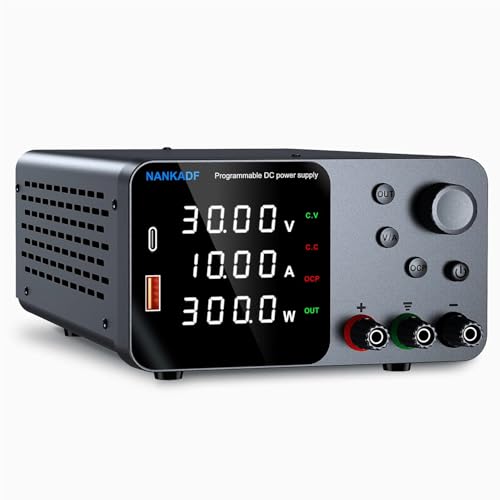
- 0.01V/0.001A encoder adjustment
- Automatic CV/CC switching and output memory
- OVP, OCP, OTP, and short-circuit alarm
Best For: Repair benches, prototyping, and automotive diagnostics
Simple Controls on a Budget

- Precise digit-by-digit encoder adjustment
- Output enable/disable button
- 18W USB charging and short-circuit alert
Best For: General repair, PC work, and everyday prototyping
Compact High-Current Pick
Jesverty SPS-3010 30V/10A Bench Supply

- 0-30V and 0-10A adjustable output
- Four-digit real-time V/A/W display
- Compact body with CV/CC and safety protection
Best For: Compact electronics benches needing up to 300W output
Battery-Charging Choice
Kungber SPS3010B 30V/10A Power Supply

- Intelligent charging can stop at full battery
- 18W USB port for device charging
- OCP alarm plus multiple protection systems
Best For: Battery charging, repairs, and compact general-purpose benches
Modern Controls Pick
Jesverty SPS-3010V 32V/10A Bench Supply

- 0-32V and 0-10A adjustable output
- Encoder coarse/fine controls and output switch
- 20W USB-A and USB-C quick-charge ports
Best For: Arduino, Raspberry Pi, repair, and feature-rich electronics work
Compact Choice

- 0–30V and 0–5A adjustable output
- Compact 0.8kg design with 4-digit display
- CV/CC modes and multiple protections
Best For: Portable electronics testing and hobbyist work
High-Current Value

- Up to 300W with 0–30V and 0–10A output
- Coarse and fine encoder adjustments
- USB and Type-C 5V/3.6A charging
Best For: Repair benches and higher-current DIY projects
Precision Control

- 0–30V and 0–10A, up to 300W
- Coarse/fine encoder with 0.01V and 0.001A resolution
- Output switch, alarm, and broad protection set
Best For: Precise repair and laboratory bench work
Compact Charging Workhorse – 0-32V 10A SPS-3010C
For electronics hobbyists who need versatile bench power supplies for electronics, the Jesverty SPS-3010C combines a 0-32V, 0-10A adjustable output with encoder controls, USB charging, and battery-charging features in a compact enclosure.
Best For: DIY electronics, Arduino and Raspberry Pi projects, battery charging, repair work, and space-limited benches.
Pros:
- Coarse and fine encoder controls provide 0.01V and 0.001A setting resolution.
- USB-A and USB-C ports support 20W quick charging.
- Intelligent battery charging can stop automatically when the battery is full.
- Compact 2.5-pound design with output control, selectable 115V/230V input, and protections.
Cons:
- The enclosure is made from plastic and polycarbonate.
- The USB outputs are rated at 20W rather than serving as the main adjustable output.
This is a practical choice when bench space and convenience matter as much as adjustable output. Its dedicated charging mode and dual USB ports give it more everyday utility than a basic supply, while the 32V/10A range covers many general electronics tasks.
Feature-Rich Precision Pick – 0-30V 10A NANKADF
The NANKADF 0-30V 10A is one of the more feature-packed bench power supplies for electronics, pairing fine encoder adjustment with automatic CV/CC switching, output memory, USB fast charging, and multiple protection systems.
Best For: Electronics repair, prototyping, school labs, battery work, and automotive diagnostics.
Pros:
- Encoder adjustment supports 0.01V and 0.001A resolution across the full range.
- Automatic CV/CC switching responds as the load changes.
- Dedicated output enable/disable button and power-off memory improve workflow.
- Includes OVP, OCP, OTP, and short-circuit alarm protection.
Cons:
- Its maximum output is 30V and 10A, so it is not intended for applications requiring higher voltage.
- The unit uses air cooling with a fan, which may be a consideration for noise-sensitive setups.
This model suits users who want more control and convenience than a basic adjustable supply provides. Adjustable display brightness, a smart fan, USB-A and USB-C charging, and configurable buzzer behavior make it particularly useful for long repair or testing sessions.
Higher-Voltage Choice – 0-60V 5A SPS-6005
When your projects need more voltage than common 30V models provide, the Jesverty SPS-6005 is a strong option among bench power supplies for electronics, offering 0-60V output, real-time power readings, and automatic CV/CC operation.
Best For: Electronics projects requiring up to 60V, lab or educational work, repair tasks, and users who value a compact supply with wattage monitoring.
Pros:
- Provides a higher 0-60V output range with up to 5A current.
- Four-digit display shows voltage, current, and wattage in real time.
- Automatic switching between constant-voltage and constant-current modes.
- Includes short-circuit and overload protection, a grounding terminal, and temperature-regulated fan cooling.
Cons:
- The 5A maximum current is lower than the 10A models in this roundup.
- The included test leads are described as giveaway leads and may not suit sustained high-current use.
- Its USB port is limited to 5V/2A charging.
The SPS-6005 is the logical pick when voltage headroom is more important than maximum current. Its compact body and clear V/A/W readout make it easy to monitor experiments, while the protections support routine bench use.
Simple Controls on a Budget – 30V 10A NANKADF
For straightforward testing and repair, this NANKADF 30V 10A model offers the core features expected from bench power supplies for electronics: precise encoder adjustment, a readable four-digit display, output control, and automatic CV/CC operation.
Best For: General electronics repair, personal computer work, prototyping, and users who want fast charging on the bench.
Pros:
- Press-and-turn encoder lets you select and adjust individual digits.
- Output enable/disable button helps prevent accidental live connections.
- Four-digit display provides 0.01V and 0.001A readout resolution.
- Short-circuit overcurrent protection includes automatic shutdown and a buzzer alert.
Cons:
- The supplied notes identify a single 18W USB fast-charging port rather than dual USB outputs.
- The output range is limited to 30V.
- Its listed cooling method is air cooling, so fan operation may matter in quiet workspaces.
This is a sensible general-purpose supply for users who prioritize precise adjustment and simple output management. It lacks some of the expanded charging and protection features of newer feature-rich models, but it covers common 30V/10A bench tasks effectively.
Compact High-Current Pick – Jesverty SPS-3010 30V/10A Bench Supply
If you need bench power supplies for electronics that balance useful output capacity with a small footprint, the Jesverty SPS-3010 is a practical option. It provides adjustable 0-30V and 0-10A output, with a four-digit display showing voltage, current, and power in real time.
Best For: Electronics work, battery charging, repairs, education, and DIY projects where compact 300W output is useful.
Pros:
- Displays measured V/A/W values with 0.01V, 0.001A, and 0.1W resolution.
- Automatically operates in constant-voltage or constant-current mode as the load changes.
- Compact 7.1 x 3.35 x 6.1-inch design weighs about 2.5 pounds.
- Includes short-circuit, overload, grounding, and temperature-regulated fan protection.
Cons:
- The included test leads are described as giveaway accessories and may not suit prolonged high-current use.
- The USB port is rated at 5V/2A rather than the faster charging output found on newer models.
The SPS-3010 is a straightforward choice when you want high-current adjustment, clear readings, and automatic CV/CC operation without giving up much bench space. Plan to use higher-capacity leads for sustained 10A work.
Battery-Charging Choice – Kungber SPS3010B 30V/10A Power Supply
Among bench power supplies for electronics, the Kungber SPS3010B stands out for projects involving battery charging and device power. Its 0-30V, 0-10A adjustable output is paired with intelligent charging, incorrect-connection detection, and an optional overcurrent alarm.
Best For: Battery charging, repair work, laboratory or school projects, and users who want a USB charging port alongside adjustable DC output.
Pros:
- Intelligent charging mode can stop charging when a battery is full.
- OCP detection can identify short circuits or overcurrent and stop output with an alarm.
- 18W USB port provides faster charging for compatible devices.
- Compact benchtop design weighs less than 2.3 pounds and includes thermal, leakage, overload, and short-circuit protection.
Cons:
- The product notes do not specify a four-digit V/A/W display resolution.
- Its plastic enclosure may feel less substantial than a metal-bodied bench supply.
This Kungber model is a sensible fit if charging safety and USB convenience matter as much as adjustable output. Its compact size also works well for home workbenches, classrooms, and repair stations.
Modern Controls Pick – Jesverty SPS-3010V 32V/10A Bench Supply
For bench power supplies for electronics with more convenient controls, the Jesverty SPS-3010V adds encoder adjustment, an output on/off button, and USB-A/USB-C quick charging. It raises the adjustable range to 0-32V while retaining up to 10A output and a four-digit LED display.
Best For: Arduino, Raspberry Pi, repair, laboratory, and DIY work where quick setting changes and USB-C charging are useful.
Pros:
- Coarse and fine encoder knobs provide 0.01V and 0.001A setting resolution.
- USB-A and USB-C ports support 20W quick charging.
- Output ON/OFF button lets you adjust settings without disconnecting the load.
- Offers selectable 115V/230V input, OCP protection, and temperature-regulated cooling.
Cons:
- The included test leads may need replacement for long-term high-current use.
- At about 2.5 pounds, it is portable but still relies on an active cooling fan.
The SPS-3010V is the most feature-focused option in this group. Its encoder controls and dedicated output switch can make repeated testing easier, while the 32V range and dual quick-charge ports add flexibility for modern electronics projects.
Compact Choice – 30V 5A Portable Bench Supply
For electronics hobbyists who need capable bench power supplies for electronics without a bulky footprint, this RANSANX model offers adjustable 0–30V and 0–5A output in a compact 195 × 102 × 80mm enclosure. Its 4-digit display, USB charging port, and adjustable voltage and current make it practical for prototyping, repair, and testing.
Best For: Hobbyists, portable workbenches, and general electronics testing where 150W output is sufficient.
Pros:
- Compact, lightweight 0.8kg benchtop design.
- Provides 0.01V voltage and 0.001A current resolution with stated 1% accuracy.
- Includes CV and CC modes, output switch, keyboard lock, and overload, short-circuit, and over-temperature protection.
- Features real-time voltage, current, and power readings plus an 18W USB charging port.
Cons:
- Maximum output is 5A and 150W, lower than the 10A models in this roundup.
- Uses a 110V AC input, so it may be less flexible for users with other mains requirements.
This is a sensible compact option when portability and straightforward controls matter more than maximum current capacity. The output switch and stored settings add convenience for repeated bench work.
High-Current Value – 0–30V 10A Switching Supply
This WANPTEK POWER unit is one of the more versatile bench power supplies for electronics, combining 0–30V and 0–10A output with coarse and fine encoder controls. It also adds USB and Type-C quick-charging ports, automatic 110V/220V ±10% input detection, and a short-circuit alarm for repair and laboratory tasks.
Best For: Electronics repair, DIY projects, communications equipment maintenance, and users who need up to 300W of output.
Pros:
- Offers up to 10A and 300W with adjustable 0–30V output.
- Separate coarse and fine controls can make precise setting faster.
- Includes 5V/3.6A USB and Type-C quick-charge ports.
- Provides short-circuit shutdown and alarm, overheat, leakage, voltage, and power protection.
Cons:
- Larger and heavier than the compact 5A option, at 2.6 pounds and 8.4 × 3.4 × 5.9 inches.
- The supplied details do not specify voltage and current resolution or accuracy.
Choose this model when higher current and charging convenience are priorities. Its encoder controls and automatic input-voltage adaptation are particularly useful in busy repair or teaching environments.
Precision Control – 30V 10A Encoder Bench Supply
For buyers comparing bench power supplies for electronics, the HANGELL HPS3010 emphasizes precise, convenient adjustment. Its 0–30V, 0–10A output is controlled with a coarse/fine encoder, while the output switch, 4-digit display, and protection features support repeatable laboratory and repair work.
Best For: Electronics repair, laboratory equipment, and users who want fine adjustment with up to 300W of output.
Pros:
- Supports adjustable 0–30V and 0–10A output at up to 300W.
- Encoder control allows coarse or fine adjustment, with digit selection by pressing the knob.
- Offers 0.01V voltage and 0.001A current resolution on a 4-digit LED display.
- Includes output switching, short-circuit alarm, and overvoltage, overcurrent, overtemperature, and overload protection.
Cons:
- At 1.2kg, it is less portable than the compact 5A model.
- The supplied specifications do not list a USB or Type-C output rating, despite the charging ports.
This model is a strong fit when adjustment precision and clear readings are central to the buying decision. Its output button lets you change settings with the load disconnected, reducing the risk of accidental output during setup.
How We Picked the Best Bench Power Supplies for Electronics
We compared these supplies by looking at their advertised voltage and current ranges, adjustment controls, display resolution, output convenience, and suitability for common electronics work. The list includes both compact lower-voltage models and higher-capacity supplies for projects that need more headroom.
Because specifications and included accessories can vary by seller or revision, confirm the product page before ordering. Pay particular attention to output accuracy, ripple, protection features, cooling, connector type, and whether the stated USB rating applies independently of the main DC output.
Quick Comparison
| Specification | What to look for | Best suited to |
|---|---|---|
| Voltage range | 0–30V or 0–32V | General bench projects, Arduino, microcontrollers, and repairs |
| Higher voltage | Up to 60V | Specialized circuits, motors, and experiments requiring extra headroom |
| Current capacity | 5A or 10A | 5A for lighter work; 10A for motors, LED systems, and power-hungry loads |
| Controls | Encoder with coarse and fine adjustment | Faster, more precise setting changes |
| Convenience ports | USB-A and USB-C | Charging devices or powering compatible accessories |
Key Buying Factors for Bench Power Supplies for Electronics
Voltage and Current Range
Choose a maximum voltage that comfortably exceeds your projects’ requirements, but do not pay for capacity you will rarely use. A 0–30V or 0–32V supply covers many hobby, repair, and educational applications. A 60V model is more appropriate when your circuits require higher rails. Current capacity matters when driving motors, lamps, power resistors, or other demanding loads.
Constant-Voltage and Constant-Current Operation
Look for clear voltage and current readings and independent current limiting. Constant-current behavior is especially useful for LED testing, battery-related work, and protecting prototypes during troubleshooting. An output-enable button can also let you configure settings before applying power.
Controls, Display, and Protection
Encoder controls with coarse and fine adjustment are generally easier to use than repeatedly turning a basic potentiometer. A four-digit LED display can improve visibility when making small changes. Overvoltage, overcurrent, short-circuit, and thermal protection are valuable safeguards, but they should supplement careful wiring and correct polarity rather than replace them.
USB Charging and Bench Layout
USB and USB-C ports are convenient for charging or powering accessories, but they are not a substitute for a properly regulated isolated output. Check the advertised charging wattage, port behavior, fan noise, dimensions, and rear ventilation so the supply fits your workspace.
Who Should Buy Which Bench Power Supplies for Electronics?
Most hobbyists and students: Choose a 0–30V or 0–32V, 10A model with a clear digital display and adjustable current limiting. It offers broad compatibility for everyday electronics.
Users building motor or LED projects: Prioritize 10A capacity, reliable cooling, and easy coarse/fine adjustment. Confirm that the supply’s continuous rating matches the expected load.
Precision-focused experimenters: Select a model with a four-digit display, encoder control, output-enable button, and clearly specified regulation and ripple performance.
Higher-voltage users: A 0–60V, 5A supply makes more sense for circuits that exceed the usual 30V range. Verify insulation, protection features, and the intended application before connecting expensive equipment.