Camera glasses let you capture a first-person view without holding a phone, but walking, cycling and quick head turns can make footage shaky. Stabilization is worth checking closely if you plan to record on the move.
These seven options span sports sunglasses, clear-lens frames and AI-enabled glasses. The buying guide below helps you compare their stabilization claims, lenses and everyday usability.
Best 7 Camera Glasses with Stabilization Picks for 2026
AI Vlogging Pick
1200P AI Glasses with 6-Axis EIS

- 1200P/30fps video and 6-axis EIS
- AI recognition and translation
- Wi-Fi syncing and app editing
Best For: Hands-free vlogging and connected travel
Everyday Wear Pick
Osawalla 1080P Photochromic AI Glasses

- 1080P video with EIS support
- 40.8g photochromic frame
- AI translation and open-ear audio
Best For: Daily wear, travel, and short POV clips
Best for Changing Light
SGUKZF 4K EIS Photochromic Smart Glasses
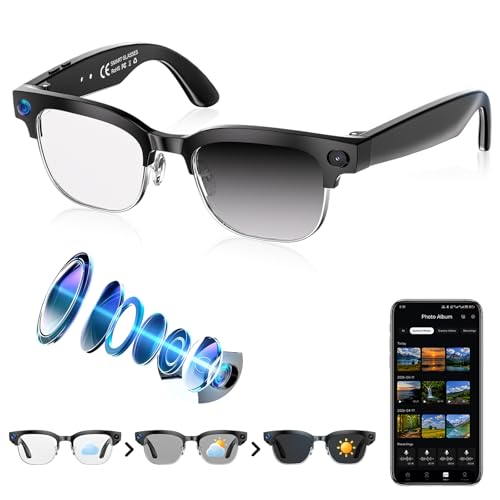
- 4K camera with EIS
- 35g frame and photochromic lenses
- 139+ language translation; IP66 rated
Best For: Travel and daily wear in changing light
Sport-Fit Pick – OHO 2K QHD Photochromic Sports Glasses
For camera glasses with stabilization that prioritize outdoor recording, these OHO glasses pair anti-shake video with 2K QHD capture and a lightweight, non-slip wraparound fit.
Best For: Runners and cyclists who want hands-free footage and lenses that adjust to changing sunlight.
Pros:
- Anti-shake stabilization is designed to reduce motion during sports.
- Photochromic UV400 lenses adapt to sunlight.
- Supports recording while charging for longer sessions.
Cons:
- Only sweat, splashes, and light rain resistance is specified; avoid heavy rain.
- Charging during a recording requires an external power source.
This is the straightforward sports choice if lens adaptability and extended recording matter more to you than AI features.
AI Vlogging Pick – 1200P AI Glasses with 6-Axis EIS
These camera glasses with stabilization combine an 8MP camera, 1200P/30fps video, and 6-axis EIS with voice-controlled AI tools for hands-free vlogging.
Best For: Cyclists and travelers who want stabilized clips alongside translation, object recognition, and quick phone transfers.
Pros:
- 6-axis sensor and EIS are intended to reduce video shake.
- Wi-Fi syncing and app-based editing streamline sharing.
- Includes AI voice features, translation, and hands-free audio.
Cons:
- No built-in HUD display; custom optical lenses are not included.
- The supplied notes conflict on weather protection, citing IP64 in the title and IP54 in a bullet; verify the rating before buying.
Choose this model for its broad connected feature set, but check the water-resistance specification if wet-weather use is a priority.
Rugged Cycling Pick – GLOSSIA 4K Glasses with 6-Axis EIS
For camera glasses with stabilization aimed at demanding outings, these GLOSSIA glasses pair claimed 4K capture with 6-axis EIS and an IP66-rated frame.
Best For: Cyclists and trail runners who want stabilized point-of-view recording, voice assistance, and stronger stated dust and water protection.
Pros:
- 6-axis gyroscope and EIS target vibration during active filming.
- IP66 rating addresses dust and water exposure.
- Offers ChatGPT-4o voice access, music playback, and dual-mic ENC calls.
Cons:
- No built-in GPS is listed.
- The supplied notes do not specify recording battery life.
Its appeal is the combination of stabilization and an IP66 rating; confirm runtime separately if you plan to film long rides.
Everyday Wear Pick – Osawalla 1080P Photochromic AI Glasses
These lightweight camera glasses with stabilization offer 1080P video with EIS, photochromic lenses, and open-ear Bluetooth audio for daily use.
Best For: Commuters and travelers who want casual first-person clips, hands-free calls, and lenses that darken outdoors.
Pros:
- 8MP camera with EIS support and selectable video clip lengths.
- 40.8g frame with photochromic lenses and IP65 protection.
- Supports AI object recognition, translation, music, and calls.
Cons:
- Lenses may darken more slowly indoors or in winter, according to the notes.
- The stated seven-hour battery figure applies to music playback, not video recording.
This is a practical everyday option if comfort and smart features matter as much as steadier footage; check video runtime for longer shoots.
Best for Changing Light – SGUKZF 4K EIS Photochromic Smart Glasses
For shoppers seeking camera glasses with stabilization that can move between indoor and outdoor settings, this SGUKZF pair combines a 4K camera with electronic image stabilization (EIS) and photochromic lenses. The 35g frame is a practical detail if you plan to wear them throughout the day.
Best For: Travel and everyday wear across changing light conditions.
Pros:
- 4K camera with EIS to help steady footage during movement.
- Photochromic lenses adjust to changing sunlight; the frame weighs 35g.
- Real-time translation in 139+ languages, open-ear audio, and IP66 water resistance.
Cons:
- No GPS geotagging.
- Notes list a 290mAh battery but do not state a runtime.
Choose this pair if adaptable lenses matter alongside stabilized capture; check the battery-life details before relying on it for a full day of recording.
Best for Detailed Photos – Zygorthla 13MP 4K EIS Smart Glasses
These Zygorthla camera glasses with stabilization pair a 13MP camera for photos with 4K EIS video. Transparent lenses make them a straightforward option for shoppers who want smart-glasses features without tinted lenses.
Best For: Everyday hands-free photos, stabilized video, and AI-assisted travel.
Pros:
- 13MP photo capture and 4K video with EIS to help reduce shake.
- Real-time translation, a ChatGPT voice assistant, and AI object recognition.
- Dual open-ear speakers for audio and calls, plus IP66 water resistance.
Cons:
- No GPS geotagging.
- Notes list a 290mAh battery but do not specify runtime.
This is the strongest fit of the three if a stated photo resolution is your priority. The companion app adds settings control, though you should confirm recording time for longer outings.
Best for Shareable Clips – VisionRay Flow Lite Stabilized Glasses
If your search for camera glasses with stabilization is driven by first-person clips, the VisionRay Flow Lite offers stabilized 1080p video and 8MP photos described in the notes as 4K. Its app can turn captured footage into highlight reels for sharing.
Best For: Casual travel clips, outdoor walks, and quick social sharing.
Pros:
- 1080p video stabilization with look, voice, or tap capture controls.
- Photochromic lenses with UV400 protection and a TR90 frame.
- App-generated highlight reels, real-time translation, and open-ear audio.
Cons:
- Video capture is listed at 1080p, not 4K.
- No GPS geotagging.
The editing features make this a useful pick for quick, shareable moments. Choose one of the 4K EIS options instead if higher listed video resolution is essential.
How We Picked the Best Camera Glasses with Stabilization
We focused on glasses that list video stabilization or anti-shake among their features, then compared their stated recording resolutions, lens types and practical extras. The seven choices include 1080p, 1200p, 2K and 4K claims, with options for outdoor sports, everyday wear and translation or voice assistance. These are manufacturer-listed specifications, not independently verified measurements of image quality or stabilization performance.
Quick Comparison
Start with how you will wear them. The OHO 2K QHD sports pair lists photochromic UV400 lenses and anti-shake recording. The polarized 1200p AI pair specifies 6-axis electronic image stabilization (EIS), while the 4K AI Ultra Pro combines a 6-axis EIS claim with an IP66 rating. The other 4K options emphasize either real-time translation or 13MP still photos and transparent lenses. At 1080p, one pair pairs EIS with Bluetooth music; another lists video stabilization alongside translation, an AI assistant and UV400 protection.
Those distinctions are a shortlist, not a ranking of smoothness. A higher resolution figure does not tell you how well footage handles walking or sudden head movement.
Key Buying Factors for Camera Glasses with Stabilization
Stabilization and Footage
EIS reduces visible shake by processing video and may crop the frame to leave room for correction. “6-axis EIS,” “EIS” and “anti-shake” are different product claims; none alone guarantees equally steady results. If possible, inspect unedited walking footage and check for a stable horizon, natural-looking motion and acceptable detail in low light. Confirm the recording resolution, frame rate and whether stabilization is available in every video mode before buying.
Fit, Lenses and Conditions
Glasses record wherever your head points, so a secure fit matters as much as the camera specification. Photochromic lenses adapt to changing light, polarized lenses can reduce glare outdoors, and transparent lenses are more versatile indoors. Check the stated UV protection for sun use. For workouts or wet weather, look for an explicit ingress-protection rating rather than assuming all sports-styled frames resist rain equally.
Power, Storage and Privacy
Look up real recording time, charging method, onboard storage and how videos transfer to your phone; headline feature lists may omit these limits. Voice assistants and translation can be useful, but they may depend on a phone, app or connection. Check local recording rules and respect others’ privacy when filming in public or shared spaces.
Who Should Buy Which Camera Glasses with Stabilization?
Choose sports-oriented, UV-protective frames if you mainly record outdoors; consider the IP66-rated option if its stated water resistance suits your activities. Pick transparent lenses for indoor-to-outdoor daily wear, or prioritize the 13MP claim if still photos matter. Translation-focused glasses make more sense for travel than for someone who only wants POV clips. If music is the main extra you will use, the 1080p EIS and Bluetooth option may be a simpler fit. Whatever your shortlist, prioritize sample footage, comfort and confirmed battery life over resolution alone.