In 2026, the landscape of photography continues to evolve, and selecting the right lens can make all the difference in your work. Whether you’re capturing wildlife, portraits, or landscapes, Canon offers a variety of lenses designed to meet different needs and styles. Knowing which lens suits your photography can enhance your skills considerably. Let’s explore the top 10 Canon camera lenses that could elevate your photography game this year.
Canon RF100-400mm Telephoto Lens for EOS R Series Cameras

If you’re a wildlife or sports photographer looking for a versatile lens that won’t weigh you down, the Canon RF100-400mm Telephoto Lens is an excellent choice for your EOS R Series camera. This compact lens offers a zoom range from 100-400mm, ensuring you capture stunning images from afar. With its Optical Image Stabilizer, you’ll enjoy up to 5.5 stops of shake correction, perfect for action shots. Plus, its fast and silent autofocus helps you stay focused on the moment. Compatible with RF extenders, it can reach up to 800mm, making it a powerful tool for any photography adventure.
Best For: Wildlife and sports photographers seeking a lightweight and versatile telephoto lens for their EOS R Series cameras.
Pros:
- Compact and Lightweight: Weighs only 816 grams, making it easy to carry for long shoots.
- High Image Stabilization: Offers up to 5.5 stops of shake correction for sharp images, even at long focal lengths.
- Fast Autofocus: Utilizes Canon’s Nano USM technology for quick and quiet focusing, ideal for capturing fast-moving subjects.
Cons:
- Maximum Aperture Limitations: Maximum aperture of F5.6-8 may not perform well in low-light situations.
- Limited Magnification: Maximum magnification of 0.41x at 400mm may not satisfy photographers needing extreme close-ups.
- No Weather Sealing: Lacks weather resistance, which could be a concern for outdoor photographers in variable conditions.
Canon EF 75-300mm f/4-5.6 III Telephoto Zoom Lens for Canon SLR Cameras

The Canon EF 75-300mm f/4-5.6 III Telephoto Zoom Lens is an excellent choice for photographers who want versatility without breaking the bank. With a focal length range of 75-300mm, this lens excels in portrait, wildlife, and sports photography. Its improved zoom mechanism guarantees smooth operation, while the DC motor provides reliable autofocus. Although it lacks image stabilization, you can achieve stunning macro shots by pairing it with a Canon 58mm Close-up lens 500D. Weighing only 16.8 ounces, it’s easy to carry. Plus, with a 4.7-star rating from thousands of users, it’s a popular option worth considering.
Best For: Photographers seeking an affordable telephoto lens that excels in portrait, wildlife, and sports photography.
Pros:
- Improved zoom mechanism ensures smooth operation.
- Lightweight design at only 16.8 ounces for easy portability.
- High customer satisfaction with a 4.7-star rating from over 5,700 reviews.
Cons:
- Lacks image stabilization, which may affect performance in low-light conditions.
- Autofocus relies on a DC motor instead of a faster USM motor.
- Not water-resistant, limiting use in wet environments.
Canon EF-S 55-250mm F4-5.6 is STM Telephoto Lens, Black
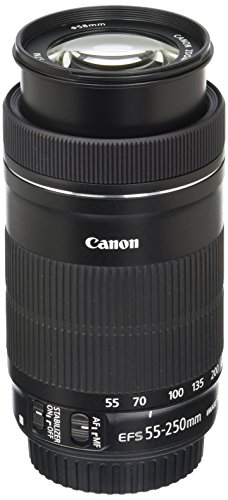
For photographers seeking versatility and quality in their lens choice, the Canon EF-S 55-250mm F4-5.6 is STM Telephoto Lens stands out with its impressive image stabilization feature. You’ll appreciate the high magnification and lightweight design, making it perfect for capturing distant subjects. The UD lens element reduces chromatic aberration, ensuring your images maintain high resolution and contrast. With a compact six-group zoom system, you can achieve a maximum magnification of 0.29x and focus as close as 2.79 feet. This lens kit includes essential accessories like a lens cap and instruction book, making it a great addition to your gear.
Best For: Photographers seeking a versatile and lightweight telephoto lens for capturing distant subjects with high image quality.
Pros:
- Image Stabilization feature provides up to 3.5 stops of shake correction for sharp images.
- Compact and lightweight design makes it easy to carry for extended periods.
- One UD lens element reduces chromatic aberration, enhancing image quality and contrast.
Cons:
- Maximum aperture of f/5.6 at telephoto end may limit low-light performance.
- Minimum focusing distance of 2.79 feet might not be suitable for extreme close-up shots.
- Non-weather-sealed design may require caution in adverse conditions.
Canon EF 100-400mm Telephoto Zoom Lens for Canon SLR Cameras

Photographers seeking versatility and exceptional image quality will find the Canon EF 100-400mm Telephoto Zoom Lens an invaluable addition to their gear. With a focal length of 100-400mm and a maximum aperture of f/4.5-5.6, this lens excels in capturing distant subjects and close portraits. Its compact size, measuring 3.6 inches in diameter and 7.4 inches in length, makes it easy to handle. The two Image Stabilizer modes guarantee sharp images, while the Fluorite and Super UD-glass elements reduce aberrations. Compatible with extenders and backed by a 1-year warranty, this lens is perfect for every photographer’s collection.
Best For: Enthusiast and professional photographers looking for a versatile telephoto lens for capturing distant subjects and detailed portraits.
Pros:
- Exceptional image quality due to the incorporation of Fluorite and Super UD-glass elements.
- Versatile focal length range of 100-400mm, suitable for various photography styles.
- Two Image Stabilizer modes enhance sharpness in both distant action shots and close-up portraits.
Cons:
- Maximum aperture of f/4.5-5.6 may be limiting for low-light conditions.
- Size and weight could be cumbersome for extended use without a tripod.
- Compatibility limited to specific extenders (1.4x II and 2x II), which may require additional investment.
Canon EF 50mm f/1.8 STM Lens, Black, Compatible with Canon EOS DSLR Cameras

If you’re looking for a versatile lens that excels in low-light conditions and delivers stunning portraits, the Canon EF 50mm f/1.8 STM is an exceptional choice. With a maximum aperture of f/1.8, it captures beautiful bokeh and sharp details, making it perfect for both action shots and nighttime photography. Its 50mm focal length (80mm on APS-C cameras) provides a natural perspective, while the minimum focusing distance of 1.15 feet allows for creative compositions. Plus, the Stepping Motor guarantees smooth and silent autofocus, enhancing your video quality. This lens is a must-have for any Canon EOS DSLR user.
Best For: Photography enthusiasts and Canon EOS DSLR users seeking a versatile lens for portraits and low-light conditions.
Pros:
- Compact and lightweight design makes it easy to carry for everyday photography.
- Wide maximum aperture of f/1.8 allows for excellent low-light performance and beautiful bokeh.
- Smooth and silent autofocus thanks to the Stepping Motor, ideal for both still photography and video recording.
Cons:
- Limited zoom capability as it is a prime lens, requiring movement to frame shots.
- Not weather-sealed, making it less suitable for extreme environmental conditions.
- May require additional accessories like filters for certain creative effects, adding to overall costs.
Canon RF200-800mm Super-telephoto Zoom Lens

The Canon RF200-800mm Super-telephoto Zoom Lens stands out as the ultimate choice for wildlife and sports enthusiasts who crave versatility and range. With a zoom range of 200mm to 800mm, you can capture stunning details from a distance. Its lightweight and compact design allows for comfortable handheld shooting, making it easy to follow fast-moving subjects. You’ll appreciate the optimized optical quality that maintains sharpness throughout the zoom range. Plus, it’s compatible with Extender RF1.4x and RF2x, enhancing your creative options. Elevate your outdoor photography with this groundbreaking lens, designed specifically for those who demand performance and flexibility.
Best For: Wildlife and sports photography enthusiasts looking for a versatile and high-performance super-telephoto lens.
Pros:
- Lightweight and compact design allows for comfortable handheld shooting and easy mobility.
- Wide zoom range of 200mm to 800mm enables capturing stunning details from a distance.
- Optimized optical quality maintains sharpness throughout the zoom range for high-quality images.
Cons:
- Maximum aperture varies from F6.3 to F9, which may limit low-light performance.
- Requires additional extenders for maximum focal length, which may add to overall cost.
- Limited to RF mount cameras, restricting compatibility with other camera systems.
Canon RF24-70mm F2.8 L is USM Lens for EOS R Series Mirrorless Cameras

With a bright f/2.8 maximum aperture, the Canon RF24-70mm F2.8 L is USM Lens is an exceptional choice for professionals and enthusiasts looking to capture stunning images in various lighting conditions. Its versatile focal length of 24-70mm lets you easily shift from wide landscapes to intimate portraits. You’ll appreciate the optical image stabilization, which provides up to 5 stops of shake correction for crisp shots. Plus, the Nano USM technology guarantees fast and quiet autofocus. With weather-resistant construction and advanced coatings, this lens is built to handle challenging environments, making it a reliable companion for your EOS R Series camera.
Best For: Professionals and photography enthusiasts seeking a versatile and high-performance lens for various shooting conditions with their EOS R Series cameras.
Pros:
- Exceptional image quality with a bright f/2.8 maximum aperture.
- Effective optical image stabilization providing up to 5 stops of shake correction.
- Fast and quiet autofocus due to advanced Nano USM technology.
Cons:
- Relatively high price point compared to other standard zoom lenses.
- Heavier than some other mirrorless lenses, which may affect portability.
- Requires a larger filter size (82mm), potentially increasing accessory costs.
Canon RF28-70mm F2.8 is STM Macro Lens, Black

Photographers seeking versatility and exceptional optical quality will find the Canon RF28-70mm F2.8 STM Macro Lens, Black, to be an invaluable addition to their gear. With a fixed f/2.8 aperture throughout its zoom range, it delivers stunning images and impressive edge-to-edge quality, thanks to its advanced optical design. The lens is lightweight and compact, making it perfect for everyday carry. Plus, the weather-resistant construction guarantees durability in harsh conditions. Equipped with a newly designed Image Stabilization unit, this lens minimizes chromatic aberration, enhancing your photography experience. It’s truly a fantastic choice for various photography needs.
Best For: Photographers seeking a versatile, high-quality lens that performs well in various environments and conditions.
Pros:
- Fixed f/2.8 aperture throughout the zoom range provides consistent exposure and depth of field control.
- Lightweight and compact design makes it easy to carry for everyday photography needs.
- Weather-resistant construction ensures durability and reliability in harsh environments.
Cons:
- Mid-range zoom capability may not be suitable for those needing extreme wide-angle or telephoto options.
- Potentially higher price point compared to basic lenses, which could be a consideration for budget-conscious buyers.
- Limited macro capabilities compared to dedicated macro lenses, which may not meet the needs of specialized macro photographers.
Canon RF70-200mm F2.8 L is USM Lens for EOS R Series Cameras

For those seeking versatile performance in a compact design, the Canon RF70-200mm F2.8 L is USM Lens stands out as an exceptional choice for EOS R Series camera users. This mirrorless telephoto zoom lens offers high image quality with a bright f/2.8 aperture and features optical image stabilization that provides up to 5 stops of shake correction. You’ll appreciate the high-speed, smooth, and quiet autofocus thanks to dual Nano USM technology. Weighing less than traditional lenses, it’s easy to carry, and with a minimum focusing distance of 2.3 ft, you can capture stunning close-ups effortlessly.
Best For: Enthusiast and professional photographers looking for a high-quality, compact telephoto lens for their Canon EOS R Series cameras.
Pros:
- High image quality with a bright f/2.8 aperture for excellent low-light performance.
- Optical image stabilization providing up to 5 stops of shake correction for sharper images.
- Lightweight and compact design makes it easy to carry for extended shoots.
Cons:
- Higher price point compared to standard zoom lenses.
- Limited compatibility as it only works with Canon EOS R Series cameras.
- Minimum focusing distance of 2.3 ft may not be ideal for extreme close-up photography.
Canon RF50mm F1.8 STM Lens for EOS R Series Cameras

The Canon RF50mm F1.8 STM Lens stands out as an ideal choice for those seeking a versatile and portable lens for their EOS R series cameras. Weighing just 5.6 ounces, it’s perfect for on-the-go photography. With a maximum aperture of f/1.8, you’ll excel in low-light situations while enjoying beautiful background blur, thanks to its circular bokeh. The lens features a Stepping Motor for smooth, quiet autofocus, making it suitable for both photos and videos. Plus, its control ring allows for quick adjustments. Whether you’re shooting portraits or landscapes, this lens delivers exceptional performance and user-friendly experience.
Best For: Photography enthusiasts and professionals looking for a lightweight, versatile lens for their EOS R series cameras that excels in low-light conditions.
Pros:
- Compact and lightweight design (5.6 ounces) makes it easy to carry for on-the-go shooting.
- Large f/1.8 maximum aperture enhances low-light performance and creates beautiful background bokeh.
- Smooth and quiet autofocus thanks to the Stepping Motor, ideal for both stills and video.
Cons:
- Limited to a fixed focal length of 50mm, which may not suit all shooting scenarios.
- No built-in image stabilization, relying instead on digital stabilization.
- The 5 aperture blades may not produce as pleasing bokeh as lenses with more blades.
Factors to Consider When Choosing a Canon Camera Lens
When choosing a Canon camera lens, you should consider several key factors that can impact your photography. Think about the focal length range, aperture size, and whether image stabilization features are important for your shooting style. Also, don’t forget to check lens compatibility and weigh the portability of your options.
Focal Length Range
Choosing the right focal length range for your Canon camera lens can make all the difference in your photography. A wider focal length range offers versatility, allowing you to adapt to various scenes and subjects. If you’re into wildlife or sports photography, consider lenses starting from 200mm to capture distant subjects effectively. For landscapes and architecture, shorter focal lengths like 24mm provide a broader field of view. Meanwhile, for stunning portraits, lenses between 50mm and 85mm excel at flattering perspectives and isolating your subject. Keep in mind that the effective focal length can vary with your camera’s sensor type; for instance, a 50mm lens on an APS-C sensor feels like 80mm, impacting your framing choices.
Aperture Size Importance
Understanding the importance of aperture size can greatly enhance your photography experience with Canon lenses. The aperture, measured in f-stops, controls how much light enters the lens, directly affecting exposure and image brightness. A larger aperture, like f/1.8, excels in low-light situations and enables faster shutter speeds, perfect for capturing motion. Additionally, a larger aperture creates a shallower depth of field, helping isolate your subjects with beautiful, blurred backgrounds. It’s also worth noting that lens sharpness often peaks one or two stops down from maximum aperture. While lenses with larger maximum apertures can be pricier, they offer greater creative flexibility for various styles, including portraits and night photography, making them invaluable tools for serious photographers.
Image Stabilization Features
Image stabilization (IS) features in Canon camera lenses can make a world of difference for your photography. They help reduce camera shake, resulting in sharper images, particularly in low-light conditions or at longer focal lengths. With Optical Image Stabilization, you can achieve up to 5.5 stops of shake correction, allowing you to shoot handheld without worrying about blurriness. When paired with in-body image stabilization (IBIS), some lenses can offer even greater stabilization, up to 6 stops. Different IS modes cater to various shooting scenarios, from fast-moving subjects to close-up portraits. The effectiveness of IS can vary based on lens design, with advanced technologies like Nano USM enhancing autofocus and stabilization for smoother performance.
Lens Compatibility Options
When selecting a Canon camera lens, compatibility with your camera mount is a primary factor to evaluate. Canon lenses are tailored for specific mounts, such as RF for EOS R series mirrorless cameras and EF for SLR models. Different lens types—like telephoto, macro, and standard zoom—can vary in compatibility, affecting performance and functionality. It is crucial to check if the lens works with your camera model. Additionally, some Canon lenses can be paired with tele extenders, which boost focal lengths but may have restrictions depending on the lens type and camera system. To avoid compatibility issues, always refer to the manufacturer’s specifications, ensuring you get the best results from your gear.
Weight and Portability
Choosing the right Canon camera lens involves not just considering its optical qualities but also its weight and portability. The weight of a lens can considerably affect your overall experience, especially during long photography sessions or when you’re traveling. Lighter lenses, around 5.6 ounces, make casual photography more enjoyable and help reduce fatigue during extended shoots. Compact designs, typically under 1 pound, facilitate handheld shooting and allow you to carry multiple lenses with ease. This is particularly important for wildlife or sports photography, where quick movements matter. A lightweight, well-balanced lens enhances your shooting experience, improving stability and ultimately leading to better image quality. So, factor in weight and portability when making your choice.
Optical Quality Considerations
While weight and portability are important, the optical quality of a lens is a key factor that directly impacts your photography results. Look for lenses with special elements like Ultra Low Dispersion (UD) and aspherical lenses, which reduce chromatic aberration and boost sharpness. The maximum aperture size, such as f/1.8 or f/2.8, determines how well your lens performs in low light and affects depth of field. Consider the minimum focusing distance for capturing fine details, especially in macro photography. Image stabilization technology, like Optical Image Stabilization (IS), enhances clarity by reducing shake, particularly in telephoto lenses or low-light conditions. Finally, quality lens coatings, such as Super Spectra Coating, improve contrast and color fidelity.