Choosing the right microscope can make a major difference in how clearly you see cells, tissues, and other biological specimens. The best models balance optical quality, lighting, and ease of use.
Below, we’ve rounded up 10 of the best compound microscopes for biology in 2026, with options for beginners, students, and more advanced users.
Best 10 Compound Microscopes for Biology Picks for 2026
Budget-Friendly STEM Kit
PalliPartners 100X-2000X Compound Microscope

- 100X-2000X magnification with WF25X eyepiece
- Includes prepared slides, blank slides, and phone clip
- Top and bottom LED lighting for varied samples
Best For: students and homeschoolers needing a ready-to-use starter kit
Classic School Lab Pick
AmScope M150C 40X-1000X Microscope

- All-metal body with optical glass components
- Five magnification settings from 40X to 1000X
- LED light works with outlet or AA batteries
Best For: school-age learners who want a durable basic microscope
All-in-One Biology Kit

- Up to 2000X magnification with WF25X eyepiece
- Dual top and bottom LED lighting for many samples
- Includes slides, tools, and a phone adapter
Best For: families and beginners wanting a complete microscope kit
Premium Lab Upgrade
AmScope B100A-MS Binocular Microscope

- Binocular head with 10x and 16x eyepieces
- Up to 1600X magnification with oil objective
- Mechanical stage and brightfield illumination
Best For: learners who want a more advanced, lab-style microscope
Advanced Binocular Pick
Microscope for Adults WF10x and WF25x Eyepiece

- 40X-2000X total magnification range
- USB 2.0 eyepiece for PC photos/videos
- Dual LED lighting with fine focus control
Best For: Students and hobbyists who want a binocular biology microscope with PC imaging
Starter Lab Bundle
AmScope M161C-2L-SP14 1000X Lab Compound Monocular Microscope

- 40X-1000X magnification range
- Top and bottom LED lights
- Includes slide preparation kit
Best For: Students and beginners who want a straightforward monocular microscope
Wide-Field Student Choice
Compound Microscope 40X-2500X WF10x and WF25x

- WF10X and WF25X eyepieces
- Dual top and bottom LED lighting
- Two-layer mechanical stage with fine focus
Best For: Biology learners who want binocular viewing and stage adjustability
Educational Starter Kit
PalliPartners 40X-2000X Binocular Microscope

- 40X-2000X magnification with Barlow lens
- Dual LED lighting for opaque and transparent specimens
- Includes slides, tools, phone clip, and remote
Best For: students and homeschoolers needing an all-in-one biology kit
Imaging-Friendly Pick
PalliPartners 40X-2000X Trinocular Microscope

- Trinocular head supports camera connection
- 40X-2000X range with dual LED lighting
- Double-layer stage helps stabilize slides
Best For: users who want to document specimens with a camera
Lab-Style Upgrade
AmScope B120B 2000X Biological Microscope
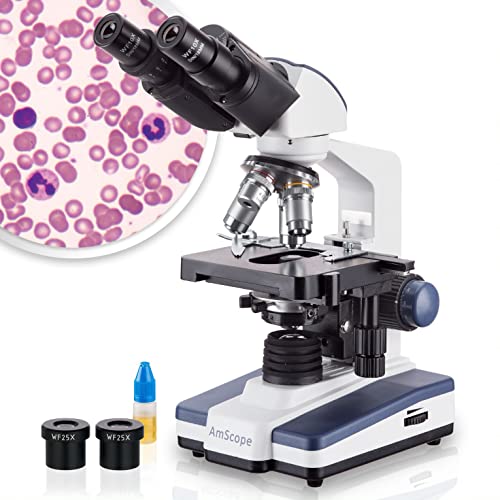
- Binocular head with 360-degree rotation
- Achromatic objectives and 100X oil lens
- Mechanical stage with Abbe condenser and dimmable LED
Best For: serious hobbyists and students wanting a more lab-like microscope
Budget-Friendly STEM Kit – PalliPartners 100X-2000X Compound Microscope
If you want compound microscopes for biology that are ready to use right out of the box, this PalliPartners kit is built for students and home learners. It combines higher magnification options with dual LED lighting, making it useful for viewing both translucent biological samples and opaque objects.
Best For: Students, homeschoolers, and beginners who want an all-in-one microscope kit with slides and phone imaging support.
Pros:
- 100X-2000X magnification range with 4X, 10X, 40X objectives and a WF25X eyepiece
- Includes 10 prepared slides, 18 blank slides, phone clip, Bluetooth remote, and power adapter
- Top and bottom LED illumination helps with both opaque and translucent specimens
- SGS certified for non-toxic materials and electrical safety
Cons:
- Designed more for basic to intermediate biology than advanced lab work
- Battery-powered design may be less ideal than a heavier corded lab scope for some users
Overall, this is a practical starter microscope for classroom projects, homeschooling, and early biology observation. It offers a strong accessory bundle and flexible lighting without pushing into professional-level complexity.
Classic School Lab Pick – AmScope M150C 40X-1000X Microscope
For buyers comparing compound microscopes for biology in a traditional school-friendly format, the AmScope M150C is a straightforward option. Its all-metal frame, optical glass elements, and simple magnification steps make it a practical pick for introductory science work at home or in class.
Best For: Elementary through high school students who want a durable, no-frills biology microscope.
Pros:
- 40X-1000X magnification with five total viewing settings
- All-metal construction adds durability for regular student use
- LED illumination can run on an outlet or three AA batteries
- Includes optical glass elements, condenser, and disc diaphragm
Cons:
- Lower maximum magnification than 1600X or 2000X models
- More basic accessory package than kit-style microscopes
This model focuses on reliability and simplicity rather than extras. If you need a sturdy biology microscope for everyday educational use, it checks the core boxes well.
All-in-One Biology Kit – PALOBIL 100X-2000X Microscope
This PALOBIL model is aimed at shoppers who want compound microscopes for biology with a full starter accessory set. It combines dual LED lighting, a metal frame, smartphone compatibility, and multiple magnification steps for studying prepared slides and beginner samples.
Best For: Kids, beginners, and families who want a feature-rich microscope kit for biology and homeschool use.
Pros:
- 6 magnification settings up to 2000X using 4X, 10X, and 40X objectives with a WF25X eyepiece
- Adjustable top incident light and bottom transmitted light for different specimen types
- Includes a phone adapter and beginner experiment kit with prepared and blank slides
- Metal frame is designed to be sturdy and durable
Cons:
- Requires 3 AA batteries or the included AC adapter for power
- Accessory-heavy design may be more than some users need for simple viewing
As a biology starter kit, this microscope leans heavily into convenience and versatility. It is a strong fit if you want one package that supports classwork, demonstrations, and at-home experimentation.
Premium Lab Upgrade – AmScope B100A-MS Binocular Microscope
If you need compound microscopes for biology with more of a real lab feel, the AmScope B100A-MS stands out. Its binocular head, mechanical stage, and oil-immersion objective make it better suited to detailed educational observation than basic entry-level models.
Best For: Students and hobbyists who want a more advanced biology microscope with binocular viewing and precise slide control.
Pros:
- 40X-1600X magnification range with 4x, 10x, 40xR, and 100x oil objectives
- Binocular head helps reduce eye and neck strain during longer sessions
- Mechanical stage supports precise slide movement on both axes
- Brightfield setup includes Abbe condenser and iris diaphragm for light control
Cons:
- Corded electric power limits portability compared with cordless models
- More complex and less beginner-focused than simple student microscopes
This is the most lab-oriented option in the group, with features that support more careful specimen study. It is a strong choice when you want a serious educational microscope without jumping to professional or research-grade equipment.
Advanced Binocular Pick – Microscope for Adults WF10x and WF25x Eyepiece
If you’re comparing compound microscopes for biology, this binocular model stands out for its wide magnification range and built-in USB 2.0 electronic eyepiece. It’s set up to handle tissue morphology, tiny objects, and classroom or hobby lab work while giving you 40X to 2000X viewing options with clear image support from dual LED lighting.
Best For: Students, hobbyists, and general biology users who want a binocular compound microscope with photo and video capture on a PC.
Pros:
- WF10X and WF25X eyepieces plus 4X, 10X, 40X, and 100X objectives provide 6 magnification settings.
- USB 2.0 electronic eyepiece lets you capture photos and videos on a computer.
- Dual LED light source helps with high-resolution viewing of a wide range of objects.
- Coaxial and fine focus controls support precise sharpening and magnification changes.
Cons:
- No slide kit is mentioned in the supplied notes.
- Best suited to users who want a feature-rich setup rather than a basic beginner scope.
Overall, this is a flexible compound microscope for biology if you want strong magnification, computer imaging, and fine focus control in one package. The feature set is broad enough for observation and documentation without needing extra add-ons right away.
Starter Lab Bundle – AmScope M161C-2L-SP14 1000X Lab Compound Monocular Microscope
This AmScope option is a practical entry point for compound microscopes for biology, especially if you want a straightforward student microscope with included slide prep tools. It offers 40X to 1000X magnification, top and bottom LED illumination, and an optical glass lens setup housed in a sturdy metal frame.
Best For: Students and beginners who want a reliable monocular biology microscope with a slide preparation kit included.
Pros:
- 40X-1000X magnification range covers common classroom and lab viewing needs.
- Top and bottom LED lights improve flexibility for different samples.
- Sturdy metal frame adds durability for student use.
- Includes AmScope SP-14 slide preparation kit for getting started.
Cons:
- Monocular design is less comfortable for extended use than binocular models.
- Uses coarse focusing only, based on the supplied details.
For a biology learner who wants a simple, package-ready microscope, this model keeps the focus on core functionality and included accessories. It’s a sensible choice when ease of setup and study tools matter more than advanced features.
Wide-Field Student Choice – Compound Microscope 40X-2500X WF10x and WF25x
For buyers comparing compound microscopes for biology, this binocular model emphasizes a wide field of view, adjustable dual LED lighting, and a two-layer mechanical stage. The supplied details highlight 40X to 2500X magnification, comfortable viewing with ultra-wide-angle eyepieces, and a design aimed at students, beginners, and hobbyists.
Best For: Biology learners and hobbyists who want a binocular microscope with a wide field of view and adjustable stage control.
Pros:
- WF10X and WF25X eyepieces support 40X-2500X magnification.
- Top and bottom LED lights provide adjustable illumination.
- Coaxial coarse and fine focusing makes sharpening easier.
- Two-layer mechanical stage and moving scale improve sample positioning.
Cons:
- The listed details are less specific about included accessories beyond the complete kit reference.
- Maximum magnification claims in the notes should be interpreted alongside the listed objective lens details.
This is a strong all-around option if you want a biology microscope with binocular comfort and a more adaptable stage setup. It looks especially useful for users who plan to spend time adjusting samples and fine-tuning observations.
Educational Starter Kit – PalliPartners 40X-2000X Binocular Microscope
If you’re comparing compound microscopes for biology, this PalliPartners binocular model is built for hands-on learning with a wide 40X-2000X range, dual LED lighting, and a bundle of slides and tools. It aims to give students and home learners a practical way to inspect cells, microorganisms, and plant tissues without moving into a much pricier lab setup.
Best For: Students, homeschoolers, and beginner biology users who want a feature-rich starter kit with included slides and tools.
Pros:
- 40X-2000X magnification with 4X, 10X, 40X objectives, WF25X eyepiece, and 2X Barlow lens
- Top and bottom LED illumination for both translucent specimens and opaque items
- Includes 10 prepared slides, 18 blank slides, collecting bottles, and dissecting tools
- Phone clip adapter and Bluetooth remote shutter included for easy image capture
Cons:
- Plastic enclosure may feel less substantial than metal-bodied lab microscopes
- More of a learning kit than a dedicated professional research instrument
Overall, this is a flexible entry point for biology study when you want accessories included and straightforward viewing at common educational magnifications. It stands out most as an all-in-one classroom or home science package.
Imaging-Friendly Pick – PalliPartners 40X-2000X Trinocular Microscope
Among compound microscopes for biology, this PalliPartners trinocular model is a strong choice if you want built-in flexibility for viewing and imaging. It covers 40X-2000X magnification, uses top and bottom LED illumination, and adds a trinocular head so you can connect a camera while still observing through the eyepieces.
Best For: Home science learners, classroom users, and hobbyists who want camera-ready viewing with a trinocular head.
Pros:
- 40X-2000X magnification range for everyday specimen inspection
- Trinocular head supports camera or imaging device connection
- Double-layer stage helps keep slides steady during use
- Top and bottom LED lights work with transparent and non-transparent specimens
Cons:
- Notes describe basic biological specimen use rather than advanced research features
- No slide kit or accessory bundle is listed in the supplied details
This model makes sense if documentation matters as much as viewing, since the trinocular design is its main advantage. It offers a practical middle ground for biology study where digital capture is useful.
Lab-Style Upgrade – AmScope B120B 2000X Biological Microscope
For buyers focused on compound microscopes for biology, the AmScope B120B leans more toward a traditional lab-style setup than a basic student scope. It combines 40X-2000X magnification with achromatic objectives, an Abbe condenser, and a mechanical stage, which are all helpful when you want better control over slide viewing and image quality.
Best For: Students, lab users, and serious hobbyists who want a more traditional biological microscope with stronger stage and optical controls.
Pros:
- Siedentopf binocular head with widefield eyepieces and 360-degree rotation
- 40X-2000X magnification using DIN achromatic objectives, including 100X oil
- Double-layer mechanical stage with X-Y movement and slide positioning marks
- LED illumination with dimmer plus Abbe condenser and iris diaphragm
Cons:
- More complex and less kit-like than beginner bundle microscopes
- Uses battery power in the supplied details, which may matter for long sessions
Compared with more basic biology scopes, this one is better suited to users who want the stage control and optics associated with a more serious lab workflow. It is a solid option when you care more about viewing performance than extra accessories.
How We Picked These Compound Microscopes for Biology
We focused on microscopes that offer the most practical value for biology work: usable magnification ranges, clear glass optics, dependable LED illumination, and stable mechanical stages. We also considered whether each model is easier for beginners to operate or better suited to more advanced classroom and lab use.
Quick Comparison: What Matters Most
When comparing Compound Microscopes for Biology, think less about the highest printed magnification and more about image quality at useful ranges. A well-built 400X to 1000X microscope with good optics often performs better than a poorly made model advertising extreme magnification. Binocular and trinocular designs can improve comfort and make documentation easier, while monocular models are often simpler and more affordable.
Key Buying Factors for Compound Microscopes for Biology
Optics and Eyepieces
Look for optical glass lenses, achromatic objectives, and eyepieces that provide a sharp field of view. WF10x eyepieces are common and practical, while additional eyepieces or interchangeable options can improve flexibility.
Magnification Range
For most biology tasks, a useful working range matters more than extreme maximum numbers. Lower powers help you find and center specimens, while higher powers are useful for examining cell structures and small organisms.
Lighting and Stage Control
Adjustable LED lighting helps reveal contrast in transparent specimens. A two-layer mechanical stage is especially helpful for precise slide movement, which is important when studying biological samples.
Build Type and Comfort
Metal construction tends to feel more stable and durable. Binocular and trinocular microscopes are worth considering if you plan longer sessions, since they reduce eye strain and can support camera use or teaching demonstrations.
Who Should Buy Which Compound Microscopes for Biology?
Students and first-time users will usually do best with a straightforward monocular or basic binocular model that is easy to set up and use. Home learners and hobbyists may want a kit with slides and a wider magnification spread for experimentation. Classroom buyers and serious biology users should prioritize binocular or trinocular microscopes with stronger mechanical stages, better optics, and reliable illumination.
If you are choosing among multiple Compound Microscopes for Biology, match the microscope to your workflow rather than chasing the biggest magnification number. The best choice is the one that stays clear, stable, and comfortable to use for the specimens you study most often.