Choosing your first DMX controller can feel complicated when channel counts, fixtures, banks, scenes, and wireless options all compete for attention. The right console should match your lighting setup without forcing you to learn more controls than you need.
We’ve compared 10 DMX controllers for beginners, from compact mini consoles and straightforward 192-channel boards to app-based systems and larger controllers suited to growing productions.
Best 10 Dmx Controllers for Beginners Picks for 2026
Best Value Beginner Board
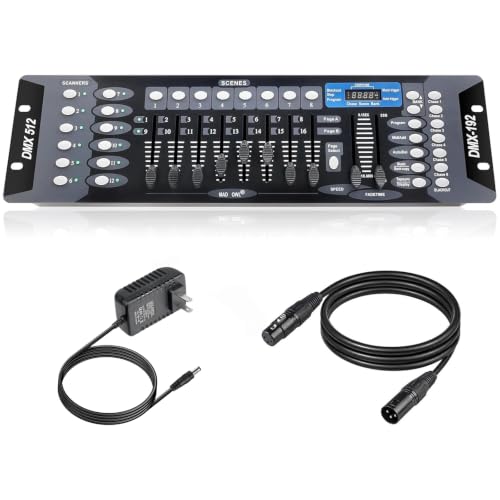
- Controls up to 12 fixtures
- Stores scenes and six chases
- Includes a 6.6-foot DMX cable
Best For: Small-to-medium beginner lighting setups
Best Feature Set for Beginners

- Controls 12 fixtures at up to 16 channels
- Stores up to 240 scenes
- Adds fog, strobe, and MIDI controls
Best For: Growing setups and effect-rich performances
Best High-Capacity Starter Console

- Offers 384 DMX channels
- Stores 30 banks of eight scenes
- Includes an LED gooseneck light
Best For: Growing stage, club, and live-show rigs
Best for Larger Fixture Control

- Controls up to 12 fixtures
- Supports up to 32 channels per fixture
- Includes 240 scenes and six chases
Best For: Intelligent lighting setups needing more channels
Versatile Scene Builder
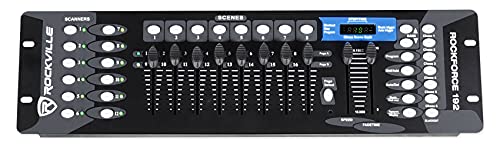
- 192-channel control for up to 12 scanners
- Scene banks, chases, and sound activation
- Beginner-friendly layout with manual sliders
Best For: Hands-on lighting control for DJs and small productions
App-Based Simplicity

- Controls up to 256 channels from a tablet
- 15,000-plus fixture library
- Presets and automatic effects reduce programming
Best For: Tablet-based control and fast fixture setup
Compact Starter Console

- Direct control across 14 DMX channels
- Grand Master and instant Blackout controls
- Compact design for small events
Best For: Beginners managing small DJ and party lighting rigs
Flexible Show Control

- 384 channels for up to 24 fixtures
- 240 scenes and six programmable chases
- MIDI, music mode, and durable metal housing
Best For: Growing DJ, club, and stage lighting setups
Simple Compact Control

- Direct control for up to 12 DMX channels
- Compact aluminum design for travel
- Three-pin DMX output and one-key blackout
Best For: Small stages and basic portable lighting rigs
Beginner-Friendly Scene Mixing

- 192 channels for up to 12 fixtures
- Stores up to 240 lighting scenes
- Organized controls with voice operation
Best For: Amateur DJs, parties, weddings, and small venues
Best Value Beginner Board – 192-Channel DMX Controller
If you are comparing DMX controllers for beginners, this 192-channel board offers a practical introduction to programming stage and DJ lighting. Its faders and buttons support hands-on adjustments, while 23 banks, 240 programmable steps, and six chases give you room to build more dynamic shows as your skills develop.
Best For: Beginners managing small-to-medium setups with up to 12 fixtures using 16 channels or fewer.
Pros:
- Controls up to 12 lighting fixtures with 16 channels or fewer each.
- Stores 23 banks of eight scenes and six programmable chases.
- Includes a 6.6-foot DMX cable for compatible equipment.
- Metal rack-mount design with straightforward faders and buttons.
Cons:
- Its 192-channel capacity is lower than some larger controllers.
- Programming multiple scenes may take practice for first-time users.
This is a sensible starting point when you want physical controls and useful scene storage without moving immediately to a more advanced console. The 12-fixture limit makes it better suited to smaller stages, clubs, and DJ lighting rigs.
Best Feature Set for Beginners – CHAUVET DJ OBEY40
The CHAUVET DJ OBEY40 is one of the more capable DMX controllers for beginners who expect their lighting setup to grow. It combines 192 channels with organized scene banks, chase programming, fog and strobe controls, and MIDI compatibility for broader performance control.
Best For: Beginners and developing operators who need scene storage plus fog, strobe, or MIDI-related controls.
Pros:
- Controls up to 12 fixtures with up to 16 channels each.
- Provides 30 banks of eight scenes, with up to 240 scenes total.
- Supports six chases containing up to 240 scenes.
- Adds fog and strobe controls, MIDI compatibility, and reversible sliders.
Cons:
- At 6.7 pounds, it is less lightweight than the simplest boards.
- The additional controls may require more setup time for absolute beginners.
Choose the OBEY40 if you want a structured controller with room for more elaborate shows. Its storage and effect-oriented controls are useful for performances, though users seeking only basic manual adjustments may not need every feature.
Best High-Capacity Starter Console – 384-Channel DMX512 Controller
For beginners who want substantial programming capacity from the start, this 384-channel DMX512 controller provides a broad platform for live shows, bars, clubs, and stage lighting. It offers 30 banks of eight programmable scenes and includes practical touches such as side handles and an LED gooseneck light.
Best For: New operators building larger programmed lighting shows with extensive channel and scene requirements.
Pros:
- Provides 384 DMX channels for detailed fixture control.
- Offers 30 banks of eight programmable scenes.
- Supports program editing for bar, club, live, and stage lighting shows.
- Includes side handles and an LED gooseneck light for operation.
Cons:
- Its higher channel count may feel more complex than necessary for a tiny rig.
- The supplied notes do not specify the maximum number of fixtures or chase storage.
This console is a strong option when expansion matters more than keeping the control layout minimal. Beginners should be comfortable investing time in programming, but the extra capacity can reduce the need to replace the controller as the lighting rig grows.
Best for Larger Fixture Control – CHAUVET DJ Obey 70
The CHAUVET DJ Obey 70 is a useful choice among DMX controllers for beginners who want to learn on a console with more fixture-channel headroom. It controls up to 12 intelligent lights with up to 32 channels each and lets you program fade and speed times into individual steps.
Best For: Beginners working with intelligent fixtures that require up to 32 channels per light.
Pros:
- Controls up to 12 intelligent lights with up to 32 channels each.
- Provides 384 DMX channels of control.
- Stores 30 banks of eight scenes, or up to 240 scenes.
- Includes six chases and programmable fade and speed times.
Cons:
- Its expanded controls may be more than needed for basic fixtures.
- The unit weighs 6.9 pounds, making it less convenient to move frequently.
The Obey 70 stands out when fixture compatibility and precise scene timing are priorities. It is a more capable learning platform than a basic controller, especially for users who expect to add intelligent lights or create timed chase sequences.
Versatile Scene Builder – Rockville ROCKFORCE 192
The Rockville ROCKFORCE 192 is a strong choice for beginners who want hands-on control without immediately moving to complex professional systems. This rack-style console manages 192 DMX channels across 12 scanners and supports repeatable scenes, chases, and sound-activated effects for parties, DJs, and small productions.
Best For: Beginners who want traditional faders and room to build customized lighting shows.
Pros:
- Controls 192 channels across 12 scanners with 16 channels each.
- Stores 23 banks of 8 scenes and supports 6 chases of 240 scenes.
- Built-in microphone enables music-triggered lighting effects.
- Power-failure memory helps retain programmed settings.
Cons:
- Its 22-inch rack-style body is less portable than a mini console.
- The larger channel capacity may be more than needed for very small setups.
With its straightforward LED display, manual sliders, and extensive scene capacity, the ROCKFORCE 192 offers a practical middle ground between beginner accessibility and more advanced show control.
App-Based Simplicity – ADJ MyDMX Go
The ADJ MyDMX Go takes a modern approach to DMX controllers for beginners by shifting operation to an iPad or Android tablet. Its app-based interface avoids traditional programming while offering access to a large fixture library, automatic effects, presets, and control through Wi-Fi or USB.
Best For: Beginners who prefer tablet-based control and quick setup over physical faders.
Pros:
- 256-channel app-based control for iPad and Android tablets.
- Fixture library includes more than 15,000 lighting fixtures.
- Offers 50 user presets and 21 automatic effects without complicated programming.
- Compact interface supports connection through standard 3-pin XLR and USB power.
Cons:
- Requires a compatible iPad or Android tablet for app-based operation.
- Users who prefer dedicated hardware controls may not like the tablet workflow.
MyDMX Go is especially approachable when speed and convenience matter. The extensive fixture library and preset-driven controls make it a flexible option for users building a system around mobile-device operation.
Compact Starter Console – DMX512 14-Channel Controller
This 14-channel DMX512 controller is designed for beginners who need essential control for a small lighting rig. Its compact layout provides channel faders, a grand master, and a blackout button, making it suitable for parties, bars, weddings, KTV rooms, and other modest events without complicated programming.
Best For: First-time users running a small number of compatible DJ, PAR, moving-head, or strobe lights.
Pros:
- Simple 14-channel design supports independent channel control and dimming.
- Seven faders per page switch between channels 1-7 and 8-14.
- Grand Master and one-touch Blackout controls simplify live operation.
- Lightweight, compact body is easy to carry and store.
Cons:
- Its 14-channel capacity is limited compared with larger controllers.
- It offers fewer programming features than controllers built for complex shows.
The DMX-14 keeps the learning curve low by focusing on direct, physical adjustments. For a small venue or first lighting setup, its dedicated brightness and blackout controls provide useful confidence during live events.
Flexible Show Control – Rockville ROCKFORCE 384
For beginners comparing DMX controllers for beginners, the Rockville ROCKFORCE 384 offers substantial room to grow. It controls up to 24 intelligent lights with 16 channels each and provides programmable scenes, chases, MIDI, and music-triggered operation.
Best For: Beginners building larger DJ, club, or stage lighting setups.
Pros:
- Controls up to 24 fixtures with 384 channels.
- Stores 240 scenes across 30 banks and supports six programmable chases.
- Includes MIDI control, a built-in microphone, manual override, and power-failure memory.
- Metal housing, LED display, gooseneck lamp, and universal 110–240V power support.
Cons:
- Its larger feature set may take more time to learn than a basic controller.
- At 20.71 inches long and 5.3 pounds, it is less compact than mini controllers.
This is a strong choice if you want beginner-friendly hands-on sliders now while keeping enough channel capacity and scene storage for more involved shows later.
Simple Compact Control – MAD OWL 12-Channel DMX Dimmer
Among DMX controllers for beginners, the MAD OWL 12-channel dimmer is a straightforward option for small setups. Its six sub-control faders and main control fader provide direct control of DMX512 lighting through a standard three-pin XLR output.
Best For: Small stages and portable setups using fixtures with no more than 12 channels.
Pros:
- Simple layout with six sub-control faders, a master fader, and one-key blackout.
- Compact, lightweight aluminum design suited to travel and quick installation.
- Uses standard three-pin DMX output for connecting compatible equipment.
- Can work with a DMX512-controlled dimming power supply as a permanent control system.
Cons:
- It cannot be used with stage lighting equipment requiring more than 12 channels.
- It is a basic dimming controller without the listed scene and chase programming features of larger boards.
Choose this controller when direct fader operation matters more than advanced programming and your lighting fixtures stay within the 12-channel limit.
Beginner-Friendly Scene Mixing – CO-Z 192 DMX Controller
The CO-Z 192 is a practical middle ground for shoppers seeking DMX controllers for beginners. It controls up to 12 intelligent lights with up to 16 channels each, while its organized controls, scene storage, and voice-control feature help simplify show operation.
Best For: Amateur DJs, parties, weddings, churches, and small entertainment venues.
Pros:
- Provides 192 channels for up to 12 fixtures and stores up to 240 scenes.
- Organized control sections cover fixture selection, scenes, channels, speed, timing, and functions.
- Voice control can switch among lighting scenes for hands-free operation.
- Supports compatible three-pin equipment including fog machines, beam lights, strobes, and PAR fixtures.
Cons:
- It supports fewer fixtures and channels than the 384-channel Rockville controller.
- The plastic construction may feel less substantial than a metal-bodied console.
With a manageable layout and generous scene capacity, the CO-Z is a sensible pick for beginners who want more creative control than a simple fader-only dimmer provides.
How We Picked the Best Dmx Controllers for Beginners
We focused on the features that make DMX control easier to learn and practical to use: clear layouts, accessible scene programming, fixture capacity, master and blackout controls, connectivity, portability, and compatibility with common DMX512 lighting equipment. We also considered whether each controller fits a small party, mobile DJ setup, rehearsal space, bar, or expanding stage system.
A high channel count alone does not make a controller beginner-friendly. Straightforward controls and a sensible workflow are often more valuable than advanced functions you may not use.
Quick Comparison
- Simple small setups: A 14-channel mini console or 12-channel dimmer is suitable for a few basic fixtures.
- General-purpose control: 192-channel consoles offer a useful balance of capacity, price, and familiar hands-on operation.
- Larger beginner systems: 384-channel models provide more room for multiple fixtures, scenes, and future expansion.
- App-based control: The ADJ MyDMX Go is worth considering if you prefer software control and wireless flexibility.
- Fog-machine integration: Controllers designed for lighting and fog can simplify operation at parties, clubs, and small events.
Key Buying Factors for Dmx Controllers for Beginners
Channel and Fixture Capacity
Check both the number of channels and the number of fixtures the controller can address. A basic RGB light may use only a few channels, while moving heads and advanced effects can use many more. Leave room for future additions rather than buying only for today’s setup.
Programming and Scene Controls
Look for dedicated faders, banks, scenes, chases, and playback controls if you want hands-on operation. A blackout button and grand master are especially useful for quickly lowering or stopping every connected light.
Portability and Setup
Compact consoles are easier to transport and store, while rack-style controllers may suit permanent installations. Confirm that the package includes the needed DMX cables, and check the connector type before ordering.
Compatibility and Expansion
DMX512 is widely supported, but fixtures can use different channel modes and addressing requirements. Verify that the controller supports your lights’ channel count and that you can assign addresses without difficulty. App-based and wireless systems may also require compatible hardware, a reliable device, or a stable network connection.
Who Should Buy Which Dmx Controllers for Beginners?
First-time users with a few lights should start with a compact 12- or 14-channel controller if portability and simplicity matter most. Mobile DJs and party hosts will generally benefit from a 192-channel board with scenes, chases, and quick blackout access. Small venues and performers planning to expand may prefer a 384-channel model or a console with MIDI support. Users who want wireless or tablet-based operation should consider an app-focused system such as MyDMX Go, provided their fixtures and network setup are compatible.
Before buying, list every fixture, note its DMX channel requirement, and decide whether you prefer physical faders or software control. That simple check will narrow the options quickly and help ensure your first controller remains useful as your lighting system grows.