A dropped screw behind an appliance or a suspected blockage in a drain is easier to investigate when you can see into the gap. An endoscope camera with light lets you inspect tight, dark spaces before taking anything apart.
These 10 picks include phone-connected and built-in-screen models, plus single-, dual-, and triple-lens options. The right choice depends on where you need to look and how you want to view the image.
Best 10 Endoscope Camera with Light Picks for 2026
Best for Multi-Angle Inspection
DEPSTECH DS620 Triple-Lens Endoscope

- Switch between three lenses
- 5-inch IPS screen; 10 LEDs
- 16.5-foot cable; IP67 probe
Best For: Multi-angle inspections with a standalone display
Best Phone-Powered Pick

- 18.04-foot semi-rigid cable
- 6.9 mm probe; eight LEDs
- Connects to iOS and Android
Best For: Long-reach inspections using a phone or tablet
Best Simple Standalone Viewer

- Built-in 4.3-inch LCD
- 16.5-foot cable; eight LEDs
- No photo or video capture
Best For: Live visual checks without a phone
Best Dual-Lens Phone Option

- Dual-lens, 7.9 mm probe
- 16.4-foot semi-rigid cable
- IP67 probe; phone app required
Best For: Dual-lens inspections using an iOS or Android device
Simple Single-Lens Pick
MugEasy 4.3-Inch Inspection Camera

- 4.3-inch IPS live-view screen
- 16.6-foot semi-rigid cable
- No photo storage
Best For: Straightforward DIY inspections without a phone
Large-Screen Dual-Lens Pick

- 5-inch built-in display
- Switchable front and side lenses
- Cannot save photos or video
Best For: Live inspections needing a larger screen and side view
Split-Screen Viewing Pick
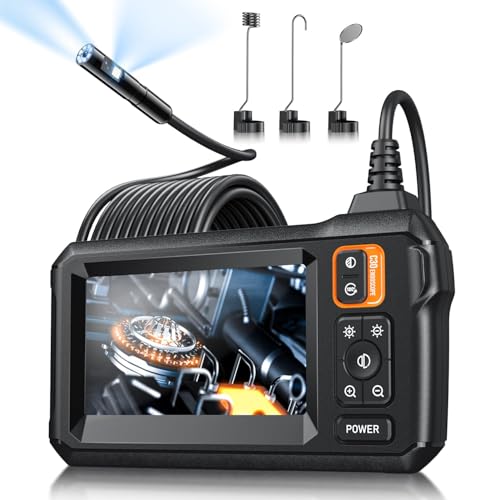
- Three viewing modes with split screen
- 16.5-foot semi-rigid cable
- No photo capture or storage
Best For: Close-up checks needing front and side perspectives
Best Single-Lens Reach
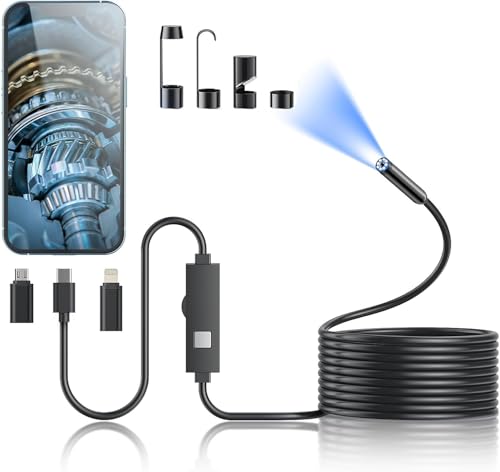
- 7.9 mm single-lens probe
- 16.4-foot semi-rigid cable
- Eight adjustable LEDs
Best For: Phone-based inspections that need cable reach
Best Dual-Lens iPhone Option

- Dual-lens inspection view
- 1920 × 1440 capture
- IP67-rated 7.9 mm probe
Best For: iPhone and iPad users inspecting tight spaces
Best Close-Range Dual Lens

- Dual-lens, close-range viewing
- 16.5-foot semi-rigid cable
- Eight plus one adjustable LEDs
Best For: Close-up pipe and cooled-engine inspections
Best for Multi-Angle Inspection – DEPSTECH DS620 Triple-Lens Endoscope
This endoscope camera with light lets you switch among three lenses at the press of a button, helping you inspect different angles without repeatedly repositioning the probe. Its 5-inch IPS screen provides a standalone, real-time view.
Best For: Inspecting machinery, vehicles, drains, or walls when multiple viewing angles and a built-in screen matter.
Pros:
- Three switchable lenses and 1080p video capture.
- 5-inch IPS display and 10 adjustable LEDs.
- 16.5-foot semi-rigid cable with an IP67 waterproof probe.
- Can save photos and videos when a microSD card is inserted.
Cons:
- MicroSD card is not included.
- Listed operating time is about 2–3 hours per charge.
Choose this model if seeing around an obstruction is more important than keeping the kit minimal. Budget for a microSD card if you need inspection records.
Best Phone-Powered Pick – BAZO 18.04-Foot Endoscope
The BAZO endoscope camera with light plugs into a compatible iOS or Android device, using the UseePlus app instead of a separate screen or Wi-Fi connection. Its slim 6.9 mm probe and long semi-rigid cable suit narrow, hard-to-reach spaces.
Best For: Phone-based inspections where a narrow probe and extra cable reach are priorities.
Pros:
- 18.04-foot semi-rigid cable and 6.9 mm probe.
- Eight adjustable LEDs and an IP67 waterproof probe.
- Includes a magnet, hook, mirror, and phone adapters.
Cons:
- Requires a compatible phone or tablet and the UseePlus app.
- No standalone display.
This is a practical choice if you already plan to use your phone as the viewer. Check device compatibility before buying, particularly if you use an older phone.
Best Simple Standalone Viewer – Daxiongmao 4.3-Inch Endoscope
This endoscope camera with light has a built-in 4.3-inch LCD, so you can inspect a space without pairing a phone or downloading an app. Its 16.5-foot semi-rigid cable and eight adjustable LEDs help with dark, awkward access points.
Best For: Quick visual checks when you want a dedicated screen and do not need to save images.
Pros:
- 4.3-inch screen works without a phone or Wi-Fi.
- 16.5-foot semi-rigid cable and eight adjustable LEDs.
- IP67 waterproof probe; hook, magnet, and side mirror included.
Cons:
- Cannot take pictures or record video, according to the product bullets.
- Specified viewing distance is 1.5–5 inches.
Its straightforward setup makes sense for live inspections. Despite conflicting capture-related fields in the supplied details, the product bullets explicitly say it cannot save photos or video, so do not choose it for documentation.
Best Dual-Lens Phone Option – Kinpthy 16.4-Foot Borescope
This dual-lens endoscope camera with light connects to compatible iOS and Android devices through the SUP-ANESOK app. It pairs a 7.9 mm probe with a 16.4-foot semi-rigid cable for close-range inspections of pipes, vehicles, and wall cavities.
Best For: Phone-based inspections when you want two lenses and a waterproof probe.
Pros:
- Dual-lens design with listed 1920 × 1440 image and video resolution.
- 16.4-foot semi-rigid cable and adjustable lighting.
- IP67 probe rated for immersion up to 3.28 feet for one hour.
- Includes connectors plus a magnet, hook, and mirror.
Cons:
- Requires a compatible phone and app; no built-in screen is listed.
- Product notes warn that some Android devices may show slightly blurry images.
The second lens adds viewing flexibility, but phone compatibility and image quality on your particular device deserve attention before purchase. Clean both lenses as directed for the clearest view.
Simple Single-Lens Pick – MugEasy 4.3-Inch Inspection Camera
This endoscope camera with light is a straightforward choice if you want to inspect pipes, walls, or vehicle components without pairing a phone. Its 4.3-inch IPS screen shows a live 1080p image, while the 16.6-foot semi-rigid cable helps guide the 7.9 mm probe into confined spaces.
Best For: DIY inspections where a built-in screen and simple, single-lens operation matter more than saving images.
Pros:
- Eight adjustable LEDs help illuminate dark spaces.
- IP67-rated probe and 2–10 cm optimal focus range suit close-up checks in wet areas.
- Includes a hook, magnet, and side mirror for different inspection tasks.
Cons:
- Cannot take or store photos.
- Side views require attaching the included mirror rather than switching lenses.
Choose this model for uncomplicated live viewing; if you need a direct side-facing view, one of the dual-lens options below may be more convenient.
Large-Screen Dual-Lens Pick – TGJOR 5-Inch Borescope
If screen size and a direct side view are priorities, this endoscope camera with light pairs a 5-inch display with front and side lenses. Its 16.4-foot semi-rigid cable, adjustable LEDs, and IP67-rated probe are suited to looking inside drains, ducts, and vehicle cavities.
Best For: Inspectors who want a larger handheld display and quick switching between front and side views.
Pros:
- Dual lenses let you change viewing direction without attaching a mirror.
- Built-in 5-inch screen needs no app or Wi-Fi connection.
- Advertised 3–4-hour runtime supports longer inspection sessions.
Cons:
- Cannot capture photos or videos.
- Specified 1.2–4-inch focus range means subjects outside that range may not appear sharp.
The larger screen and lens switching are useful upgrades for live troubleshooting, but this is not the right tool if you need a visual record of your findings.
Split-Screen Viewing Pick – MugEasy Dual-Lens Borescope
This endoscope camera with light adds dual-lens viewing to a compact 4.3-inch IPS display. Its three viewing modes include a split-screen option, making it easier to examine a pipe wall or tight cavity from more than one angle without fitting the supplied side mirror.
Best For: Close-up inspections where front and side perspectives on the same handheld screen are useful.
Pros:
- Switches among three viewing modes, including split-screen viewing.
- 16.5-foot semi-rigid cable and 7.9 mm probe help reach confined areas.
- Eight adjustable LEDs and an IP67-rated probe support dark, wet-space inspections.
Cons:
- Cannot take or store photos, despite photo and video formats appearing in the product details.
- The 2–10 cm optimal focus range favors nearby surfaces.
Compared with the single-lens MugEasy model, this one is worth considering for its built-in side view and split-screen mode; both are live-view tools rather than image-recording cameras.
Best Single-Lens Reach – Kinpthy 16.4-Foot Borescope
The Kinpthy endoscope camera with light pairs a 7.9 mm single-lens probe with a 16.4-foot semi-rigid cable for inspecting pipes, engine areas, and other hard-to-reach spaces. It connects to compatible iOS and Android devices through an app.
Best For: Buyers who want a phone-connected, single-lens inspection camera with a long, shape-holding cable.
Pros:
- Captures 1920 × 1440 photos and video at close range.
- Eight adjustable LEDs help illuminate dark inspection areas.
- IP67 probe is rated for submersion up to 3.28 feet for one hour; hook, magnet, and mirror are included.
Cons:
- Single lens does not provide a separate side view.
- Requires the SUP-ANESOK app and a compatible phone or tablet.
This is a practical pick when cable reach and included retrieval accessories matter more than having a second camera angle.
Best Dual-Lens iPhone Option – MugEasy 16.4-Foot Borescope
This MugEasy endoscope camera with light offers a dual-lens design and a 16.4-foot semi-rigid cable for looking into pipes, appliances, walls, and machinery. Its 7.9 mm probe has eight adjustable LEDs for dim spaces.
Best For: iPhone or iPad users who want a dual-lens inspection camera for tight, poorly lit areas.
Pros:
- Dual-lens design offers another viewing angle.
- Records photos and video at 1920 × 1440 resolution.
- IP67-rated probe and included hook, magnet, and side mirror add inspection versatility.
Cons:
- Requires downloading the recommended app.
- The supplied notes specify direct iPhone and iPad connection but do not confirm Android compatibility.
Choose this model if a second viewing angle is more useful to you than the simpler setup of a single-lens scope; confirm device compatibility before ordering.
Best Close-Range Dual Lens – Elecshion 16.5-Foot Borescope
The Elecshion endoscope camera with light combines two lenses, an approximately 8 mm probe, and a 16.5-foot semi-rigid cable. Its stated optimal viewing distance of 1.2–4 inches makes it especially relevant for close-range checks inside pipes or around a cooled engine.
Best For: Buyers who need dual viewing angles for close-up inspections and a cable that holds its bend.
Pros:
- Dual lenses and 1920 × 1440 capture support detailed close-range inspection.
- Eight plus one adjustable LEDs provide lighting for dark spaces.
- IP67 probe is rated for submersion up to 3.28 feet for one hour.
Cons:
- Probe is not heat-resistant; let engines cool before use.
- Specified optimal viewing range is relatively close at 1.2–4 inches.
This is the strongest fit of the three when close working distance and two camera angles are priorities. Handle the probe gently around sharp edges to protect its waterproof layer.
How We Picked the Best Endoscope Camera with Light
We compared the listed features most likely to affect a real inspection: viewing method, lens arrangement, cable length and stiffness, adjustable lighting, and stated water resistance. The selection spans straightforward phone-connected borescopes and models with dedicated screens, including dual- and triple-lens designs. Advertised resolution is useful for narrowing a shortlist, but it does not establish how clearly a camera will show detail in a dark, reflective, or wet space. Check current specifications, compatibility, and included accessories before buying.
Quick Comparison: Which Type Fits Your Job?
Phone-connected models may be a compact choice if you are happy using a compatible phone to view and save images. Built-in-screen models keep the display and camera together, which can be simpler in a garage or under a sink. Single-lens cameras suit direct, forward-looking checks; dual- and triple-lens cameras offer additional viewing angles when turning the cable is difficult. Several picks list cables around 16.4 to 16.5 feet, but more length is not automatically better: a shorter run can be easier to control at close range.
Key Buying Factors for an Endoscope Camera with Light
Lighting and Image Quality
Adjustable LEDs help balance visibility when the camera moves from a deep cavity toward a nearby surface. More light is not always clearer: shiny metal, standing water, and pale plastic can produce glare. Look beyond a 1080P or 1920P label and consider the viewing angle, usable focus distance, and whether the display or connected device makes details easy to judge.
Cable Control and Reach
A semi-rigid cable can be shaped to guide the tip through an open pipe or around an engine component. Compare the cable length with the actual route you need to inspect, including bends and the distance from your viewing position. Also check the camera-head diameter against the opening; a long cable is no help if the tip cannot fit.
Water Resistance and Compatibility
Some listings specify IP67 water resistance, but confirm exactly which parts are rated and follow the manufacturer’s immersion limits. Do not assume a waterproof camera tip means the connector or display can get wet. For phone-connected models, verify your device, connector, and app support before ordering.
Who Should Buy Which Endoscope Camera with Light?
For occasional household checks in dry gaps, start with a simple single-lens model that has adjustable LEDs and a cable you can steer. For automotive work or awkward pipe bends, consider a dual-lens option to see sideways without repeatedly repositioning the tip. Choose a built-in-screen model if you do not want to depend on your phone during messy jobs; a triple-lens design may be worthwhile when multiple angles matter. For drains and other damp locations, prioritize a clearly stated water-resistance rating and a head diameter that fits the access point. An inspection camera helps locate a problem, but it is not a substitute for a rated drain-cleaning tool or a professional diagnosis.