The best engineering building sets turn abstract STEM concepts into projects kids can see, test, rebuild, and improve. This roundup compares 10 hands-on options spanning structural design, machines, robotics, hydraulics, engines, and renewable energy.
Use the buying guide below to match each set’s complexity, parts, mechanisms, and learning goals with the builder’s age and experience.
Best 10 Engineering Building Sets Picks for 2026
Best Structural Engineering Set

- Build 20 structural models
- Explore force, load, compression, and tension
- Includes 285+ pieces and a 36-page manual
Best For: Intermediate builders ages 8–14 studying structural engineering
Best Motorized Engineering Set

- 638-piece construction set
- Build up to 25 vehicle designs
- Includes a motorized crane and real tools
Best For: Builders ages 10+ interested in mechanical vehicles
Best Physics Engineering Set
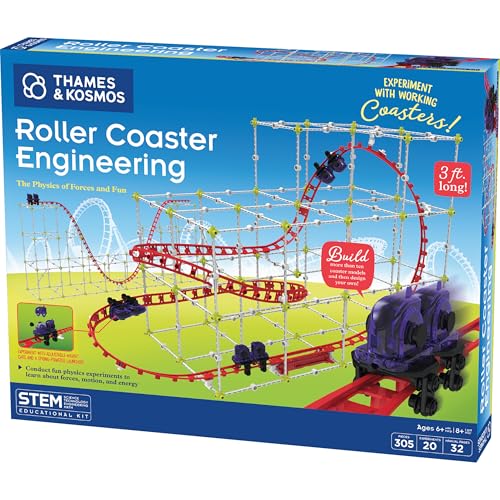
- Build working roller coaster models
- Explore force, motion, and energy
- Includes challenges and a 32-page manual
Best For: Builders ages 6+ learning physics through motion
Best Hydraulic Engineering Set

- Build a water-powered robotic arm
- Six axes with up to 270-degree rotation
- Includes a controllable gripper and suction components
Best For: Builders ages 12+ exploring hydraulics and robotics
Working Engine Challenge

- Builds a working miniature V8-style engine
- Includes moving mechanical parts and engine sounds
- Requires 3 AA batteries, not included
Best For: Hands-on vehicle mechanics and STEM learning
Open-Ended Maker Pick
PATHFINDERS Engineering Maker Set

- Includes wood parts, hydraulics, gears, levers, and pulleys
- Provides 10 guided builds and 15 challenge cards
- Designed for repeated builds and open-ended invention
Best For: Reusable maker learning for ages 8 and up
Clear Model Learning Pick
National Geographic 4-Cylinder Engine Kit
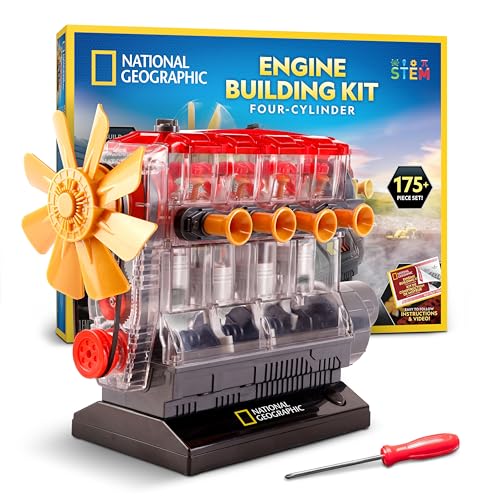
- Builds a working clear 4-cylinder engine model
- Includes 175-plus pieces, tools, and a Learning Guide
- Shows pistons, valves, and gears in motion
Best For: Guided engine mechanics learning for ages 10 and up
Versatile Starter Set

- 112-piece plastic STEM kit with 10 models
- Includes cranes, vehicles, a bulldozer, and windmill
- Guided assembly with storage box
Best For: Young builders ages 4–8 beginning STEM and construction play
Hands-On Metal Builder
194-Piece Off-Road Vehicle Kit

- Metal kit with 194 precision-engineered pieces
- Builds two mechanical designs, one at a time
- Includes screwdriver, wrench, and visual instructions
Best For: Ages 8+ seeking a detailed mechanical vehicle project
Solar STEM Explorer

- 190-piece kit with 12 robot and vehicle models
- Powered by sunlight or a strong indoor light
- Offers progressively challenging builds
Best For: Ages 8+ exploring robotics and renewable energy
Best Structural Engineering Set – Bridges & Skyscrapers
For engineering building sets focused on real-world structures, this Thames & Kosmos kit offers a hands-on introduction to forces, loads, compression, and tension. Its interchangeable pieces support 20 different models, making it a practical choice for guided STEM exploration.
Best For: Intermediate builders ages 8–14 who want to explore structural engineering and mechanical physics.
Pros:
- Supports 20 different structural models.
- Includes more than 285 interchangeable plastic building pieces.
- 36-page illustrated manual combines assembly instructions with experiments.
Cons:
- Recommended for an intermediate skill level.
- Focuses primarily on structural models rather than powered mechanisms.
This is a strong pick for learners interested in how bridges and skyscrapers handle forces. The experiment manual adds educational depth beyond simple construction.
Best Motorized Engineering Set – Meccano Super Construction
Among engineering building sets, the Meccano Super Construction kit stands out for its large 638-piece inventory and motorized functionality. Builders can create construction vehicles and bring a crane model to life with the included 6V motor.
Best For: Builders ages 10 and up who enjoy mechanical construction vehicles and motorized projects.
Pros:
- Offers 25 possible construction vehicle models.
- Includes 638 pieces, a 6V motor, and three real tools.
- Motorized crane features a rotating body and extendable hook.
Cons:
- Models are built one at a time.
- Requires four AA batteries for operation.
- The supplied information lists an instruction sheet for 11 models, despite the 25-model claim.
Choose this set if moving mechanisms and vehicle-style builds are more appealing than purely static structures. Its substantial parts count also leaves room for creative rebuilding and customization.
Best Physics Engineering Set – Roller Coaster Engineering
This roller coaster kit is one of the most engaging engineering building sets for learning through motion. Children can design working coaster models while investigating force, energy, and motion through challenges and guided experiments.
Best For: Young builders ages 6 and up who learn best through moving, reusable models and hands-on physics.
Pros:
- Builds working roller coaster models.
- Introduces force, motion, and energy through experiments.
- Includes a durable, reusable plastic building system and a 32-page color manual.
Cons:
- Primarily centered on roller coaster designs rather than varied engineering themes.
- Some challenges may require patience and repeated rebuilding.
The working coaster format makes abstract physics concepts easy to observe. It is a particularly approachable option for younger children who want immediate motion from their builds without batteries.
Best Hydraulic Engineering Set – Teach Tech Hydrobot Arm
For older learners seeking engineering building sets with a functional result, the Teach Tech Hydrobot Arm provides an in-depth mechanical project. Builders assemble a water-powered robotic arm with six axes, a rotating range of up to 270 degrees, and a controllable gripper.
Best For: Builders ages 12 and up who want a longer STEM project involving hydraulics, robotics, mechanics, and problem solving.
Pros:
- Builds a working hydraulic robotic arm.
- Uses water power, so no batteries are required.
- Six axes and up to 270-degree rotation support hands-on experimentation.
- Gripper can be replaced with suction components for picking up objects.
Cons:
- Requires careful assembly and multiple hours of build time.
- Recommended for ages 12 and up, making it less suitable for younger builders.
- Instructions are supplied in English.
This kit is best treated as a serious STEM building project rather than a quick toy. Its hydraulic controls and interchangeable end components offer an especially tangible introduction to fluid power and robotics.
Working Engine Challenge – Playz V8 Engine Model Kit
For builders looking for engineering building sets with moving parts, the Playz V8 Engine Model Kit offers a hands-on way to assemble and operate a miniature internal-combustion engine. Its visible pistons, belts, pulleys, exhaust valves, fan, and engine sounds make the finished model interactive, though assembly requires patience and 3 AA batteries for operation.
Best For: Kids 8 and up, teens, and adults interested in vehicle mechanics, working models, and mechanical-engineering concepts.
Pros:
- Working V8-style model with moving pistons, fan, cables, belts, and pulleys.
- Supports STEM learning, spatial reasoning, problem-solving, and motor skills.
- Offers an engaging build-and-operate experience for both children and adults.
Cons:
- Requires 3 AA batteries, which are not included.
- Its small, plastic construction may feel less substantial than a full-size display model.
- The listed manufacturer recommendation is 12 years, despite broader marketing for younger builders.
This is a strong choice among engineering building sets when the goal is to see a completed project actually run. Choose it for engine-focused learning and interactive play rather than broad, open-ended construction.
Open-Ended Maker Pick – PATHFINDERS Engineering Maker Set
The PATHFINDERS Engineering Maker Set is one of the most flexible engineering building sets for children who want to build, rebuild, and invent. With wood components, functional hydraulics, gears, levers, pulleys, 10 guided challenges, and 15 open-ended challenge cards, it supports both structured learning and free-form experimentation.
Best For: Kids ages 8 and up, maker spaces, classrooms, school projects, and families seeking a reusable engineering activity.
Pros:
- Includes 156 wood pieces designed for repeated building and rebuilding.
- Demonstrates hydraulics, gear ratios, levers, pulleys, and mechanical advantage.
- Offers guided projects such as a catapult, robotic arm, scissor lift, and dump truck.
- Challenge cards encourage children to develop their own solutions.
Cons:
- Manual operation means it does not use motors or batteries.
- Hydraulic builds may require troubleshooting air bubbles and water pressure.
- The open-ended challenges may be less suitable for children who prefer a single quick build.
Among engineering building sets, this stands out for longevity and variety. Its real wood parts and working water-powered mechanisms make it especially useful when you want a kit that can remain engaging well beyond the initial instructions.
Clear Model Learning Pick – National Geographic 4-Cylinder Engine Kit
The National Geographic 4-Cylinder Engine Building Kit gives young builders a clear view of how pistons, valves, and gears work together. As engineering building sets go, it combines a substantial 175-plus-piece assembly with included tools, illustrated instructions, and a Learning Guide, then brings the completed model to life with 3 AA batteries.
Best For: Children ages 10 and up who enjoy cars, mechanical models, and guided STEM construction projects.
Pros:
- Clear working model visibly demonstrates moving pistons, valves, and gears.
- Includes 175-plus pieces, tools, instructions, and a Learning Guide.
- Encourages problem-solving, curiosity, construction skills, and engineering exploration.
- Provides a focused engine-building project rather than a general construction set.
Cons:
- Requires 3 AA batteries, which are not included.
- The plastic-and-metal model focuses on one 4-cylinder engine design.
- Its 10-and-up recommendation may limit suitability for younger children.
This kit is a practical pick for families wanting a guided, engine-centered STEM activity with a visible payoff. It offers more instructional support than an open-ended set, making it well suited to first-time model-engine builders.
Versatile Starter Set – 10-in-1 Construction Vehicles
For younger builders exploring engineering building sets, this 112-piece STEM kit offers 10 vehicle and machinery designs, including an excavator, bulldozer, crane, forklift, and windmill. It combines guided assembly with moving projects and includes a storage box for easier cleanup.
Best For: Children ages 4–8 who enjoy construction vehicles, hands-on STEM activities, and building projects with different challenge levels.
Pros:
- Offers 10 different engineering-themed models.
- Includes detailed assembly instructions.
- Projects are designed to move after assembly.
- Comes with a sturdy storage box.
Cons:
- Uses plastic rather than metal components.
- Some designs may require adult help for younger builders.
This is a practical entry point for children who want variety without moving straight to a more advanced metal kit. Its multiple models and guided instructions make it well suited to repeated play and early engineering practice.
Hands-On Metal Builder – 194-Piece Off-Road Vehicle Kit
This metal engineering building set is aimed at older children who are ready for detailed mechanical assembly. Its 194 precision-engineered components can be used to build two different designs, while the included screwdriver, wrench, and illustrated instructions support a hands-on building experience.
Best For: Kids ages 8 and up who enjoy mechanical vehicles, logic challenges, and durable metal construction.
Pros:
- Includes 194 metal components for a detailed build.
- Supports two different mechanical designs.
- Comes with basic tools and illustrated instructions.
- Encourages spatial reasoning and problem-solving.
Cons:
- Only one model can be built at a time.
- The smaller components may be demanding for beginners.
Compared with simpler plastic sets, this kit offers a more substantial mechanical-building feel. It is a strong choice when durability, tool use, and a focused vehicle project matter more than a large number of simultaneous builds.
Solar STEM Explorer – 12-in-1 Solar Robot Kit
For children interested in engineering building sets with an energy theme, this 190-piece solar robot kit provides 12 progressively challenging models. Builders can create robots, cars, and other designs, then power them with sunlight outdoors or a strong artificial light source indoors.
Best For: Kids ages 8 and up who want a screen-free robotics project combined with an introduction to solar power and renewable energy.
Pros:
- Offers 12 models with increasing difficulty.
- Uses solar power without requiring batteries.
- Includes a larger solar panel for stronger light capture.
- Provides step-by-step instructions for independent or shared building.
Cons:
- Solar operation depends on sufficient sunlight or strong artificial light.
- The number of parts and models may make assembly time longer.
This set stands out for connecting building play with renewable-energy concepts. Its model variety gives children room to progress, while the solar-powered operation adds an interactive feature beyond a conventional construction kit.
How We Picked These Engineering Building Sets
We selected sets that offer meaningful construction challenges rather than simple assembly alone. The lineup includes different engineering disciplines, including structural engineering, gears and levers, hydraulics, motorized mechanisms, internal-combustion engine models, solar power, and programmable-style robotics. We also considered age guidance, project variety, reusability, working features, part count, and how well each kit supports independent or guided learning.
Because “STEM toy” can describe products with very different experiences, compare the expected building time and mechanical complexity—not just the number of included pieces. A smaller kit with functional mechanisms may teach more than a large set focused mainly on decorative construction.
Quick Comparison
- Best for structures: Thames & Kosmos Structural Engineering: Bridges & Skyscrapers.
- Best for broad construction variety: MECCANO Super Construction 25-in-1.
- Best for motion and track design: Thames & Kosmos Roller Coaster Engineering.
- Best for hydraulics: TEACH TECH Hydrobot Arm or PATHFINDERS Engineering Maker Set.
- Best for engine enthusiasts: Playz Mini V8 Engine Kit or National Geographic 4-Cylinder Engine Kit.
- Best for younger builders: The 10-in-1 STEM Building Block Kit, subject to its listed age guidance and supervision needs.
- Best for metal-model construction: Buildable 3D Metal Engineering Kit.
- Best for solar-powered projects: Sillbird 12-in-1 Solar Robot Building Kit.
Key Buying Factors for Engineering Building Sets
Age, Patience, and Assistance
Age labels are useful starting points, but fine-motor skills, reading ability, and tolerance for troubleshooting matter just as much. Younger children often benefit from larger parts and short, clearly defined projects. Older builders may prefer dense instructions, small fasteners, engines, or mechanisms that require calibration. Check whether an adult should help with assembly, tools, or testing.
Engineering Focus
Choose a set that matches the learner’s interests. Bridge and skyscraper kits emphasize stability and load distribution; roller coaster sets explore motion and energy; hydraulic arms demonstrate fluid pressure; engine models explain pistons and crankshafts; solar robots introduce power conversion and simple robotics.
Rebuildability and Working Features
Multiple models, challenge cards, moving parts, motors, lights, or solar panels can extend play beyond the first build. Verify whether batteries, tools, glue, or other supplies are required. Working mechanisms are especially valuable when the goal is experimentation rather than display.
Space, Durability, and Storage
Consider the finished model’s footprint and the amount of loose hardware. Metal and mechanical kits can be rewarding but may be easier to lose or bend. Sets with many small components need organized storage and a dedicated workspace.
Who Should Buy Which Engineering Building Sets?
For a child interested in buildings, choose the structural set; for a hands-on tinkerer, consider MECCANO or the PATHFINDERS maker kit. Engine fans should look at the V8 or four-cylinder models, while children drawn to robots may prefer the solar robot or Hydrobot arm. Families seeking a broad first introduction should prioritize accessible, multi-project kits, then move to more specialized Engineering Building Sets as confidence grows.