A good home inspection camera for roof inspections helps you spot loose flashing, missing shingles, leaks, and hidden damage without climbing into risky positions.
Below, we focus on the best options for reach, image quality, durability, and ease of use so you can choose the right tool for your inspection workflow.
Best 10 Home Inspection Camera for Roof Inspections Picks for 2026
Ground-Level Roof View
Teslong 5FT Telescopic Endoscope

- Extends from 16" to 69" for roof and gutter access
- 4.5" IPS screen and built-in 32GB storage
- IP67 waterproof probe with 8 LED lights
Best For: Ground-level roof, gutter, attic, and ceiling inspections
Long Reach Borescope
Teslong Dual Lens Borescope 16.5FT

- Dual-lens probe shows forward and side views
- 16.5-foot semi-rigid cable for deep access
- 4.3-inch screen with IP67 waterproof probe
Best For: Long-reach inspections of vents, HVAC, walls, and hidden spaces
Steering-Style Inspection
DXZtoz Two-Way Articulating Borescope

- 220° two-way articulation for steering around obstacles
- 1080P output with 4.3" IPS monitor
- IP67 waterproof probe with adjustable LED lighting
Best For: Precise close-up inspections in tight, obstacle-filled spaces
Articulating Reach

- Two-way 210° articulation for tight spaces
- 4.5" IPS screen with no app required
- Includes 32GB card and carrying case
Best For: Cramped inspection areas that need precise camera control
Compact Dual-Lens Pick

- 1920P still images with 2.0MP sensor
- Works with iOS and Android phones
- 16.4ft semi-rigid, IP67 waterproof probe
Best For: Phone-based roof and home inspections
Balanced All-Rounder
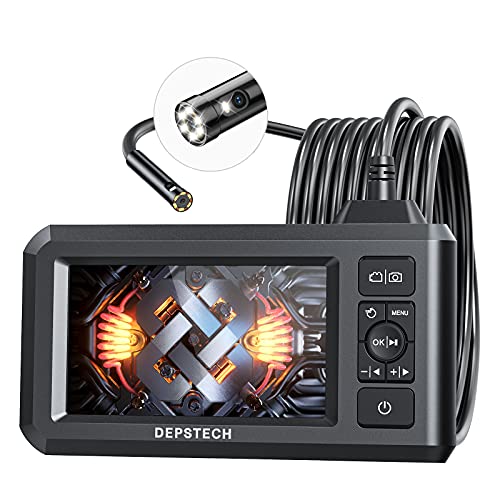
- 1080P HD with dual-lens split-screen viewing
- 4.3-inch IPS display keeps it self-contained
- 16.5ft semi-rigid cable with IP67 waterproofing
Best For: Portable home inspections with a built-in screen
Ground-Level Roof View – Teslong 5FT Telescopic Endoscope
If you want a home inspection camera for roof inspections that lets you work from the ground, this Teslong telescopic endoscope is built for that job. The pole extends from 16 inches to 69 inches, and the flexible gooseneck tip helps you angle the camera around gutters, ceilings, chimneys, and other hard-to-see spots without climbing a ladder.
Best For: Inspectors and homeowners who want a ground-level camera for roofs, gutters, attics, and ceiling checks.
Pros:
- Telescoping pole reaches up to 69 inches for safer ground-level inspections.
- Built-in 4.5-inch IPS screen shows live video without needing a phone.
- 32GB built-in storage keeps photos, 1080P videos, and voice memos on the device.
- IP67 waterproof probe and 8 LED lights help in dark or damp inspection areas.
Cons:
- Video capture is listed at 720p, not true 1080p recording.
- Battery life is about 4 hours, so long jobs may need planning.
This is a practical pick if you want a self-contained inspection tool with a screen, storage, and enough reach to reduce ladder use. It is especially useful when documenting findings for clients or keeping records for later review.
Thermal Scan Helper – HF96 Thermal Camera with AI Detection
For a home inspection camera for roof inspections that focuses on temperature issues, the HF96 thermal camera offers a different approach than a visible-light scope. Its AI scene recognition is designed to identify water leaks and insulation gaps, while the thermal image sensor helps reveal hotspots and cold spots that can matter during building checks.
Best For: Inspectors who want thermal imaging for leak, insulation, HVAC, and building-envelope checks.
Pros:
- AI scene detection helps identify water leaks and insulation gaps faster.
- Live super resolution boosts thermal images to 240×240 clarity.
- Wide -4b0F to 1022b0F range supports many inspection tasks.
- Up to 11 hours of runtime and 4GB storage reduce interruptions.
Cons:
- It does not provide moisture readings.
- Thermal cameras do not replace a visual roof camera for close physical detail.
This model makes sense when the inspection call is about heat loss, moisture-related anomalies, or equipment performance rather than looking directly at roof surfaces. It is a strong companion tool for broader home diagnostic work.
Long Reach Borescope – Teslong Dual Lens Borescope 16.5FT
If your home inspection camera for roof inspections needs reach more than a climbing-friendly screen, this Teslong dual-lens borescope is a flexible option for tight spaces. The 16.5-foot semi-rigid cable and IP67 waterproof probe make it useful for ducts, wall vents, HVAC paths, and other hidden areas where a long probe matters more than a telescoping pole.
Best For: Inspectors who need a long, flexible borescope for wall, vent, HVAC, and hard-to-reach interior spaces.
Pros:
- Dual-lens design gives forward and side views for better coverage.
- 16.5-foot semi-rigid cable helps reach deep or awkward areas.
- 4.3-inch screen provides real-time viewing without app setup.
- IP67 waterproof rating and included hook, magnet, and accessories add versatility.
Cons:
- It uses an SD card that is not included.
- Battery life is up to about 3 hours, which is shorter than some alternatives.
This is a solid inspection tool when the job calls for extra length and dual viewing angles rather than a roof-specific telescoping design. It is especially practical for users who inspect concealed interior routes and want a ready-to-use handheld display.
Steering-Style Inspection – DXZtoz Two-Way Articulating Borescope
When you need a home inspection camera for roof inspections that can turn toward the exact point of interest, this DXZtoz articulating borescope brings steering control to the probe. Its 220b0 two-way articulation and 5.5-foot flexible probe are useful for navigating around obstacles in tight mechanical, HVAC, or wall spaces where a fixed lens is harder to aim.
Best For: Users who need precise probe control for tight, obstacle-filled inspection paths.
Pros:
- 220b0 two-way articulation helps the camera look around bends and obstacles.
- 1080P resolution and a 4.3-inch IPS monitor provide clear live viewing.
- 8 LED lights with adjustable brightness support dark inspections.
- IP67 waterproof, oil-resistant probe with included accessories adds versatility.
Cons:
- The probe is 5.5 feet, so it is less reach-focused than longer borescopes.
- Best suited to close-up work rather than broad roof scanning from the ground.
This model stands out when directional control matters more than cable length. It is a good fit for detailed inspections where you need to actively steer the camera into position and review fine features on the display.
Dual-Lens Pipe View – Teslong 50FT Sewer Camera
If you need a home inspection camera for roof inspections that also handles drains and wall voids, this Teslong model is built around long reach and split-screen visibility. The 50FT semi-rigid cable is better suited to straight runs, and the dual cameras let you check forward and inspect nearby surfaces at the same time on the 4.3″ display.
Best For: Inspectors and homeowners who want a long-reach camera for straight pipes, wall cavities, and general utility checks.
Pros:
- 50FT semi-rigid cable reaches deep into straight pipes and confined spaces.
- Dual lenses with split-screen show forward view and pipe walls simultaneously.
- 4.3″ IPS screen tilts and rotates 180° for easier viewing in tight positions.
- Rechargeable 3000mAh battery supports all-day inspections.
Cons:
- Semi-rigid cable has limited flexibility through tight 90° elbows and P-traps.
- Murky water can reduce visibility, so cleaner lines work best.
- TF card is sold separately if you want onboard recording.
This is a practical pick when reach matters more than advanced articulation. For straightforward inspection work, the dual-view setup and simple standalone screen make it easy to use without app setup or wireless pairing.
Articulating Reach – Teslong 210° Borescope
For buyers comparing a home inspection camera for roof inspections, this Teslong stands out for its two-way articulation and compact handheld design. The 5FT semi-rigid gooseneck helps you steer through tight spaces while the 4.5″ IPS screen shows a clear live view without needing an app.
Best For: Users who need precise probe control in cramped areas and prefer a compact screen-based borescope.
Pros:
- Two-way 210° articulating probe makes it easier to direct the camera.
- 4.5″ IPS screen delivers clear viewing in bright or dim conditions.
- 5FT semi-rigid gooseneck balances flexibility and shape retention.
- Includes 32GB storage and a carrying case for convenient use on the go.
Cons:
- 5FT cable is shorter than long-reach sewer-style models.
- Better suited to close-range inspection work than deep runs.
- Not a smart-home or app-connected tool.
This model makes sense when control matters more than distance. The articulating head and compact body are useful for navigating awkward inspection points where a fixed camera would be harder to position.
Triple-Lens Overview – DEPSTECH 50FT Inspection Camera
If you’re shopping for a home inspection camera for roof inspections, this DEPSTECH model offers a long 50FT cable and a triple-lens layout that helps you switch between views without changing tools. The 5″ IPS screen gives you a larger viewing area, and the included storage makes it ready for photo and video capture right away.
Best For: Inspectors who want a long cable, larger screen, and multiple viewing angles in one tool.
Pros:
- 50FT semi-rigid cable reaches deep into drains, walls, ceilings, and other voids.
- Triple-lens system lets you switch between front and side views.
- 5″ IPS screen is larger and easier to read during detailed checks.
- Includes a 32GB memory card and a carrying case for portability.
Cons:
- Semi-rigid cable may need extra help in more complex routing.
- Best visibility still depends on cleaner, less murky inspection areas.
- It is more inspection-focused than a multi-purpose articulating borescope.
As a long-reach inspection camera, this DEPSTECH is strongest when you want broad access and easy view switching. The combination of triple lenses, a bigger screen, and included storage makes it a straightforward choice for routine inspection work.
Compact Dual-Lens Pick – 16.4ft HD Borescope
If you need a home inspection camera for roof inspections that’s easy to carry and quick to connect, this 16.4ft borescope is a practical compact option. Its dual lenses, 1920P still resolution, and adjustable LED lighting help you check tight roof spaces, attic edges, and other hard-to-reach areas without a bulky setup.
Best For: Homeowners and DIYers who want a lightweight, phone-based inspection camera for occasional roof and interior checks.
Pros:
- 1920P HD still resolution with a 2.0MP camera for clear close-range inspection
- Compatible with iOS 9.0+ and Android 7+ via included connectors
- 16.4ft semi-rigid cable offers a balance of flexibility and shape retention
- IP67 waterproof probe and adjustable LED brightness for darker areas
Cons:
- Uses a phone app instead of a built-in screen
- Some Android devices may show slightly less clarity than iOS
- Shorter cable than dedicated long-run inspection models
This is a sensible entry-level choice if you value portability and simplicity over maximum reach. It fits routine roof-adjacent inspections where a slim probe and dependable lighting matter more than advanced viewing features.
Most Versatile Screen Model – 50FT Triple-Lens Inspector
For a home inspection camera for roof inspections where reach and visibility matter, this 50ft model stands out. The long semi-rigid cable, triple-lens design, and 5-inch IPS screen make it easier to inspect roof-related spaces, wall cavities, ductwork, and other areas where you want real-time viewing without using a phone.
Best For: Users who want a long-cable inspection camera with a built-in screen for broader home and roof-related checks.
Pros:
- 50ft semi-rigid cable gives strong reach for larger inspection jobs
- Triple lenses with split-screen viewing and multiple modes
- 5-inch IPS screen provides a large live view for navigation
- IP67 waterproof build and included carrying case add practicality
Cons:
- Bulkier and heavier than phone-connected borescopes
- Best suited to users who want a dedicated handheld screen
- More than many casual homeowners need for quick spot checks
This model is the strongest pick when you want maximum reach and a straightforward, standalone workflow. It makes sense for more involved inspections where viewing comfort and cable length are top priorities.
Balanced All-Rounder – 4.3in Dual-Lens Borescope
If you want a home inspection camera for roof inspections that balances portability, clarity, and ease of use, this DEPSTECH model is a solid middle-ground choice. The 4.3-inch IPS screen, dual-lens viewing, and 16.5ft semi-rigid cable make it useful for roof-adjacent spaces, chimneys, HVAC runs, and other narrow inspection paths.
Best For: Home inspectors and DIY users who want a compact standalone camera with dependable image quality.
Pros:
- 1080P HD video and 2.0MP stills for crisp inspection views
- Dual lenses with split-screen and a wider 70° field of view
- 4.3-inch IPS display keeps the setup self-contained
- IP67 waterproof and 4-hour battery life support practical field use
Cons:
- Smaller screen than 5-inch alternatives
- No TF card included according to the notes
- 16.5ft cable is useful, but not as far-reaching as 50ft models
Overall, this is the best fit if you want a reliable inspection tool without stepping up to a larger, heavier system. It offers a good mix of portability and viewing convenience for common home inspection tasks.
How We Picked the Best Home Inspection Camera for Roof Inspections
We prioritized tools that make roof checks easier from the ground, attic, or tight access points. That means a practical balance of reach, viewing clarity, lighting, maneuverability, and ruggedness. We also favored models that are simple to set up and reliable in real-world inspection work.
For a Home Inspection Camera for Roof Inspections, the most useful features are a stable screen, enough cable or pole length for reach, adjustable LEDs, waterproofing, and a probe that can handle angles around soffits, vents, flashing, and penetrations.
Quick Comparison: Which Type Fits Your Use?
Long cable borescopes are best for deeper access into attic spaces, wall voids, and roof-adjacent cavities. Telescoping pole cameras are better when you want fast exterior checks from the ground. Thermal cameras are useful for finding moisture patterns, insulation gaps, and heat anomalies that a standard visual camera may miss.
If you need one tool for broad property inspections, a dual-lens or articulating model offers the best flexibility. If you mostly inspect drainage, vents, or longer runs, a 50-foot camera may be the smarter choice.
Key Buying Factors for Home Inspection Camera for Roof Inspections
Reach and Probe Control
Choose a length that matches your access points. Shorter probes are easier to manage in attic spaces, while longer cables help when you need to reach farther into hard-to-access roof areas. Articulating heads are especially helpful when you need to look around corners.
Image Quality and Display
Higher-resolution imaging improves your ability to identify cracked sealant, debris buildup, water staining, and surface defects. A bright IPS screen also helps outdoors and in dim attic conditions.
Lighting and Visibility
Adjustable LED lighting is essential. Roof voids and attic spaces are often dark, and too much or too little light can hide details. Look for models that let you fine-tune brightness.
Durability and Water Resistance
Roof work can involve dust, moisture, and rough handling. A waterproof or weather-resistant probe is a major plus, especially if you inspect around gutters, drains, or exterior penetrations.
Special Features Worth Considering
Split-screen views, dual lenses, thermal imaging, and storage support can improve workflow. For contractors and inspectors, those extras can save time and make documentation easier.
Who Should Buy Which Home Inspection Camera for Roof Inspections?
Buy a telescoping pole camera if you want quick, ground-level roof checks with minimal setup. Choose an articulating borescope if you need precision around tight corners and irregular spaces. Pick a long-cable inspection camera if you routinely inspect attics, vents, or concealed channels.
If your work includes moisture diagnostics or energy-loss checks, a thermal model is the best specialty option. For most buyers, the best Home Inspection Camera for Roof Inspections is the one that matches your access style, typical inspection depth, and reporting needs—not just the one with the highest resolution on paper.