Finding the right inspection tool can make engine diagnostics faster, cleaner, and far less frustrating. If you need to see into tight spaces around belts, valves, ports, and wiring, a good camera can save time and guesswork.
This roundup of the best infrared inspection camera for car engines options focuses on image quality, probe control, cable reach, and durability so you can choose with confidence.
Best 10 Infrared Inspection Camera for Car Engines Picks for 2026
Precision Access
FOXWELL Y400 Two-Way Articulating Borescope

- 6.2mm ultra-slim probe for narrow engine openings
- 220° two-way articulation with thumb-wheel control
- HD IPS screen with zoom and adjustable LEDs
Best For: Mechanics who need precise access into tight engine spaces
Simple Viewer
Teslong 4.3'' Screen Borescope with 16.5FT Cable

- 8 LED lights and a 4.3-inch screen
- 16.5FT semi-rigid cable for reach and positioning
- Includes hook, magnet, side mirror, and 32GB card
Best For: DIYers and mechanics wanting an easy, no-fuss inspection camera
Dual-View Utility
5" 1080P Dual-Lens Inspection Borescope

- Dual-lens camera switches front and side views
- 1080P display with 170° wide-angle viewing
- 16.4FT waterproof semi-rigid probe with 8 LEDs
Best For: Inspectors who want side-view flexibility in tight mechanical spaces
Articulating Control
Teslong 4.5" IPS Articulating Borescope

- Two-way 210° articulation for precise steering
- 4.5-inch IPS screen with clear real-time viewing
- 8 LEDs and one-handed joystick control
Best For: Technicians who need accurate steering in confined engine spaces
Ultra-Slim Dual-Lens Choice
Patented Dual Lens Articulating Borescope with Light

- 0.25-inch probe reaches tight engine spaces
- Dual-lens view helps reduce blind spots
- 5-inch 1080P display with 10X zoom
Best For: Tight automotive inspections where flexibility and close access matter
Long-Reach Dual-Lens Pick
Teslong Dual Lens Borescope with Light

- 16.5-foot semi-rigid cable for extended reach
- Dual lenses and 8 LEDs help in dark areas
- Includes 32GB card and 24-month warranty
Best For: Longer-reach inspections in automotive and shop environments
High-Maneuverability Articulating Pick
Two-Way Articulating Borescope with Light

- 220° two-way articulation improves steering
- 8 LEDs with 4 brightness levels
- 1080P IPS screen with included accessories
Best For: Close-up engine inspections where steering around obstacles is essential
Quick Everyday Pick
4.3" LCD Snake Camera for Engine Checks

- 1080P live viewing on a 4.3-inch LCD
- 8 adjustable LED lights for dark spaces
- 8mm probe fits spark plug holes
Best For: Simple, phone-free engine inspections and general DIY checks
Ultra-Slim Access Pick
3.9mm Endoscope for Tight Engine Spaces

- Ultra-slim 3.9mm probe for narrow gaps
- 1920P HD viewing on a 4.3-inch IPS screen
- IP67 waterproof with 6 LED lights
Best For: Very tight engine access points and compact inspection spaces
Most Versatile Pick
Dual-Lens 1080P Borescope with Long Cable
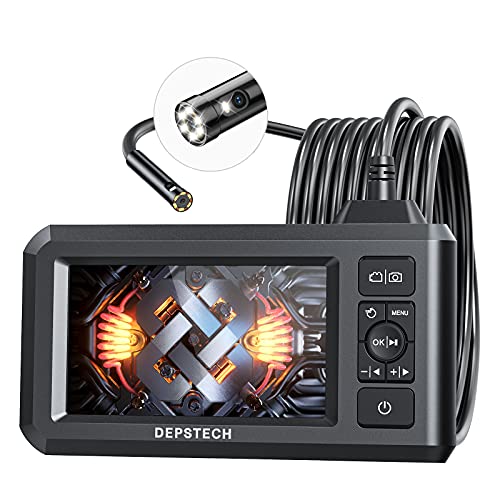
- Dual-lens design with split-screen viewing
- 16.5-foot semi-rigid cable for deep reach
- 1080P HD on a 4.3-inch IPS display
Best For: Multi-angle inspections that need long reach and flexible viewing
Precision Access – FOXWELL Y400 Two-Way Articulating Borescope
If you need an infrared inspection camera for car engines in a practical sense—meaning a tool that can see deep into tight, dark mechanical spaces—the FOXWELL Y400 is built for reach and control. Its ultra-slim 6.2mm probe and 220° two-way articulation make it easier to inspect spark plug holes, valve areas, cylinder walls, and other cramped engine zones without tearing anything apart first.
Best For: Mechanics and technicians who want a slim, easy-to-steer borescope for engine diagnostics and other tight-access inspections.
Pros:
- 6.2mm ultra-slim probe fits spark plug holes and other narrow openings.
- 220° two-way articulation with thumb-wheel control for precise steering.
- HD IPS screen, 4X zoom, and 6 LEDs with 3 brightness levels for dark areas.
- IP67 probe and overheat protection add durability for jobsite use.
Cons:
- More specialized than a basic fixed-probe inspection camera.
- 5-7 hour runtime is good, but not unlimited for all-day heavy use.
The Y400 stands out when the job demands accurate viewing in cramped engine spaces rather than broad-area scanning. If steering precision and slim access matter most, this is a strong diagnostic pick.
Simple Viewer – Teslong 4.3'' Screen Borescope with 16.5FT Cable
For buyers comparing an infrared inspection camera for car engines, this Teslong model is a straightforward screen-based borescope that emphasizes simple operation and steady illumination. The 8 LED lights, 0.32-inch probe, and 16.5-foot semi-rigid cable make it useful for getting visual access into automotive spaces, vents, pipes, and other hard-to-reach areas.
Best For: DIY users and mechanics who want a plug-and-play inspection camera with a long cable and easy viewing screen.
Pros:
- 8 adjustable LED lights help brighten dark inspection areas.
- 16.5FT semi-rigid cable holds shape for controlled positioning.
- 4.3-inch screen is ready to use with no setup required.
- Includes hook, magnet, side mirror, and 32GB TF card.
Cons:
- 3-hour battery life is shorter than some larger-powered competitors.
- 1.0MP HD is more modest than higher-resolution inspection cameras.
This model is best when convenience matters more than advanced diagnostics. It offers a practical balance of visibility, cable reach, and included accessories for general automotive inspection work.
Dual-View Utility – 5" 1080P Dual-Lens Inspection Borescope
If you’re shopping for an infrared inspection camera for car engines and want broader visibility inside tight areas, this dual-lens borescope offers a practical alternative. The front and side views switch instantly, while the 1080P screen, 8 LEDs, and 1.2-4 inch focus range help reveal detail in automotive, plumbing, and HVAC inspections.
Best For: Users who want a dual-view inspection camera for close-up engine checks and general industrial use.
Pros:
- Dual-lens design switches between front and side views.
- 1080P output with a 170° wide-angle view for clearer framing.
- 16.4FT semi-rigid probe is waterproof and shape-holding.
- Eight adjustable LEDs support work in dark or wet spaces.
Cons:
- Cannot take pictures or videos, which limits record-keeping.
- Focus range is narrow, so it’s best kept close to the target.
This is a strong fit for buyers who value live viewing and side-angle inspection more than documentation features. The dual-lens setup makes it especially useful when you need to inspect around obstacles rather than straight ahead only.
Articulating Control – Teslong 4.5" IPS Articulating Borescope
For a more controlled infrared inspection camera for car engines-style workflow, this Teslong articulating borescope is designed to make tight mechanical inspections easier to manage. The two-way 210° probe, 4.5-inch IPS screen, and built-in LEDs help you position the view precisely in automotive, HVAC, and wall inspection tasks.
Best For: Mechanics and technicians who want one-handed articulating control for detailed engine and confined-space inspections.
Pros:
- Two-way 210° articulation improves maneuverability in tight spaces.
- 4.5-inch IPS screen provides sharp, easy-to-read visuals.
- 8 LED lights support dark-area inspections.
- Compact design and centrally placed joystick aid one-handed use.
Cons:
- 5FT gooseneck is shorter than some cable-heavy alternatives.
- Not the best choice if you need a very long reach for deep runs.
This model focuses on precision, comfort, and control rather than maximum cable length. It’s a solid option when the key challenge is guiding the camera exactly where you want it inside an engine or other confined area.
Ultra-Slim Dual-Lens Choice – Patented Dual Lens Articulating Borescope with Light
If you want an infrared inspection camera for car engines alternative that can still get deep into tight automotive spaces, this DXZtoz borescope is built for close-up mechanical checks. Its 0.25-inch ultra-thin probe, dual-lens view, and two-way articulation make it practical for spotting head gasket issues, piston ring wear, valve sealing problems, injector faults, and other hidden engine damage.
Best For: Mechanics and DIY users who need a slim, highly flexible inspection camera for tight engine access and detailed internal checks.
Pros:
- 0.25-inch probe and 2-way articulation help reach tight engine areas
- Dual-lens design reduces blind spots with a 90° side camera
- 5-inch 1080P display and 10X zoom make details easier to inspect
- Includes photo/video capture, 32GB card, hooks, magnet, and case
Cons:
- Uses a wired screen-based design rather than a phone app
- 5-foot cable is shorter than some longer shop scopes
- Best suited to inspection work, not general imaging tasks
This model stands out when maneuverability matters more than range. The front-exit cable design and thumb-stick articulation should make it easier to work upward and forward in crowded engine bays.
Long-Reach Dual-Lens Pick – Teslong Dual Lens Borescope with Light
For buyers comparing an infrared inspection camera for car engines, this Teslong model offers a practical long-reach borescope setup for seeing into difficult automotive spaces. The dual-lens design, 16.5-foot semi-rigid cable, and adjustable LED lighting help you inspect hard-to-reach areas without setup hassle.
Best For: Mechanics and DIYers who want a longer cable and simple, ready-to-use inspection camera for engine and general repair work.
Pros:
- Dual lenses plus 8 adjustable LEDs improve visibility in dark spaces
- 16.5-foot semi-rigid cable offers strong reach and shape retention
- IP67 waterproof build suits automotive, plumbing, and HVAC use
- Includes 32GB card, hook, magnet, and a 24-month warranty
Cons:
- 4.3-inch display is smaller than some competing inspection cameras
- 720p video capture is lower than the listed 1080p class options
- Probe size and long cable may be less nimble in very cramped engine bays
This is a strong choice if reach and ease of use are your priorities. It is designed to power on quickly and handle routine inspections with minimal fuss.
High-Maneuverability Articulating Pick – Two-Way Articulating Borescope with Light
If you need an infrared inspection camera for car engines alternative that can physically steer around obstructions, this DXZtoz articulating borescope is aimed at detailed internal engine checks. Its 220° two-way articulation, 8.5mm probe, and 1-15cm focal range help you inspect cylinders, valves, spark plugs, and other cramped mechanical areas with less guesswork.
Best For: Mechanics who need precise camera steering for close-up engine and equipment inspections in tight spaces.
Pros:
- 220° two-way articulation helps navigate around obstacles
- 8.5mm probe with 8 LEDs and 4 brightness levels improves visibility
- 4.3-inch IPS screen shows true-color 1080P inspection footage
- Includes hook, magnet, side mirror, carrying case, and 32GB card
Cons:
- 4.3-inch screen is smaller than some premium inspection displays
- 5.5-foot cable may be limiting for deeper access needs
- Designed for close viewing, so it is less suited to broader-area inspection
This model is especially useful when you need to look back or steer around internal components. The articulation and included accessories make it a practical shop tool for fast diagnosis.
Quick Everyday Pick – 4.3" LCD Snake Camera for Engine Checks
If you want an infrared inspection camera for car engines that is simple to use right out of the box, this Daxiongmao borescope keeps the workflow straightforward. The 4.3-inch screen shows live 1080P HD viewing without needing a phone app, and the 8mm probe can fit through a spark plug hole for basic combustion chamber inspection.
Best For: Drivers and DIY users who want a plug-and-play engine inspection camera for quick under-hood checks.
Pros:
- 4.3-inch LCD lets you inspect in real time without using a smartphone
- 8 adjustable LED lights help in dark engine bays and other low-light areas
- 8mm probe can pass through spark plug holes for combustion chamber viewing
- IP67 waterproof rating supports wet or dirty inspection jobs
Cons:
- Cannot take pictures or videos
- Thicker 8mm probe is not as slim as some smaller-diameter options
Overall, this is a practical, no-fuss inspection tool for routine car maintenance and general home or workshop use. It focuses on fast live viewing and useful lighting rather than advanced capture features.
Ultra-Slim Access Pick – 3.9mm Endoscope for Tight Engine Spaces
For a more compact infrared inspection camera for car engines, this NIDAGE borescope stands out for its ultra-slim 3.9mm probe. That smaller tip is designed to reach tight, narrow spaces where a standard probe may struggle, while the 4.3-inch IPS screen gives you immediate 1920P HD viewing without connecting to a phone.
Best For: Mechanics and DIY users who need a very small probe for narrow engine and equipment access points.
Pros:
- 3.9mm probe is much slimmer than typical 8mm endoscopes
- 1920P HD display on a 4.3-inch IPS screen supports clear live inspection
- 5-foot semi-rigid cable balances flexibility and shape retention
- IP67 waterproof design and 6 adjustable LED lights help in dim or damp areas
Cons:
- Cannot take pictures or videos
- 5-foot cable is shorter than some industrial borescopes
This model is best when access matters more than cable length. If your car engine inspection involves very tight gaps or small openings, the slim probe is the key advantage here.
Most Versatile Pick – Dual-Lens 1080P Borescope with Long Cable
If you need an infrared inspection camera for car engines that can do more than a basic front view, this DEPSTECH borescope offers the most flexibility. Its dual-lens design lets you switch between viewing angles, and the 16.5-foot semi-rigid cable gives you plenty of reach for automotive, HVAC, plumbing, and other inspection jobs.
Best For: Users who want a long-reach borescope with front and side viewing options for broader inspection work.
Pros:
- Dual-lens system with split-screen viewing and three observation modes
- 4.3-inch IPS screen with 1080P HD video and 2.0 MP still image support
- 16.5-foot semi-rigid cable reaches deep into larger inspection areas
- 7 adjustable LED lights and IP67 waterproof rating support low-light work
Cons:
- No TF card included
- Bulkier long cable may be more than you need for quick basic checks
For buyers who want the most adaptable inspection tool in this group, this model is the strongest all-around option. The dual-lens setup and long cable make it especially useful when one angle is not enough.
How We Picked the Best Infrared Inspection Camera for Car Engines
We looked for inspection cameras that are practical for engine work, not just general-purpose gadgets. The strongest picks combine a clear screen, usable lighting, a probe slim enough for tight bays, and enough cable length to reach deeper engine areas. Articulation matters too, since it helps you aim around manifolds, timing covers, and hard-to-see sensor locations.
We also favored models with durable construction and waterproof or oil-resistant designs, since real-world automotive use often means grime, heat, and repeated handling.
Quick Comparison
In this category, the main trade-offs are screen size versus portability, image resolution versus flexibility, and probe diameter versus maneuverability. Dual-lens models are useful when you want both forward and side viewing, while articulating models give you more control in compact engine compartments.
For an Infrared Inspection Camera for Car Engines, the best choice is usually the one that balances visibility and access. A sharper display helps you spot wear or damage, but a slimmer probe and longer cable often matter just as much during actual diagnostics.
Key Buying Factors for an Infrared Inspection Camera for Car Engines
Image Quality and Screen Clarity
Look for at least 1080P-class resolution or a crisp HD display. Better image quality makes it easier to identify cracked hoses, buildup, leaks, corrosion, and damaged connectors.
Probe Size and Flexibility
A slimmer probe can fit where larger tools cannot. If you frequently inspect valve trains, cylinder bores, or narrow passages, articulation and a small diameter are especially valuable.
Cable Length and Handling
Longer cables are helpful in full-size engine bays and under-dash work, but they should still feel manageable. Semi-rigid cables offer a good mix of control and reach.
Lighting and View Modes
Adjustable LEDs help with dark engine compartments. Dual-lens designs can reduce repositioning, while side-view support can be useful when inspecting inside housings or around bends.
Durability for Garage Use
Waterproofing, rugged housings, and reliable button controls matter more than flashy extras. A dependable tool should handle repeated use around oil, dust, and cleaning.
Who Should Buy Which Infrared Inspection Camera for Car Engines?
DIY car owners usually want a simple, easy-to-read model with a straightforward screen and enough reach for common engine checks. Mobile mechanics and shop users may benefit more from articulating probes and higher resolution for quicker fault isolation. If you work on compact engines or need to inspect deep, angled, or obstructed spaces, prioritize a slim probe with strong articulation. For broader diagnostic flexibility, dual-lens cameras are often the most versatile choice.
In short, choose the tool that fits your most common inspection task first. The best Infrared Inspection Camera for Car Engines is the one that gives you clear visibility exactly where you need it, without slowing down the job.