Finding roof leaks and hidden heat loss is easier when you can see what the eye cannot. An infrared inspection camera for roof problems helps spot missing insulation, moisture intrusion, and temperature anomalies before small issues become expensive repairs.
Below, we focus on practical handheld thermal cameras that balance resolution, temperature range, battery life, and usability for roof inspections, whether you are a homeowner, contractor, or property inspector.
Best 10 Infrared Inspection Camera for Roof Problems Picks for 2026
Field-Ready Thermal Detail
TOPDON TC004 3.5" Thermal Imaging Camera

- 3.5-inch display for easier thermal review
- TISR-enhanced 256×192 IR up to 512×384
- 64GB storage plus Wi-Fi reporting support
Best For: Inspectors who want a larger screen and stronger image detail
Classic Rugged IR Picker
FLIR TG165-X Thermal Imaging Camera

- MSX improves image readability with visual detail
- Bullseye laser helps target the measurement area
- IP54 rugged design for jobsite conditions
Best For: Users who want a simple, durable camera for quick checks
Pocket Thermal Scout
TOPDON TC004 Mini Thermal Imaging Camera

- Pocket-friendly design for easy carry
- 15-hour battery life for longer inspections
- High/low alerts with auto photo capture
Best For: DIY users and technicians who want portable thermal checks
Lightweight Dual-Mode Scanner

- Thermal imaging plus thermometer mode
- Ultra-light 240g body for easier handling
- 14-hour battery life with custom alarms
Best For: Users who want lightweight dual-mode inspection
Professional Thermal Detail
FOXWELL RT280 Thermal Imaging Camera, 320 x 240 LCD

- 320 x 240 LCD with TISR-enhanced effective resolution
- 25Hz refresh rate with 50° x 38° field of view
- Windows PC analysis with reports, 2D/3D views
Best For: Users who want clearer thermal detail and PC reporting for inspections
Reliable Mid-Range Inspector
MILESEEY TR10 Thermal Imaging Camera, 192 x 192 Super Resolution

- 192 x 192 super resolution with 25Hz refresh
- NETD <50mK and ±2°C accuracy for detection
- 8-hour battery life with 6.6ft drop protection
Best For: Routine inspection work that benefits from rugged build and long runtime
Compact All-Rounder
240x240 Thermal Camera with Temperature Alarm

- 240x240 super-resolution imaging
- 25Hz refresh rate and 50° FOV
- Temp alarm with max/min/center readings
Best For: Portable roof and home inspection use
Scene Detection Pick
Dual-Camera Thermal Imager with IntellFault
- Thermal, visual, and fusion image modes
- IntellFault helps spot leaks and insulation gaps
- Laser pointer and tripod support
Best For: Guided roof inspections with extra image context
Pro Documentation Choice
320x240 Super Resolution Thermal Imager

- 320x240 super-resolution clarity
- 32GB storage with Windows PC software
- Dual camera with 4 image modes
Best For: Detailed roof inspections and reporting
Field-Ready Thermal Detail – TOPDON TC004 3.5" Thermal Imaging Camera
If you want an infrared inspection camera for roof problems that gives you room to see more at a glance, the TOPDON TC004 is built around a larger 3.5-inch display and sharper thermal imaging. Its TISR-enhanced resolution helps reveal hot spots and temperature differences more clearly, which is useful when you’re trying to trace leaks, insulation gaps, or other roof-related anomalies.
Best For: Contractors and inspectors who want a larger screen, stronger image detail, and built-in reporting support for field work.
Pros:
- 3.5-inch display makes thermal patterns easier to review during inspections.
- 256×192 IR with TISR up to 512×384 helps capture finer temperature variations.
- Wi-Fi and PC analysis support faster file transfer and report creation.
- 64GB storage lets you save thousands of images and videos without stopping.
Cons:
- Larger body may be less pocket-friendly than mini thermal cameras.
- Feature set may be more than needed for occasional users.
- Designed for field use, but still requires learning the app and reporting workflow.
For roof inspections where clarity and documentation matter, this model stands out for its bigger display, stronger thermal detail, and rugged build. It’s a practical choice if you want to inspect, record, and report from the same tool.
Classic Rugged IR Picker – FLIR TG165-X Thermal Imaging Camera
The FLIR TG165-X is a straightforward infrared inspection camera for roof problems when you want fast temperature checks and easy-to-read thermal images. Its bullseye laser helps define the measurement area, while MSX overlays visual detail to make the picture easier to interpret during building inspections.
Best For: Users who want a rugged, simple thermal camera for quick roof, HVAC, and building checks.
Pros:
- MSX technology adds visual detail to thermal images for clearer interpretation.
- Bullseye laser indicates the measurement area for faster targeting.
- IP54 enclosure and drop-tested design suit rough jobsite use.
- Measures from -25°C to 300°C for a broad range of inspection tasks.
Cons:
- 80×60 IR resolution is lower than some newer thermal cameras.
- Best suited to spot checks rather than highly detailed imaging.
- Less advanced for reporting workflows compared with Wi-Fi-connected models.
If you value durability and quick usability over high-resolution imaging, this FLIR is a reliable inspection tool. It’s especially practical for users who want a tough, proven camera for fast thermal checks on roofs and around the building envelope.
Pocket Thermal Scout – TOPDON TC004 Mini Thermal Imaging Camera
For buyers looking for an infrared inspection camera for roof problems in a compact form, the TOPDON TC004 Mini keeps things portable without giving up useful inspection features. It starts with 128×128 thermal imaging and uses TISR to enhance clarity, while smart alerts and automatic photo capture can help you document temperature issues as you move across a roof or around the house.
Best For: DIY users and technicians who want a pocket-sized thermal camera with alerting and long battery life.
Pros:
- Compact, pocket-friendly design makes it easy to carry on inspections.
- 15-hour battery life supports longer work sessions with fewer charges.
- High/low temperature alerts and auto photo capture help streamline diagnostics.
- 128×128 IR enhanced to 240×240 TISR improves thermal clarity.
Cons:
- Smaller size and lower base resolution may not match larger pro-level cameras.
- 512MB storage is limited compared with models offering much more onboard memory.
- No charging head included, so you’ll need your own power adapter.
This is a strong pick if you want a portable thermal imager that balances runtime, storage, and smart alert features. It’s especially handy when you need a lightweight tool for frequent checks and quick documentation.
Lightweight Dual-Mode Scanner – GT14S Thermal Imaging Camera
The GT14S is a lightweight infrared inspection camera for roof problems and other temperature-tracking jobs when you want both thermal imaging and thermometer mode in one tool. Its live thermal view, adjustable alarms, and edge-enhanced display help you spot temperature changes quickly, while the wide temperature range makes it useful across home, HVAC, and maintenance tasks.
Best For: Users who want a light camera with dual-mode inspection and all-day runtime.
Pros:
- Dual mode combines thermal imaging and thermometer readings for flexible checks.
- Very light 240g design is easier to hold during long inspections.
- 14-hour battery life supports extended use without frequent charging.
- Custom high/low alarms and a 50° field of view help speed up scanning.
Cons:
- Designed more for general inspection than advanced reporting workflows.
- Users who only need image capture may not use the thermometer mode often.
- Accuracy and emissivity settings may require some setup for best results.
Overall, the GT14S is a versatile everyday thermal tool for users who want lightweight handling and multiple ways to inspect temperature issues. It’s a solid fit when you need quick roof scanning plus exact spot readings in the same device.
Professional Thermal Detail – FOXWELL RT280 Thermal Imaging Camera, 320 x 240 LCD
If you need an infrared inspection camera for roof problems, the FOXWELL RT280 is built for clear thermal spotting and practical field use. Its 320 x 240 display, TISR-enhanced effective resolution, 25Hz refresh rate, and 50° x 38° field of view help you track subtle temperature differences when checking insulation gaps, leaks, and other problem areas.
Best For: Home inspectors, HVAC techs, and DIY users who want detailed thermal readings plus PC-based analysis.
Pros:
- 320 x 240 LCD with TISR-enhanced effective resolution for clearer thermal detail.
- 25Hz refresh rate and wide 50° x 38° FOV for smoother scanning.
- PC software supports point, line, area analysis, 2D/3D views, and report generation.
- 8GB storage, laser pointer, LED light, and 9 color palettes improve day-to-day use.
Cons:
- Windows-only PC analysis; not compatible with Mac.
- Best suited to inspection workflows rather than advanced laboratory imaging.
Overall, the RT280 offers a balanced mix of image clarity, measurement tools, and documentation features. For roof problem inspections where you want more than just a basic heat map, it provides enough detail to help identify hot spots and irregular temperature patterns efficiently.
Reliable Mid-Range Inspector – MILESEEY TR10 Thermal Imaging Camera, 192 x 192 Super Resolution
The MILESEEY TR10 is a practical infrared inspection camera for roof problems when you want dependable thermal readings without a lot of complexity. Its 192 x 192 super resolution, 25Hz refresh rate, and high thermal sensitivity make it well suited for spotting hot spots and temperature anomalies during building checks.
Best For: Users who want a durable thermal camera with long battery life for routine inspections.
Pros:
- 192 x 192 super resolution with 25Hz refresh rate for smooth viewing.
- NETD <50mK and ±2°C accuracy help improve temperature detection.
- High/low temperature alarms automatically flag anomalies.
- 8-hour battery life, 8GB storage, and 6.6ft drop protection support field work.
Cons:
- Resolution is lower than higher-end options in this group.
- No advanced PC analysis features are highlighted in the supplied notes.
For general roof and building inspections, the TR10 focuses on durability, readable thermal output, and straightforward anomaly detection. It is a solid choice if you value battery endurance and rugged handling more than extra software tools.
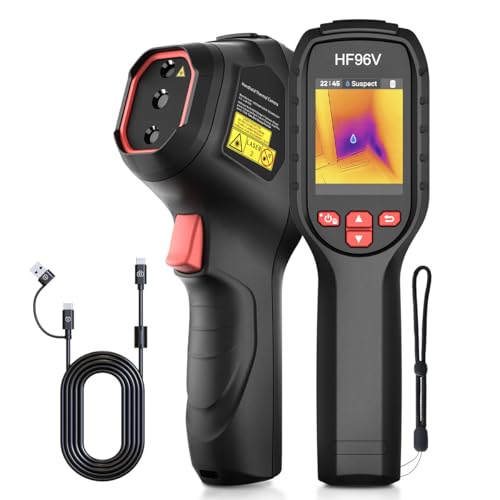
Smart Scene Detection Pick – HF96 Thermal Camera with AI Scene Detection, 240 x 240 Super Resolution
If your priority is an infrared inspection camera for roof problems with smarter guidance, the HF96 stands out for its AI scene recognition and live super resolution. It is designed to help locate water leaks and insulation gaps faster, while still offering the temperature range, alarms, and imaging tools needed for everyday building inspections.
Best For: Inspectors and homeowners who want AI-assisted leak and insulation detection.
Pros:
- AI scene detection can help identify water leaks and insulation gaps.
- Live super resolution boosts images to 240 x 240 clarity.
- 25Hz refresh rate, 50° field of view, and multiple alarms support efficient scanning.
- 11-hour runtime, 4GB storage, tripod hole, and Windows PC software add convenience.
Cons:
- No moisture readings are included, despite leak-oriented scene detection.
- 4GB storage is smaller than some competing models.
The HF96 is a strong fit when you want a thermal camera that does more of the initial spotting for you. Its AI scene recognition, wide coverage, and long runtime make it especially useful for roof-related troubleshooting and home energy checks.
Compact All-Rounder – 240×240 Thermal Camera with Temperature Alarm
If you want an infrared inspection camera for roof problems that balances clarity, portability, and broad temperature coverage, this handheld model is built for practical scanning. Its 240×240 super-resolution output, 25Hz refresh rate, and 50° field of view help you spot temperature differences while checking for heat loss, moisture-related issues, or other roof anomalies.
Best For: Homeowners and inspectors who want a portable thermal camera for general roof, leak, and HVAC-style troubleshooting.
Pros:
- 240×240 super-resolution imaging helps reveal more detail than basic entry-level thermal cams.
- 25Hz refresh rate supports smooth scanning across large roof sections.
- Temperature alarm plus max/min/center readings help flag abnormal heat sources quickly.
- IP54 resistance and 6.6-foot drop protection add confidence for field use.
Cons:
- It is described as an indoor-use model, so it may be less specialized for harsh outdoor roof work than heavier-duty options.
- No visible-light camera is listed, so context imagery is more limited than dual-camera models.
Overall, this is a straightforward thermal inspection tool for buyers who want better detail than basic imagers without a complicated feature set. It covers the core needs of roof diagnostics well, especially when you want fast anomaly checks and a portable body.
Scene Detection Pick – Dual-Camera Thermal Imager with IntellFault
For an infrared inspection camera for roof problems where you want extra context and automated help, this dual-camera model stands out. It combines thermal and visible views, uses a 50° field of view, and adds IntellFault scene detection that is designed to identify issues like water leaks and insulation gaps more quickly.
Best For: Buyers who want a more guided roof-inspection camera with dual imaging and automated scene recognition.
Pros:
- Dual-camera setup offers thermal, visual, and fusion modes for better scene context.
- IntellFault scene detection is aimed at spotting water leaks and insulation gaps.
- 25Hz refresh rate and 240×240 live super resolution support smoother, clearer viewing.
- Laser pointer, tripod support, and PC software make inspections more convenient.
Cons:
- The base IR camera is listed at 96×96 before super resolution, so raw thermal detail is lower than some higher-native-resolution competitors.
- Using the scene-detection feature requires firmware updates and selecting the Scene setting.
This is a strong choice if you value guided detection and a visible-light reference image when checking roof areas. It is especially appealing for users who want the camera to help highlight likely problem zones instead of relying only on manual scanning.
Pro Documentation Choice – 320×240 Super Resolution Thermal Imager
If you need an infrared inspection camera for roof problems that leans toward detail and documentation, this Firecore model is a solid fit. It offers 320×240 super-resolution clarity, a dual-camera layout, and built-in storage for capturing and reviewing thermal findings during roof, plumbing, or home inspection work.
Best For: Inspectors and serious DIY users who want stronger image detail and easier reporting.
Pros:
- 320×240 super-resolution output gives it the strongest listed clarity in this group.
- Dual-camera design with thermal, visible light, picture-in-picture, and thermal mix modes improves context.
- 32GB built-in storage and Windows PC software support image analysis and report generation.
- Laser, LED light, and smart alerts help with low-light inspections and quick anomaly checks.
Cons:
- PC software is listed as Windows-only and not compatible with Mac.
- Its 40° x 30° field of view is narrower than the 50° options, so wide roof scans may take more passes.
For buyers who care about recording findings and producing clearer inspection documentation, this is the most report-friendly option here. It is especially practical when roof issues need to be captured, reviewed, and shared after the inspection.
How We Picked the Best Infrared Inspection Camera for Roof Problems
We prioritized thermal resolution, refresh rate, temperature range, runtime, and display clarity, along with features that matter in the field such as laser pointers, MSX or visual overlays, and durability. For roof work, we also favored models that can quickly reveal cold spots from moisture or missing insulation without making the workflow complicated.
Quick Comparison
The best choices in this group range from budget-friendly entry models to higher-resolution options with better detail for larger roofs and harder-to-read surfaces. Lower-resolution cameras can still work for basic leak tracing, but higher-resolution units usually make subtle thermal differences easier to interpret.
What Higher Resolution Changes
On an Infrared Inspection Camera for Roof Problems, resolution is one of the biggest factors in how confidently you can identify anomalies. More pixels generally mean sharper edges around damp areas, flashing defects, and insulation voids, especially from a distance.
Key Buying Factors for Infrared Inspection Camera for Roof Problems
Thermal resolution: Choose the highest resolution you can afford if you want cleaner detail on shingles, seams, valleys, and attic transitions.
Temperature range: A wider range helps when you are inspecting roofs in extreme climates or comparing sun-heated surfaces with shaded areas.
Frame rate: A 25 Hz camera feels smoother when panning across a roofline and makes it easier to track changing heat patterns.
Battery life: Long runtime matters if you are scanning an entire home exterior or doing repeated inspections in one day.
Screen and targeting tools: A bright display, spot readings, laser pointer, and scene enhancement features can improve accuracy and speed.
Durability: Roof inspections often involve dust, light weather exposure, and frequent carrying, so a rugged build is a plus.
Who Should Buy Which Infrared Inspection Camera for Roof Problems?
Homeowners: A simpler, lower-cost thermal camera can be enough for spotting obvious leaks or insulation gaps.
Contractors and inspectors: Step up to higher-resolution and better feature sets for more reliable diagnostics and client-facing reports.
Frequent field users: Prioritize battery life, ergonomics, and a clearer screen so the camera stays useful during long inspection days.
If your main goal is identifying roof leaks and heat-loss patterns, focus less on extra app-style features and more on image quality, runtime, and ease of interpretation. Those are the traits that make an Infrared Inspection Camera for Roof Problems genuinely useful in the field.