The best interactive globes turn geography into an engaging, hands-on activity. Kids can explore countries, animals, landmarks, constellations, and more through touch controls, talking features, augmented reality, apps, or educational games.
We compared 10 interactive globes across age range, learning features, display quality, ease of use, and value to help you choose the right fit for home, classroom, or gift giving.
Best 10 Interactive Globes Picks for 2026
Best AR Globe for Young Explorers
Orboot Earth Interactive Globe

- AR app brings facts, games, and global wonders to life
- Includes 1,000+ facts for ages 4–10
- Passport and stickers add imaginative travel play
Best For: Young learners and hands-on STEM exploration
Best Globe with Video Content
LeapFrog Magic Adventures Globe
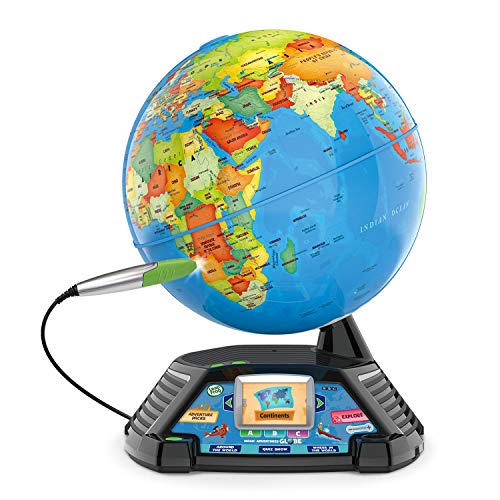
- 2.8-inch screen shows BBC videos and animations
- Stylus activates facts, games, and map content
- Covers cultures, habitats, landmarks, and geography
Best For: Video-loving learners ages 5–12
Best Talking Globe for Trivia Practice
Interactive 9-Inch Talking Globe

- Wireless smart pen delivers spoken location facts
- Covers capitals, languages, climates, and currencies
- Includes 300 trivia questions for ages 8–12
Best For: Audio-based geography practice and classroom use
Best Wildlife-Themed Talking Globe
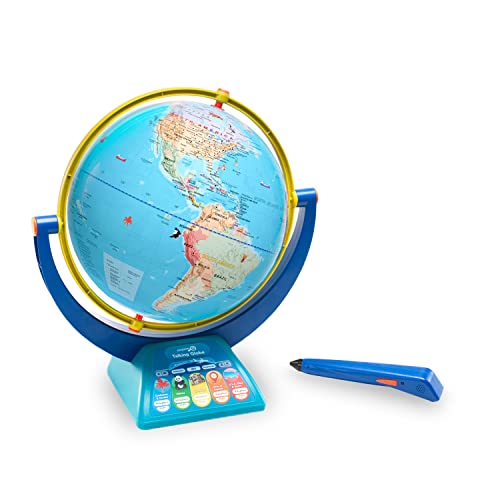
- Bindi Irwin narrates facts and quiz questions
- Offers 1,000+ facts with three play modes
- 12-inch rotating globe suits ages 4–8
Best For: Young wildlife and nature enthusiasts
Best Hands-On Pick

- 48 touch points for interactive discovery
- Three play modes plus world music
- Recommended for ages 3 and up
Best For: Young children beginning geography play
Best Detailed App-Connected Globe

- Educational app supports interactive country content
- LED display features 88 constellations
- Detailed 10-inch political map
Best For: App-supported geography and astronomy learning
Best AR Learning Globe
PlayShifu Orboot Earth Explorer

- AR app includes 400-plus wonders and 1,000-plus facts
- Games, quests, quizzes, and constellation mode
- Recommended for ages 4 and up
Best For: Activity-driven AR geography learning
Best Talking Globe
Replogle Intelliglobe 12-Inch Talking Globe

- Rechargeable pen and narrated discovery book
- Touch features, quizzes, games, and world facts
- 12-inch globe for ages 4-8 and classrooms
Best For: Young learners who prefer guided, audio-based geography activities
Best Hands-On Globe
PlayShifu Orboot Core Interactive Globe

- Three-layer Earth design with glowing core
- 1,000+ facts spanning geography and geology
- Free app with no subscriptions, ads, or Wi-Fi
Best For: Ages 4-10, homeschool, and STEM-focused exploration
Best Illuminated Globe
9-Inch Light-Up Interactive World Globe

- World map and illuminated 88-constellation mode
- Includes geography cards and constellation guide
- Spinning desktop globe doubles as a nightlight
Best For: Compact home, classroom, or décor-friendly geography and astronomy learning
Best AR Globe for Young Explorers – Orboot Earth Interactive Globe
For families seeking interactive globes that combine physical play with digital discovery, the PlayShifu Orboot Earth stands out with augmented-reality activities. Its free app adds more than 1,000 facts, games, quizzes, and cultural highlights for children ages 4–10.
Best For: Young learners, homeschool activities, and hands-on STEM exploration.
Pros:
- Uses augmented reality to explore animals, cultures, places, and monuments.
- Includes more than 1,000 facts plus games, quizzes, and activities.
- Comes with a passport, visa stamp, and flag sticker booklet for imaginative play.
- Supports geography, problem-solving, memory, and early STEM learning.
Cons:
- Requires the free Orboot app for its AR features.
- Designed primarily for children ages 4–10, so older learners may outgrow it.
The 10-inch globe offers a particularly engaging blend of tactile exploration and app-based content. Choose it when AR play and broad early-learning coverage matter more than a built-in screen or traditional talking-pen format.
Best Globe with Video Content – LeapFrog Magic Adventures Globe
Among interactive globes for children ages 5 and up, the LeapFrog Magic Adventures Globe is a strong option for families that want visual media alongside geography practice. A 2.8-inch screen, stylus, games, and BBC videos cover cultures, animals, habitats, and landmarks.
Best For: Children who learn well through videos, guided games, and quiz-based exploration.
Pros:
- Built-in screen displays videos and animations with BBC content.
- Offers thousands of facts across geography, cultures, animals, habitats, and landmarks.
- Includes three interactive games involving races, mysteries, and quiz questions.
- Stylus-based interaction makes exploring the map straightforward.
Cons:
- Requires four AA batteries; included batteries are intended for demonstration purposes.
- Designed for one player at a time.
Its defining advantage is the integrated video screen, which gives the globe a more guided, multimedia feel than a standard talking map. It is a practical pick for ages 5–12 when BBC videos and game-based learning are priorities.
Best Talking Globe for Trivia Practice – Interactive 9-Inch Talking Globe
For shoppers comparing interactive globes with spoken facts, this 9-inch talking globe uses a wireless smart pen to provide real-time audio information. It covers countries, capitals, languages, currencies, populations, climates, and other geography topics for ages 8–12.
Best For: Older elementary students who enjoy audio learning and structured trivia.
Pros:
- Smart pen provides spoken information when children touch locations on the globe.
- Covers a broad range of country and geography facts.
- Includes 300 trivia questions to reinforce learning.
- Compact 9-inch size suits home or classroom use.
Cons:
- Has fewer trivia questions than some competing talking globes in this roundup.
- Its audio-focused design may be less visually immersive than an AR or video globe.
This model keeps the learning experience focused and easy to use: touch a location, listen, and test knowledge with trivia. Its compact format and age range make it a sensible choice for independent practice or classroom activities.
Best Wildlife-Themed Talking Globe – GeoSafari Talking Globe
The Educational Insights GeoSafari Talking Globe is one of the more distinctive interactive globes for younger children, pairing a 12-inch rotating map with narration by Bindi Irwin. Its smart pen delivers more than 1,000 facts and quiz questions about animals, nature, geography, and the world.
Best For: Children ages 4–8 who are especially interested in wildlife and nature.
Pros:
- Bindi Irwin provides the voice content for an engaging wildlife-focused experience.
- Includes more than 1,000 facts and quiz questions.
- Three play modes cover exploring, finding locations, and measuring distances.
- Large 12-inch rotating globe works well for home or classroom learning.
Cons:
- The smart pen requires two AAA batteries, which are not included.
- Its content is aimed at younger children ages 4–8.
With its larger globe, simple play modes, and strong animal and nature emphasis, the GeoSafari is well suited to early geography learning. Pick it when an approachable talking globe and wildlife theme are more important than app-based AR or video.
Best Hands-On Pick – LeapFrog LeapGlobe
The LeapFrog LeapGlobe is a kid-friendly choice for introducing interactive globes to children ages 3 and up. Its touch points, lights, music, and quiz modes make basic geography more active than simply viewing a map.
Best For: Young children who benefit from simple, hands-on geography play.
Pros:
- Includes 48 touch points covering animals, landmarks, languages, and foods.
- Offers Exploration, Music, and Find-It modes for varied play.
- Features rainbow lighting and music inspired by instruments and melodies from different countries.
- Compact 7.6-by-8.3-by-12.2-inch design is sized for tabletop play.
Cons:
- Requires two AA batteries, with the included batteries intended for demonstration only.
- Designed for one player.
This is a straightforward, accessible interactive globe for preschool and early-elementary learners. It prioritizes discovery and replayable activities over detailed map reference.
Best Detailed App-Connected Globe – SJ Smart Globe
The 10-inch SJ Smart Globe combines a detailed political map with an educational app for interactive globe learning. It is a practical option for families who want country content, geographic details, and a constellation display in one STEM-focused model.
Best For: Older children and families seeking app-supported geography and astronomy exploration.
Pros:
- Works with the Click Word Atlas app on iPad, iPhone, and Android phones.
- Displays 88 constellations, zodiac signs, and the Milky Way with LED illumination.
- Map includes mountain ranges, ocean currents, deserts, lakes, state capitals, and major cities.
- Full-swing meridian allows rotation left, right, up, and down.
Cons:
- Interactive app features require a compatible phone or tablet.
- Its 10.5-inch diameter and 2.8-pound weight may require a dedicated tabletop space.
Choose this model when map detail and app-based content matter more than preschool simplicity. The added constellation lighting also gives it appeal as a nighttime astronomy display.
Best AR Learning Globe – PlayShifu Orboot Earth Explorer
The PlayShifu Orboot Earth Explorer brings interactive globes to life through an augmented-reality companion app for ages 4 and up. With more than 400 wonders, 1,000 facts, games, quests, and a constellation mode, it suits children who enjoy learning through activities.
Best For: Kids who prefer AR games, quizzes, and guided exploration over traditional globe reference.
Pros:
- Companion app offers 400-plus wonders and 1,000-plus facts.
- Includes games, quizzes, scavenger hunts, ecosystem activities, and star-themed play.
- Constellation mode lights up more than 60 constellations.
- Includes a magic stylus, passport, stamp, sticker book, and two Zap-on panels.
Cons:
- Requires a separate compatible device; the device is not included.
- App-based features depend on using the companion app.
- At 1.59 kg, it is heavier than some compact tabletop globes.
This is the most game-oriented option in the group, with a strong mix of AR content and physical accessories. It is a good fit when sustained, activity-based exploration is the priority.
Best Talking Globe – Replogle Intelliglobe 12-Inch Talking Globe
For shoppers comparing interactive globes for young learners, the Replogle Intelliglobe combines touch-activated exploration with a traditional 12-inch world map. It includes a rechargeable pen and a 60-page narrated World Discovery Book, giving children several ways to investigate geography and world facts.
Best For: Children ages 4-8, classrooms, and families looking for a fact-rich talking globe with quizzes and guided activities.
Pros:
- Offers thousands of narrated facts in English through the included rechargeable pen and book.
- Covers geography, national anthems, populations, politics, flora, fauna, landmarks, and Earth facts.
- Includes touch-and-explore features, time comparisons, find games, trivia, and multiple-choice challenges.
- Made in the USA and sized at 12 inches for desktop or classroom use.
Cons:
- The pen provides up to 2.5 hours of battery life per charge.
- Using the interactive features requires keeping the pen charged and correctly reading globe or book labels.
This is a strong choice when spoken content and structured activities matter more than app-based exploration. Its broad subject coverage should keep curious children engaged, though the rechargeable pen adds a maintenance step.
Best Hands-On Globe – PlayShifu Orboot Core Interactive Globe
Among interactive globes, the PlayShifu Orboot Core stands out for making Earth itself part of the lesson. Its three-layer design opens from the surface through the fossil-filled crust and mineral-rich mantle to a glowing core, while the free app adds more than 1,000 facts across geography, culture, and Earth science.
Best For: Children ages 4-10, homeschoolers, and classrooms seeking hands-on geography, geology, and STEM exploration without subscriptions or Wi-Fi after setup.
Pros:
- Separates into three Earth layers and reaches a glowing core without batteries.
- Combines app-supported exploration with facts about animals, cultures, cuisines, monuments, inventions, fossils, and minerals.
- Requires no subscription, recurring fees, in-app purchases, ads, or Wi-Fi for continued use after initial setup.
- Includes a passport, stamp, and sticker book to encourage repeat play.
Cons:
- The AR experience depends on using the companion app and completing initial setup.
- Its 0.8-kilogram plastic construction may be less substantial than a larger traditional classroom globe.
Choose this model if you want children to investigate both the world’s surface and its interior. The layered construction gives it a clear hands-on advantage, while the offline, ad-free design helps keep digital exploration focused.
Best Illuminated Globe – 9-Inch Light-Up Interactive World Globe
If you want interactive globes that also work as room décor, this 9-inch illuminated model combines a spinning political world map with a constellation mode. Its LED lighting reveals 88 constellations, and the included STEM flags, country cards, and constellation guide add hands-on learning activities.
Best For: Children, homeschoolers, classrooms, and shoppers wanting a compact globe that doubles as a nightlight or celestial display.
Pros:
- Provides both a detailed world map and a light-up view of 88 constellations.
- Includes an interactive geography card game and constellation guide for supplemental learning.
- Spinning globe design and LED illumination suit desks, classrooms, bedrooms, or offices.
- Sturdy base and vibration-resistant locking are designed to help it arrive ready to glow.
Cons:
- At 9 inches, it offers less map area than the 12-inch Replogle model.
- Bulb replacement and maintenance require consulting the user manual.
This is the most versatile décor-oriented option in the group, especially for children interested in both geography and astronomy. Its smaller footprint is convenient, while the illuminated constellation mode adds use beyond daytime map study.
How We Picked the Best Interactive Globes
We evaluated these Interactive Globes for the features that matter most to families and educators: geographic content, age suitability, durability, interactivity, setup requirements, and educational value. We also considered whether each globe supports independent play or requires a phone, tablet, smart pen, batteries, or an internet-connected app.
Because children learn differently, the selection includes several formats: talking globes, augmented-reality models, touch-activated designs, illuminated globes, constellation viewers, and products that combine maps with cards or games.
Quick Comparison
| Type | Best For | What to Look For |
|---|---|---|
| AR globe | Visual, exploratory learning | Compatible device, app support, content library |
| Talking globe | Audio-based discovery | Clear speech, responsive controls, useful topics |
| Touch globe | Independent play | Simple navigation and age-appropriate facts |
| Illuminated globe | Day-and-night display | Map clarity, LED brightness, safe power design |
| Globe with cards or games | Structured practice | Included materials and replay value |
Key Buying Factors for Interactive Globes
Age Range and Learning Level
Start with the child’s age and reading level. Preschool models should have large controls, simple facts, and sturdy construction. Older children may benefit more from detailed maps, STEM topics, country statistics, astronomy content, or open-ended AR exploration.
Technology and Setup
Some models work independently, while others depend on a smart pen, companion app, tablet, or smartphone. Check device compatibility before buying and consider whether the child can use the globe without adult help. App-based products may also receive updates that change available content.
Map Detail and Content
A globe should be attractive, but learning content matters more than decoration. Look for clearly labeled countries, continents, oceans, borders, landmarks, animals, and physical features. If astronomy is important, verify whether the product includes constellations or simply provides an illuminated map.
Size, Durability, and Power
Measure the intended desk or shelf before choosing a larger model. A lightweight globe is easier for young children to handle, while a heavier stand may provide better stability. Check battery requirements, cord placement, and whether the globe is designed for regular touching and spinning.
Who Should Buy Which Interactive Globes?
Choose an AR globe for children who enjoy visual discovery and already have access to a compatible device. Talking globes suit auditory learners and kids who like quizzes, facts, and independent exploration. A touch-activated globe is a practical choice for younger children who need straightforward controls.
Families interested in astronomy should prioritize an illuminated model with genuine constellation content. For classrooms or shared play, choose a larger, durable globe with broad subject coverage. If you want a screen-free gift, select a talking, touch, or card-based model that delivers useful content without requiring an app. The best Interactive Globes are the ones that match the child’s interests while remaining simple enough to use regularly.