Choosing the right microscope can make soldering, inspection, and rework faster, cleaner, and far less frustrating. For PCB and board-level jobs, the best options balance magnification, working distance, lighting, and stable positioning.
In this roundup, we focus on microscopes for electronics repair that are practical for real bench use, from compact LCD models to higher-resolution HDMI and autofocus setups.
Best 10 Microscopes for Electronics Repair Picks for 2026
Top Pick for Multi-Use Bench Work
Andonstar AD249S-M Plus 3-Lens Microscope

- Three lenses for repair, general inspection, and ultra-close viewing
- 10.1-inch HDMI display for larger-screen work
- Includes helping hands, tool holder, extension base, and 32GB card
Best For: Repairers who want a flexible all-in-one microscope with a built-in soldering station layout
Best Simple Workbench Viewer
10.1" LCD Soldering Microscope

- Large 10.1-inch screen for easier detail tracking
- Built for PCB, SMD, and solder joint inspection
- No computer needed for live workbench viewing
Best For: PCB and SMD inspection without needing to connect to a computer
Budget USB Repair Scope
Andonstar HD 2MP USB Microscope

- Basic USB microscope with HD 2MP imaging
- LED lighting and corded power
- Simple option for soldering and repair viewing
Best For: Buyers who want a basic USB microscope for soldering and repair viewing
Editor’s Pick
Hayve 10.1 Inch Digital Microscope for Repair

- 10.1-inch IPS screen with wide viewing angle
- 50X–2000X digital magnification
- 10 LED lights plus remote and PC view
Best For: Techs who want a large-screen microscope for soldering and PCB inspection
Compact Bench Choice
5" LCD Soldering Microscope with C-Clamp

- C-clamp stand keeps both hands free
- 5-inch IPS screen for close-up viewing
- Plug-and-play PC mode with 1080P recording
Best For: Small repair benches that need a hands-free microscope with easy PC viewing
Best Value Storage Kit
TOMLOV DM9 7" Digital Microscope

- 7-inch LCD with stable metal base and stand
- 12MP photos plus 1080P video recording
- 16GB memory card included
Best For: Bench users who want a practical microscope for PCB checks and saving inspection media
Best with Extra Features
Andonstar AD246S-M 3-Lens 2160P Digital Microscope

- L lens is made for circuit boards and mobile phone repair.
- 2160P recording plus HDMI output for larger-screen viewing.
- Adjustable boom arm stand suits soldering work.
Best For: Electronics repair users who want a flexible multi-lens microscope.
High-Detail Runner-Up
4K HDMI Soldering Microscope with Flex Arm

- True 4K 30FPS HDMI output for crisp PCB detail.
- Flex arm stand clamps to a desk for stable hands-free use.
- 1.5 cm minimum focus helps with fine-pitch electronics work.
Best For: Technicians who want maximum image detail for PCB soldering and inspection.
Most Adjustable
TOMLOV TM3K-3D 3K Soldering Microscope
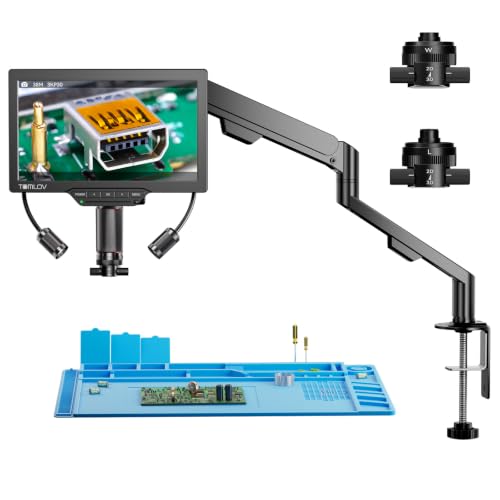
- 3D side-viewing and 360° rotation improve inspection angles.
- Magnetic dual lenses switch quickly between task types.
- 7-inch IPS screen and gooseneck light support bench work.
Best For: Users who want angle flexibility for detailed repair and inspection.
Top Pick for Multi-Use Bench Work – Andonstar AD249S-M Plus 3-Lens Microscope
If you want one of the most versatile microscopes for electronics repair, the Andonstar AD249S-M Plus stands out for PCB work, soldering, and general bench inspection. Its three-lens setup lets you switch between lower-power repair views and much higher magnification when you need a closer look at fine detail.
Best For: Repairers who want a flexible all-in-one microscope with a built-in soldering station layout.
Pros:
- Three lenses cover soldering, general inspection, and very high-magnification viewing.
- 10.1-inch HDMI display supports easy viewing on a larger screen.
- Upgraded stand setup adds extension base, tool holder, helping hands, and storage boxes.
- Includes 32GB card, adjustable LED lighting, remote, and measurement software support.
Cons:
- Lens swapping requires removing and installing screws.
- Many accessories make it a more involved setup than a basic microscope.
Overall, this is a strong pick if you want a repair microscope that doubles as a more complete soldering workstation. The extra accessories and lens options make it especially useful for users who work across different types of close-up tasks.
Best Simple Workbench Viewer – 10.1" LCD Soldering Microscope
This 10.1″ LCD model is built for electronics repair tasks where a large live view matters more than extra lab features. As a microscope for electronics repair, it focuses on PCB inspection, solder joint checks, circuit traces, and small component work directly at the bench.
Best For: PCB and SMD inspection without needing to connect to a computer.
Pros:
- Large 10.1-inch screen makes it easier to follow fine details while working.
- No computer is needed for live inspection.
- Designed specifically for PCB repair, SMD components, and solder joint checks.
- Includes a sturdy mount, IR remote, and USB/Type-C cables.
Cons:
- It is aimed at opaque surfaces, not slides or lab samples.
- Maximum magnification is lower than some multi-lens or 4K alternatives.
For straightforward bench use, this is a practical pick that keeps the workflow simple. It is especially appealing if you want a dedicated inspection tool for boards and solder joints without extra setup steps.
Budget USB Repair Scope – Andonstar HD 2MP USB Microscope
If you are looking for a simpler microscope for electronics repair, this Andonstar USB model keeps the formula basic: HD 2MP imaging, LED lighting, and corded power. It is best thought of as a compact USB inspection tool for soldering and repair tasks rather than a feature-heavy bench station.
Best For: Buyers who want a basic USB microscope for soldering and repair viewing.
Pros:
- USB microscope format is straightforward for repair use.
- HD 2MP imaging provides a basic digital view of close-up work.
- LED light source helps illuminate small details.
- Simple design may suit users who want fewer features and less complexity.
Cons:
- Supplied details do not include a screen, stand, or accessory bundle.
- Less feature-rich than the larger HDMI and autofocus models here.
This is the most minimal option in the group, so it makes sense if you only need a basic USB microscope for repair viewing. It is not the most advanced choice, but it may fit a simpler workflow.
Best Premium Autofocus Choice – TOMLOV TM4K-AF Max Microscope
The TOMLOV TM4K-AF Max is a high-end option for microscope for electronics repair shoppers who want autofocus and a larger, more polished viewing setup. Its TOF and AI autofocus are designed to keep images sharp while you move between circuit repairs, watch work, and other fine-detail tasks.
Best For: Users who want autofocus, 4K capture, and a flexible HDMI repair setup.
Pros:
- Autofocus with TOF distance sensing and AI helps reduce manual refocusing.
- 4K UHD video and 52MP image support add strong detail capture.
- 10.1-inch IPS screen and HDMI/USB output support multi-screen workflows.
- 360° spin arm and ring light improve positioning and illumination at the bench.
Cons:
- Premium feature set likely makes it more than a basic repair-only purchase.
- Some of the advanced display and capture features may be more than casual users need.
For users who value convenience and image clarity, this model offers one of the most advanced setups in the list. It is a strong fit when you want autofocus support and a more refined inspection experience for electronics work.
Editor’s Pick – Hayve 10.1 Inch Digital Microscope for Repair
If you’re comparing microscopes for electronics repair, this Hayve model stands out for its large 10.1-inch IPS display, stable metal stand, and PC viewing support. It’s aimed at precision soldering and PCB work, with enough screen size and lighting control to reduce eye strain during longer repair sessions.
Best For: Techs and hobbyists who want a big-screen digital microscope for detailed soldering, PCB inspection, and shared viewing.
Pros:
- 10.1-inch IPS screen with 178° viewing angle for comfortable close-up work
- 50X–2000X magnification supports PCB inspection and other micro-detail tasks
- 10 LED lights plus two flexible auxiliary lights help reduce shadows and glare
- Remote control and USB PC connection make capture and viewing easier
Cons:
- Best suited to bench use rather than portable field work
- Highest magnification is digital, so real-world sharpness depends on setup and focus
Overall, this is a strong choice if your priority is a large, stable viewing setup for repair work. It combines a roomy display, useful lighting, and PC connectivity in a package designed around careful electronics inspection.
Compact Bench Choice – 5" LCD Soldering Microscope with C-Clamp
For microscopes for electronics repair in tighter workspaces, this 5-inch LCD model focuses on practical bench use. The C-clamp stand keeps both hands free, the flexible arm helps position the lens over small boards, and the plug-and-play PC viewing mode makes it easier to inspect solder joints on a larger screen.
Best For: Repair benches that need a compact, hands-free microscope with simple PC viewing.
Pros:
- C-clamp and flexible arm help keep the work area stable and hands free
- 5-inch IPS display reduces strain during close-up inspection
- Plug-and-play PC mode works without driver downloads or third-party software
- 1080P recording support with Micro SD card storage for saved captures
Cons:
- Micro SD card is required for saving and is not included
- Not an auto-focus unit, so setup depends on manual distance and focus adjustments
- Screen size is smaller than larger bench microscopes
This is a straightforward option if you want a smaller microscope that still supports practical repair tasks. It makes sense for users who value a fixed bench setup, simple computer connection, and a no-nonsense approach to focusing.
Best Value Storage Kit – TOMLOV DM9 7" Digital Microscope
If you want microscopes for electronics repair that also cover general inspection and documentation, the TOMLOV DM9 is a versatile middle-ground option. It combines a 7-inch LCD screen, 12MP imaging, PC connection, and included 16GB storage, which is handy if you want to save photos and videos without buying accessories separately.
Best For: Users who want a stable bench microscope for PCB checks, recording, and everyday close-up inspection.
Pros:
- 7-inch LCD display offers a comfortable view for extended inspection
- 12MP camera with 1080P video supports photo and video capture
- 16GB memory card is included for saving findings right away
- Metal base and stand improve stability for detailed work
Cons:
- Magnification and working range depend on height adjustment and focus setup
- Best for bench use rather than highly portable repair work
- Includes a lot of inspection features, which may be more than some basic users need
For repair users who want a balanced feature set, this TOMLOV model is easy to recommend. It offers the core essentials—screen, recording, PC view, and stable support—while adding storage in the box for convenience.
Best with Extra Features – Andonstar AD246S-M 3-Lens 2160P Digital Microscope
If you want microscopes for electronics repair that can also handle general inspection tasks, the Andonstar AD246S-M is a versatile pick. Its L lens is aimed at soldering and circuit board work, while the HDMI output and 2160P recording make it practical for a bigger shared screen or detailed documentation.
Best For: Electronics repair, soldering, and users who want a multi-lens microscope that can also cover other inspection needs.
Pros:
- Includes an L lens designed for repairing circuit boards and mobile phones.
- Supports UHD 2160P video recording and HDMI output for larger-screen viewing.
- Pro boom arm stand is adjustable and made for a soldering-friendly workspace.
- Comes with accessories like slides, remote control, and a 32GB micro SD card.
Cons:
- Multi-lens setup adds extra steps when switching between uses.
- The product is positioned as all-purpose, so it may be more than needed for simple bench-only soldering.
This model stands out if you want one digital microscope that can move between repair, inspection, and educational use. The adjustable stand and HDMI workflow make it especially comfortable for bench work where stability and eye relief matter.
High-Detail Runner-Up – 4K HDMI Soldering Microscope with Flex Arm
For microscopes for electronics repair where detail is the priority, this 4K HDMI model is built around a sharp 3840×2160 image and a stable flex arm stand. The 1.5 cm minimum focus distance and 8 LED lights make it suited to close PCB inspection, fine-pitch work, and checking solder joint quality.
Best For: Technicians and hobbyists who want a 4K digital microscope for close-up PCB inspection and soldering.
Pros:
- True 4K 30FPS sensor provides high-resolution HDMI viewing with no compression.
- Flex arm stand clamps to a desk and gives stable hands-free positioning.
- 1.5 cm minimum focus distance is suited to 0402 SMD and fine-pitch IC work.
- Can connect to HDMI monitors or Windows/Mac via USB for flexible use.
Cons:
- The product notes focus heavily on microscope body and stand features rather than bundled accessories.
- Best results depend on having an external display setup if you want a larger view.
This is a strong choice if you value image clarity above extras. The 4K feed, close focusing, and flexible mounting make it a very practical bench microscope for careful electronics work.
Most Adjustable – TOMLOV TM3K-3D 3K Soldering Microscope
If you need microscopes for electronics repair that give you more viewing angles, the TOMLOV TM3K-3D adds side-viewing and 360° rotation to the usual bench setup. The magnetic dual-lens design, 7-inch IPS screen, and gooseneck spotlight make it a flexible option for soldering, inspection, and close-up component work.
Best For: Electronics repair users who want adjustable viewing angles and a flexible dual-lens setup.
Pros:
- 3D side-viewing and 360° rotation help inspect components and solder joints from multiple angles.
- Magnetic dual lenses switch easily between wide-frame and long-distance viewing.
- 7-inch IPS display with 3K UHD output offers clear on-screen inspection.
- Flexible arm stand and adjustable LED spotlight support precise bench work.
Cons:
- Side-viewing and dual-lens features may take extra setup time compared with simpler microscopes.
- The feature set is broad, so it may be more than needed if you only want a basic soldering scope.
This model is a good fit when inspectability matters as much as magnification. The rotating view, magnetic lens changes, and flexible lighting make it especially useful for detailed repair tasks where angle control is important.
How We Picked These Microscopes for Electronics Repair
We prioritized models that suit real repair workflows: clear image quality, enough working distance for soldering tools, usable magnification for component-level inspection, and stands or arms that stay steady while you work. We also favored screens and output options that reduce eye strain during long sessions.
Quick Comparison
If you want a simple rule of thumb: larger LCD units are usually better for all-day bench use, HDMI microscopes can offer sharper external display workflows, and autofocus or higher-resolution models are better for detailed inspection and documentation. Compact 5-inch units are often the most space-efficient choice for smaller benches.
Key Buying Factors for Microscopes for Electronics Repair
Working Distance
You need enough space between the lens and the board to fit a soldering iron, hot air nozzle, tweezers, or rework tools. A microscope with poor working distance may look sharp but be awkward in actual repair tasks.
Magnification and Image Clarity
Higher magnification is not automatically better. For Microscopes for Electronics Repair, a usable mid-range zoom with a crisp image is usually more valuable than extreme magnification that narrows the field of view too much.
Display Type
Integrated LCD screens are convenient and easy to use out of the box. HDMI models are a strong choice if you want a larger monitor, better ergonomics, or a shared viewing setup. USB models can work well for lighter-duty inspection or computer-based workflows.
Stand Stability
A shaky stand makes precise soldering harder. Look for a rigid base, arm, or clamp system that minimizes vibration and holds position reliably over the PCB.
Lighting and Focus
Even illumination and smooth focusing matter more than many buyers expect. Good ring lighting, fine focus control, and minimal lag help you see solder joints, pads, and tiny components clearly.
Who Should Buy Which Microscopes for Electronics Repair?
If you do frequent bench repair, a 7-inch or 10-inch LCD microscope is often the best all-around choice. If you want maximum clarity and plan to use an external monitor, choose an HDMI model. If your workspace is tight, a compact 5-inch microscope may fit better. For users who work on dense boards, autofocus and 3D-capable viewing can be especially helpful, but only if they still provide enough working room for tools.
Overall, the best Microscopes for Electronics Repair are the ones that make your hands more precise, not the ones with the biggest spec sheet. Prioritize comfort, stability, and practical viewing over headline magnification alone.