The best oscilloscopes for electronics repair make it easier to see voltage changes, identify noise, verify timing, and troubleshoot circuits that a multimeter alone cannot fully explain.
This roundup compares 10 compact and multifunction models, including handheld scopes with multimeters and signal generators, so you can match features, bandwidth, portability, and price to the work you actually do.
Best 10 Oscilloscopes for Electronics Repair Picks for 2026
Versatile Repair Workstation
FNIRSI 2C53T 3-in-1 Oscilloscope

- 50 MHz, two-channel scope with 250 MSa/s sampling
- 4.5-digit multimeter and 50 kHz signal generator
- Portable design with 3000 mAh battery and waveform storage
Best For: Automotive repair, field service, and general electronics troubleshooting
Hands-On Learning Pick

- DIY kit with ARM Cortex-M3 processor
- 2.4-inch color TFT display for basic waveform viewing
- Suitable for electronics training and customization
Best For: Students and hobbyists learning oscilloscope fundamentals
Advanced Portable Choice
FNIRSI 2D15P 100 MHz 3-in-1 Oscilloscope

- 100 MHz, two-channel scope with 500 MS/s sampling
- 19,999-count TRMS multimeter and 10 MHz DDS generator
- 4.3-inch touchscreen and 5000 mAh rechargeable battery
Best For: Technicians needing detailed portable diagnostics
Compact Starter Scope
BTMETER Mini Handheld Digital Oscilloscope

- 250 kHz bandwidth and 2.5 MSa/s sampling
- Auto, normal, and single trigger modes
- Pocket-size body with 2.8-inch LCD and rechargeable battery
Best For: Basic low-frequency checks, education, and portable troubleshooting
Compact Signal Testing

- 10 MHz scope with 48 MS/s sampling
- DDS generator with 13 waveform types
- Portable, rechargeable handheld design
Best For: Portable waveform testing and basic signal simulation
Two-Channel Repair Workhorse
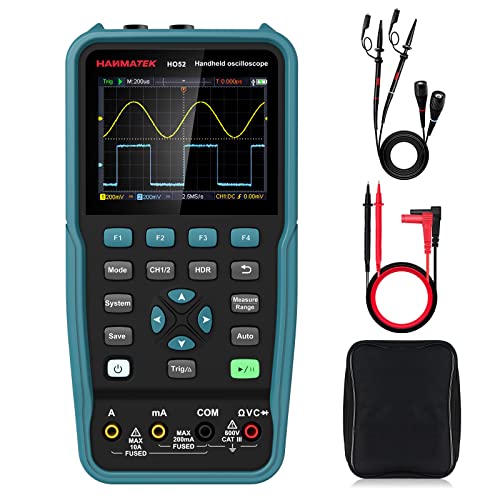
- 50 MHz bandwidth with two channels
- Built-in multimeter and auto-ranging
- Saves images, settings, references, and CSV waveforms
Best For: Repair work requiring scope and multimeter functions
Pocket Maintenance Scope

- 200 KHz bandwidth and 2.5 MS/s sampling
- One-key setup with full trigger modes
- 10.2-ounce body and approximately four-hour battery life
Best For: Basic low-frequency maintenance and portable troubleshooting
Versatile Automotive Tester
3-in-1 50MHz Handheld Oscilloscope

- Dual-channel scope with up to 50MHz bandwidth
- 25,000-count multimeter included
- Built-in signal generator and USB-C charging
Best For: Portable automotive and electronics diagnostics
Compact Bench Companion
DSO154Pro 18MHz Portable Oscilloscope

- 18MHz bandwidth option for general testing
- 40MSa/s sampling rate
- Compact body with color TFT display
Best For: Portable debugging and hobby electronics
Storage-Ready Repair Tool
3-in-1 15MHz Handheld Oscilloscope

- Oscilloscope, True RMS meter, and DDS generator
- SD card waveform storage
- Up to eight hours of battery use
Best For: Automotive repair and portable electronics diagnostics
Versatile Repair Workstation – FNIRSI 2C53T 3-in-1 Oscilloscope
The FNIRSI 2C53T is a practical all-in-one option for anyone comparing oscilloscopes for electronics repair. It combines a two-channel, 50 MHz oscilloscope with a 4.5-digit multimeter and a DDS signal generator, making it useful when troubleshooting circuits without carrying several separate instruments.
Best For: Automotive electronics, general bench work, hobbyists, schools, and technicians who want multiple test functions in a portable unit.
Pros:
- 50 MHz bandwidth and 250 MSa/s sampling for general waveform troubleshooting
- Built-in multimeter measures voltage, current, resistance, capacitance, continuity, and more
- Signal generator supports 13 waveforms up to 50 kHz
- Rechargeable 3000 mAh battery, waveform storage, and Type-C connectivity
Cons:
- Limited to a 1 Kpoint record depth
- The compact 2.8-inch display may provide less viewing area than a bench scope
Its broad feature set makes the 2C53T especially convenient for field repairs and mixed measurement tasks. The relatively shallow record depth is worth considering if you routinely analyze long or highly detailed waveforms.
Hands-On Learning Pick – DSO 138 DIY Oscilloscope Kit
The DSO 138 is a build-it-yourself learning platform rather than a ready-to-use professional instrument. For readers exploring oscilloscopes for electronics repair, assembling this kit can provide practical familiarity with oscilloscope structure, components, and basic low-frequency waveform observation.
Best For: Students, beginners, electronics training, and hobbyists who want to assemble and study an oscilloscope.
Pros:
- DIY format encourages hands-on understanding of oscilloscope operation
- 2.4-inch color TFT display and ARM Cortex-M3 processor
- Can be adapted for projects such as a millivoltmeter or data recorder
- Useful for observing audio, video synchronization, and low-frequency signals
Cons:
- Requires user assembly before operation
- Its 1 MSPS design is aimed at basic, lower-frequency testing rather than advanced diagnostics
This kit is best viewed as an educational project and development board, not a replacement for a fully featured repair oscilloscope. It is a good fit when learning value and customization matter more than fast, ready-to-go measurements.
Advanced Portable Choice – FNIRSI 2D15P 100 MHz 3-in-1 Oscilloscope
The FNIRSI 2D15P is a higher-capability portable instrument for demanding oscilloscopes for electronics repair applications. Its two-channel, 100 MHz scope is paired with a 19,999-count TRMS multimeter, a 10 MHz DDS generator, touchscreen controls, and deeper memory options for more detailed troubleshooting.
Best For: Technicians and serious hobbyists handling automotive, bench, and field diagnostics that benefit from higher bandwidth and integrated analysis tools.
Pros:
- 100 MHz bandwidth and 500 MS/s sampling across two channels
- Selectable 10 K, 100 K, and 1 M memory depths for waveform capture
- 19,999-count TRMS multimeter with curve view and minimum/maximum display
- 10 MHz DDS generator, 4.3-inch IPS touchscreen, and 5000 mAh battery
Cons:
- Heavier than a pocket-sized handheld scope at about 907 g
- The feature-rich interface may be more than beginners need
The 2D15P stands out when waveform analysis, measurement flexibility, and battery life are more important than minimal size. Its larger display and deeper memory options make it a stronger choice for detailed portable diagnostics than basic entry-level scopes.
Compact Starter Scope – BTMETER Mini Handheld Digital Oscilloscope
The BTMETER Mini Handheld Digital Oscilloscope is a straightforward choice for basic oscilloscopes for electronics repair tasks. With 250 kHz bandwidth, 2.5 MSa/s sampling, one-touch auto setup, and a lightweight pocket-size body, it is suited to checking common low-frequency signals without the complexity of a larger lab instrument.
Best For: Beginners, education, quick field checks, and basic low-frequency analog or digital signal testing.
Pros:
- Compact design weighs approximately 100 g and fits easily in a toolkit
- Auto, normal, and single trigger modes support simple waveform capture
- 2.8-inch 320×240 LCD with accessible side controls
- Built-in 1 kHz calibration signal and rechargeable battery
Cons:
- 250 kHz bandwidth limits it to relatively low-frequency work
- Battery life is rated for up to 3 hours
- Input range is limited to ±40 V in X1 mode, or up to ±400 V in X10 mode depending on the probe
This BTMETER is attractive when portability and ease of use matter most. It is a sensible secondary scope or learning tool, but users working with faster signals or more advanced analysis should consider a higher-bandwidth model.
Compact Signal Testing – FNIRSI DSO-510
For shoppers comparing oscilloscopes for electronics repair, the FNIRSI DSO-510 combines a 10 MHz oscilloscope with a DDS signal generator in a compact handheld design. Its one-key AUTO function and built-in battery make it practical for quick bench or field checks.
Best For: Portable waveform testing and basic signal simulation.
Pros:
- 10 MHz bandwidth, 48 MS/s sampling, and a 50 ns–20 s time-base range.
- DDS generator outputs 13 waveform types up to 50 KHz.
- Infinite afterglow, waveform scaling, image saving, and Type-C charging.
Cons:
- The 2.8-inch, 320×240 display is relatively compact.
- Its 50 KHz generator output and 10 MHz scope bandwidth limit advanced applications.
The DSO-510 is a useful all-in-one option when portability and signal generation matter more than high-frequency performance. It suits routine troubleshooting and basic waveform simulation.
Two-Channel Repair Workhorse – HANMATEK HO52
The HANMATEK HO52 is a strong choice among oscilloscopes for electronics repair when you want two-channel measurements plus built-in multimeter functions. Its 50 MHz bandwidth, 250 MSa/s real-time sampling, and data-saving features support more involved troubleshooting.
Best For: Repair technicians who need scope and multimeter functions in one portable instrument.
Pros:
- Two oscilloscope channels with 50 MHz bandwidth and 250 MSa/s sampling.
- Built-in multimeter measures voltage, current, resistance, diode, continuity, and capacitance.
- Supports automatic measurements, reference waveforms, images, CSV files, and USB-C computer connectivity.
Cons:
- Its feature-rich design may take longer to learn than a basic handheld scope.
- The supplied notes list a 2.6 lb weight, making it less pocket-friendly than the smallest models.
With dual inputs and independent multimeter functionality, the HO52 offers broader diagnostic coverage than a single-purpose pocket scope. It is especially practical for repair benches, automotive work, and technical training.
Pocket Maintenance Scope – FNIRSI DSO152
For straightforward oscilloscopes for electronics repair, the FNIRSI DSO152 emphasizes portability and simple operation. It provides a 200 KHz bandwidth, 2.5 MS/s real-time sampling, full trigger modes, and one-key setup in a lightweight handheld format.
Best For: Basic maintenance checks, education, and portable low-frequency troubleshooting.
Pros:
- Lightweight 10.2-ounce design with a 2.8-inch HD LCD.
- Auto, Normal, and Single trigger modes support periodic and aperiodic signals.
- Built-in 1000 mAh battery provides about four hours of continuous use after charging.
Cons:
- Its 200 KHz bandwidth is suited to lower-frequency work rather than advanced high-speed circuits.
- It has a single-channel handheld configuration.
The DSO152 is a sensible entry-level and field-service tool when compact size and quick measurements are priorities. Its limited bandwidth makes it better for basic maintenance than demanding electronics analysis.
Versatile Automotive Tester – 3-in-1 50MHz Handheld Oscilloscope
For shoppers comparing oscilloscopes for electronics repair, the ZT-703 combines a dual-channel oscilloscope, digital multimeter, and signal generator in a compact battery-powered unit. Its selectable normal and high-speed modes provide up to 50MHz bandwidth and 280MSa/s sampling when enabled.
Best For: Automotive technicians and electronics users who want several diagnostic tools in one handheld device.
Pros:
- Combines oscilloscope, 25,000-count multimeter, and signal generator functions.
- High-speed mode supports up to 50MHz bandwidth and 280MSa/s sampling.
- Can output sine, square, and triangle waves and store waveform images.
- Uses USB-C for charging and data transfer.
Cons:
- High-speed mode uses more power than normal mode.
- The product’s many functions make consulting the manual important.
This is a feature-rich choice when portability and integrated testing matter more than a simple, single-purpose scope. The dual-channel design and included probe, test leads, cable, and bag add practical flexibility for field work.
Compact Bench Companion – DSO154Pro 18MHz Portable Oscilloscope
For basic oscilloscopes for electronics repair, the DSO154Pro focuses on portability and straightforward operation. It has an 18MHz bandwidth option, 40MSa/s sampling, a color TFT display, and one-click controls for auto adjustment, measurement, and single capture.
Best For: Hobbyists and technicians needing a compact scope for on-site debugging and general waveform checks.
Pros:
- Compact design is suited to portable on-site troubleshooting.
- 2.4-inch, 320×240 color TFT display offers clear data viewing.
- 40MSa/s sampling uses an ARM, FPGA, and ADC architecture.
- One-click auto adjustment, measurement, and single capture simplify operation.
Cons:
- The listed 18MHz version has less bandwidth than higher-spec repair scopes.
- The supplied notes do not specify multimeter or signal-generator functionality.
This model is best viewed as a small, focused oscilloscope rather than an all-in-one diagnostic instrument. Its simple controls and portable format may appeal to users who value quick waveform checks in the field.
Storage-Ready Repair Tool – 3-in-1 15MHz Handheld Oscilloscope
For oscilloscopes for electronics repair that also handle everyday electrical checks, this handheld 3-in-1 model pairs a 15MHz scope with a 4000-count True RMS multimeter and DDS signal generator. It adds SD card waveform storage, three trigger modes, and up to eight hours of stated battery use.
Best For: Automotive repair, electronics DIY, and users who need waveform capture alongside voltage and component testing.
Pros:
- Combines a 15MHz oscilloscope, True RMS multimeter, and DDS generator.
- Supports Auto, Normal, and Single trigger modes with one-key auto setup.
- Stores, views, and analyzes waveforms using an SD card.
- 2000mAh battery provides up to eight hours of continuous use.
Cons:
- Its 15MHz bandwidth is more limited than broader-bandwidth models.
- The multimeter is rated at 4000 counts, lower than some specialized meters.
- Probe limits depend on the selected ×1 or ×10 mode.
The T60 stands out for repair workflows that benefit from saving measurements for later review. Its integrated meter, generator, adjustable display, and carrying case make it a practical portable kit, while the moderate bandwidth keeps it aimed at general rather than high-frequency work.
How We Picked These Oscilloscopes for Electronics Repair
We focused on practical tools for diagnosing power supplies, audio equipment, embedded boards, automotive electronics, and general low-voltage circuits. The selection includes basic DIY kits, compact single-channel scopes, dual-channel handheld models, and multifunction instruments that combine an oscilloscope with a multimeter or DDS signal generator.
We compared the stated bandwidth, sampling rate, channel count, display, input limits, triggering features, waveform storage, portability, and included accessories. Because specifications and bundled probes can vary by seller, confirm the current listing before buying—especially maximum input voltage, probe attenuation, and whether accessories are included.
Quick Comparison
| Type | Best For | What to Prioritize |
|---|---|---|
| DIY kit | Learning and basic signals | Assembly quality, documentation, probe, and calibration |
| Entry-level handheld | Simple repairs and field checks | Usability, trigger modes, battery life, and input protection |
| Dual-channel handheld | Comparing signals or monitoring input/output | Independent channel controls, bandwidth, and grounding |
| Multifunction model | Portable repair kits | Scope performance, meter accuracy, generator frequency range, and safety limits |
Key Buying Factors for Oscilloscopes for Electronics Repair
Bandwidth and Sampling Rate
Bandwidth determines the highest frequency the scope can display accurately, while sampling rate affects how well it captures waveform detail. For microcontroller, switching, and communications work, more bandwidth and faster sampling provide greater margin. For audio, sensors, power rails, and basic automotive diagnostics, modest specifications may be sufficient.
Channels and Triggering
Two channels are useful when comparing a clock with data, an input with an output, or a control signal with a power response. Look for auto, normal, and single-shot triggering when you need to capture intermittent faults. A stable trigger is often more valuable than a higher headline bandwidth.
Input Safety and Probes
Check the instrument’s maximum input rating and understand whether that rating applies only through a 10× probe. Many handheld scopes are intended for low-voltage, floating, or battery-powered work and are not substitutes for an isolated mains-rated oscilloscope. Never attach a grounded probe to a live circuit unless the scope and measurement setup are designed for it.
Portability and Extra Functions
Handheld designs suit field service and cramped enclosures, while larger screens are easier for extended bench sessions. Integrated multimeters and signal generators can reduce the number of tools you carry, but do not assume the extra functions match the accuracy or output capability of dedicated instruments.
Who Should Buy Which Oscilloscopes for Electronics Repair?
Choose a DIY kit if your priority is learning how oscilloscopes work and viewing simple, low-frequency signals. Pick a basic compact scope for occasional troubleshooting where portability and low cost matter most. A dual-channel model is the better choice for repair work involving timing relationships or simultaneous input and output measurements.
For technicians who want one portable instrument, a multifunction oscilloscope with a meter and DDS generator can be convenient. Choose the higher-bandwidth options for faster digital edges, switching supplies, and more demanding diagnostics, but verify their safety limitations first. If you regularly work on mains-powered equipment, high-speed buses, or precision analog circuits, consider a properly rated benchtop oscilloscope instead of relying solely on a budget handheld.