The best oscilloscope for a hobbyist depends on more than bandwidth. Your projects, available bench space, preferred portability, and need for features such as signal generation or multimeter functions all affect the right choice.
This roundup compares 10 options across entry-level, handheld, DIY, and full-size categories so you can match performance and price to the way you actually work.
Best 10 Oscilloscopes for Hobbyists Picks for 2026
Best All-in-One Pick
FNIRSI 2C53T 3-in-1 Oscilloscope

- 50 MHz two-channel scope with 250 MSa/s sampling
- Built-in multimeter and 50 kHz DDS generator
- Portable design with 3000 mAh battery
Best For: Hobbyists wanting one compact tool for multiple measurements
Best for Advanced Bench Work
RIGOL DS1202Z-E 200MHz Oscilloscope

- 200 MHz bandwidth and 1 GSa/s sampling
- Up to 24 Mpts memory and 30,000 wfms/s capture
- Serial decoding for UART, I2C, and SPI
Best For: Detailed bench debugging and embedded-system projects
Best Budget Portable Pick
FNIRSI DSO-510 Handheld Oscilloscope

- Compact 10 MHz handheld oscilloscope
- One-key AUTO and infinite afterglow
- Built-in 50 kHz DDS generator
Best For: Basic portable testing and beginner electronics work
Best Four-Channel Value
RIGOL DS1054Z 4-Channel Oscilloscope

- Four analog channels for multi-signal testing
- Up to 1 GSa/s sampling and 24 Mpts memory
- Includes serial decoding, FFT, and waveform playback
Best For: Bench setups that need simultaneous multi-channel debugging
Best Portable Pick
FNIRSI DSO152 Handheld Oscilloscope

- 200 kHz bandwidth and 2.5 MS/s sampling
- One-key auto setup and three trigger modes
- About four hours of battery use
Best For: Portable troubleshooting and beginner electronics work
Best Advanced Bench Option
RIGOL DHO802 70 MHz Digital Oscilloscope

- 70 MHz bandwidth with two analog channels
- 12-bit resolution and up to 25 Mpts memory
- Serial decode, FFT, LAN, and SCPI control
Best For: Embedded projects and detailed bench troubleshooting
Best Learning Project

- 1 MSPS digital scope with 2.4-inch color TFT
- Hands-on assembly for electronics learning
- Customizable for development experiments
Best For: Students and DIY builders learning oscilloscope fundamentals
Best Bench Scope

- 100 MHz bandwidth with 1 GSa/s sampling
- Deep memory and fast waveform capture
- Serial decoding plus LAN and USB connectivity
Best For: Bench-based electronics debugging and embedded projects
Best Portable Multitool
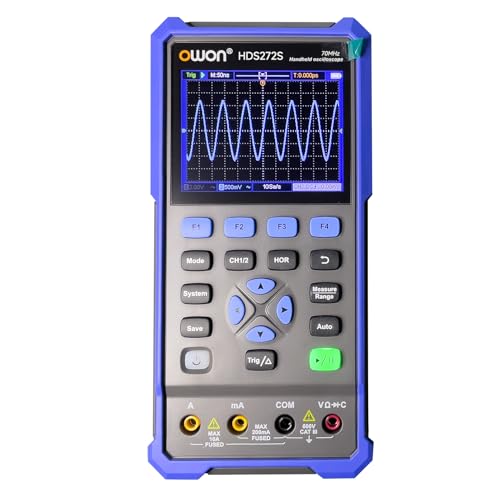
- Two-channel, 70 MHz handheld oscilloscope
- Built-in 20,000-count multimeter
- Signal generator with up to 25 MHz output
Best For: Portable electronics and automotive troubleshooting
Best Simple Pick

- Four channels with 100 MHz bandwidth
- 1 GSa/s sampling and 24 Mpts memory
- Optional MSO upgrade path with logic connector
Best For: Multi-signal embedded and electronics debugging
Best All-in-One Pick – FNIRSI 2C53T 3-in-1 Oscilloscope
For hobbyists who want one compact tool for several jobs, the FNIRSI 2C53T combines a two-channel oscilloscope, multimeter, and DDS signal generator. Its 50 MHz bandwidth, 250 MSa/s sampling rate, and automatic measurements make it a flexible option for bench work, automotive electronics, and general troubleshooting.
Best For: Hobbyists seeking a portable, multi-function test instrument.
Pros:
- Combines a 50 MHz, two-channel oscilloscope with a 4.5-digit multimeter and signal generator.
- Includes math, cursor measurement, persistence, XY mode, waveform storage, and reference-waveform comparison.
- Portable 400 g design with a 3000 mAh battery, protective case, and Type-C charging.
Cons:
- Its 1 Kpts record depth is modest compared with larger desktop oscilloscopes.
- The signal generator is limited to a maximum output frequency of 50 kHz.
The 2C53T is a strong choice when convenience and portability matter more than deep memory or advanced bench instrumentation. It offers a broad feature set for hobby electronics in a single handheld package.
Best for Advanced Bench Work – RIGOL DS1202Z-E 200MHz Oscilloscope
The RIGOL DS1202Z-E is a desktop choice for hobbyists who need more bandwidth, memory, and analysis capability than a basic portable scope provides. With two channels, 1 GSa/s sampling, 24 Mpts of standard memory, and serial-bus decoding, it is well suited to detailed electronics debugging.
Best For: Embedded projects, education labs, and hobbyists analyzing fast or intermittent signals.
Pros:
- Provides 200 MHz bandwidth, up to 1 GSa/s real-time sampling, and up to 24 Mpts memory.
- Captures up to 30,000 waveforms per second and supports recording and playback of up to 60,000 frames.
- Includes RS232/UART, I2C, and SPI trigger and decoding functions, plus USB and LAN connectivity.
Cons:
- Its desktop form factor is less portable than handheld oscilloscopes for hobbyists.
- It has two analog channels, which may be limiting for projects requiring more simultaneous inputs.
The DS1202Z-E is a capable option when waveform visibility, long captures, and protocol troubleshooting are priorities. Its larger display and connectivity also make it a practical centerpiece for a permanent workbench.
Best Budget Portable Pick – FNIRSI DSO-510 Handheld Oscilloscope
The FNIRSI DSO-510 is a straightforward option for hobbyists who value portability and simple signal generation. Its 10 MHz oscilloscope, one-key AUTO function, and 13-waveform DDS generator cover basic testing while the handheld design makes it convenient for field or automotive use.
Best For: Beginners and hobbyists handling basic analog and digital signal checks away from the bench.
Pros:
- Compact handheld design with a 2.8-inch display and Type-C charging.
- Offers 10 MHz bandwidth, 48 MS/s sampling, and voltage measurements up to 400 V.
- Includes infinite afterglow, waveform scaling and saving, and a 50 kHz DDS generator with 13 waveform types.
Cons:
- The 10 MHz bandwidth and 48 MS/s sampling rate are suited to basic work rather than high-speed analysis.
- Its 1000 mAh battery is smaller than the battery in the FNIRSI 2C53T.
The DSO-510 makes sense when low weight, simple controls, and basic waveform generation are more important than extensive decoding or deep-memory features. It is a practical entry point for portable hobby testing.
Best Four-Channel Value – RIGOL DS1054Z 4-Channel Oscilloscope
For hobbyists who regularly need to compare several signals at once, the RIGOL DS1054Z offers four analog channels with 1 GSa/s sampling and up to 24 Mpts of memory. Its capture, playback, decoding, and FFT tools give a workbench setup considerably more room for growing projects.
Best For: Multi-signal debugging, teaching labs, and power or embedded projects.
Pros:
- Four analog channels allow simultaneous viewing of more signals than two-channel models.
- Provides up to 1 GSa/s sampling and up to 24 Mpts memory, depending on channel use.
- Includes 30,000 wfms/s capture, 60,000-frame recording/playback, serial decoding, FFT, and filters.
Cons:
- Memory depth decreases to 6 Mpts when using three or four channels.
- At 6.6 pounds and desktop size, it is not intended for portable measurements.
The DS1054Z is a strong value-oriented choice for a fixed hobby bench, especially when four-channel visibility matters. It balances useful analysis features with enough memory and sampling performance for a broad range of electronics projects.
Best Portable Pick – FNIRSI DSO152 Handheld Oscilloscope
For hobbyists who need a compact tool for quick checks, the FNIRSI DSO152 is a practical entry among oscilloscopes for hobbyists. Its 200 kHz bandwidth, 2.5 MS/s real-time sampling rate, one-key auto setup, and built-in battery make it convenient for bench work, field troubleshooting, and basic electronics learning.
Best For: Portable waveform checks, automotive maintenance, and introductory electronics work.
Pros:
- Compact, assembled design with a 2.8-inch 320×240 display.
- 2.5 MS/s sampling and 200 kHz bandwidth support general low-frequency measurements.
- Auto, normal, and single trigger modes plus one-key parameter setup simplify operation.
- Built-in 1,000 mAh battery provides about four hours of continuous use.
Cons:
- Its 200 kHz bandwidth is limited compared with more advanced bench oscilloscopes.
- The small display may be less comfortable for detailed waveform analysis.
The DSO152 emphasizes portability and ease of use rather than extensive bench features. It is a sensible choice for hobbyists who want a ready-to-use scope for everyday, lower-frequency troubleshooting.
Best Advanced Bench Option – RIGOL DHO802 70 MHz Digital Oscilloscope
The RIGOL DHO802 is a stronger choice for hobbyists who want room to grow beyond basic waveform viewing. With 70 MHz bandwidth, two analog channels, 12-bit resolution, deep memory, serial-bus decoding, and a 7-inch touch display, it is suited to embedded projects and more demanding bench analysis.
Best For: Embedded development, power-supply ripple inspection, and CAN, UART, I2C, or SPI troubleshooting.
Pros:
- 70 MHz bandwidth, 1.25 GSa/s sampling, and 12-bit resolution provide detailed captures.
- Up to 25 Mpts memory helps with long acquisitions and intermittent events.
- Peak detect, waveform navigation, event tables, FFT, and 41 automatic measurements expand analysis options.
- Serial decode, LAN/SCPI control, USB connectivity, and HDMI support documentation and automation.
Cons:
- Its 3.92-pound size and desktop-oriented design are less convenient for field use.
- Its broad feature set may be more than needed for simple beginner measurements.
Among oscilloscopes for hobbyists, the DHO802 stands out for users working with digital buses, switching supplies, and long or intermittent captures. It offers substantially more analysis capability than a pocket scope, provided you have space for a bench instrument.
Best Learning Project – DSO138 DIY Oscilloscope Kit
The DSO138 DIY kit takes a hands-on approach to oscilloscopes for hobbyists. It combines a 1 MSPS digital scope, 2.4-inch color TFT, ARM Cortex-M3 processor, and included components for learners who want to assemble an instrument while studying basic electronics and oscilloscope principles.
Best For: Electronics students, DIY builders, and component or chip-assembly practice.
Pros:
- DIY format helps demonstrate oscilloscope structure and operating principles.
- ARM Cortex-M3 processor and color TFT support waveform viewing and development experiments.
- Can be used for low-frequency applications such as audio, video synchronization, and infrared signals.
- Open design allows software customization for projects such as a millivoltmeter or data recorder.
Cons:
- The kit must be assembled by the user.
- Its 1 MSPS sampling rate is intended for learning and low-frequency signals rather than demanding measurements.
- Assembly and modification require suitable electronics skills and tools.
This kit is less about immediate convenience and more about learning by building. It makes the most sense when the assembly process, experimentation, and potential software customization are part of the goal.
Best Bench Scope – RIGOL DS1102Z-E
For hobbyists who want a traditional bench instrument, the RIGOL DS1102Z-E is a strong choice among oscilloscopes for hobbyists. Its 100 MHz bandwidth, two analog channels, deep memory, and high waveform capture rate suit electronics debugging, embedded work, and longer signal captures.
Best For: Electronics hobbyists who need detailed waveform viewing, serial-bus troubleshooting, and a capable scope for a fixed bench setup.
Pros:
- 100 MHz bandwidth, 1 GSa/s real-time sampling, and up to 24 Mpts of memory.
- Up to 30,000 wfms/s capture rate helps reveal intermittent glitches.
- Supports RS232/UART, I2C, and SPI triggering and decoding.
- USB, LAN, and AUX interfaces support data transfer and bench integration.
Cons:
- Only two analog channels are provided.
- At 8.83 pounds, it is intended more for bench use than portability.
The DS1102Z-E is a practical all-around bench scope when deep memory and waveform visibility matter more than compact size. Its recording, playback, and decoding features add useful flexibility for diagnosing occasional faults.
Best Portable Multitool – OWON HDS272S
The OWON HDS272S takes a different approach to oscilloscopes for hobbyists by combining a two-channel oscilloscope, multimeter, and signal generator in one handheld unit. It is designed for users who value portability and want several everyday measurement tools without a larger bench setup.
Best For: Hobbyists, automotive users, and home technicians who need portable scope, meter, and signal-generation functions.
Pros:
- Combines a 70 MHz oscilloscope, 20,000-count multimeter, and signal generator.
- Handheld battery-powered design offers up to six hours of use.
- Measures voltage, current, resistance, capacitance, diode, and continuity functions.
- Can save measurements and compare reference and measured waveforms.
Cons:
- Its 8K record depth is less suited to extended captures than deep-memory bench scopes.
- The 3.5-inch display is smaller than typical desktop oscilloscope screens.
The HDS272S is compelling when convenience outweighs maximum display size or memory depth. Its integrated meter and generator make it especially useful for troubleshooting away from a permanent electronics bench.
Best Simple Pick – Rigol DS1104Z Plus
For hobbyists who need to observe several signals at once, the Rigol DS1104Z Plus is a versatile option among oscilloscopes for hobbyists. It pairs four analog channels with 100 MHz bandwidth, 1 GSa/s sampling, and 24 Mpts of memory for more involved circuit debugging.
Best For: Hobbyists working on multi-signal digital, embedded, and power-electronics projects who need four-channel visibility.
Pros:
- Four analog channels make it easier to compare multiple signals simultaneously.
- Provides 100 MHz bandwidth, 1 GSa/s sampling, and 24 Mpts of memory.
- Up to 30,000 wfms/s capture rate supports visibility into intermittent events.
- Includes a built-in BND-MSO/DS1000Z software bundle and digital logic connector for an optional MSO upgrade.
Cons:
- The optional MSO upgrade is not included as a standard four-channel feature.
- Its desktop format is less convenient for field work than a handheld instrument.
The DS1104Z Plus is a strong fit when channel count is the priority. Its four inputs and deep memory provide useful headroom for comparing clocks, data, power rails, and control signals in the same session.
How We Picked the Best Oscilloscopes for Hobbyists
We organized these Oscilloscopes for Hobbyists around the specifications and features that matter most in real projects: bandwidth, sample rate, channel count, memory depth, display usability, portability, and included functions. We also considered whether each model suits basic electronics troubleshooting, embedded development, automotive work, audio experiments, or more demanding bench testing.
Specifications are useful, but they do not tell the whole story. A compact handheld scope may be more practical for field diagnosis, while a four-channel benchtop instrument can make it easier to compare signals in a complex circuit. Combination devices can also save space when a built-in multimeter or signal generator is useful.
Quick Comparison
| Type | Best suited to | What to prioritize |
|---|---|---|
| Basic handheld | Simple repairs and learning | Ease of use, battery life, input protection |
| DIY kit | Learning how scopes work | Assembly experience and modest expectations |
| Portable combination | Field and automotive testing | Multimeter functions, ruggedness, portability |
| Two-channel benchtop | General electronics projects | Bandwidth, memory depth, waveform controls |
| Four-channel benchtop | Embedded and multi-signal debugging | Channel count, triggering, processing speed |
Key Buying Factors for Oscilloscopes for Hobbyists
Bandwidth and Sample Rate
Bandwidth determines the highest-frequency signal the scope can display accurately, while sample rate affects how finely it captures that signal. For general microcontroller, power-supply, and audio work, a modest model may be sufficient. Faster digital edges and higher-frequency circuits call for more headroom. As a practical rule, choose bandwidth comfortably above the fastest signal you expect to measure rather than buying exactly to the stated frequency.
Channels and Memory
Two channels cover many basic tasks, including comparing an input and output. Four channels are more useful for examining clocks, data lines, control signals, and analog waveforms at the same time. Deeper memory can help capture longer events, but usable triggering and responsive controls are equally important.
Portability and Extra Tools
Handheld models are convenient when you work away from a bench or need to test equipment in place. A built-in waveform generator can support experiments, and a multimeter function reduces the number of instruments you need to carry. Check probe quality, input protection, battery operation, and charging options before choosing a portable unit.
Who Should Buy Which Oscilloscopes for Hobbyists?
Choose an entry-level handheld or DIY kit if you are learning basic waveforms, testing low-speed circuits, or want a low-cost introduction. A two-channel benchtop model is the better all-around choice for regular electronics projects because it generally offers a larger display, more stable controls, and easier probing.
Move to a four-channel model if you troubleshoot microcontrollers, communication buses, motor controls, or circuits where several signals must be viewed together. Choose a portable combination instrument for automotive or field work, especially when multimeter measurements are as important as waveform viewing. Finally, prioritize higher bandwidth and sample rate when working with fast switching supplies, high-speed digital interfaces, or RF-adjacent projects.