The best oscilloscopes for home workshops make troubleshooting electronics, audio equipment, power supplies, and embedded projects faster and more precise. The right model depends on your signal types, bandwidth needs, bench space, and budget.
This roundup compares ten options spanning portable 3-in-1 instruments, affordable bench scopes, and higher-bandwidth tools, so you can choose practical capability without paying for features you will not use.
Best 10 Oscilloscopes for Home Workshops Picks for 2026
Best Value
Rigol DS1054Z 50MHz 4-Channel Oscilloscope

- Four channels with up to 1 GSa/s sampling
- Deep memory and fast waveform capture
- Serial decoding, FFT, USB, and LAN
Best For: General home-bench electronics debugging
Budget Feature Pick
Hantek DSO2D15 150MHz 2-Channel Scope

- 150 MHz bandwidth in a cost-focused design
- Arbitrary waveform output included
- 14 triggers and five serial decode options
Best For: Budget-conscious electronics hobbyists
Most Portable
FNIRSI DST-210 3-in-1 Handheld Scope

- Scope, multimeter, and DDS generator in one
- 48 MSa/s sampling with 10 MHz bandwidth
- Rechargeable and designed for field diagnostics
Best For: Portable electronics and automotive troubleshooting
High-Bandwidth Choice
Siglent SDS1202X-E 200MHz Scope
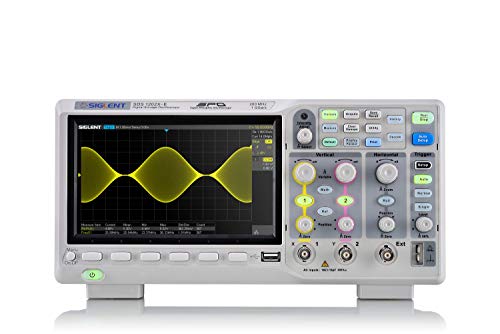
- 200 MHz bandwidth and 1 GSa/s sampling
- 14 Mpts record length for longer captures
- Decodes I2C, SPI, UART, CAN, LIN, and RS232
Best For: Faster embedded and digital-signal troubleshooting
Best All-in-One Value
FNIRSI 2C53T 3-in-1 Oscilloscope

- 50MHz two-channel oscilloscope
- Built-in multimeter and 50kHz generator
- Portable battery-powered design
Best For: Hobbyists seeking one versatile workshop tester
Best Bench Scope
RIGOL DS1102Z-E 100MHz Digital Oscilloscope

- 100MHz bandwidth and 1GSa/s sampling
- Up to 24Mpts deep memory
- Serial decoding and waveform playback
Best For: Detailed bench-based electronics debugging
Best Portable Meter Combo
HANMATEK HO52 Handheld Oscilloscope
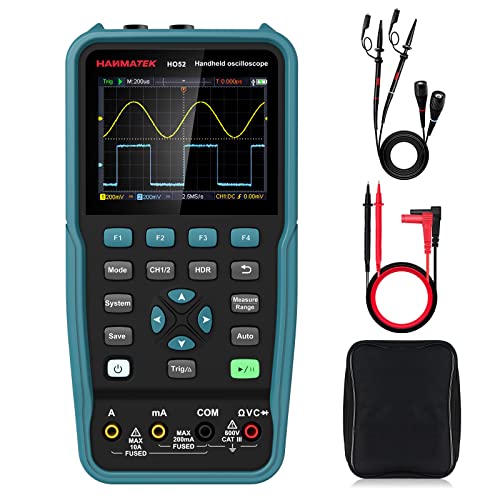
- 50MHz two-channel scope and 4.5-digit meter
- Lightweight battery-powered handheld design
- Saves images, settings, and CSV waveforms
Best For: Portable automotive and electronics troubleshooting
Best Bench Upgrade

- 70 MHz bandwidth with 12-bit resolution
- Deep memory and advanced waveform search
- Serial decoding, FFT, and SCPI control
Best For: Embedded, power-supply, and bus troubleshooting
Best Pocket Option

- Compact 10.2-ounce handheld design
- 200 kHz bandwidth and 2.5 MS/s sampling
- Auto setup and roughly four-hour battery life
Best For: Portable maintenance and basic waveform checks
Best All-in-One Tool

- 350 MHz scope with 1 GSa/s sampling
- Built-in spectrum and frequency-response analyzers
- DDS generator with 0–50 MHz output
Best For: Multifunction analog and signal-integrity work
Best Value – Rigol DS1054Z 50MHz 4-Channel Oscilloscope
For oscilloscopes for home workshops, the Rigol DS1054Z is a versatile bench instrument with four analog channels, a 50 MHz bandwidth, and up to 1 GSa/s sampling on a single channel. Its deep memory and strong capture tools suit electronics troubleshooting, embedded projects, and teaching.
Best For: Home workshops needing a capable four-channel scope for general electronics debugging and longer waveform captures.
Pros:
- Four channels, 50 MHz bandwidth, and up to 1 GSa/s sampling
- Up to 24 Mpts memory and capture rates up to 30,000 waveforms per second
- Serial decoding for RS232/UART, I2C, and SPI, plus FFT and filtering
- USB, LAN, and AUX connectivity for documentation and bench integration
Cons:
- Lower sample rates and memory depth apply when using multiple channels
- At 6.6 pounds, it is less portable than a handheld instrument
The DS1054Z offers a particularly broad feature set for a home bench, especially when four-channel visibility and serial-bus troubleshooting matter more than compact size.
Budget Feature Pick – Hantek DSO2D15 150MHz 2-Channel Scope
The Hantek DSO2D15 is a cost-conscious choice among oscilloscopes for home workshops. It combines 150 MHz bandwidth with two channels, arbitrary waveform output, multiple trigger modes, and serial protocol triggering and decoding for a range of electronics projects.
Best For: Budget-focused hobbyists and makers who want higher bandwidth plus waveform-generation and protocol tools.
Pros:
- 150 MHz bandwidth for examining faster signals
- Supports arbitrary waveform output
- Offers 14 trigger modes
- Includes five serial protocol trigger and decode options
Cons:
- Only two channels are available for simultaneous measurements
- The supplied notes do not specify sampling rate or memory depth
Its mix of higher bandwidth, signal generation, and serial tools makes the DSO2D15 a practical economy instrument when those features are more important than extensive channel count or documented memory capacity.
Most Portable – FNIRSI DST-210 3-in-1 Handheld Scope
The FNIRSI DST-210 takes a compact approach to oscilloscopes for home workshops by combining a 10 MHz oscilloscope, multimeter, and DDS signal generator. Its rechargeable battery, color display, and waveform export make it useful for quick bench checks, field work, and automotive diagnostics.
Best For: Mobile technicians and hobbyists who want scope, meter, and basic signal-generation functions in one handheld tool.
Pros:
- Combines a 10 MHz, 48 MSa/s oscilloscope with a 19,999-count multimeter
- DDS generator provides 13 waveforms up to 50 kHz
- Measures voltage, current, resistance, capacitance, frequency, diode, and temperature
- Rechargeable 3,000 mAh battery and waveform image save/export support portability
Cons:
- Its 10 MHz bandwidth is substantially lower than many full-size bench scopes
- Generator amplitude is limited to 0.1–3.0 V
- It has only one included oscilloscope probe
The DST-210 prioritizes convenience and versatility over advanced scope performance, making it a strong secondary instrument or compact choice for low-frequency troubleshooting.
High-Bandwidth Choice – Siglent SDS1202X-E 200MHz Scope
For home workshops tackling faster circuits, the Siglent SDS1202X-E provides 200 MHz bandwidth, two channels, and real-time sampling up to 1 GSa/s. Its 14 Mpts record length and broad serial decode support are useful for digital-bus analysis and detailed troubleshooting.
Best For: Experienced hobbyists and home labs that need higher bandwidth for faster signals and embedded-system work.
Pros:
- 200 MHz bandwidth supports faster signal measurements
- Real-time sampling rate reaches 1 GSa/s
- Record length extends to 14 Mpts
- Serial triggering and decoding supports I2C, SPI, UART, RS232, CAN, and LIN
Cons:
- Two channels provide less simultaneous visibility than four-channel alternatives
- The supplied notes do not list connectivity options or waveform capture rate
- Its larger listed dimensions may require more bench space
The SDS1202X-E is a compelling higher-bandwidth option when signal speed and extensive serial-bus support are priorities, though a two-channel layout may limit more complex measurements.
Best All-in-One Value – FNIRSI 2C53T 3-in-1 Oscilloscope
For home workshops that need more than waveform viewing, the FNIRSI 2C53T combines a two-channel, 50MHz oscilloscope with a 4.5-digit multimeter and DDS signal generator. Its handheld design, battery power, automatic measurements, and waveform storage make it a versatile choice for electronics and automotive troubleshooting.
Best For: Hobbyists who want one portable instrument for scope work, electrical measurements, and basic signal generation.
Pros:
- Combines a 50MHz, two-channel oscilloscope, multimeter, and signal generator.
- Offers 250MSa/s sampling, math and cursor functions, persistence, and XY mode.
- Includes a 3000mAh battery, storage case, probes, and Type-C connectivity.
Cons:
- The oscilloscope has a 1 Kpts record depth.
- The signal generator output reaches 50kHz, below the scope’s bandwidth.
The 2C53T is especially appealing when bench space and budget are limited. It is a practical multipurpose option for home workshops, though users needing deeper waveform memory or a larger display may prefer a dedicated bench oscilloscope.
Best Bench Scope – RIGOL DS1102Z-E 100MHz Digital Oscilloscope
The RIGOL DS1102Z-E is a dedicated bench oscilloscope for home workshops that need stronger capture performance and a larger display. With 100MHz bandwidth, 1GSa/s sampling, deep memory, high waveform refresh, and serial-bus decoding support, it is suited to detailed electronics debugging.
Best For: Workshop users working on embedded systems, digital electronics, intermittent faults, and longer waveform captures.
Pros:
- Provides 100MHz bandwidth, two analog channels, and up to 1GSa/s real-time sampling.
- Deep memory reaches 24Mpts, or 12Mpts with both channels in use.
- Supports waveform recording and playback, serial decoding, LAN, and USB connectivity.
- The 7-inch WVGA intensity-graded display helps show jitter and noise.
Cons:
- Its listed weight is 8.83 pounds, making it less portable than handheld models.
- It is a dedicated oscilloscope rather than a combined oscilloscope and multimeter.
For a permanent home-workshop bench, the DS1102Z-E offers the most capable capture and analysis feature set of these three options. Its larger footprint and dedicated scope format are trade-offs for the deeper memory, faster sampling, and broader debugging tools.
Best Portable Meter Combo – HANMATEK HO52 Handheld Oscilloscope
The HANMATEK HO52 is a compact option for oscilloscopes for home workshops, especially when portability matters. It pairs a two-channel 50MHz oscilloscope with a 4.5-digit multimeter, automatic measurements, self-calibration, and USB-C waveform export in a lightweight handheld body.
Best For: Mobile repair, automotive work, students, and hobbyists who need scope and multimeter functions in one easy-to-carry device.
Pros:
- Combines two-channel, 50MHz scope functionality with a true 4.5-digit multimeter.
- Includes 250MSa/s sampling, up to 10,000wfms/s refresh, cursor measurements, and XY mode.
- Can save settings, images, reference waveforms, and CSV data for computer review.
- USB-C supports charging, power-bank operation, and computer connection.
Cons:
- The recording length is listed as up to 8k dots.
- It has less bandwidth and memory than the RIGOL bench model.
- The supplied notes do not specify a signal-generator function.
The HO52 makes a strong case when a home workshop tool must also travel to a vehicle, machine, or classroom. It offers useful scope analysis and meter coverage in a small package, while dedicated bench instruments remain better suited to complex, long-duration captures.
Best Bench Upgrade – RIGOL DHO802
For home workshops tackling embedded systems, power supplies, and bus troubleshooting, the RIGOL DHO802 is a capable choice among oscilloscopes for home workshops. Its 70 MHz bandwidth, two analog channels, 12-bit resolution, and deep memory support detailed waveform inspection.
Best For: Home benches working on SMPS ripple, embedded bring-up, and CAN, UART, I2C, or SPI signals.
Pros:
- 12-bit resolution, up to 1.25 GSa/s sampling, and up to 25 Mpts memory depth.
- Fast waveform capture, event search, and peak detection for intermittent glitches.
- Includes serial decoding, FFT, LAN-based SCPI control, USB, HDMI, and a 7-inch touch display.
Cons:
- Its 3.92-pound, bench-oriented design is less pocketable than the handheld options here.
- Only two analog channels are provided.
The DHO802 is the strongest fit when a home workshop needs deeper analysis, automation, and documentation features rather than simple waveform viewing.
Best Pocket Option – FNIRSI DSO152
The FNIRSI DSO152 is a compact, approachable option for basic measurements in home workshops. With a 200 kHz bandwidth, one-key auto setup, and a built-in battery, it suits quick checks when portability matters more than advanced analysis.
Best For: Portable maintenance, entry-level waveform checks, automotive work, and education.
Pros:
- Small 10.2-ounce handheld design with a 2.8-inch display.
- Auto, normal, and single trigger modes support periodic and aperiodic signals.
- About four hours of battery use, with USB-C charging, data transfer, and firmware updates.
- One-key auto setup simplifies initial measurements.
Cons:
- Its 200 kHz bandwidth and 2.5 MS/s sampling rate limit it to lower-frequency work.
- The small screen and basic feature set are less suited to detailed bench analysis.
Choose the DSO152 when convenience and low weight are priorities. It is a practical starter or backup instrument, but demanding digital, RF, or high-speed power work calls for a more capable scope.
Best All-in-One Tool – FNIRSI DPOS350P
The FNIRSI DPOS350P packs an oscilloscope, spectrum analyzer, frequency response analyzer, and signal generator into one portable instrument. For home workshops, that combination can reduce the need for separate test equipment while supporting signal integrity, filter, and control-loop work.
Best For: Makers and technicians who want broad test capability, waveform generation, and frequency-response analysis in one unit.
Pros:
- 350 MHz bandwidth, 1 GSa/s sampling, two channels, and a 7-inch touchscreen.
- FFT spectrum analysis includes harmonic markers and 2D/3D waterfall views.
- Built-in frequency response analyzer supports gain, phase, Bode plots, and loop-stability tests.
- DDS generator offers 14 standard waveforms, 0–50 MHz output, and custom clipping waveforms.
Cons:
- At 3.56 pounds, it is portable but not as pocket-friendly as the DSO152.
- The 47 Kpts memory depth is less than the RIGOL DHO802’s stated maximum.
The DPOS350P is an appealing multifunction choice when space or budget favors one versatile instrument. Its generator and analyzer functions make it especially useful for analog design and signal-integrity experiments.
How We Picked the Best Oscilloscopes for Home Workshops
We focused on the specifications and features that matter in a non-commercial workshop: bandwidth, sample rate, channel count, waveform visibility, portability, measurement functions, and overall value. The selection includes established bench instruments such as Rigol and Siglent models alongside compact FNIRSI and HANMATEK tools.
Because workshop needs vary, we did not treat the highest bandwidth as automatically best. A portable scope with a built-in multimeter and signal generator may be more useful for field repairs, while a four-channel bench scope can be a better choice for debugging microcontrollers, motor drivers, or power electronics.
Quick Comparison
For general bench work, the Rigol DS1054Z offers four channels and a strong feature set at an accessible price. The Rigol DS1102Z-E and Siglent SDS1202X-E provide more bandwidth for faster signals, while the Rigol DHO802 adds 12-bit resolution for clearer low-level measurements. The FNIRSI DPOS350P is the highest-bandwidth option listed, but its feature set and workflow should be checked carefully against your preferred use.
Handheld models are easier to carry and often combine oscilloscope, multimeter, and DDS generator functions. The FNIRSI DST-210, FNIRSI 2C53T, and HANMATEK HO52 fit that category. The FNIRSI DSO152 is best reserved for basic, low-frequency checks because its 200kHz bandwidth is substantially lower than the other selections.
Key Buying Factors for Oscilloscopes for Home Workshops
Bandwidth and Sample Rate
Choose bandwidth based on the fastest signal edges you need to inspect, not just its nominal frequency. More bandwidth preserves waveform detail, while a higher sample rate improves the accuracy of displayed transients and timing. For audio, sensors, and hobby microcontrollers, entry-level bandwidth can be sufficient; switching supplies, communications, and fast digital circuits benefit from more headroom.
Channels and Resolution
Two channels cover many troubleshooting tasks, but four channels make it easier to compare clocks, data lines, control signals, and outputs simultaneously. Resolution matters when measuring small ripple or low-amplitude signals. A 12-bit scope can show finer vertical detail than a typical 8-bit model, provided the noise floor and probe quality are also suitable.
Portability and Built-In Tools
Handheld instruments are valuable when space is limited or measurements happen away from the bench. Built-in multimeters and signal generators reduce the number of tools needed, although dedicated bench instruments generally offer a larger display, deeper controls, and a more comfortable long-session workflow.
Probes, Safety, and Usability
Check included probes, input limits, grounding arrangements, record length, triggering controls, and USB or storage options. Never connect a grounded oscilloscope probe directly across mains or other floating high-energy points without appropriate differential or isolated measurement equipment.
Who Should Buy Which Oscilloscopes for Home Workshops?
Choose a four-channel Rigol if you want a versatile central bench instrument. Pick a 100MHz-to-200MHz model from Rigol or Siglent for faster digital and power-electronics work. Select the RIGOL DHO802 when vertical resolution is especially important. For portable repair and maker projects, a FNIRSI or HANMATEK combination instrument offers convenience. Choose the entry-level FNIRSI DSO152 only for slow, simple signals and basic diagnostics.