A crowded workbench does not mean you have to compromise on measurement capability. The best oscilloscopes for small workbenches balance bandwidth, channel count, controls, and connectivity with a footprint that leaves room for your circuit, probes, and other tools.
This roundup compares 10 options ranging from portable oscilloscope-multimeter-generator combinations to capable four-channel benchtop instruments. Use the buying guide below to narrow the choices by project type, workspace, and budget.
Best 10 Oscilloscopes for Small Workbenches Picks for 2026
Bench-Ready 4-Channel Choice

- Four channels with 100 MHz bandwidth
- 1 GSa/s sampling and 14 Mpts memory
- Serial decoding for IIC, SPI, UART, CAN, and LIN
Best For: Compact benches needing four-channel analysis
Portable Multitool

- Two-channel, 50 MHz oscilloscope
- Built-in multimeter and 50 kHz signal generator
- Compact 400-gram rechargeable design
Best For: Space-conscious repair and hobby work
High-Bandwidth Bench Scope
- 200 MHz bandwidth on two channels
- 1 GSa/s sampling and 14 Mpts record length
- Decodes IIC, SPI, UART, RS232, CAN, and LIN
Best For: Small benches needing higher bandwidth
Economy Development Scope

- Two channels with 150 MHz bandwidth
- Arbitrary waveform output
- 14 trigger modes and serial-protocol decoding
Best For: Budget-conscious development and education benches
Compact Multitasker
FNIRSI 2C53P 3-in-1 Oscilloscope

- Two-channel, 50 MHz scope with 250 MS/s sampling
- Built-in multimeter and 10 MHz DDS generator
- Portable touchscreen design with FFT and X-Y modes
Best For: Compact benches, hobby projects, and automotive troubleshooting
Desktop Debugging Workhorse
RIGOL DS1202Z-E 200 MHz Digital Oscilloscope

- 200 MHz bandwidth and 1 GSa/s sampling
- Up to 24 Mpts memory with 30,000 wfms/s capture
- Serial decoding plus USB and LAN connectivity
Best For: Embedded debugging, education labs, and detailed bench captures
Advanced Portable Analyzer
FNIRSI DPOS350P 350 MHz 4-in-1 Oscilloscope

- 350 MHz bandwidth, 1 GSa/s sampling, and 50,000 wfms/s
- FFT spectrum and frequency-response analysis included
- 50 MHz DDS generator with 8000 mAh battery
Best For: Signal integrity, EMI checks, filter tuning, and portable lab work
Best Compact Starter
FNIRSI DSO510 Portable 2-in-1 Oscilloscope
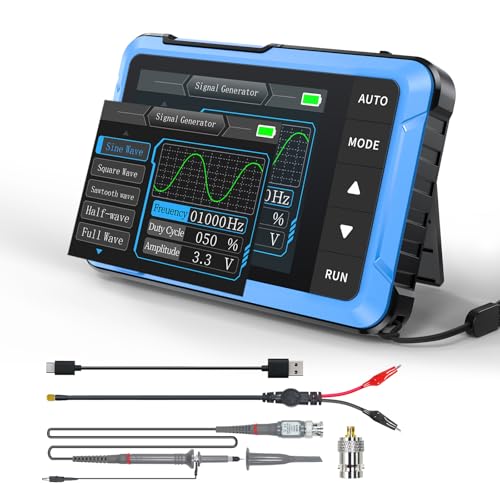
- 10 MHz bandwidth and 48 MS/s sampling
- Built-in DDS generator with 13 waveform types
- Compact, battery-powered design
Best For: Portable electronics checks and hobbyist benches
Best Advanced Mixed-Signal Pick
RIGOL DHO914 125MHz 4-Channel Oscilloscope
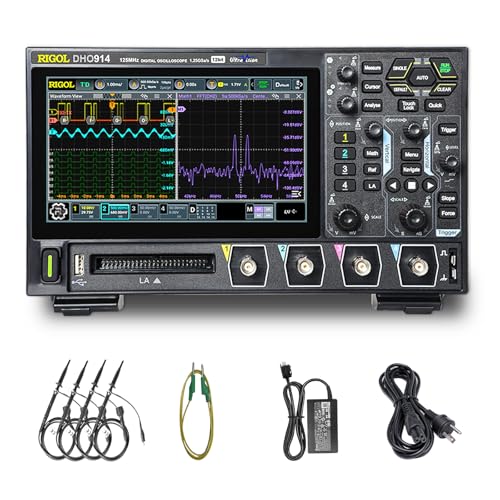
- 125 MHz, four channels, and 12-bit resolution
- Deep 50 Mpts memory and fast waveform capture
- Serial decode plus LAN, USB, and SCPI support
Best For: Embedded and power debugging on a capable bench
Best Traditional Bench Value
RIGOL DS1102Z-E 100MHz Oscilloscope

- 100 MHz bandwidth and 1 GSa/s sampling
- Deep memory with recording and playback
- Serial decoding for UART, I2C, and SPI
Best For: Two-channel electronics and embedded debugging
Bench-Ready 4-Channel Choice – Siglent SDS1104X-U
Siglent Technologies SDS1104X-U 100MHz Super Phosphor Digital Oscilloscopes 4 Channels
Check Price On AmazonFor oscilloscopes for small workbenches, the Siglent SDS1104X-U offers four channels in a compact 12.28-by-5.22-by-5.94-inch body. Its 100 MHz bandwidth, 1 GSa/s real-time sampling, and long record length make it suited to examining multiple signals without taking over the bench.
Best For: Small workbenches where four-channel measurement, serial-bus analysis, and a clear display are priorities.
Pros:
- Four channels with 100 MHz bandwidth
- Up to 1 GSa/s sampling and 14 Mpts record length
- Standard serial triggering and decoding for IIC, SPI, UART, CAN, and LIN
- 7-inch, 800-by-480 TFT-LCD display
Cons:
- Its feature set may be more than needed for basic two-channel work
- The supplied notes do not specify built-in signal-generation capability
This is a strong all-around bench instrument when channel count and protocol support matter. The compact dimensions and large screen balance space efficiency with practical waveform visibility.
Portable Multitool – FNIRSI 2C53T 3-in-1
The FNIRSI 2C53T is a practical option for oscilloscopes for small workbenches when one handheld device needs to cover more than waveform viewing. It combines a two-channel, 50 MHz oscilloscope with a multimeter and DDS signal generator in a 6.57-by-3.5-by-1.38-inch, 400-gram design.
Best For: Hobbyists, students, and repair users who want portable oscilloscope, multimeter, and signal-generator functions in one unit.
Pros:
- Three functions in one compact handheld instrument
- 50 MHz bandwidth, 250 MSa/s sampling, and automatic measurements
- 4.5-digit multimeter with voltage, current, resistance, capacitance, and continuity functions
- Built-in battery provides up to six hours of standby time
Cons:
- Two channels and 1 Kpts record depth are modest compared with larger bench scopes
- Its 2.8-inch display is smaller than typical desktop oscilloscope screens
- The signal generator output is limited to 50 kHz
This model prioritizes versatility and portability over deep memory or a large display. It makes especially good sense where bench space is limited and multimeter functions are used alongside basic scope measurements.
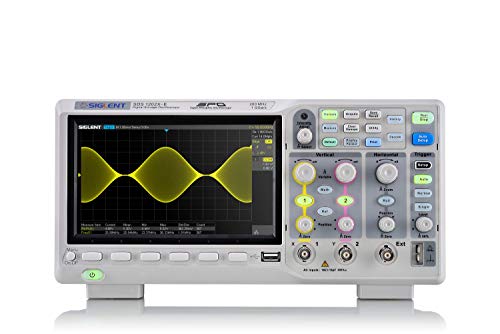
High-Bandwidth Bench Scope – Siglent SDS1202X-E 200 MHz
For a small workbench that still needs substantial bandwidth, the Siglent SDS1202X-E provides 200 MHz performance in a two-channel digital oscilloscope. It supports up to 1 GSa/s real-time sampling and a 14 Mpts record length, while retaining serial-bus analysis features.
Best For: Bench users who need higher bandwidth and long waveform records but can work with two channels.
Pros:
- 200 MHz bandwidth for faster signal work
- Up to 1 GSa/s real-time sampling
- 14 Mpts record length
- Serial triggering and decoding for IIC, SPI, UART, RS232, CAN, and LIN
Cons:
- Only two input channels
- At 5.5 pounds, it is less portable than the handheld option
- The supplied notes do not specify display size or resolution
This is the better fit when bandwidth is more important than maximum channel count. Its protocol support and deep record length add useful capability for embedded and digital troubleshooting on a compact bench.
Economy Development Scope – Hantek DSO2D15 150 MHz
The Hantek DSO2D15 is a cost-conscious choice among oscilloscopes for small workbenches. This two-channel model offers 150 MHz bandwidth and is positioned as a commissioning instrument for embedded systems, computers, communications, education, and related technical work.
Best For: Budget-minded users who need a two-channel scope for development, commissioning, education, or general electronics troubleshooting.
Pros:
- 150 MHz bandwidth in a two-channel format
- Supports arbitrary waveform output
- Includes 14 trigger modes
- Standard support for five serial-protocol triggers and decodes
Cons:
- Its 4.2-pound weight is less convenient for frequent relocation
- The supplied notes do not specify sampling rate or record length
- Only two channels are available
This Hantek emphasizes useful development features at an economy price. It is a sensible option when arbitrary waveform output and serial triggering are valuable, but the supplied specifications leave some performance details for the buyer to verify.
Compact Multitasker – FNIRSI 2C53P 3-in-1 Oscilloscope
For small workbenches, the FNIRSI 2C53P combines a two-channel oscilloscope, multimeter, and DDS signal generator in a compact handheld design. Its 4.3-inch touchscreen, one-key auto setup, and battery operation help reduce bench clutter while covering everyday testing and troubleshooting tasks.
Best For: Hobbyists, automotive troubleshooting, and compact workbenches that need several basic instruments in one device.
Pros:
- Combines a two-channel, 50 MHz oscilloscope with a 19999-count multimeter and signal generator.
- Supports 250 MS/s sampling, FFT analysis, X-Y mode, waveform storage, and export.
- Portable battery-powered design with a 4.3-inch IPS touchscreen and USB-C charging.
- Signal generator offers 12 waveforms up to 10 MHz.
Cons:
- Approximately four hours of battery life may require recharging during extended sessions.
- The signal generator’s maximum frequency is lower than the oscilloscope’s 50 MHz bandwidth.
The 2C53P is a practical space-saving choice when versatility matters more than the deep capture memory or larger display of a full desktop scope. It is especially appealing for quick measurements, field service, and general electronics work.
Desktop Debugging Workhorse – RIGOL DS1202Z-E 200 MHz Digital Oscilloscope
The RIGOL DS1202Z-E is a desktop-oriented option for small workbenches that need substantial memory and reliable waveform visibility. With two channels, 200 MHz bandwidth, 1 GSa/s sampling, and a 7-inch display, it is suited to detailed electronics debugging without requiring a larger laboratory setup.
Best For: Embedded development, electronics education, and bench debugging where deep memory and serial-bus tools are useful.
Pros:
- Provides 200 MHz bandwidth, two analog channels, and up to 1 GSa/s real-time sampling.
- Standard memory reaches 24 Mpts, or 12 Mpts with both channels, for longer captures.
- Up to 30,000 waveform captures per second helps expose intermittent glitches.
- Supports RS232/UART, I2C, and SPI triggering and decoding, plus USB and LAN connectivity.
Cons:
- Its desktop dimensions take more bench space than a handheld instrument.
- The supplied notes identify one included probe rather than a complete multi-channel probe set.
Choose the DS1202Z-E when a small workbench can accommodate a traditional scope and the priority is capture depth, display size, and connectivity. Its recording, playback, and protocol-decoding functions make it a strong fit for repeatable debugging workflows.
Advanced Portable Analyzer – FNIRSI DPOS350P 350 MHz 4-in-1 Oscilloscope
The FNIRSI DPOS350P packs advanced analysis tools into a portable two-channel instrument, making it a strong candidate for oscilloscopes for small workbenches where one device must handle varied tasks. Its 350 MHz bandwidth, 1 GSa/s sampling, touchscreen interface, spectrum analyzer, frequency response analyzer, and signal generator cover more than basic waveform viewing.
Best For: Signal-integrity work, EMI investigation, filter tuning, loop-stability testing, and bench-to-field use.
Pros:
- Offers 350 MHz bandwidth, 1 GSa/s sampling, 50,000 wfms/s refresh, and two channels.
- Includes FFT spectrum analysis with harmonic markers and 2D/3D waterfall views.
- Frequency response analyzer covers 10 Hz to 50 MHz for gain, phase, and Bode-plot work.
- Built-in DDS generator reaches 50 MHz, supports 14 waveforms, and stores custom clipping waveforms.
Cons:
- Its 47 Kpts record depth is substantially less than the RIGOL’s stated 24 Mpts maximum.
- At 3.56 pounds, it is portable but less lightweight than a typical handheld scope.
- The extensive feature set may be more than needed for simple voltage and frequency checks.
The DPOS350P is the most capable choice here for analysis-heavy work in a constrained space. It trades some recording depth and lightness for unusually broad functionality, including frequency-response testing, EMI-oriented spectrum views, and a capable signal generator.
Best Compact Starter – FNIRSI DSO510 Portable 2-in-1 Oscilloscope
For oscilloscopes for small workbenches, the FNIRSI DSO510 is a space-saving option that combines basic waveform viewing with a built-in DDS signal generator. Its compact, battery-powered design is convenient for quick checks at a bench or away from one.
Best For: Portable electronics checks, automotive work, and hobbyists who want an oscilloscope and signal generator in one small instrument.
Pros:
- Compact 99 × 68.3 × 19.5 mm body weighs about 10.2 ounces.
- 10 MHz bandwidth and 48 MS/s sampling rate support general-purpose measurements.
- Built-in DDS generator outputs 13 waveform types up to 50 kHz.
- Included 10X probe supports voltage measurements up to 400V, according to the supplied notes.
Cons:
- The 2.8-inch TFT display is much smaller than the screens on full-size bench scopes.
- Its 10 MHz bandwidth and 48 MS/s sampling rate are aimed at basic work rather than demanding high-speed analysis.
- The signal generator’s maximum output frequency is 50 kHz.
The DSO510 makes the most sense when bench space and portability matter more than advanced analysis. Its one-key auto setup, four-hour battery claim, and combined generator function make it a practical compact tool for routine troubleshooting.
Best Advanced Mixed-Signal Pick – RIGOL DHO914 125MHz 4-Channel Oscilloscope
Among oscilloscopes for small workbenches, the RIGOL DHO914 is the feature-rich choice for users who need substantial measurement capability in a relatively compact bench instrument. It pairs four analog channels with high-resolution acquisition, deep memory, and optional mixed-signal expansion.
Best For: Embedded bring-up, power-supply troubleshooting, timing correlation, and users who need advanced capture and protocol-analysis features.
Pros:
- 125 MHz bandwidth, four analog channels, 1.25 GSa/s sampling, and 12-bit vertical resolution.
- Up to 50 Mpts of memory helps preserve longer waveform captures.
- Supports waveform search/navigation, event tables, and up to 1,000,000 wfms/s acquisition.
- Standard serial trigger and decode support covers CAN/LIN/UART/I2C/SPI.
Cons:
- The 3.92-pound, 10.45-inch-wide chassis requires more bench room than a handheld scope.
- The 16 digital channels require the separately sold PLA2216 logic-analyzer probe.
- Digital channels do not support Slow sweep and Roll mode.
The DHO914 is a strong fit when a small workbench still needs serious debugging depth. Its seven-inch capacitive display, LAN and USB connectivity, web control, and SCPI support also make it suitable for structured lab or automation setups.
Best Traditional Bench Value – RIGOL DS1102Z-E 100MHz Oscilloscope
The RIGOL DS1102Z-E is a conventional two-channel bench scope for oscilloscopes for small workbenches where dependable debugging features matter. It offers 100 MHz bandwidth, deep memory, waveform recording, and common serial-bus tools without moving to a four-channel platform.
Best For: Electronics debugging, education labs, embedded development, and power-related bring-up using two analog channels.
Pros:
- 100 MHz bandwidth, 1 GSa/s sampling, and up to 24 Mpts of standard memory.
- Up to 30,000 wfms/s capture rate helps expose intermittent glitches.
- Seven-inch WVGA display uses intensity-graded color to make jitter and noise easier to see.
- Supports waveform recording/playback and RS232/UART, I2C, and SPI decoding.
Cons:
- It has only two analog channels, limiting simultaneous signal comparisons.
- At 8.83 pounds, it is less portable than compact handheld instruments.
- Its feature set is less extensive than the four-channel DHO914 for mixed-signal work.
The DS1102Z-E is a sensible middle ground for a small but established workbench. Its deep memory, recording tools, serial decode, LAN, and USB interfaces cover many everyday troubleshooting tasks while keeping the channel count straightforward.
How We Picked the Best Oscilloscopes for Small Workbenches
We focused on instruments that suit limited desk space without sacrificing the core features needed for electronics troubleshooting. The selection includes compact benchtop oscilloscopes and portable multifunction devices, with attention to bandwidth, channel count, sampling performance, display usability, signal-generation features, and practical versatility.
Specifications such as bandwidth and sampling rate are useful starting points, but they do not tell the whole story. A clear interface, accessible controls, suitable probes, and a manageable footprint can matter just as much when an oscilloscope is used regularly on a crowded bench.
Quick Comparison
| Type | Best suited to | Main advantage | Trade-off |
|---|---|---|---|
| Portable multifunction | Field work, automotive checks, hobby projects | Oscilloscope, meter, and generator in one device | Smaller displays and fewer bench-oriented controls |
| Two-channel benchtop | General electronics repair and development | Good balance of capability and desk space | Limited when comparing several signals at once |
| Four-channel benchtop | Embedded systems, power, and mixed-signal work | More simultaneous signal visibility | Typically larger and more expensive |
| High-bandwidth compact model | Faster digital edges and advanced troubleshooting | Greater signal-detail headroom | May cost more than basic projects require |
Key Buying Factors for Oscilloscopes for Small Workbenches
Bandwidth and Sampling Rate
Choose bandwidth based on the fastest signal edges you expect to measure, not only the nominal clock frequency. More bandwidth provides useful headroom, while a higher sampling rate helps capture waveform detail. For routine low-frequency analog and digital work, 50 to 100 MHz can be sufficient; faster designs benefit from additional margin.
Channel Count
Two channels cover many basic tasks, including comparing an input and output or checking a clock against a data line. Four channels are more useful for power-rail sequencing, motor control, buses, and embedded systems where several signals must remain visible together.
Size, Controls, and Display
Measure the available depth and width before buying. Portable models conserve space and often combine several tools, but compact screens can make detailed waveform analysis less comfortable. A benchtop unit with dedicated controls is usually faster for repeated measurements.
Extra Functions and Connectivity
A built-in DDS generator or multimeter can reduce the number of tools on a small bench. Also check probe quality, USB or other data connections, waveform storage, decoding options, and whether the interface supports your preferred workflow.
Who Should Buy Which Oscilloscopes for Small Workbenches?
Choose a portable multifunction model if space, mobility, and tool consolidation are your priorities. Select a two-channel benchtop scope for general repair, education, and hobby electronics. Move to a four-channel model when you routinely correlate multiple signals or work with more complex control systems. If you test fast edges or want longer-term capability, prioritize bandwidth and sampling headroom over the smallest possible enclosure.