SDI remains a dependable choice for cameras, switchers, and broadcast equipment, but getting that signal onto modern streaming platforms requires the right encoder. The best streaming encoders with SDI balance video quality, protocol support, reliability, and a workflow that fits your production.
Our roundup covers compact single-input models, dual-purpose HDMI/SDI units, recording-capable encoders, and professional options with features such as SRT, RTMP, NDI, 4K, and dual-input mixing. Use the guide below to narrow the choices based on your sources, destination, and production needs.
Best 10 Streaming Encoders with Sdi Picks for 2026
Versatile Multi-Protocol Pick

- Outputs up to four streams simultaneously
- Supports RTMP, SRT, HLS, RTSP, UDP, and more
- Offers extensive stream customization controls
Best For: Multi-platform broadcasting and customized SDI workflows
All-in-One Production Choice
AVMATRIX SE2017 Encoder/Recorder

- Combines 3G-SDI and HDMI inputs
- Streams and records up to 1080p60
- Includes USB capture and SD/USB recording
Best For: Portable productions needing streaming and recording
OLED Monitoring Value

- Outputs up to four streams simultaneously
- Includes OLED real-time status monitoring
- Supports SRT, RTMP(S), RTSP, HLS, and PoE
Best For: Multi-platform SDI streaming with at-a-glance monitoring
Two-Way Workflow Flexibility
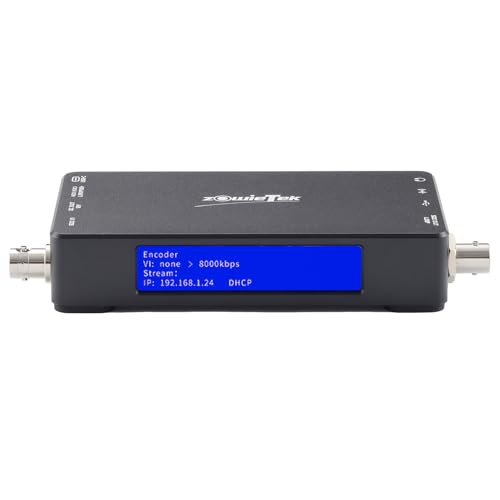
- Converts between SDI, IP streams, and UVC
- Supports SRT, RTMP(S), RTSP, and H.264/H.265
- Adds PoE, SDI loopout, and standalone operation
Best For: Professional SDI/IP/UVC production workflows
Best All-in-One Pick

- HDMI and SDI inputs with picture-in-picture or side-by-side mixing
- 4K encoding plus streaming to up to six destinations
- Simultaneous recording with overlays and onboard processing
Best For: Mixed-input live productions needing advanced routing and recording
Best Compact SDI-to-NDI Pick

- SDI-to-NDI and NDI-to-SDI conversion
- Standalone SRT, RTMP(S), and RTSP streaming
- Compact aluminum design with PoE and tripod mounting
Best For: Portable SDI extension and NDI|HX workflows
Best Broadcast-Focused 4K Pick
Blackmagic Streaming Encoder 4K
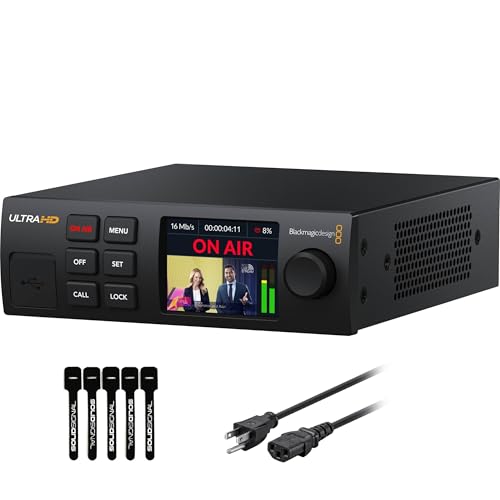
- 12G-SDI input with support up to DCI 4K60
- H.264/H.265 streaming over SRT or RTMP
- Ethernet and mobile connectivity with automatic failover
Best For: Professional 4K SDI streaming with resilient connectivity
Best 4K Dual-Input Pick

- 4K HDMI input up to 30fps
- 3G-SDI, HDMI, and USB connectivity
- NDI, SRT, and RTMP support
Best For: 4K-capable HDMI and SDI broadcasts
Best Multi-Platform SDI Value

- 1080p60 encoding support
- Up to three simultaneous streams
- Overlays and broad protocol support
Best For: Multi-platform 1080p live streaming
Best Stream-and-Record Combo

- Streams, records, and captures video
- HDMI and SDI inputs with loop-out
- 1080p60 recording and PoE support
Best For: Broadcasts requiring live streaming and local recording
Versatile Multi-Protocol Pick – URayCoder SDI IP Encoder
For buyers comparing streaming encoders with SDI, the URayCoder USE265-1L stands out for broad protocol support and flexible multi-stream output. Its 3G-SDI input can feed up to four streams simultaneously, with options for services and workflows using RTMP, SRT, HLS, RTSP, UDP, and more.
Best For: Broadcaster and live-streaming setups that need several simultaneous outputs and detailed stream customization.
Pros:
- Supports up to four video streams at the same time.
- Works with a wide range of protocols, including RTMP(S), SRT, HLS, RTSP, and UDP.
- Allows text, logos, timestamps, cropping, rotation, flipping, and other output adjustments.
- Includes lifetime technical support, warranty coverage, and SDK/API documentation.
Cons:
- Provides one SDI port, so it is not designed for multiple physical SDI inputs.
- The listed power plug is Type I, which may require compatibility planning in some regions.
This is a feature-rich choice when protocol flexibility and simultaneous distribution matter more than a simple, minimal setup.
All-in-One Production Choice – AVMATRIX SE2017 Encoder/Recorder
The AVMATRIX SE2017 is a practical option among streaming encoders with SDI because it combines 3G-SDI and HDMI connectivity with recording and USB capture. It supports up to 1080p60, can stream to as many as six platforms, and includes an OLED display and onboard controls for standalone operation.
Best For: Creators and small production teams that want streaming, local recording, HDMI/SDI flexibility, and webcam-style USB capture in one unit.
Pros:
- Accepts HDMI and 3G-SDI inputs and provides loop outputs.
- Supports streaming and recording up to 1080p60.
- Can stream to up to six platforms using RTMP, SRT, RTSP, HTTP-FLV, unicast, or multicast.
- Records to SD card or USB storage and provides USB-C video capture output.
Cons:
- Maximum listed resolution is 1920 x 1080, rather than 4K.
- Only a 3.5mm audio input is specified for external line audio.
With its recording slots, USB capture function, PoE-capable network port, and screen-based controls, the SE2017 is especially appealing for portable or compact production systems.
OLED Monitoring Value – ORIVISION ES901 SDI Encoder
The ORIVISION ES901 offers a focused SDI streaming workflow with an OLED status display and support for several common delivery protocols. For anyone evaluating streaming encoders with SDI, its ability to output up to four streams simultaneously and support PoE can simplify multi-platform or installation-based deployments.
Best For: SDI live broadcasters who want OLED monitoring, multi-stream output, PoE, and support for both standard and low-latency protocols.
Pros:
- Supports up to four simultaneous video streams.
- Includes HTTP, RTSP, UDP/RTP, RTMP(S), SRT, HLS, and FLV protocol support.
- OLED display provides real-time status information.
- Supports PoE and offers a three-year limited warranty with remote technical service.
Cons:
- The supplied details list one port and do not describe a second SDI input or loop output.
- The product details identify the connector type as HDMI despite the SDI encoder title, so buyers should verify the physical connection specification before ordering.
The ES901 is a sensible fit when live status visibility and simultaneous protocol delivery are priorities, but its connection details deserve careful verification before purchase.
Two-Way Workflow Flexibility – ZowieBox SDI Encoder Decoder
The ZowieBox is more than a one-way encoder: it converts SDI to SRT, RTMP(S), or RTSP, decodes IP streams back to SDI, and can also function as a UVC capture device. That makes it a distinctive option among streaming encoders with SDI for productions that move between professional SDI equipment, IP sources, and computer-based workflows.
Best For: Live-production teams that need SDI/IP conversion, UVC webcam functionality, low-latency SRT transport, and flexible power options.
Pros:
- Supports SDI-to-IP encoding and IP-to-SDI decoding.
- Provides SDI-to-UVC and UVC-to-SDI conversion for computer and broadcast workflows.
- Supports H.264/H.265 encoding, SDI loopout, and standalone operation.
- Offers PoE, USB Type-C, and DC power options, plus a tripod mount and tally light.
Cons:
- The unit is SDI-only for its professional video interface, without a listed HDMI input.
- Warranty coverage is listed as one year.
- The included power supply is specified for U.S. use only.
Choose the ZowieBox when bidirectional conversion and UVC integration are as important as streaming. Its broader workflow capabilities make it more specialized than a basic SDI-to-IP encoder.
Best All-in-One Pick – Magewell Ultra Encode AIO
For flexible streaming encoders with SDI, the Magewell Ultra Encode AIO stands out by combining SDI and HDMI inputs, 4K encoding, onboard processing, and multi-destination streaming in one rack-mountable unit. It is suited to live productions that need more than a basic point-to-point encoder.
Best For: Live production teams mixing SDI and HDMI sources while streaming and recording simultaneously.
Pros:
- Accepts HDMI and SDI inputs, with picture-in-picture and side-by-side mixing.
- Supports up to six simultaneous destinations and protocols including RTMP, RTMPS, SRT, NDI|HX, and HLS.
- Encodes up to 4K and can record to SD cards, USB storage, or network drives while streaming.
- Includes scaling, cropping, de-interlacing, and up to eight text, image, or clock overlays.
Cons:
- SDI input support reaches 4K at up to 30p, rather than 4K60.
- The 3.6-pound rack-mountable design is less compact than a simple portable encoder.
The Ultra Encode AIO is a strong choice when your workflow spans multiple input types and destinations. Its recording, overlay, networking, and control features add useful flexibility for complex productions.
Best Compact SDI-to-NDI Pick – Zowietek ZowieBox
The Zowietek ZowieBox is a compact option among streaming encoders with SDI, designed for SDI-to-NDI conversion, standalone streaming, and network-based SDI extension. Its aluminum enclosure, tripod mount, and PoE support make it practical for portable or distributed setups.
Best For: Compact SDI, NDI|HX, and LAN extension workflows that need flexible power options.
Pros:
- Converts SDI to NDI or NDI to SDI and supports NDI|HX3, NDI|HX2, and NDI|HX.
- Can stream independently from a computer using SRT, RTMP(S), or RTSP.
- Supports PoE, USB-C power, and DC output, with a standard tripod mount.
- Can turn UVC cameras into SDI sources at up to 1080p60 in decoding mode.
Cons:
- It cannot encode and decode at the same time; users must switch between modes.
- It supports NDI|HX formats but not full NDI|HB.
- The supplied notes specify a one-year hardware manufacturer warranty.
Choose the ZowieBox when size, network integration, and deployment flexibility matter more than 4K capability. Its mode-switching limitation is important, but its SDI extension and NDI|HX support are useful for compact production systems.
Best Broadcast-Focused 4K Pick – Blackmagic Streaming Encoder 4K
The Blackmagic Streaming Encoder 4K is a broadcast-oriented choice among streaming encoders with SDI, offering 12G-SDI input, 4K60 H.264 or H.265 streaming, standards conversion, and automatic Ethernet-to-mobile failover. It is built for productions that need monitoring and control features alongside internet delivery.
Best For: Professional SDI workflows requiring 4K60 streaming, standards conversion, and backup connectivity.
Pros:
- Supports 12G-SDI input up to DCI 4K60 with SDI loop output.
- Streams in H.264 or H.265 through SRT or RTMP without an encoding computer.
- Offers Gigabit Ethernet and USB-C smartphone tethering with automatic failover.
- Includes SDI and HDMI monitor outputs, closed-caption support, timecode, REST API control, and webcam output.
Cons:
- Its one-third-rack form factor and broadcast feature set may be more than simple streaming setups need.
- Remote camera control, tally, and talkback depend on compatible Blackmagic Design cameras and equipment.
- The supplied notes specify a one-year manufacturer warranty.
For SDI-based productions where uptime and signal-format flexibility are priorities, this encoder offers a particularly complete feature set. Its mobile failover, standards conversion, and 4K60 support make it well suited to demanding live workflows.
Best 4K Dual-Input Pick – E3 4K HDMI/3G-SDI Encoder
If you need streaming encoders with SDI and modern HDMI connectivity, the KILOVIEW E3 is a versatile option for higher-resolution productions. It supports 4K HDMI input at up to 30fps, 3G-SDI connectivity, and protocols including NDI HX3/HX2, SRT, and RTMP.
Best For: 4K-capable broadcasts, live productions using HDMI and SDI sources, and setups that benefit from PoE networking.
Pros:
- Supports up to 3840x2160p at 30fps through HDMI.
- Offers 3G-SDI and dual HDMI input/output connectivity.
- Includes NDI HX3/HX2, SRT, and RTMP support for flexible streaming.
- Provides a 1.14-inch LCD display with touch buttons for control and monitoring.
Cons:
- 4K support is listed at up to 30fps rather than 60fps.
- Its feature set may be more than needed for basic 1080p streaming.
Choose the E3 when resolution flexibility and broad protocol support matter. Its SDI and HDMI connections, PoE-capable Gigabit Ethernet, and onboard controls make it well suited to more involved broadcast systems.
Best Multi-Platform SDI Value – AVMATRIX SE1117 Encoder
The AVMATRIX SE1117 is a practical choice among streaming encoders with SDI for 1080p productions. It supports encoding up to 1080p60, multiple streaming protocols, graphic overlays, and up to three simultaneous video stream outputs.
Best For: Multi-platform 1080p streaming, online broadcasts, and productions needing overlays or HDMI loop-out monitoring.
Pros:
- Supports video encoding up to 1080p60.
- Can output up to three video streams simultaneously.
- Works with HTTP, RTSP, RTMP/RTMPS, SRT, UDP, RTP, multicast, and unicast protocols.
- Includes graphic overlays and HDMI loop-out functionality.
Cons:
- Its listed video resolution is limited to 1080p rather than 4K.
- The supplied details identify SDI connectivity but do not specify the number of SDI inputs or outputs.
The SE1117 stands out when distributing one production to several platforms is more important than 4K resolution. Its protocol range, three-stream capability, and overlay tools make it a flexible 1080p encoder for live content.
Best Stream-and-Record Combo – AVMATRIX SE2017 Encoder
For buyers comparing streaming encoders with SDI that can also record locally, the AVMATRIX SE2017 combines streaming, recording, and USB capture. It accepts HDMI and SDI sources, supports up to 1080p60, and offers RTMP, RTSP, UDP, HTTP-FLV, and SRT streaming options.
Best For: Conferences, church broadcasts, and other 1080p workflows that need live streaming plus USB or SD-card recording.
Pros:
- Combines streaming, recording, and USB capture in one device.
- Supports HDMI and SDI inputs with loop-out.
- Records MP4 or TS files to USB or SD card at up to 1080p60.
- Supports encoding bit rates up to 32Mbps and both PoE and DC power.
Cons:
- Maximum listed output resolution is 1920×1080.
- The line audio input does not support a microphone input.
The SE2017 is a strong fit when a single box needs to handle both online delivery and local capture. Its SDI/HDMI inputs, USB-C capture, recording formats, and dual power options support flexible 1080p broadcast setups.
How We Picked the Best Streaming Encoders with Sdi
We compared these models by looking at the features that matter most in real streaming workflows: SDI format support, maximum resolution and frame rate, encoding efficiency, streaming protocols, recording options, connectivity, and setup flexibility. We also considered whether each unit is best suited to a fixed installation, portable production kit, broadcast environment, or multi-platform workflow.
Protocol support is especially important. RTMP and RTMPS work with many mainstream platforms, while SRT can improve reliability over unpredictable networks. RTSP, UDP, HLS, and NDI may be more useful for local distribution, contribution feeds, or production systems.
Quick Comparison
| Best For | Features to Prioritize | Models in This Roundup |
|---|---|---|
| Basic SDI streaming | 1080p support, RTMP, simple setup | AVMATRIX SE1117, ZowieBox 3G SDI |
| Flexible broadcast workflows | SRT, RTMP/RTMPS, recording, multiple protocols | AVMATRIX SE2017, Magewell Ultra Encode AIO |
| NDI production | NDI support, SDI input, network integration | Zowietek ZowieBox NDI models |
| 4K production | 4K encoding, HEVC, high-bandwidth connectivity | Blackmagic Design, Magewell, E3 Dual-Channel |
Key Buying Factors for Streaming Encoders with Sdi
SDI Format and Signal Compatibility
Confirm whether your source uses SD-SDI, HD-SDI, or 3G-SDI, and check the supported resolution and frame-rate combinations. A 1080p60 workflow needs different capabilities than a 1080p30 or standard-definition source. Also verify whether the encoder accepts embedded SDI audio and how many audio channels it handles.
Resolution, Codec, and Bitrate
HEVC/H.265 can deliver comparable quality at lower bitrates than H.264, which is useful when upload bandwidth is limited. However, H.264 remains broadly compatible. If you produce in 4K, make sure the encoder supports your required frame rate, input format, and output protocol rather than assuming every 4K device offers the same workflow.
Streaming Protocols and Network Options
Choose an encoder that supports the destinations you actually use. RTMP or RTMPS is common for online platforms, SRT is valuable for resilient contribution, and NDI can simplify integration with compatible production software and hardware. Ethernet is generally preferable for fixed installations; mobile or wireless options can help with field production.
Recording and Production Features
Built-in recording, USB capture, dual-input mixing, OLED status displays, and simultaneous streaming can reduce the need for additional hardware. These extras are worthwhile when the encoder will serve as part of a larger production system, but a simpler unit may be easier to configure and maintain.
Who Should Buy Which Streaming Encoders with Sdi?
For straightforward 1080p SDI delivery, choose a compact encoder such as the AVMATRIX SE1117 or a ZowieBox 3G SDI model. They make sense for churches, classrooms, conference rooms, and fixed camera installations.
For a more flexible event or broadcast setup, the AVMATRIX SE2017 or Magewell Ultra Encode AIO are stronger choices because they combine broad protocol support with recording and more adaptable input options. Buyers building an NDI-centered studio should focus on the Zowietek ZowieBox NDI version.
For 4K productions, consider the Blackmagic Design, Magewell, or E3 models, but first verify your entire signal chain, network capacity, platform compatibility, and storage requirements. The best streaming encoder is the one that matches your source format and delivery workflow without adding unnecessary conversion steps.