Shopping for telescopes can feel overwhelming fast, especially when aperture, mount type, and portability all matter at once. The best choice depends on what you want to see and how often you’ll use it.
Below, we’ve selected 10 options that cover easy entry-level models, smarter smartphone-guided picks, and more capable scopes for deeper observing.
Best 10 Telescopes Picks for 2026
Beginner Travel Refractor

- 70mm aperture with fully coated optics
- Phone adapter, wireless remote, and carry bag included
- Lightweight starter build for travel and backyard use
Best For: Kids, beginners, and portable casual stargazing
Smartphone Guided Reflector
Celestron StarSense Explorer LT 114AZ
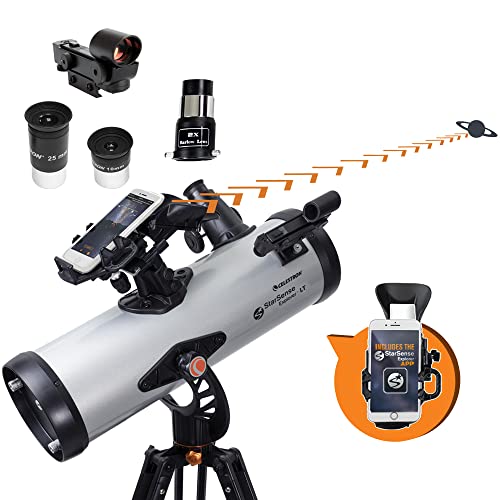
- Phone app guides you to sky targets
- 114mm reflector for Moon, planets, and bright deep-sky objects
- Includes eyepieces, Barlow lens, and warranty support
Best For: Beginners who want smartphone-assisted sky navigation
High-Powered Refractor Kit

- 90mm aperture with fully multi-coated optics
- Includes 10mm/25mm eyepieces, 3x Barlow, and phone adapter
- Carry bag and stainless steel tripod improve portability
Best For: Beginners wanting a brighter, more capable refractor
Portable Smart Astro Scope

- 1.85 lb compact smart telescope
- App control with Auto GOTO and built-in sky atlas
- EQ mode and cloud processing support imaging
Best For: Travelers and beginners who want easy smart astrophotography
Deep-Sky Starter Pick
Celestron AstroMaster 130EQ Telescope for Deep-Sky Beginners

- 130mm Newtonian reflector with aluminum and SiO₂ coatings
- Equatorial mount with slow-motion control knobs
- Includes 20mm/10mm eyepieces and StarPointer finder
Best For: Beginners ready to step up to deeper sky viewing
Portable Budget Viewer
Koolpte 80mm Telescope with Phone Adapter and Tripod

- 80mm aperture with fully multi-coated optics
- Includes 25mm/10mm eyepieces, 3x Barlow, and finder scope
- Comes with phone adapter, remote, bag, and tripod
Best For: Beginners who want portability and easy smartphone viewing
Smartphone Navigation Choice
Celestron StarSense Explorer DX 130AZ with App Guidance

- Uses StarSense app and smartphone sky recognition
- 130mm reflector for Moon, planets, and deep-sky objects
- Dual-axis slow-motion controls and included eyepieces
Best For: Users who want app-guided target finding
Starter-Friendly 90mm Refractor

- 90mm fully coated objective lens
- 32×–240× magnification with Barlow lens
- Includes tripod, phone adapter, and bag
Best For: Beginners and families wanting a portable starter scope
Advanced Computerized SCT

- 8-inch Schmidt-Cassegrain optics
- GoTo mount with 40,000+ object database
- SkyAlign setup speeds alignment
Best For: Upgraders who want computerized deep-sky and planetary viewing
Portable Beginner Refractor
Celticbird 80mm 600mm Telescope

- 80mm aperture with fully coated optics
- Includes backpack, tripod, phone adapter, and moon filter
- 30× and 66× eyepieces for basic viewing
Best For: Beginners and kids who want a portable, easy-to-use scope
Beginner Travel Refractor – Gskyer 70mm Kids Telescope
If you want one of the more approachable telescopes for casual moon-and-star viewing, this Gskyer refractor keeps things simple with a 70mm aperture, 400mm focal length, and a travel-friendly kit. It’s aimed at kids and beginners, and the included smartphone adapter, wireless remote, and carry bag make it easy to bring along for backyard observing or trips.
Best For: Kids, first-time users, and families who want a portable starter telescope with phone-friendly features.
Pros:
- 70mm aperture and fully coated optics for bright beginner views
- Includes two eyepieces plus a 3x Barlow lens for more magnification options
- Phone adapter and wireless remote support simple smartphone photography
- Carry bag and adjustable aluminum tripod make it easy to transport
Cons:
- Manual altazimuth setup is better for learning than for advanced tracking
- Shorter 400mm focal length limits reach versus larger telescopes
Overall, this is a practical entry-level pick if you want a lightweight telescope that’s easy to pack, simple to use, and built around basic stargazing and phone snapshots.
Smartphone Guided Reflector – Celestron StarSense Explorer LT 114AZ
Among beginner-friendly telescopes, this Celestron model stands out because your smartphone does the hard part of finding targets. The StarSense Explorer app uses sky recognition to guide you to objects, while the 114mm Newtonian reflector and coated mirrors are set up to show the Moon, planets, and brighter deep-sky sights with clear detail.
Best For: Beginners who want an easier way to find objects in the night sky with smartphone guidance.
Pros:
- StarSense Explorer app gives on-screen arrows and target guidance
- 114mm reflector is suited to Moon, planets, and bright deep-sky objects
- Includes 25mm and 10mm eyepieces plus a 2x Barlow lens
- Backed by a 2-year warranty and US-based support
Cons:
- Manual altazimuth mount still requires hands-on aiming
- Best performance depends on using the smartphone app
If you want a telescope that helps you locate targets faster without jumping into a complicated setup, this Celestron is a smart beginner choice with useful app-based guidance.
High-Powered Refractor Kit – MEEZAA 90mm 800mm Telescope
If you’re comparing telescopes for a stronger beginner-to-hobbyist upgrade, this MEEZAA refractor brings a larger 90mm aperture and 800mm focal length to the table. It comes with two eyepieces, a 3x Barlow lens, a phone adapter, and a carry bag, so it’s set up for backyard observing, camping, and simple photo capture.
Best For: Beginners and casual astronomy users who want more light-gathering power in a portable refractor package.
Pros:
- 90mm aperture and fully multi-coated optics for brighter views
- 800mm focal length with 10mm and 25mm eyepieces plus a 3x Barlow lens
- Includes phone adapter, carry bag, and adjustable stainless steel tripod
- Paper manual and advertised quick setup make assembly easier
Cons:
- Manual focus and altazimuth mount are less automated than smart models
- More powerful magnification still depends on steady setup and alignment
This is a solid all-around option if you want a bit more aperture and reach than a basic starter scope, while still keeping the kit portable and beginner friendly.
Portable Smart Astro Scope – DWARFLAB Dwarf Mini Telescope
For telescopes that prioritize portability and smart imaging, the DWARF Mini is very different from a traditional tube-and-eyepiece setup. It weighs just 1.85 lbs, uses app control with built-in sky atlas, and adds Auto GOTO, 360° pivoting, and EQ mode for long-exposure imaging and easier target capture.
Best For: Travelers, beginners, and families who want a compact smart telescope for easy astrophotography.
Pros:
- Extremely lightweight and pocket-friendly at 1.85 lbs
- App control with built-in sky atlas speeds up first-time use
- Auto GOTO, 360° pivot, and EQ mode support advanced observing and imaging
- Includes light pollution filtering and cloud processing features
Cons:
- 30mm objective is much smaller than traditional beginner telescopes
- Digital workflow may appeal less to users wanting a classic optical experience
This is a strong pick if your main goal is a compact, modern telescope that makes sky photography and easy target finding more accessible than a conventional setup.
Deep-Sky Starter Pick – Celestron AstroMaster 130EQ Telescope for Deep-Sky Beginners
If you want one of the most capable beginner telescopes for exploring the night sky, the Celestron AstroMaster 130EQ is built around a 130mm Newtonian reflector and a stable equatorial mount. It’s a practical choice if you want brighter views of the Moon and a better shot at deep-sky objects without moving into a complicated setup.
Best For: Beginners who want a more serious visual astronomy telescope with manual controls and strong light gathering.
Pros:
- 130mm optics provide solid light-gathering for Moon, planets, and deep-sky targets.
- Equatorial mount with slow-motion knobs helps with smooth, accurate pointing.
- Quick setup with no tools required makes it easy to get observing fast.
- Includes 20mm and 10mm eyepieces plus a StarPointer red dot finderscope.
Cons:
- Manual operation means you’ll need to learn basic aiming and tracking.
- Bigger and heavier than entry-level tabletop scopes at 17 pounds.
Overall, this is a strong first serious telescope for buyers who want better optics and control than ultra-basic beginner models. The included accessories and stable mount make it a sensible step up for backyard astronomy.
Portable Budget Viewer – Koolpte 80mm Telescope with Phone Adapter and Tripod
The Koolpte telescope is a straightforward option for casual astronomy, combining an 80mm aperture, 600mm focal length, and fully multi-coated optics in a portable package. It’s designed for easy setup and simple use, making it a practical pick for beginners who want a travel-friendly telescope with phone-capture support.
Best For: New users who want a lightweight telescope with easy setup and smartphone-friendly features.
Pros:
- 80mm aperture and fully multi-coated optics help improve brightness and clarity.
- Includes 25mm and 10mm eyepieces plus a 3x Barlow lens for more magnification options.
- Phone adapter, wireless remote, tripod, and carrying bag make it easy to transport and use.
- No-tool assembly is a plus for first-time telescope owners.
Cons:
- Altazimuth mount is simpler, but less advanced than equatorial tracking setups.
- Best suited to casual observing rather than highly specialized astronomy use.
For buyers who value convenience over complexity, this model covers the basics well. It offers a flexible entry point into telescopes without making setup or portability a chore.
Smartphone Navigation Choice – Celestron StarSense Explorer DX 130AZ with App Guidance
The Celestron StarSense Explorer DX 130AZ stands out among telescopes because it uses your smartphone to help you find targets in the sky. With a 130mm Newtonian reflector, dual-axis slow-motion controls, and app-guided alignment, it’s built for people who want a simpler path to locating planets, nebulae, galaxies, and star clusters.
Best For: Beginners and casual observers who want smartphone-assisted sky navigation.
Pros:
- StarSense Explorer app helps guide you to targets with on-screen arrows and sky recognition.
- 130mm reflector delivers bright views of the Moon, planets, and deep-sky favorites.
- Dual-axis slow-motion controls improve manual tracking once you reach your target.
- Includes 25mm and 10mm eyepieces, red dot finder, and preassembled mount and tripod.
Cons:
- Requires a smartphone for the app-guided experience to shine.
- Still a manual telescope, so tracking is not fully automatic.
This is a smart pick if you want a telescope that helps you spend less time searching and more time observing. The app-driven targeting makes it especially appealing for users who are new to backyard astronomy.
Starter-Friendly 90mm Refractor – Dianfan 90mm 800mm Telescope
If you want a practical beginner option in telescopes, the Dianfan 90mm refractor gives you a larger aperture, a long 800mm focal length, and an easy setup that makes it straightforward to start observing. It is built for mixed use, so you can use it for the Moon, basic planetary viewing, and even daytime targets like wildlife or cityscapes.
Best For: Beginners and families who want a portable, easy-to-set-up telescope with strong all-around value.
Pros:
- 90mm fully coated objective lens helps gather more light for brighter, clearer views.
- Includes two eyepieces, a 3× Barlow lens, and a 45° zenith mirror for 32×–240× viewing and upright terrestrial images.
- Quick assembly and smooth manual focusing make it beginner-friendly.
- Comes with a stainless steel tripod, phone adapter, and carrying bag for portability.
Cons:
- Manual focus and altazimuth mount mean you’ll be doing the tracking yourself.
- Best suited to casual observing rather than advanced astronomy setups.
Overall, this is a well-rounded entry-level telescope for shoppers who want simple setup, decent light-gathering power, and flexible use beyond the night sky.
Advanced Computerized SCT – Celestron NexStar 8SE
Among telescopes for serious hobbyists, the Celestron NexStar 8SE stands out for its 8-inch Schmidt-Cassegrain optics and fully computerized GoTo mount. It is designed to make finding objects easier, with a large built-in database and fast SkyAlign setup for observers who want more performance without giving up portability.
Best For: Experienced beginners and upgraders who want a computerized telescope with strong deep-sky and planetary capability.
Pros:
- Large 8-inch aperture gathers plenty of light for lunar detail, Jupiter, and deep-sky objects.
- GoTo mount with NexStar+ hand control can automatically slew to and track objects from a 40,000+ object database.
- SkyAlign makes setup faster by using any three bright stars or planets.
- Compact SCT design is relatively portable for its aperture size.
Cons:
- Heavier and larger than beginner refractors, so it is less grab-and-go.
- Batteries or external power are required and are not included.
This is a strong step-up telescope for users who want automation, a big aperture, and a proven system that can grow with more accessories later.
Portable Beginner Refractor – Celticbird 80mm 600mm Telescope
If you’re shopping telescopes for beginners and want something easy to carry, the Celticbird 80mm refractor keeps things simple with a portable design, included backpack, and quick assembly. Its 80mm aperture and coated optics are aimed at brighter, clearer views of the Moon, Saturn, and Jupiter.
Best For: Beginners, kids, and casual observers who want a portable telescope with simple setup and useful accessories.
Pros:
- 80mm aperture with fully coated optics helps improve light transmission and image clarity.
- Includes a backpack, adjustable aluminum tripod, phone adapter, and moon filter.
- Easy to assemble with no tools required, based on the supplied manual and video.
- Two eyepieces provide 30× and 66× magnification for basic lunar and planetary viewing.
Cons:
- Shorter 600mm focal length limits reach compared with larger-aperture models.
- Manual altazimuth mounting means you’ll need to guide the scope by hand.
For shoppers who want an affordable-feeling, travel-ready telescope that is simple to learn, this one covers the basics well without adding complexity.
How We Picked These Telescopes
We focused on the features that matter most to real buyers: optical aperture, mount stability, ease of setup, portability, and the viewing experience each design is best suited for. We also favored Telescopes that make sense for beginners without ignoring more advanced users who want better deep-sky performance.
That means you’ll see a mix of lightweight refractors for simple grab-and-go use, Newtonian reflectors for more light-gathering power, and computerized or smartphone-guided models for easier target finding.
Quick Comparison of the Telescope Types
Refractor Telescopes are usually the easiest to use and maintain, making them a solid choice for moon, planets, and casual backyard viewing. Reflectors typically offer better aperture for the money, which helps with faint deep-sky objects. Smart Telescopes and guided models reduce the learning curve, while larger computerized designs are better if you want a more ambitious observing setup.
Key Buying Factors for Telescopes
Aperture
Aperture is one of the most important specs because it determines how much light the telescope collects. Bigger apertures usually mean brighter, more detailed views, especially on nebulae, galaxies, and globular clusters.
Mount Type
An unstable mount can ruin an otherwise good telescope. Alt-azimuth mounts are simpler and more intuitive, while equatorial mounts can be helpful for tracking, especially if you plan to spend more time on astronomy. Computerized mounts add convenience but also increase cost and setup complexity.
Portability and Setup
If a telescope is too heavy or complicated, it often stays in the closet. Beginners and families may prefer lighter, faster setups, while dedicated observers may accept more weight in exchange for better optical performance.
Ease of Finding Objects
Smartphone-guided systems, built-in alignment features, and go-to functionality can make a big difference for first-time buyers. These features are especially useful if you want less frustration and more time actually observing.
Who Should Buy Which Telescopes?
If you want the easiest path into astronomy, choose a simple refractor or a guided model with a straightforward mount. If you care most about deep-sky views, look for a reflector with a larger aperture and a sturdy base. If portability matters, a compact smart telescope may be the best fit. And if you want a long-term backyard setup with room to grow, a larger computerized telescope is worth the investment.
For most buyers, the right telescope is the one you’ll use often. Balance optical power with setup time, comfort, and how much effort you want to spend learning the sky.