A good thermal camera can help mechanics spot overheating components, uneven brake temps, electrical faults, and hidden heat loss before those issues turn into bigger repairs.
Below, we break down the best options for shop use so you can choose a thermal imaging tool for mechanics that fits your workflow, budget, and inspection needs.
Best 10 Thermal Imaging Tool for Mechanics Picks for 2026
Rugged Detail Pick
TOPDON TC004 3.5" Thermal Imaging Camera

- 3.5-inch screen for easier viewing
- TISR boosts 256×192 to 512×384
- 64GB storage plus Wi-Fi reporting
Best For: Mechanics needing detailed thermal images and tough field reliability
Compact Toolbox Choice
Klein Tools TI250 Rechargeable Thermal Imaging Camera

- Over 19,200 pixels for hot/cold spotting
- Adjustable emissivity improves accuracy
- Rechargeable battery with carrying case
Best For: Mechanics who want a compact thermal imager for quick checks
All-Around Shop Scanner
FOXWELL RT280 Thermal Imaging Camera

- TISR-enhanced thermal clarity
- Windows PC analysis with reports
- Over 20,000 images on 8GB eMMC
Best For: Mechanics needing a balanced camera for diagnosis and reporting
Lightweight Long-Haul Pick

- Ultra-light 240g body
- Thermal imaging plus thermometer mode
- Up to 14 hours of runtime
Best For: Mechanics who need a lightweight camera for long inspection sessions
Compact Thermal Inspector

- 128x128 thermal imaging enhanced to 240x240
- 25Hz refresh and temp alerts with auto photo capture
- 15-hour battery life in a pocket-size body
Best For: Mechanics and DIY users needing a portable, easy-to-carry thermal camera
Rugged Spot Scanner

- 80x60 IR sensor with -25°C to 300°C range
- MSX adds visible detail and bullseye laser helps aim
- IP54 rugged body for dirty shop environments
Best For: Mechanics and HVAC users who want a simple, durable thermal scanner
High-Detail Diagnostic Camera

- 256x192 detector boosted to 640x480 super resolution
- Wi-Fi app pairing plus Windows PC analysis software
- Intelligent scene detection for leaks and insulation issues
Best For: Users needing higher-detail thermal imaging and reporting tools
Phone-Based Pick
GOYOJO USB-C Thermal Camera for iPhone and Android

- 192x192 IR resolution
- Wide 50° field of view
- -4°F to 752°F range
Best For: Quick phone-based thermal checks for automotive and maintenance work
All-in-One Diagnostic Pick
FIXCHIGO 2-in-1 Thermal Camera With Multimeter

- Thermal camera plus 20,000-count multimeter
- IRS256x192 pixels with 427x320 display
- Supports AC/DC voltage, resistance, and more
Best For: Technicians who want thermal imaging and electrical testing in one unit
Fusion Imaging Pick
GH192 Thermal Camera With Fusion Imaging
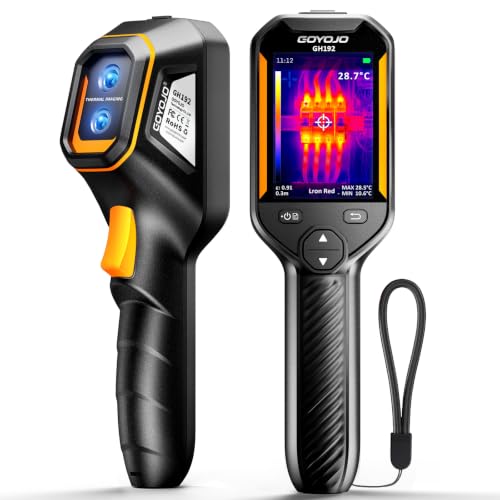
- 240x240 thermal resolution with 2MP visible camera
- Fusion imaging plus temp alarms
- 8-hour runtime with IP54 and drop resistance
Best For: Hands-on inspections that benefit from fusion imaging and temperature alerts
Rugged Detail Pick – TOPDON TC004 3.5" Thermal Imaging Camera
If you want a thermal imaging tool for mechanics that balances image clarity, storage, and ruggedness, the TOPDON TC004 is built for busy inspection work. Its 3.5-inch display, TISR-enhanced resolution, and red laser pointer make it easier to spot hot areas and line up what you see on screen with the real-world target.
Best For: Mechanics and technicians who want a durable handheld thermal camera with strong image detail and long onboard storage.
Pros:
- 3.5-inch display offers a larger, easier-to-read viewing area during inspections.
- 256×192 infrared resolution enhanced to 512×384 with TISR for sharper thermal detail.
- 64GB built-in storage supports thousands of images and videos for documentation.
- Wi-Fi transfer and PC analysis help speed up reporting and review.
Cons:
- Higher-end feature set may be more than casual users need.
- Heavier-duty design and extras can make it less minimal than simple spot tools.
The TC004 stands out when you need a practical inspection camera that can take daily field use seriously. For mechanics who value visibility, documentation, and rugged build quality, it offers a well-rounded setup.
Compact Toolbox Choice – Klein Tools TI250 Rechargeable Thermal Imaging Camera
The Klein Tools TI250 is a compact thermal imaging tool for mechanics who want a simple rechargeable camera for spotting hot and cold areas. With over 19,200 pixels, adjustable emissivity, and user-selectable temperature alarms, it focuses on practical troubleshooting rather than extra complexity.
Best For: Technicians who want a small, rechargeable thermal imager for quick temperature checks and easy carry.
Pros:
- Over 19,200 pixels support accurate hot-spot and cold-spot analysis.
- Adjustable emissivity helps improve readings across different surfaces and materials.
- User-selectable high and low temperature alarms add monitoring flexibility.
- Rechargeable battery and included case make it easy to keep in the toolbox.
Cons:
- Screen and feature set are more compact than some larger inspection cameras.
- USB-C saving is useful, but storage and sharing options are more basic than wireless models.
This is a straightforward option if you want a dependable handheld thermal camera without a lot of setup. It suits mechanics who need portability, alerting, and a familiar tool-brand package.
All-Around Shop Scanner – FOXWELL RT280 Thermal Imaging Camera
The FOXWELL RT280 is a thermal imaging tool for mechanics that combines a clear display, useful analysis features, and rugged portability. Its TISR-enhanced resolution, laser pointer, LED light, and PC software make it well suited for diagnosing mechanical faults, engine issues, and other inspection tasks.
Best For: Mechanics who want a feature-rich thermal camera with software analysis and strong all-around inspection tools.
Pros:
- 2.8-inch LCD with TISR-enhanced effective resolution helps reveal small temperature differences.
- PC software supports point, line, and area analysis plus report generation.
- Stores over 20,000 images and videos in built-in 8GB eMMC memory.
- Laser pointer, LED light, and IP54/drop resistance support field use.
Cons:
- PC analysis is Windows-only, so Mac users are not supported.
- 8GB storage is solid, but smaller than some higher-capacity options.
The RT280 is a smart middle-ground choice when you want more than a basic thermal imager but do not need the most expensive setup. It brings together inspection clarity, documentation, and rugged handling in one portable unit.
Lightweight Long-Haul Pick – GT14S Thermal Imaging Camera
If battery life and portability matter most, this thermal imaging tool for mechanics is built to stay comfortable in hand and keep working all day. The GT14S combines thermal imaging and thermometer mode, making it useful both for broad scans and for quick point temperature checks.
Best For: Technicians who want an ultra-light thermal camera with long runtime and simple dual-mode operation.
Pros:
- Ultra-light 240g design makes extended handheld use easier.
- Thermal imaging plus thermometer mode adds flexibility for different inspection styles.
- Up to 14 hours of battery life supports long workdays.
- NETD < 50mK, adjustable emissivity, and 50° FOV help with subtle temperature checks.
Cons:
- Storage capacity is not highlighted in the supplied specs.
- Some users may prefer a larger screen or more advanced reporting features.
The GT14S is appealing if you want a lightweight, easy-to-use thermal camera that can stay in service for long inspections. It is especially practical for mechanics who value comfort, fast scanning, and flexible temperature readouts.
Compact Thermal Inspector – TOPDON TC004 Mini
If you want a thermal imaging tool for mechanics that’s easy to carry but still gives you useful detail, the TOPDON TC004 Mini is built around portability and practical diagnostics. It starts at 128×128 thermal imaging and uses TISR to enhance to 240×240, with a 25Hz refresh rate for smoother viewing during quick inspections.
Best For: Mechanics and DIY users who want a pocket-friendly thermal camera for general troubleshooting, electrical checks, and routine leak or hot-spot inspections.
Pros:
- 128×128 thermal imaging enhanced to 240×240 with TISR for improved detail
- 25Hz refresh rate and 40° x 30° field of view for smoother, wider inspections
- High/low temperature alerts with automatic photo capture when thresholds are exceeded
- Long 15-hour battery life with auto shut-off options to conserve power
Cons:
- No charging head included in the box
- Built-in storage is limited to the device’s internal 512MB eMMC memory
Overall, the TC004 Mini makes sense if you value convenience, long runtime, and alert-driven diagnostics more than the highest native resolution. Its rugged, pocket-size design and broad temperature range make it a practical entry-level option for everyday work.
Rugged Spot Scanner – FLIR TG165-X
The FLIR TG165-X is a practical thermal imaging tool for mechanics who want fast temperature checks and clearer target identification. Its 80×60 IR sensor covers -25°C to 300°C, while FLIR’s MSX technology adds visual detail to help make thermal images easier to read.
Best For: Mechanics, HVAC techs, and building inspectors who want a rugged, simple thermal scanner with a laser pointer for faster spot checks.
Pros:
- MSX technology improves image clarity by embossing visual details onto thermal images
- Bullseye laser pointer helps indicate the measurement area
- Rugged IP54 enclosure is designed to resist dirt, dust, and oil
- Measures from -25°C to 300°C for common inspection tasks
Cons:
- 80×60 IR resolution is lower than newer higher-resolution thermal cameras
- Best suited to spot measurements rather than advanced imaging workflows
If you need a straightforward scanner that favors durability and speed over advanced features, the TG165-X fits that role well. It’s a dependable choice for everyday mechanical and HVAC troubleshooting where quick readings matter most.
High-Detail Diagnostic Camera – HSFTOOLS F2W
For mechanics who want a more advanced thermal imaging tool for mechanics, the HSFTOOLS F2W offers a strong mix of resolution, software support, and anomaly detection. It uses a 256×192 detector with live super resolution up to 640×480, plus a 3.2-inch screen and 25Hz refresh rate for smooth inspection work.
Best For: Users who need higher-detail thermal imaging, app sharing, and PC-based analysis for deeper diagnostic work.
Pros:
- 256×192 IR resolution enhanced to 640×480 super resolution
- Intelligent Scene Detection helps flag leaks and insulation issues
- Wi-Fi app support and Windows PC software for analysis and reporting
- Wide -4°F to 1022°F range with hotspot, cold spot, and user spot readings
Cons:
- More feature-rich than a basic handheld scanner, so it may be more than some users need
- App and PC workflow may add setup steps compared with simpler models
The F2W stands out when you want better image detail and more diagnostic tools in one package. For workshop users who review images, share findings, or document faults, its software ecosystem adds real value.
Phone-Based Pick – GOYOJO USB-C Thermal Camera for iPhone and Android
If you want a thermal imaging tool for mechanics that stays compact and easy to carry, this GOYOJO USB-C camera turns a compatible phone into a pocket thermal imager. It’s aimed at quick scans for hot spots, leaks, and overheating parts, with enough resolution and temperature range to handle common automotive and maintenance checks.
Best For: Mechanics and DIYers who want a phone-based thermal camera for fast under-hood and around-the-shop diagnostics.
Pros:
- 192×192 infrared resolution for clearer thermal detail.
- Wide 50° field of view helps scan larger areas faster.
- Measures from -4°F to 752°F, covering many automotive and electrical tasks.
- USB-C plug-and-play design keeps setup simple with no batteries or pairing.
Cons:
- Requires a compatible Android or iPhone 15/16/17 series device.
- Uses the phone as the display, which may not suit everyone.
- Less feature-rich than full handheld thermal imagers with built-in screens.
For users who value portability and quick access over a standalone body, this is a practical entry point into thermal diagnostics. It fits well for spot-checking electrical hotspots, engine heat, and other routine inspection jobs.
All-in-One Diagnostic Pick – FIXCHIGO 2-in-1 Thermal Camera With Multimeter
This thermal imaging tool for mechanics combines infrared imaging with a 20,000-count multimeter, making it a strong all-in-one option for troubleshooting. The built-in screen and saved images mean you can inspect hot spots, document findings, and test electrical values without relying on a phone.
Best For: Mechanics and technicians who want thermal imaging plus electrical testing in one portable handheld device.
Pros:
- 2-in-1 design combines thermal imaging and multimeter functions.
- IRS256x192 thermal pixels with 427×320 display resolution for detailed viewing.
- Measures from -20°C to 550°C and includes 15 color palettes.
- Supports AC/DC voltage, resistance, capacitance, diode, frequency, and duty cycle tests.
Cons:
- Bulkier than a simple phone-connected thermal imager.
- Built for utility over advanced imaging features like fusion or visual camera overlays.
- Operation may take a little learning if you are only using basic thermal scans.
If you need one tool that can help with both heat diagnostics and electrical measurements, this model is a practical shop companion. It is especially useful when you want to move between thermal inspection and meter testing without switching devices.
Fusion Imaging Pick – GH192 Thermal Camera With Fusion Imaging
For a thermal imaging tool for mechanics that adds more on-screen detail, the GH192 stands out with fusion imaging, a visible camera, and auto temperature tracking. It is built for faster inspections where you want a clear picture of both the heat pattern and the physical target.
Best For: Mechanics and inspectors who want a handheld thermal imager with fusion viewing and temperature alarms.
Pros:
- 240×240 thermal resolution with a 2MP visible camera and fusion imaging.
- Auto center, min, and max temperature tracking with high/low alarms.
- 25Hz refresh rate and 2.8-inch IPS display for responsive viewing.
- Rugged design includes 8-hour runtime, USB-C charging, IP54 protection, and 6.6-foot drop resistance.
Cons:
- Higher-end feature set may be more than casual users need.
- Accuracy is listed at ±2°C, which is less precise than some specialized tools.
- Best results depend on adjusting emissivity correctly for the material.
This model makes sense when you want a more complete inspection workflow and clearer visual context during troubleshooting. Its alarms, fusion modes, and durable build make it a strong fit for shop and field use alike.
How We Picked the Best Thermal Imaging Tool for Mechanics
We focused on tools that make real diagnostic work easier: dependable thermal resolution, useful temperature ranges, fast refresh rates, readable displays, and battery life that can handle a full shift. We also favored models with practical features such as spot readings, fusion views, laser targeting, high/low alarms, and rugged builds suited to a busy garage.
Quick Comparison: What Matters Most
For most buyers, the best Thermal Imaging Tool for Mechanics balances image clarity and speed. Higher-resolution sensors make it easier to distinguish hot connectors, seized bearings, and uneven exhaust or brake temperatures. A 25Hz refresh rate helps when scanning moving parts or checking a running engine. If you work in bright bays or outdoors, display quality and contrast matter almost as much as sensor specs.
Key Buying Factors for a Thermal Imaging Tool for Mechanics
Resolution and Image Detail
Look for enough thermal detail to separate small hotspots from background heat. Lower-resolution tools can still be useful for quick checks, but higher-resolution models are easier to trust when you need to narrow down the exact failure point.
Temperature Range and Accuracy
A wide temperature range is important in automotive diagnostics because you may inspect both cold-start behavior and very hot components. Check that the camera covers the temperatures you commonly see on engines, brakes, HVAC parts, and electrical circuits.
Ergonomics and Battery Life
A compact, lightweight camera is easier to use in tight engine bays and under-vehicle inspections. Battery life matters too, especially if you move between vehicles all day or rely on the camera for longer diagnostic sessions.
Helpful Shop Features
Features like high/low temperature markers, fusion or visible-light overlays, and alarm alerts can speed up diagnosis. For some users, a spot thermometer or multimeter integration is especially valuable because it combines thermal and electrical testing in one workflow.
Who Should Buy Which Thermal Imaging Tool for Mechanics?
Mobile techs and general repair shops often benefit from a balanced handheld model with solid resolution, long runtime, and straightforward controls. Electrical-focused mechanics may prefer tools with strong hotspot detection, alarms, and clearer overlays for tracing load-related heat. If you mainly need quick spot checks, a simpler and more affordable Thermal Imaging Tool for Mechanics can still deliver strong value without the extra complexity.
Choose the most capable camera you can justify for your day-to-day work, but prioritize usability over headline specs if you want faster diagnostics and fewer missed clues.