The RIX Titan-T3 Review 2026 centers on a specialized thermal monocular with a 25mm lens, 384×288 detector, laser rangefinder, and integrated ballistic calculator.
It is aimed at buyers who need a clear nighttime spotting tool with practical distance data, not a general-purpose camera.
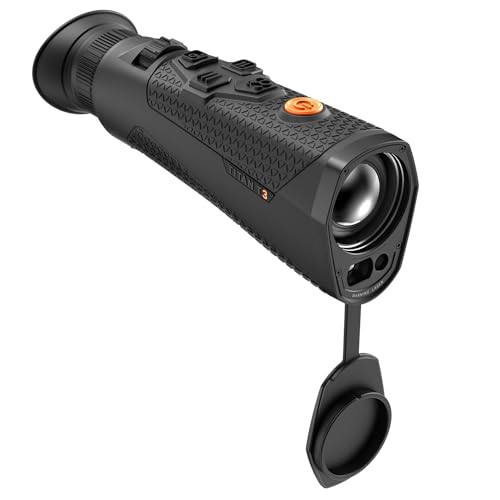
RIX Titan-T3 Review Summary
The RIX Titan-T3 makes the strongest case for itself by combining several useful field functions in one compact viewing device.
Its 384×288 thermal sensor, 1920×1080 OLED display, 25mm F0.9 lens, electronic image stabilization, and rangefinder address the main challenges of nighttime observation: finding heat, seeing detail, holding a steady image, and judging distance.
The manufacturer also lists AI-assisted digital zoom and an integrated ballistic calculator, giving the Titan-T3 a more capable feature set than a basic thermal viewer.
This is best suited to hunters, land managers, and safety-minded observers who can make use of thermal detection and distance measurement.
The listing claims detection out to 1,421 yards and ranging out to 1,312 yards, but those are manufacturer figures rather than independent field-test results.
Buyers should also note that the evidence supplied here does not include battery-life, weather-resistance, storage, weight, or operating-temperature details.
The main attraction is capability density; the main uncertainty is the lack of supporting everyday-use specifications.
Review Scorecard
| Category | Editorial score | Buyer rationale |
|---|---|---|
| Thermal detail | 9/10 | A 384×288 detector and claimed NETD of 20mK provide a strong stated foundation for identifying heat patterns. |
| Display clarity | 9/10 | The 1920×1080, 0.49-inch OLED is substantially more detailed on paper than a standard 1024×768 screen. |
| Low-light gathering | 8/10 | The 25mm F0.9 lens is listed as gathering more light than a traditional F1.0 lens. |
| Rangefinding utility | 9/10 | An integrated LRF is specified for distances up to 1,312 yards. |
| Field stability | 8/10 | Electronic image stabilization is designed to reduce shake and blur during movement or vehicle vibration. |
| Controls | 8/10 | One-hand operation, an accessible focus wheel, and ergonomically placed buttons should help while observing. |
| Evidence completeness | 6/10 | Core imaging features are detailed, but several ownership specifications are not provided. |
Key Features and Specifications of RIX Titan-T3
The Titan-T3 is built around a 25mm objective lens and a 384×288 thermal detector with a 12-micrometer pixel pitch.
The listing gives a NETD figure of 20mK or lower, a specification associated with sensitivity to relatively small temperature differences.
In practical buying terms, those numbers suggest a device designed to show more than a simple bright heat spot; however, image quality still depends on conditions, target distance, atmospheric effects, and correct focus.
The display is one of the model’s clearest differentiators.
RIX specifies a 1920×1080 OLED panel measuring 0.49 inches and describes it as 2.5 times the resolution of a 1024×768 OLED screen.
A high-resolution eyepiece can make the viewing experience more comfortable and preserve fine visual information, particularly when inspecting a target or scene rather than merely confirming that a heat source is present.
The 25mm F0.9 lens is another meaningful choice.
According to the listing, it gathers 20% more light than a traditional F1.0 lens, which is intended to improve brightness and image quality in low-light or high-humidity conditions.
Because this is thermal equipment, buyers should treat that as a manufacturer claim about the optical design, not a guarantee that every scene will appear equally bright or detailed.
The Titan-T3 also adds tools beyond basic thermal viewing:
- The integrated laser rangefinder is specified to measure distances up to 1,312 yards.
- The free integrated ballistic calculator is intended to use distance data to support more informed aiming decisions.
- Electronic image stabilization uses motion sensors and algorithms to reduce shake and blur.
- The listing says its RET technology uses AI to enhance pixel detail during digital zoom and limit the usual loss of clarity at higher magnification.
- The focus wheel is positioned near the eyepiece for one-finger adjustment, while the buttons are designed for one-hand access.
The listing also describes the device as a 50 Hz thermal monocular and identifies the laser as Class I with power output below or equal to 1mW.
Those details may matter to buyers comparing refresh behavior and laser safety classifications.
The available record does not provide a complete technical sheet, so confirm included accessories, power system, mounting options, warranty, and local use requirements before ordering.
Pros and Cons of RIX Titan-T3
Pros
- High-resolution viewing: The 1920×1080 OLED display is an unusually prominent specification for a monocular in this class.
- Useful thermal foundation: The 384×288 sensor, 12-micrometer pixel pitch, and claimed NETD of 20mK or lower point toward detailed thermal observation.
- Integrated distance tools: The rangefinder and ballistic calculator can reduce the need to carry separate instruments.
- Practical lens design: A 25mm F0.9 lens is intended to improve light gathering and image brightness.
- Stability while moving: Electronic image stabilization is specifically designed for movement and vehicle vibration.
- One-hand controls: The focus wheel and button layout prioritize quick adjustments during observation.
Cons
- Limited ownership information: Battery life, dimensions, weight, storage, protection rating, and included items are not stated in the supplied evidence.
- Manufacturer-only performance figures: Detection and ranging distances are useful comparison points, but they are not independent test results.
- Digital zoom still has limits: RET may help preserve detail, but no digital-zoom levels or comparative samples are provided.
- Specialized purchase: Its rangefinding and ballistic features add value only for buyers whose work or recreation actually requires them.
Who Should Buy RIX Titan-T3?
The best match is a nighttime hunter or outdoor observer who wants thermal detection and distance measurement together.
The 25mm lens and claimed long detection range make the Titan-T3 worth considering for open-area scanning, while the high-resolution OLED display should help when the task involves examining a target rather than simply locating one.
The stabilization feature is also relevant to anyone who observes from a moving vehicle or needs a steadier view while walking.
It may also suit property and wildlife observers who value a one-hand workflow.
Being able to focus, view, range, and use the device’s software-supported ballistic function from one monocular could make field equipment simpler.
That said, the ballistic calculator is a specialized feature, so it should not be the deciding factor for buyers who only need wildlife observation or general nighttime awareness.
Skip this model if you are looking for a simple, inexpensive night-vision viewer, a fully documented rugged device, or a product whose endurance and accessories are already clear from the specification sheet.
Since the supplied record does not include battery-life or protection details, professional users should verify those points before relying on it for extended or harsh-environment work.
How the Titan-T3 Features Work Together in the Field
High-resolution thermal observation
The 384×288 detector supplies the thermal image while the 1920×1080 OLED presents it with substantial display resolution.
That combination is designed to make heat signatures easier to inspect, although real-world clarity will still vary with distance and conditions.
Rangefinding and ballistic support
The built-in LRF is listed for measurements up to 1,312 yards, and RIX pairs it with a ballistic calculator.
This creates a more integrated workflow for users who need distance-informed aiming decisions, rather than manually transferring measurements between devices.
Stabilization during movement
Electronic image stabilization uses motion sensors and algorithms to minimize shake and blur.
The feature is particularly relevant when the observer is moving or dealing with vehicle vibration, where a stable image can be more useful than a specification alone.
One-hand operation and digital zoom
The nearby focus wheel and ergonomic buttons are intended to keep the main controls accessible with one hand.
RET technology is described as enhancing pixel detail during digital zoom, addressing the pixelation that commonly makes magnified thermal images less useful.
Alternatives to RIX Titan-T3
Buyers comparing thermal monoculars may also want to search for the AGM Taipan thermal monocular line, which is a credible option for users prioritizing straightforward thermal observation.
The AGM Taipan thermal monocular line is worth comparing by sensor resolution, lens size, refresh rate, and included accessories.
The Pulsar Axion line is another established product family to investigate when compact thermal viewing is the priority.
Browse the Pulsar Axion thermal monocular line and compare its available sensor and rangefinder configurations with the Titan-T3’s integrated tools.
For buyers who want a more budget-oriented comparison, the FLIR Scout line may be useful as a reference point.
The FLIR Scout thermal monocular line can help clarify whether you need advanced rangefinding, a high-resolution display, or simply dependable heat detection.
Is RIX Titan-T3 Worth It?
The RIX Titan-T3 is worth considering when your priority is a feature-rich thermal monocular that combines a 384×288 detector, a high-resolution 1920×1080 OLED display, stabilization, ranging, and ballistic assistance.
It is the better fit for serious nighttime observation and distance-aware use than for casual buyers seeking a basic viewer.
The buying decision should come down to verification as much as features.
The supplied evidence supports an impressive specification-led case, but it does not establish battery endurance, durability, accessories, or independent detection performance.
If those practical details check out for your intended conditions, the Titan-T3 offers a compelling integrated toolkit; if not, a simpler and better-documented monocular may be the safer purchase.