If you are searching for a WORX WR310 robot lawn mower review, this model stands out for combining Vision AI with RTK Cloud navigation and no perimeter wire.
The WORX WR310 Landroid Vision Cloud Robot Lawn Mower is aimed at owners of lawns up to one-quarter acre who want automated mowing with detailed app control.
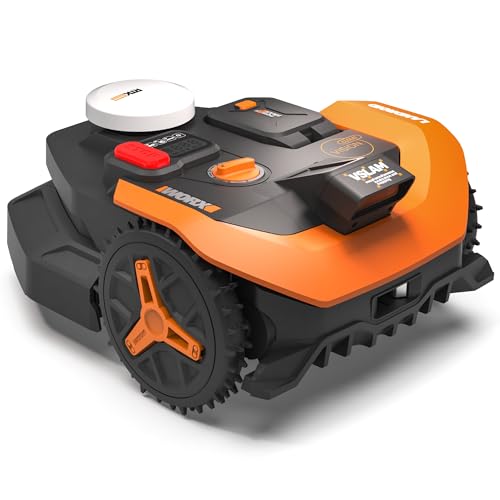
WORX WR310 Review Summary
The WORX WR310 is most compelling for buyers who want a cleaner, more automated lawn-maintenance routine without installing a local antenna or laying perimeter wire.
According to the supplied product information, its RTK Cloud system provides centimeter-level positioning, while Vision AI helps it understand lawn shapes, boundaries, and obstacles.
That combination should appeal to homeowners managing a moderately sized yard with multiple areas or changing mowing preferences.
This is an editorial assessment based on the manufacturer’s listed features, not hands-on testing.
The strongest case for buying it is the breadth of its navigation system: auto mapping, V-SLAM sensor fusion for shaded areas, custom no-go zones, unlimited mowing zones, and several finishing patterns.
The main caution is that the listing provides no detailed specifications beyond the one-quarter-acre capacity and 30% slope claim, so buyers should confirm physical dimensions, battery details, weather handling, and installation requirements before ordering.
Review Scorecard
| Category | Score | Buyer assessment |
|---|---|---|
| Wire-free setup | 9/10 | RTK Cloud is designed to work without a local antenna or perimeter wire. |
| Navigation | 9/10 | Centimeter-level RTK Cloud accuracy is supported by V-SLAM in shaded areas. |
| Mapping flexibility | 9/10 | Auto mapping, custom pathways, no-go areas, and unlimited zones are strong tools. |
| Obstacle handling | 8/10 | Vision AI is designed to recognize and respond to objects intelligently. |
| Edge performance | 8/10 | Cut-to-edge behavior targets closer borders and less leftover grass. |
| Slope capability | 8/10 | The listing identifies support for slopes up to 30%. |
| Finish control | 9/10 | Parallel, checkerboard, diamond, and natural mowing patterns are available. |
Overall verdict: The WORX WR310 looks like a feature-rich choice for buyers prioritizing wire-free mapping and flexible mowing zones.
Its value depends on whether the cloud-based navigation approach suits the property and whether the yard falls within the stated one-quarter-acre use case.
Key Features and Specifications of WORX WR310
RTK Cloud navigation without a local antenna
The defining feature is commercial-grade RTK technology delivered through the cloud.
WORX says the system provides centimeter-level accuracy without requiring a local antenna and without additional cloud costs.
For buyers comparing robot mowers, that could simplify setup and reduce the amount of equipment placed around the property.
The product listing also says the mower can maintain navigation in shaded or partially covered sections.
There, V-SLAM-based sensor fusion works with Vision AI to take over when RTK performance is less dependable.
That is an important design choice for yards with trees, structures, or other areas where a satellite-oriented navigation system may face interruptions.
It is still sensible to assess the actual layout of your lawn, since the listing does not provide a map of coverage limits or detailed connectivity requirements.
Vision AI and obstacle avoidance
The WR310 is presented as more than a mower that simply detects an object and stops.
Its Vision AI is described as recognizing and understanding objects, using a neural network and processing power of up to 10 trillion operations per second.
In buyer terms, the goal is smoother, safer, and less interrupted mowing around objects in the yard.
Because no hands-on notes or independent test results were supplied, this should be treated as a manufacturer claim rather than a guarantee that every object will be identified perfectly.
Buyers should still clear toys, tools, hoses, and other movable items before a mowing session.
Auto mapping and multi-zone control
The mower is designed to automatically map the yard and understand different lawn shapes and boundary types.
WORX says this enables smoother paths, closer edge-following, and fuller coverage from the start.
The app adds the ability to manage unlimited mowing zones, create custom pathways, define no-go areas, edit the map, and monitor the mower remotely.
That feature set is especially relevant when a property is divided into separate grass areas or includes sections that need different access rules.
It also gives the owner more control than a simple start-and-stop schedule.
The listing does not state how zones connect physically or how the mower handles transitions, so those details should be checked if your yard has gates, narrow passages, or separate sections.
Cut-to-edge mowing and patterns
The WR310’s edge strategy is designed around boundary recognition.
The mower can cross ridable edges where appropriate to reduce uncut strips, while fixed borders are handled with closer cutting while respecting the boundary.
That should help reduce the manual trimming often left behind by conventional robotic mowing patterns.
For appearance, the app supports parallel, checkerboard, diamond, and natural-looking finishes.
This is a useful differentiator for owners who care about visible mowing lines or want to change the appearance of the lawn over time.
These are pattern options, not a promise of a particular finish on every grass type or terrain.
Pros and Cons of WORX WR310
Pros
- No perimeter wire or local antenna is listed as necessary, which may make the initial setup less intrusive.
- RTK Cloud navigation targets centimeter-level accuracy for straighter, more consistent mowing paths.
- V-SLAM and Vision AI are intended to support shaded areas, where navigation can be more difficult.
- Auto mapping and unlimited mowing zones suit yards with multiple sections and custom access rules.
- Remote app control allows owners to edit maps, define no-go areas, create pathways, and monitor mowing.
- Cut-to-edge behavior is designed to reduce missed grass along different types of borders.
- Four visual mowing styles give owners more control over the lawn’s finished appearance.
- A stated 30% slope capability makes it more suitable for gently hilly lawns than a flat-only model.
Cons
- The product evidence does not include detailed hardware specifications, such as battery capacity, cutting width, noise level, or charging time.
- Cloud-based navigation may require buyers to consider connectivity and property layout, though the supplied listing does not detail those requirements.
- AI obstacle avoidance should not replace basic yard preparation, especially because no independent detection testing is provided here.
- The one-quarter-acre capacity limits its obvious fit for owners with substantially larger lawns.
- Boundary and zone behavior may need confirmation for yards with gates, narrow links, or disconnected grass sections.
Who Should Buy WORX WR310?
The WORX WR310 is a strong candidate for homeowners with a lawn of up to one-quarter acre who want a wire-free approach and substantial control over where and how the mower works.
It is particularly well matched to buyers who dislike installing boundary wire, have a yard with shade, or want to divide mowing into several custom zones.
Owners who care about straight stripes or changing between checkerboard, diamond, parallel, and natural patterns may also appreciate the app-based finish controls.
It could make sense for a property with varied boundaries because the listing specifically emphasizes understanding lawn shapes and boundary types.
The 30% slope rating also makes it worth considering for a moderately uneven or sloped yard, subject to the manufacturer’s conditions.
However, shoppers with a much larger property should look for a model designed for that area rather than stretching the stated capacity.
Buyers whose lawns contain complicated transitions, locked gates, or separate islands should verify how the mapping system handles those features.
If you prefer a simple mower with minimal software or are uncomfortable relying on cloud-assisted navigation, a less connected design may be a better fit.
How the WORX WR310 Handles Real-World Yard Complexity
Shaded sections
The RTK Cloud system is paired with V-SLAM-based sensor fusion and Vision AI for shaded or partially covered areas.
That layered approach is intended to help the mower preserve precise navigation when conditions are less favorable for its primary positioning method.
Irregular boundaries
Auto Mapping is designed to understand lawn shapes and boundary types, while cut-to-edge behavior adapts to ridable edges and fixed borders.
The practical benefit is less missed grass without treating every boundary identically.
Objects in the mowing path
Vision AI is intended to recognize objects and respond intelligently, keeping mowing smoother and safer.
Even so, a clear lawn remains the best starting point, and the supplied evidence does not establish performance with every object or lighting condition.
Changing lawn appearance
Parallel, checkerboard, diamond, and natural patterns let owners change the visual result in the app.
That makes the WR310 more adaptable for buyers who want both routine automation and some control over presentation.
Alternatives to WORX WR310
Buyers comparing the WORX WR310 should consider other Amazon-sold robot-mower lines such as the Husqvarna Automower, Mammotion LUBA, Segway Navimow, and Greenworks robotic lawn mower range.
These alternatives can be useful comparison points for navigation method, property size, boundary setup, slope handling, and app features.
Confirm the exact model’s current specifications and compatibility with your lawn before choosing.
Is WORX WR310 Worth It?
The WORX WR310 is worth considering if your priority is a wire-free robotic mower with cloud-assisted precision, AI obstacle avoidance, automatic mapping, multi-zone controls, and flexible mowing patterns.
Its listed one-quarter-acre capacity and 30% slope support define a sensible buyer profile, while the lack of detailed supplied specifications means some practical questions remain for pre-purchase research.
**Buy it if you want extensive app control and a cleaner installation concept for a moderately sized lawn.
Skip it if your property exceeds the stated area, has unusually complex transitions, or you want a mower whose operation depends less on connected navigation.**