Choosing among the best resin printers for miniatures means balancing detail, reliability, build volume, ease of use, and the ongoing cost of resin and replacement parts. The right printer can produce crisp tabletop figures, terrain, busts, and display models without making setup unnecessarily complicated.
We’ve gathered 10 current options ranging from accessible beginner machines to high-resolution and large-format printers. Use the guide below to compare their strengths and identify the best fit for your workspace, printing habits, and miniature collection.
Best 10 Resin Printers for Miniatures Picks for 2026
Best Overall

- 12K resolution for fine miniature detail
- Tilt release with speeds up to 150 mm/h
- Automatic leveling and smart print monitoring
Best For: Detailed, fast, and highly automated miniature printing
Best for Reliable Detail

- 14K LCD for crisp miniature features
- Wave Release reduces release force by 60%
- Automatic leveling and resin monitoring
Best For: Stable, high-detail printing with advanced resin support
Best High-Resolution Upgrade

- 16K LCD with 14 × 19 micrometer pixels
- Factory pre-leveling and built-in resin heating
- Remote monitoring and wash-cure workflow support
Best For: Dedicated makers pursuing maximum detail and convenience
Best Compact Speed Pick

- 9K LCD with 1818 micrometer XY resolution
- Up to 150 mm/h with tilt release
- Wi-Fi control and smart mechanical sensing
Best For: Fast, connected miniature printing in a smaller setup
High-Detail Value Pick

- 7-inch 10K screen with 17×17μm pixels
- Balanced LighTurbo lighting for smoother surfaces
- Beginner-friendly leveling and power-loss recovery
Best For: Detailed miniature printing with a simple setup
Beginner-Friendly Safety Pick
- One-click automatic leveling
- 4K mono LCD with COB light source
- Self-check, residue detection, and overheat protection
Best For: New users prioritizing easy setup and monitoring
Fast Premium Detail Pick
ANYCUBIC Photon Mono 4 Ultra 10K

- 10K screen with 17×17μm XY resolution
- Up to 120 mm/h stated print speed
- Five intelligent inspections for print monitoring
Best For: Detailed, faster miniature printing with automated checks
Best Beginner Pick

- 4K monochrome screen for detailed prints
- Automatic leveling simplifies setup
- Built-in checks and overheat protection
Best For: Beginners printing detailed miniatures
Best High-Precision Option

- High-contrast amber screen for sharp detail
- Automated slicing and support generation
- Force sensing helps monitor print failures
Best For: Experienced users seeking speed and precision
Best Overall – ELEGOO Saturn 4 Ultra 12K
For shoppers comparing resin printers for miniatures, the ELEGOO Saturn 4 Ultra combines a high-resolution 12K display with fast printing and several automation features. Its tilt-release system can reach speeds of up to 150 mm/h, while automatic leveling helps reduce setup work.
Best For: Miniature makers who want detailed prints, fast production, and extensive monitoring features.
Pros:
- 12K resolution supports detailed miniature printing.
- Tilt release enables printing speeds up to 150 mm/h.
- One-touch automatic leveling simplifies setup.
- AI camera, resin alerts, foreign-object detection, and print-resume features add convenience.
Cons:
- At 40 pounds, it is a substantial printer for smaller workspaces.
- AI detection results can vary with the environment, models, and resin types.
The Saturn 4 Ultra is a strong all-around choice when speed, detail, and automation matter. Its larger footprint and weight are worth considering before purchase.
Best for Reliable Detail – ANYCUBIC Photon P1 14K
The ANYCUBIC Photon P1 is a compelling option among resin printers for miniatures, pairing a 14K LCD with a stable ball-screw and guide-rail structure. Its automated leveling, release technology, and monitoring tools are designed to make detailed printing more consistent.
Best For: Detail-focused users who value stable motion, automated setup, and compatibility with demanding resins.
Pros:
- 14K resolution and a 16.8 × 24.8 micrometer XY pixel size support crisp details.
- Wave Release Technology reduces release force by 60%.
- Factory-calibrated Smart Leveling 3.0 avoids routine manual leveling.
- Supports ultra-high-viscosity resins up to 8,000 cps.
Cons:
- Its dimensions require considerable workspace.
- Advanced resin support may be more capability than casual users need.
The Photon P1 stands out for precision and stability, with useful safeguards for repeat printing. It is especially appealing if you plan to experiment with specialty or high-viscosity resins.
Best High-Resolution Upgrade – UniFormation GK3T 16K
The UniFormation GK3T targets users who want maximum resolution and a more streamlined workflow. With a 16K LCD, factory pre-leveling, resin heating, remote monitoring, and compatible wash-and-cure integration, it is built for detailed miniature work with less hands-on setup.
Best For: Enthusiasts and production-minded makers seeking very fine detail and an integrated workflow.
Pros:
- 16K resolution and 14 × 19 micrometer pixels capture fine features.
- Factory pre-leveling supports plug-and-play setup.
- Built-in heating helps maintain resin fluidity down to 0°C/32°F.
- Remote control, monitoring, and timelapse support improve convenience.
Cons:
- At 52.8 pounds, it is the heaviest option in this roundup.
- The larger all-in-one workflow may be excessive for occasional hobby printing.
The GK3T is a feature-rich choice for miniature creators who prioritize resolution and year-round consistency. Its weight and broader ecosystem make it better suited to a dedicated workspace.
Best Compact Speed Pick – ELEGOO Mars 5 Ultra 9K
The ELEGOO Mars 5 Ultra offers a practical balance for shoppers seeking resin printers for miniatures without moving to the largest machine in the group. Its 9K monochrome LCD, 1818 micrometer XY resolution, tilt release, automatic calibration, and Wi-Fi support make it a capable, connected option.
Best For: Hobbyists who want detailed miniatures, fast printing, and convenient wireless control.
Pros:
- 9K LCD and 92% light uniformity support detailed models.
- Tilt release enables speeds up to 150 mm/h.
- Smart mechanical sensors assist with calibration and issue alerts.
- Wi-Fi file transfer and cluster printing support remote workflows.
Cons:
- Its 9K resolution is lower than the 12K, 14K, and 16K alternatives here.
- Wireless features require a compatible 2.4G or 5G network.
The Mars 5 Ultra is a sensible pick for users who value speed and ease of use while still wanting detailed miniature output. Its connected features are particularly useful for multi-printer setups.
High-Detail Value Pick – ANYCUBIC Photon Mono 4 10K
The ANYCUBIC Photon Mono 4 is a practical choice among resin printers for miniatures, especially if fine surface detail and a straightforward setup matter most. Its 7-inch 10K monochrome screen, 17×17μm XY pixel size, and balanced LighTurbo light source are designed for sharp, smooth models.
Best For: Beginners and hobbyists who want highly detailed miniature prints with a useful mid-size build area.
Pros:
- 7-inch 10K screen supports highly detailed prints.
- LighTurbo matrix lighting helps reduce layer lines and rasterization.
- Laser-engraved platform improves adhesion while keeping removal manageable.
- Four-point leveling is beginner-friendly, and printing can resume after power restoration.
Cons:
- Anycubic APP service is not supported.
- It uses a manual four-point leveling process rather than one-click automatic leveling.
With a 153.4 × 87 × 165 mm build volume, the Photon Mono 4 offers enough room for individual miniatures and many small projects while prioritizing detailed output and accessible operation.
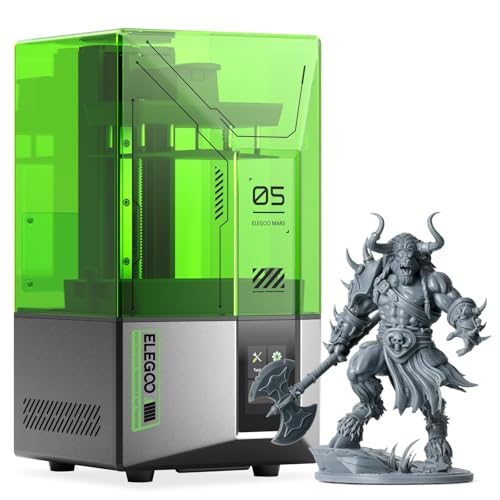
Beginner-Friendly Safety Pick – ELEGOO Mars 5 Resin Printer
The ELEGOO Mars 5 is one of the more approachable resin printers for miniatures because its one-click automatic leveling reduces setup work. A 4K monochrome LCD, COB light source, residue detection, and self-check features also make it suited to users who want guidance during routine printing.
Best For: New resin-printing users who value automatic leveling, print checks, and protective monitoring features.
Pros:
- One-click automatic leveling simplifies initial setup.
- 4K monochrome LCD and COB lighting reproduce intricate details.
- Residue detection, resin-shortage alerts, and leveling-failure alarms can reduce waste.
- Self-check functionality and overheat protection support more reliable operation.
Cons:
- Its 4K screen offers less stated resolution than the 10K models in this roundup.
- The supplied notes do not specify the build volume or print speed.
Mars 5 focuses on reducing common setup and monitoring hassles. It is a sensible fit for beginners who prefer convenience and built-in checks over the highest stated screen resolution.
Fast Premium Detail Pick – ANYCUBIC Photon Mono 4 Ultra 10K
The ANYCUBIC Photon Mono 4 Ultra combines the fine detail expected from a 10K resin printer with features aimed at faster, more consistent production. Its ACF film, Intelligent Release Algorithm, precision motion hardware, and automated inspections make it a strong option for demanding miniature work.
Best For: Experienced hobbyists who want detailed miniatures, faster stated print speeds, and extensive automated monitoring.
Pros:
- 7-inch 10K display delivers 17×17μm XY resolution.
- Maximum stated print speed reaches 120 mm/h with ACF film and intelligent release control.
- COB lighting and Fresnel lenses provide a stated light uniformity rate of at least 90%.
- Five intelligent inspections help monitor resin, print failures, and printer condition.
Cons:
- The supplied notes do not specify its build volume.
- Its larger listed dimensions may require more workspace.
For miniature makers balancing surface detail with throughput, the Mono 4 Ultra adds speed and diagnostic features over a basic 10K setup. Its eight-language interface also supports a more accessible operating experience.
Best Beginner Pick – ELEGOO Mars 5
The ELEGOO Mars 5 is a practical starting point for shoppers comparing resin printers for miniatures. Its 6.6-inch 4K monochrome screen supports fine detail, while automatic leveling, one-click self-checks, and built-in alerts reduce some of the setup and troubleshooting work.
Best For: Beginners who want a compact resin printer with helpful safety and setup features for everyday miniature printing.
Pros:
- 6.6-inch 4K monochrome LCD with 35 × 35 μm resolution for detailed models.
- Automatic leveling helps simplify initial setup.
- Mechanical sensing can detect foreign objects, resin issues, and leveling failures.
- Overheat protection and an advanced cooling system add operating safeguards.
Cons:
- The listed details do not indicate a large build volume for oversized projects.
- Its feature set is focused on straightforward printing rather than advanced production controls.
Choose the Mars 5 if ease of use and dependable basic safeguards matter more than maximum size or specialized automation. The 4K screen makes it well suited to detailed miniatures, while the automatic checks can make the learning curve less intimidating.
Best High-Precision Option – Reflex RS Turbo
The Reflex RS Turbo targets shoppers who want speed, automation, and tightly controlled results from resin printers for miniatures. Its high-contrast amber screen, automated model preparation, force sensing, and precision motion hardware are designed to support consistent detail and efficient workflows.
Best For: Experienced hobbyists and makers prioritizing fast, highly automated printing with precision-focused hardware.
Pros:
- High-contrast amber screen is designed for crisp details, dimensional accuracy, and faster curing.
- One-click slicing can repair common model defects and generate supports automatically.
- Force sensors can detect resin residue, pause prints, and generate diagnostic reports.
- C5 ball-screw Z-axis offers stated repeat positioning accuracy of 2 μm or less.
Cons:
- At 50.6 pounds, it is substantially heavier than a compact desktop printer.
- The advanced systems may be more capability than beginners need.
- The supplied details do not specify the exact build volume.
The Reflex RS Turbo stands out when workflow automation and repeatability are central buying criteria. Its sensor-driven monitoring and precision components make it a compelling choice for demanding miniature work, provided you are comfortable with its larger, heavier design.
Best Large-Format Pick – Anycubic Photon Mono M7 Max
The Anycubic Photon Mono M7 Max is the large-format choice among these resin printers for miniatures. Its 298 × 164 × 300 mm build volume can accommodate substantial terrain, props, and batches of models, while temperature control and automatic resin handling are intended to make longer jobs easier to manage.
Best For: Makers printing large terrain pieces, cosplay components, full-size masks, or many miniatures without splitting models.
Pros:
- Large build volume supports full-size masks, game terrain, cosplay props, and bigger models.
- LighTurbo 3.0 combines a COB light source and Fresnel lens with over 90% light uniformity.
- Dynamic resin temperature control helps maintain an appropriate printing temperature.
- Auto-fill and one-key resin recycling simplify resin management for large jobs.
Cons:
- Its 52.8-pound weight and large footprint require substantial workspace.
- The larger vat and build area may be unnecessary for users printing only small individual miniatures.
- Large-format resin printing can demand more material and cleanup than compact projects.
If your priority is capacity, the M7 Max is the most versatile option here. Its generous build area reduces the need to cut and assemble large models, while the resin management features are particularly useful for extended or material-intensive prints.
How We Picked These Resin Printers for Miniatures
We focused on features that directly affect miniature printing: LCD resolution, XY detail, exposure consistency, build volume, leveling and calibration systems, print monitoring, and everyday usability. We also considered whether each model makes sense for beginners, hobbyists printing frequently, or creators who need larger production capacity.
Resolution is only part of the picture. A well-designed printer with dependable mechanics, effective exposure control, and a stable release platform can produce better results than a higher-resolution model that is difficult to calibrate. Because resin printing also requires washing, curing, ventilation, and careful handling, practical workflow features matter throughout the selection process.
Quick Comparison
The ELEGOO Saturn 4 Ultra 12K, ANYCUBIC Photon P1 14K, and UniFormation GK3T target users who want very fine detail and more advanced capabilities. The ELEGOO Mars 5 Ultra, ANYCUBIC Photon Mono 4, ELEGOO Mars 5, and Mars 5 MSLA models are more compact choices for desks, beginners, and smaller batches. The Reflex RS Turbo emphasizes its high-contrast amber screen, while the ANYCUBIC Photon Mono M7 MAX is the large-format option for printing more models or larger pieces in one job.
For the best match, compare not only the advertised resolution but also the printer’s physical footprint, build area, software support, replacement screen availability, and the price of consumables.
Key Buying Factors
Detail and Screen Resolution
Miniatures benefit from fine XY resolution because faces, armor plates, weapons, and small textures need clean edges. A 9K, 10K, 12K, 14K, or 16K label can be useful, but pixel size and optical quality are more meaningful than the headline number alone.
Build Volume
Compact printers are easier to place and can be economical for individual figures. Larger machines let you print armies, terrain, busts, or multiple models simultaneously, reducing the number of separate jobs. Measure your available workspace and leave room for ventilation and safe resin handling.
Ease of Setup and Reliability
Auto-leveling, mechanical sensors, guided setup, and stable build platforms can reduce failed prints, especially for new users. Still, correct supports, resin settings, temperature, and cleaning remain essential for consistent results.
Workflow and Operating Costs
Check slicer compatibility, file-transfer options, replacement film and screens, vat design, and resin compatibility. Budget for nitrile gloves, cleaning alcohol or an alternative wash solution, a curing station, paper towels, and suitable ventilation. Resin should never be handled as casually as ordinary filament.
Who Should Buy Which Resin Printers for Miniatures?
Beginners: Choose a compact model with guided setup, dependable leveling, and straightforward software, such as one of the Mars 5 or Photon Mono 4 options.
Detail-focused hobbyists: Look toward the Saturn 4 Ultra, Photon P1, or UniFormation GK3T if you want high-resolution output and the flexibility to print multiple detailed models at once.
Frequent printers and army builders: A larger-format machine such as the Photon Mono M7 MAX can save time by fitting more figures or larger pieces into each build.
Workspace-conscious buyers: A smaller MSLA printer is usually easier to ventilate, clean, and store. Whichever model you choose, plan the complete resin-printing setup—not just the printer—before buying.