Reliable signal distribution is essential when a live stream must feed multiple monitors, recorders, switchers, or confidence displays at once. The right amplifier preserves video quality while matching your connection type, resolution, cable runs, and output count.
This roundup compares 10 distribution amplifiers spanning SDI, HDMI, BNC, and CAT5e/6-based systems, helping you narrow the choices for studio, event, security, and hybrid video workflows.
Best 10 Video Distribution Amplifiers for Live Streaming Picks for 2026
Best SDI Expansion
Mini Converter SDI Distribution

- Eight re-clocked SDI outputs
- Auto-switches SD, HD, and 3G-SDI
- Redundant input and embedded-audio support
Best For: Broadcast and live-event SDI distribution
Best Analog CCTV Splitter
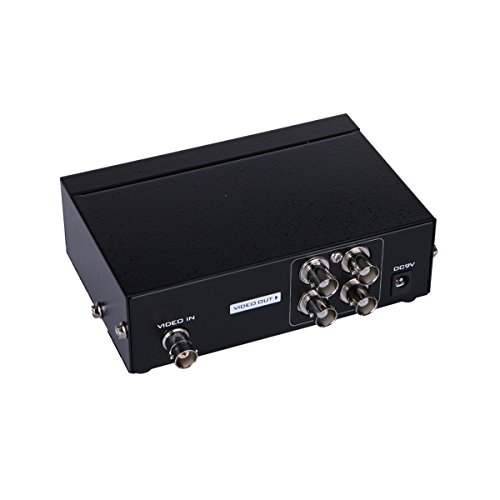
- One BNC input and four outputs
- Supports PAL, NTSC, and SECAM
- Plug-and-play metal housing
Best For: Analog CCTV and monitoring systems
Best HDMI 2.1 Distribution

- 48 Gbps HDMI bandwidth
- Custom and extended EDID support
- Extracts digital or analog audio
Best For: High-bandwidth HDMI 2.1 installations
Best Long-Run SDI Splitter

- Four re-clocked SDI outputs
- Supports SD, HD, and 3G-SDI
- Long-distance transmission specifications
Best For: Extended-distance SDI live-production systems
Compact HDMI Splitter

- Compact 7.38 x 4.53 x 1-inch design
- Lightweight at 14.1 ounces
- Designed for audio or video distribution
Best For: Space-conscious HDMI distribution setups
Long-Run SDI Distribution
AVMATRIX SD1191 1×9 SDI Splitter

- One input feeds nine SDI outputs
- Supports 3G/HD/SD-SDI up to 1080p 60 Hz
- Reclocks signals for longer cable runs
Best For: Multi-destination SDI production systems
4K HDR HDMI Distribution

- Supports up to 4K HDR HDMI 2.0
- HDCP 2.2 compliant
- Equalizes and reclocks one input to two outputs
Best For: Two-display 4K HDR HDMI setups
Compact BNC Splitter
Speco VIDDIST 1x4 Video Distribution Amplifier

- One BNC input feeds four BNC outputs
- Compact plastic housing
- Simple option for BNC video routing
Best For: Small BNC-based streaming and camera setups
Long-Run HDMI Distribution
KanexPro HDMI 1x8 Over CAT5e/6

- Distributes one HDMI source to eight displays
- Supports 4K at 60Hz
- Extends signals up to 192 feet over CAT5e/6
Best For: Multi-display streaming systems with longer cable runs
High-Count Rack Distribution
Kramer 1:16 HDMI Distribution Amplifier

- Distributes HDMI across 16 channels
- Includes rack ears
- Switches video and audio without physical access
Best For: Centralized rack-mounted streaming and AV systems
Best SDI Expansion – Mini Converter SDI Distribution
For live streaming workflows built around SDI, the Blackmagic Design Mini Converter distributes one SD, HD, or 3G-SDI source to multiple devices. Its eight re-clocked outputs, automatic format switching, embedded-audio support, and redundant SDI input make it a strong choice when signal continuity matters.
Best For: Broadcast, live-event, and multi-device SDI distribution setups.
Pros:
- Provides eight re-clocked SDI outputs from one input.
- Automatically supports SD, HD, and 3G-SDI formats.
- Handles ancillary data, embedded audio, and ASI.
- Includes a redundant SDI input for mission-critical use.
Cons:
- Uses SDI rather than HDMI or analog BNC connections.
- Its eight-output capacity may be more than smaller setups require.
This is one of the more capable video distribution amplifiers for live streaming when the system uses SDI and needs multiple synchronized feeds. Confirm your source, destination connectors, and required video format before buying.
Best Analog CCTV Splitter – 1×4 BNC Video Splitter
The AuviPal 1-to-4 BNC splitter is a straightforward option for analog video distribution. It sends one CVBS source to four BNC-connected displays or devices, supports up to 1080p at 60Hz according to the supplied notes, and installs without configuration.
Best For: Analog CCTV, monitoring systems, and other PAL, NTSC, or SECAM video setups.
Pros:
- Splits one BNC input to four outputs simultaneously.
- Plug-and-play design requires no additional setup.
- Metal housing is designed for stability, heat resistance, and continuous operation.
- Includes a US power adapter, user manual, and one-year warranty.
Cons:
- Not compatible with SDI or digital signals.
- Requires cameras to be set to CVBS mode.
- Designed for analog distribution rather than modern HDMI streaming chains.
Among video distribution amplifiers for live streaming, this model fits best when the source is an analog security or monitoring signal. It is not the right match for SDI or digital-video production equipment.
Best HDMI 2.1 Distribution – AC-DA14-AUHD-GEN2
The AC-DA14-AUHD-GEN2 is a four-output HDMI distribution amplifier for newer live streaming and presentation systems. Its 48 Gbps bandwidth, HDMI 2.1b-focused features, custom EDID blending, and audio extraction support make it suited to demanding HDMI installations.
Best For: HDMI 2.1 systems using high-bandwidth sources, multiple displays, and extracted audio.
Pros:
- Offers 48 Gbps bandwidth with Fixed Rate Link 6.
- Supports custom EDID blending and extended four-block EDID.
- Includes HDMI 2.1b gaming-focused feature support.
- Extracts up to 7.1 digital or two-channel analog audio.
Cons:
- Requires a 12V DC power supply.
- Its advanced HDMI features may exceed the needs of basic distribution setups.
- The supplied notes do not specify cable length or supported video resolutions.
This is a compelling HDMI choice among video distribution amplifiers for live streaming when display compatibility and audio routing are priorities. Verify the source and display requirements, especially around EDID and HDMI 2.1 features.
Best Long-Run SDI Splitter – AVMATRIX SD1141
The AVMATRIX SD1141 distributes one SDI input to four outputs while automatically detecting HD, SD, and 3G-SDI signals. Reclocking on every output and stated transmission distances of up to 400m for SD, 200m for HD, and 120m for 3G make it particularly useful for longer cable runs.
Best For: Live production and streaming systems that need four re-clocked SDI feeds over extended distances.
Pros:
- Auto-detects HD, SD, and 3G-SDI signals.
- Reclocks all outputs for stable long-distance transmission.
- Outputs 2 and 4 support DVB-ASI signals.
- Includes a detachable wall-mounting bracket and three-year warranty.
Cons:
- Provides four outputs rather than the eight offered by some larger SDI distribution units.
- Uses a 17V DC input, so power compatibility should be checked.
- SDI-only design is unsuitable for HDMI or analog sources without conversion.
For video distribution amplifiers for live streaming, the SD1141 is a practical fit when cable distance and SDI signal integrity are central concerns. Its compact form and wall-mounting option also help in permanent or space-limited installations.
Compact HDMI Splitter – Kramer VM-2H2
For shoppers comparing video distribution amplifiers for live streaming, the Kramer VM-2H2 is a compact HDMI distribution amplifier suited to straightforward signal-splitting setups. Its supplied dimensions are 7.38 x 4.53 x 1 inch, with a listed weight of 14.1 ounces.
Best For: Compact HDMI distribution installations where a simple, space-conscious amplifier is appropriate.
Pros:
- Compact 7.38 x 4.53 x 1-inch product dimensions
- Lightweight 14.1-ounce design
- Purpose-built as an audio or video distribution amplifier
Cons:
- The supplied notes do not specify resolution, output count, or HDCP support
- Country of origin is listed as China
The VM-2H2 is worth considering when physical size and basic HDMI distribution are the main priorities. Buyers needing confirmed 4K, HDR, or multi-output specifications should verify those details before purchasing.
Long-Run SDI Distribution – AVMATRIX SD1191 1×9 SDI Splitter
The AVMATRIX SD1191 is a strong option among video distribution amplifiers for live streaming when an SDI source must feed multiple destinations. It accepts one auto-detected HD, SD, or 3G-SDI input and provides nine outputs, supporting signals up to 1080p at 60 Hz.
Best For: Broadcast, live production, and control-room setups that need nine SDI outputs and longer cable runs.
Pros:
- One input and nine outputs for broad SDI distribution
- Supports 3G/HD/SD-SDI signals up to 1080p 60 Hz
- Built-in reclocking and equalization support longer runs, listed up to 120 m for 3G-SDI
- Includes a detachable wall-mounting bracket and 12V power adapter
Cons:
- Designed for SDI rather than HDMI connections
- Requires a 12V DC power source
With nine outputs, signal reclocking, and support for multiple SDI rates, the SD1191 is tailored to more demanding distribution layouts. Its included mounting bracket and stated technical-support coverage add practical value for fixed installations.
4K HDR HDMI Distribution – Kramer VM-2H2 1:2 HDMI DA
Kramer 10-804080190 VM-2H2 is A 1:2 Distribution Amplifier for UP to 4K HDR, HDMI Signals That COMPL
Check Price On AmazonFor HDMI-based video distribution amplifiers for live streaming, this Kramer VM-2H2 is specified for up to 4K HDR HDMI 2.0 signals with HDCP 2.2 compliance. It takes one HDMI input, equalizes and reclocks the signal, then sends it to two identical outputs.
Best For: HDMI 2.0 installations needing 1:2 distribution with stated 4K HDR and HDCP 2.2 support.
Pros:
- Supports HDMI 2.0 signals up to 4K HDR
- Complies with HDCP 2.2 content protection
- Equalizes and reclocks the input signal
- Provides two identical HDMI outputs
Cons:
- Limited to one input and two outputs
- Supplied notes list no warranty
This model is a focused choice for modern HDMI workflows where 4K HDR compatibility and signal conditioning matter. Its 1:2 configuration is convenient for two displays or downstream devices, but larger systems will need additional distribution hardware.
Compact BNC Splitter – Speco VIDDIST 1×4 Video Distribution Amplifier
Speco VIDDIST 1 in/4 Out Video Distribution Amplifier 1 Input to 4 Output Video Bnc Splitter
Check Price On AmazonFor simple camera or video routing, the Speco VIDDIST is a compact option among video distribution amplifiers for live streaming. It accepts one BNC video input and distributes the signal to four BNC outputs in a small plastic housing.
Best For: Basic BNC-based video distribution where four outputs are sufficient.
Pros:
- Distributes one video input to four outputs.
- Uses familiar BNC connectors.
- Compact 4-1/2-inch-wide, 1-inch-high design.
Cons:
- Limited to four outputs.
- Designed for BNC video connections rather than HDMI.
- Plastic construction may be less suitable for demanding installations.
This is a straightforward choice when your streaming setup uses BNC equipment and needs modest signal distribution without a larger rack-style unit.
Long-Run HDMI Distribution – KanexPro HDMI 1×8 Over CAT5e/6
The KanexPro HDMI 1×8 distribution amplifier is built for sending one HDMI source to eight displays over CAT5e/6 cabling. For video distribution amplifiers for live streaming, its 4K support and stated 192-foot transmission distance can suit larger multi-display layouts.
Best For: Distributing one HDMI source to multiple HD or UHD 4K displays over longer cable runs.
Pros:
- Provides eight independent receiver outputs.
- Supports UHD 4K at 60Hz.
- Transmits over single CAT5e/6 cable runs up to 192 feet.
- Works with televisions, monitors, projectors, laptops, and gaming consoles.
Cons:
- Requires separate receivers for the eight outputs.
- At 6.9 pounds, it is less lightweight than compact splitters.
- Uses an HDMI-to-CAT5e/6 distribution design rather than direct HDMI outputs.
Choose this model when your production or monitoring environment needs many displays and the flexibility of extending HDMI through existing network-style cabling.
High-Count Rack Distribution – Kramer 1:16 HDMI Distribution Amplifier
The Kramer VM-16H/110V is a rack-mount 1:16 HDMI distribution amplifier for setups that need to route one source across many destinations. It also switches video and audio without requiring physical access to the source connection, making it suited to centralized streaming and AV installations.
Best For: Rack-mounted systems that need HDMI distribution to as many as 16 channels.
Pros:
- Supports distribution across 16 channels.
- Includes rack ears for installation.
- Switches video and audio without physical source access.
- Designed to connect with computers and other HDMI equipment.
Cons:
- Its 16-channel capacity may be excessive for small streaming setups.
- Rack mounting is less convenient for portable installations.
- The supplied notes do not specify supported resolution or transmission distance.
This is the strongest fit of the three for a centralized, high-output HDMI environment where rack mounting and broad distribution matter more than portability.
How We Picked the Best Video Distribution Amplifiers for Live Streaming
We focused on products that split one source into multiple usable outputs without requiring a complex matrix switcher. The selection covers common live-production signal types, including HDMI, SDI, and coaxial BNC, as well as output configurations ranging from 1:2 to 1:16. We also considered support for HD, 3G-SDI, 4K, HDR, cable-extension options, and practical installation needs.
Because compatibility matters more than a long feature list, verify the exact signal standard and connector type before buying. A distribution amplifier designed for SDI will not replace an HDMI model, and a basic CCTV splitter may not support the bandwidth or timing requirements of a modern streaming rig.
Quick Comparison
| Best For | Signal Type | Output Range |
|---|---|---|
| Compact SDI production | SDI | 1:4 |
| Large SDI monitoring systems | SDI | 1:9 |
| 4K or HDR HDMI workflows | HDMI | 1:2 to 1:4 |
| Multiple HDMI displays | HDMI | 1:8 to 1:16 |
| CCTV and analog BNC distribution | Coaxial/BNC | 1:4 |
| Longer HDMI runs over network cable | HDMI over CAT5e/6 | Varies by receiver setup |
Key Buying Factors for Video Distribution Amplifiers for Live Streaming
Signal Format and Resolution
Match the amplifier to your source and displays. HDMI models are common for cameras, computers, and consumer video gear, while SDI is preferred for longer professional cable runs and broadcast equipment. Check whether the unit supports your required HD, 3G-SDI, 4K, or HDR format.
Output Count and Expansion
Choose enough outputs for current devices plus a small amount of headroom. A 1:4 unit suits a camera feed going to a switcher, recorder, and two displays; 1:8 or 1:16 models are better for production rooms, classrooms, venues, or monitoring walls.
Signal Integrity and Cable Distance
Amplification helps distribute a source, but it does not make every cable unlimited. For HDMI, consider cable quality and supported distance. For SDI and BNC systems, use appropriate impedance-rated coaxial cable and confirm the supported data rate. If runs are especially long, HDMI over CAT5e/6 may be more practical.
EDID, HDCP, and Professional Features
HDMI installations can encounter handshake problems when displays have different capabilities. EDID management can improve consistency, while HDCP support may be important for protected content. For live streaming, prioritize stable signal locking and straightforward operation over unnecessary switching features.
Who Should Buy Which Video Distribution Amplifiers for Live Streaming?
Choose SDI for Broadcast-Style Rigs
SDI distribution amplifiers are a strong fit for professional cameras, switchers, converters, and studio monitoring systems. Select a 1:4 model for a compact setup or a 1:9 model when several destinations need the same feed.
Choose HDMI for General Streaming and 4K Displays
HDMI units work well with computers, mirrorless cameras, capture devices, televisions, and projectors. Look for 4K or HDR support if your workflow requires it, and choose a higher-output model when adding multiple screens.
Choose BNC or CAT5e/6 Options for Specialized Installs
A coaxial BNC amplifier is appropriate for compatible CCTV or analog video systems, not automatically for modern HDMI or SDI sources. HDMI-over-CAT5e/6 products make more sense when structured cabling is already installed or direct HDMI runs are impractical.