The right bench power supply makes electronics testing more predictable, whether you are powering a prototype, troubleshooting a circuit, or repairing equipment. Models under $300 now offer useful features such as constant-voltage and constant-current operation, memory presets, output controls, and USB charging ports.
This roundup compares 10 variable DC supplies across different voltage and current ranges, control layouts, protection features, and linear or switching designs. Use the buying guide below to narrow the list based on your workspace, project demands, and preferred level of control.
Best 10 Bench Power Supplies Under 300 Picks for 2026
Reliable Linear Control

- Linear-regulated 0–30V/0–10A output
- Memory presets and panel lock
- Low-noise fan with protective features
Best For: Dedicated electronics labs and repair benches
Compact High-Resolution Pick

- 0–32V/0–10.1A, 300W maximum
- Compact 1kg body with fine LED resolution
- Memory, key lock, USB charging, and five protections
Best For: Crowded or mobile electronics workspaces
Precise Testing Controls

- 30V/10A/300W single-channel output
- 10mV/1mA resolution and live power display
- Three presets with CC/CV and triple protection
Best For: Development, repair, and precision bench testing
Budget-Friendly Compact Choice

- Adjustable 0–30V/0–10A, 300W output
- Output enable/disable button for safer setup
- Compact 1kg design with 5V/2A USB port
Best For: DIY electronics, maintenance, and portable bench use
Best Compact Memory-Enabled Pick
NANKADF 30V 5A Bench Power Supply

- Three recallable voltage/current presets
- Encoder control with power readout
- Four protection functions and USB charging
Best For: Compact repair benches and repeat testing
Best for Battery Charging
Jesverty SPS-3010C 32V 10A Supply

- 0–32V, 0–10A variable output
- Intelligent charging with auto-stop
- 20W USB-A and USB-C quick charging
Best For: Battery charging and higher-current projects
Best Complete Kit
X-Tronic PX-70 30V 5A Linear Supply

- Includes three lead sets and a project mat
- Fine 0.01V and 0.001A adjustments
- Memory, locks, output control, and five protections
Best For: Repair benches and users needing versatile accessories
Best Precision Controls
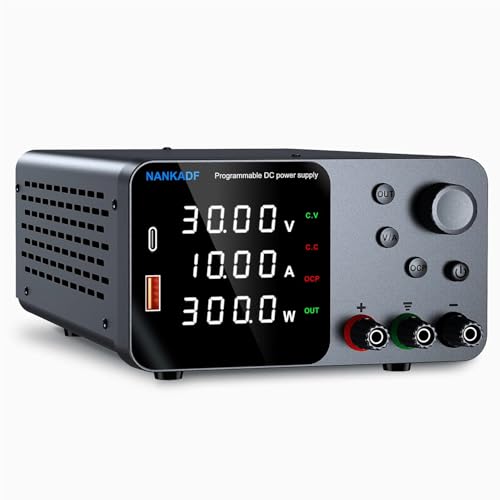
- 0.01V/0.001A encoder adjustment
- USB-A and USB-C quick charging
- Four-layer safety protection
Best For: Repair benches, prototyping, and automotive diagnostics
Best for Repetitive Testing

- Three memory presets for recurring tests
- Output switch, OCP, and key lock
- Compact design with USB charging
Best For: Repair procedures, diagnostics, and lab testing
Best Safety-Focused Value

- Coarse and fine encoder adjustment
- 0.01V/0.001A display resolution
- Short-circuit alarm and broad protection
Best For: General electronics testing and lab projects
Reliable Linear Control – KORAD KA3010D
For shoppers comparing bench power supplies under 300, the KORAD KA3010D is a sturdy linear-regulated option with adjustable output up to 30V and 10A. Its digital display, memory presets, low-noise temperature-controlled fan, and CC/CV operation suit detailed electronics work.
Best For: Electronics labs, repair benches, and users who prioritize dependable, low-noise regulated power.
Pros:
- Linear-regulated 0–30V, 0–10A output with 300W capacity
- Memory presets and panel lock support repeatable, controlled testing
- Over-voltage and over-current protection help protect equipment
- Temperature-controlled fan is designed for lower-noise cooling
Cons:
- At 11 pounds, it is less convenient to move than compact switching models
- Its listed dimensions make it better suited to a dedicated bench
The KA3010D emphasizes predictable linear regulation and practical lab controls. It is a strong fit when precision and a quieter working environment matter more than minimum size or weight.
Compact High-Resolution Pick – YITRANIC 3010MS
Among bench power supplies under 300, the YITRANIC 3010MS stands out for packing 0–32V and up to 10.1A into a compact 1kg housing. A four-digit display, encoder control, memory function, output switch, and universal 100–240V input make it versatile for bench and mobile use.
Best For: Crowded workbenches, portable setups, and repetitive testing that benefits from quick recall and fine readouts.
Pros:
- Adjustable 0–32V and 0–10.1A output with 300W maximum power
- 0.01V/0.001A display resolution supports fine adjustments
- Compact 1kg design includes memory and separate output activation
- Five protections, key lock, and an 18W QC3.0 USB port add convenience
Cons:
- The compact design may offer less physical workspace than larger supplies
- Its feature set may be more than needed for simple power tasks
The 3010MS is a particularly space-efficient choice with strong convenience features. Its dual-switch logic and automatic CC/CV operation are useful when preventing accidental output changes is a priority.
Precise Testing Controls – OWON SPX3103
The OWON SPX3103 is a focused option for bench power supplies under 300, offering 30V, 10A, and 300W output in a compact single-channel format. Its 10mV voltage and 1mA current resolution, real-time readback, and three presets are helpful for development, repair, and testing.
Best For: Electronics development and troubleshooting where fine setting resolution and visible output monitoring are important.
Pros:
- 10mV/1mA setting and readback resolution for precise control
- Displays voltage, current, and real-time power information
- Automatic CC/CV operation with OVP, OCP, and OTP protection
- Compact footprint and three presets support efficient repetitive work
Cons:
- It is a single-channel supply, limiting simultaneous independent outputs
- The supplied notes do not specify input-voltage range or included accessories
With strong resolution and clear live measurements, the SPX3103 is aimed at users who want more than basic voltage and current adjustment. Its compact footprint also helps conserve valuable bench space.
Budget-Friendly Compact Choice – HANMATEK HM310
For buyers seeking bench power supplies under 300, the HANMATEK HM310 offers adjustable 0–30V and 0–10A output in a compact, portable package. Its output enable/disable button lets you set parameters before applying power, while the display calculates output power automatically.
Best For: DIY electronics, maintenance, teaching, battery charging, and workspaces that need a portable supply with USB charging.
Pros:
- Adjustable 0–30V and 0–10A output with 300W capacity
- Output switch helps prevent changes while power is actively applied
- Over-voltage, over-current, over-power, over-temperature, and short-circuit protection
- Compact 1kg design includes a front 5V/2A USB charging port
Cons:
- The supplied notes do not state the display’s voltage and current resolution
- Its compact form may provide fewer controls than larger traditional supplies
The HM310 combines essential adjustable output with practical safety controls and portability. It is a sensible choice for hobbyists and technicians who want straightforward operation without dedicating much bench space.
Best Compact Memory-Enabled Pick – NANKADF 30V 5A Bench Power Supply
For shoppers comparing bench power supplies under 300, this compact NANKADF model combines a 0–30V, 0–5A output with convenient presets and an output control button. Its encoder adjustment and simultaneous voltage, current, and power readouts make routine setup straightforward.
Best For: Mobile and computer repair, electronics teaching, battery charging, and general bench testing where memory presets are useful.
Pros:
- Three memory groups allow quick recall of frequently used voltage and current settings.
- Encoder controls provide continuous adjustment, while the display shows voltage, current, and power together.
- Includes over-voltage, over-current, over-heat, and short-circuit protection.
- Compact 2.5-pound design with a 5V/3.6A USB quick-charge output.
Cons:
- Output is limited to 30V and 5A, so it is not intended for higher-power applications.
- The listed USB connector and fast-charging features may be more than needed for basic bench work.
This is a practical choice when space, fast setup, and basic protection matter more than maximum output capacity. The three presets and output enable/disable button are especially helpful for repeat testing.
Best for Battery Charging – Jesverty SPS-3010C 32V 10A Supply
Among bench power supplies under 300, the Jesverty SPS-3010C stands out for its higher 0–32V, 0–10A range and dedicated intelligent charging mode. Coarse and fine encoder controls provide 0.01V and 0.001A setting resolution, while the dual USB ports add useful device-charging flexibility.
Best For: Battery charging, Arduino and Raspberry Pi projects, repair work, educational labs, and users who want both bench output and quick-charge ports.
Pros:
- 0–32V and 0–10A output offers more current capacity than the 5A models in this group.
- Intelligent charging can stop automatically when a battery is full and includes reverse-connection protection.
- USB-A and USB-C ports support 20W quick charging.
- Output switching, selectable 115V/230V input, and temperature-regulated cooling fan add convenience.
Cons:
- The enclosure is listed as plastic and polycarbonate rather than aluminum.
- Its 20W USB output is separate from the main variable output and should not be confused with the 320W maximum supply rating.
The SPS-3010C is the most versatile option here for users who regularly charge batteries or power small development boards. Its extra current headroom and charging automation make it a strong all-around pick, provided the plastic housing suits your workspace.
Best Complete Kit – X-Tronic PX-70 30V 5A Linear Supply
For buyers evaluating bench power supplies under 300, the X-Tronic PX-70 pairs a 0–30V, 0–5A output with detailed controls, multiple protection modes, and a generous lead kit. Its course and fine adjustments support 0.01V and 0.001A tuning for more controlled electronics work.
Best For: Advanced hobbyists, computer repair services, laboratories, schools, and users who want several test-lead styles included.
Pros:
- Includes precision probe, hook/plunger, and alligator-clip lead sets plus a magnetic project mat.
- Offers memory recall, output on/off, voltage/current lock, and a 5V limit switch.
- Lists low output noise and ripple, ±0.02V voltage accuracy, and less than 0.01%+3mV voltage/load stability.
- Five protection modes include overcurrent, over-temperature, and over-power protection.
Cons:
- Input is specified for 110/120V, 60Hz, with no 220V option listed.
- Its 30V, 5A output provides less current than the Jesverty model.
- The unit is larger than the compact 2.5-pound supplies described here.
The PX-70 makes sense when included accessories, fine control, and protective features are priorities. Its three lead sets can reduce the need for separate purchases, while the warranty and lifetime technical support add reassurance for ongoing bench use.
Best Precision Controls – NANKADF 30V 10A Bench Supply
For shoppers comparing bench power supplies under 300, the NANKADF offers a full 0–30V, 0–10A range with fine encoder adjustment and automatic CV/CC switching. Its output control, USB charging ports, and multiple protection features make it a versatile choice for repair benches and prototyping.
Best For: Electronics repair, prototyping, school labs, and automotive diagnostics.
Pros:
- Encoder provides 0.01V and 0.001A adjustment resolution.
- Dedicated output enable/disable button and power-off memory simplify repeated work.
- Includes USB-A and USB-C ports with up to 18W quick charging.
- OVP, OCP, OTP, and short-circuit protection are built in.
Cons:
- Its 300W capacity may be more than needed for low-power projects.
- USB charging features may add cost if you only need regulated bench output.
The NANKADF stands out when adjustment precision, convenient output control, and integrated device charging matter as much as basic voltage and current regulation.
Best for Repetitive Testing – WANPTEK 30V 10A Bench Supply
Among bench power supplies under 300, the WANPTEK focuses on repeatable lab and repair workflows. It combines 0–30V, 0–10A regulated output with three memory presets, an output switch, key lock, and encoder-based adjustment.
Best For: Technicians and lab users who frequently repeat the same voltage and current tests.
Pros:
- Three M1/M2/M3 presets allow quick recall of common settings.
- Digit-by-digit encoder adjustment supports precise testing.
- Output switch, OCP protection, and key lock help prevent operating mistakes.
- Compact horizontal design includes a USB fast-charge port.
Cons:
- Supplied test leads are described as suitable mainly as a giveaway, not for sustained high current.
- The rear input switch must be set to 115V for use in the United States.
- The display is a 4-digit LED rather than a higher-resolution readout.
Choose this WANPTEK if saved presets and bench-friendly controls can save time during recurring diagnostics. Plan to use heavier-duty leads for extended high-current work.
Best Safety-Focused Value – HANGELL 30V 10A Bench Supply
The HANGELL is a practical option for shoppers seeking bench power supplies under 300 with straightforward controls and safety features. Its 0–30V, 0–10A switching-regulated output includes coarse and fine encoder adjustment, automatic CV/CC switching, and a dedicated output button.
Best For: General electronics testing, lab projects, and users who want clear readings and simple output control.
Pros:
- Coarse and fine encoder controls make voltage and current adjustments easier.
- 4-digit LED display offers 0.01V and 0.001A resolution.
- Short-circuit alarm and OVP, OCP, overtemperature, and overload protection are included.
- USB and Type-C ports provide up to 18W quick charging.
Cons:
- The listed USB output is 18W, so it is intended for charging rather than high-power device operation.
- Unlike the WANPTEK, the supplied notes do not mention memory presets or a key-lock function.
The HANGELL is a well-rounded pick when you want precise display resolution, coarse/fine adjustment, and broad protection coverage without requiring preset storage.
How We Picked the Best Bench Power Supplies Under 300
We focused on adjustable DC bench supplies suitable for electronics labs, repair benches, classrooms, makerspaces, and hobby work. The comparison considers output range, maximum current, rated power, regulation controls, display readability, adjustment precision, and practical safety features such as over-voltage, over-current, over-temperature, and short-circuit protection.
We also looked at workflow features that matter during repeated testing, including output enable/disable controls, memory presets, encoder knobs, coarse and fine adjustment, USB ports, charging modes, and low-noise linear designs. Always verify the manufacturer’s specifications before purchase, particularly for continuous-load performance and included accessories.
Quick Comparison
| Specification | What to look for |
|---|---|
| Voltage range | Up to 30V or 32V covers most low-voltage electronics projects. |
| Current capacity | 5A suits many circuits; 10A provides more headroom for motors, lighting, and power testing. |
| Power rating | Higher wattage is useful only when the supply can deliver the required voltage and current together. |
| Supply type | Linear models generally emphasize low ripple; switching models are often lighter and more feature-rich. |
| Controls | Encoder adjustment, output switching, presets, and lock functions improve repeatability. |
Key Buying Factors for Bench Power Supplies Under 300
Voltage, Current, and Power
Choose a supply that exceeds your normal operating requirements rather than running at its limit. A 0–30V, 5A model is adequate for many boards and modules, while a 10A unit is more suitable for motors, automotive electronics, amplifiers, and higher-current prototypes. Check the total wattage rating because maximum voltage and maximum current may not be available simultaneously.
Regulation and Output Quality
Constant-voltage and constant-current modes let you set either a target voltage or a safe current ceiling. For sensitive analog, audio, sensor, or radio circuits, prioritize low ripple and stable regulation. Switching supplies can be excellent general-purpose choices, but a linear design may be preferable when noise performance is the main concern.
Controls and Protection
Digital displays should be clear and sufficiently precise for your work. Fine adjustment, memory recall, output enable buttons, and panel locks reduce setup errors. Look for short-circuit, over-current, over-voltage, and thermal protection, especially if multiple users will operate the unit.
Who Should Buy Which Bench Power Supplies Under 300?
Choose a 30V, 5A supply for general bench work, small prototypes, Arduino or microcontroller projects, and repair tasks. Select a 30V or 32V, 10A model when you need extra current for motors, strips, battery-related testing, or demanding loads. Pick a linear supply when low electrical noise is more important than compact size and USB features. A switching model is typically the better fit for buyers who want a lighter unit, charging ports, memory presets, and flexible everyday functionality.