The best robot building kits for outdoor use combine durable construction, engaging controls, and enough programming or mechanical depth to keep young builders learning. This roundup compares 10 options for everything from solar experiments to app-controlled rover projects.
Before choosing, consider the child’s age, coding experience, terrain, power source, and whether the kit will be used for short supervised sessions or ongoing outdoor projects.
Best 10 Robot Building Kits for Outdoor Use Picks for 2026
Best Solar Starter
Sillbird 12-in-1 Solar Robot Kit

- Solar-powered outdoor STEM play
- 12 models and 190 parts
- Clear instructions for ages 8+
Best For: Solar learning and beginner-friendly building
Best Programmable Car

- Arduino-compatible coding platform
- FPV, line tracking and avoidance modes
- Rechargeable battery included
Best For: Coding-focused builders and robotics projects
Best for Rough Outdoor Play

- Built for varied-terrain exploration
- Includes mBot2 and Rover builds
- Interactive sounds, games and expressions
Best For: Outdoor driving and interactive robot play
Best Feature-Packed Build
Sillbird 5-in-1 Programmable Robot
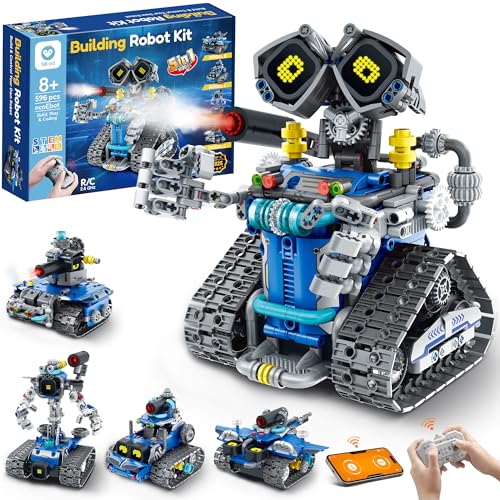
- 596 pieces across five models
- Remote and Bluetooth app control
- Up to 40 minutes per charge
Best For: Interactive, multi-model STEM building
All-Terrain Metal Pick

- Tracked drive handles grass, gravel, sand, and light snow.
- Metal body with a 4-DOF arm and interchangeable bucket.
- Remote-controlled build for ages 8-14.
Best For: Outdoor mechanical play and sturdy robot-arm building
Mechanical Coding Choice

- Programs actions with a mechanical coding wheel.
- Can throw, lift, kick, and draw.
- Multi-hour STEM build for ages 10 and up.
Best For: Screen-free mechanical coding and engineering practice
Solar Experimenter

- Builds 12 rolling, crawling, or floating robot designs.
- Uses solar power outdoors or a battery box indoors.
- Introduces renewable energy and mechanical science.
Best For: Beginner-friendly outdoor solar experiments and build variety
Best for Multi-Level Coding

- Supports Scratch, Arduino, and Python
- Includes 16 guided tutorials
- App and IR remote control
Best For: Kids and teens progressing through multiple coding languages
Best for Rebuildable Space Designs

- 780 pieces build six models
- App and 2.4GHz remote control
- Rechargeable battery and powered motor
Best For: Kids who enjoy rebuilding space-themed robots and vehicles
Best for Outdoor Surface Control

- Five models from 757 pieces
- Four app and remote control modes
- Supports indoor and outdoor surfaces
Best For: Ages 8–16 wanting programmable outdoor robot play
Best Solar Starter – Sillbird 12-in-1 Solar Robot Kit
For families looking for robot building kits for outdoor use, the Sillbird 12-in-1 is a straightforward solar-powered option. Its 190 parts support 12 different builds, while the larger solar panel lets children explore renewable energy in sunlight or with a strong artificial light source indoors.
Best For: Kids ages 8 and up who want screen-free STEM building with gradually increasing challenges.
Pros:
- Solar-powered design encourages hands-on exploration of renewable energy.
- Supports 12 models, including robots and cars, with varied difficulty levels.
- Clear step-by-step instructions support independent or family assembly.
Cons:
- Solar performance depends on available sunlight or a sufficiently strong artificial light.
- It does not include a battery-powered drive system.
This kit is a good fit when the priority is accessible construction and solar learning rather than app control or advanced programming. The range of models also gives children a reason to revisit the set as their building skills develop.
Best Programmable Car – ELEGOO UNO R3 Smart Robot Car
The ELEGOO UNO R3 Smart Robot Car is suited to robot building kits for outdoor use when coding and driving features matter. After assembly, children can experiment with app or IR control, line tracking, obstacle avoidance and live FPV video from the onboard camera.
Best For: Older beginners, coding clubs and family projects focused on Arduino programming and interactive driving.
Pros:
- Combines building with Arduino coding and robotics experiments.
- Includes line tracking, ultrasonic obstacle avoidance and FPV video.
- Keyed connectors and illustrated guidance help reduce beginner wiring errors.
- Comes with a rechargeable 2000 mAh lithium-ion battery.
Cons:
- The manufacturer recommends adult guidance for first-time builders.
- Its electronics and programming focus may be more involved than a simple remote-control toy.
This is the strongest choice here for a build-and-code experience. It offers meaningful ways to modify movement, sensor responses and routes, though the greater feature set makes it better suited to children ready for electronics and programming.
Best for Rough Outdoor Play – Makeblock mBot2 Rover Kit
The Makeblock mBot2 Rover stands out among robot building kits for outdoor use because its supplied design emphasizes remote-controlled exploration. The kit includes both an mBot2 and Rover construction, with a powerful drive system described as suitable for varied terrain and able to withstand shocks.
Best For: Kids ages 8 and up who want a buildable robot companion for outdoor driving and interactive play.
Pros:
- Designed for outdoor exploration across varied terrain.
- Includes two building experiences: the simpler mBot2 and the more complex Rover.
- Offers interactive features such as dancing, music, games and customizable expressions.
Cons:
- The set requires a lithium-ion battery.
- Its operation mode is listed as manual, so it may offer less programming depth than coding-focused kits.
This kit prioritizes physical play and personality over detailed electronics instruction. It is a practical option for children who want to assemble a rover, drive it outdoors and use it as an interactive companion.
Best Feature-Packed Build – Sillbird 5-in-1 Programmable Robot
For families comparing robot building kits for outdoor use, this Sillbird set offers a large 596-piece construction experience with remote and Bluetooth app control. Children can build five designs, including a robot, tank and car, then explore LED expressions, sounds and a water-activated mist feature.
Best For: Kids ages 8–14 who want multiple builds, remote control and introductory programmable play.
Pros:
- Five build models provide different levels of construction challenge.
- Remote and Bluetooth app control add flexible ways to operate the robot.
- LED eyes, sound effects and a mist-spray feature make play more interactive.
- Rechargeable battery provides up to 40 minutes of continuous play per charge.
Cons:
- The mist feature requires adding water before use.
- Outdoor use will depend on suitable conditions for its electronic components.
This is a versatile choice for children who value variety and visual interaction. It provides more pieces and play features than a basic robot kit, while the colorful manual is intended to keep the multi-stage building process approachable.
All-Terrain Metal Pick – VANLINNY 4-DOF Robot Arm Tank
Among robot building kits for outdoor use, the VANLINNY stands out for its tracked chassis and metal construction. It can travel across grass, gravel, sand, and light snow, while the interchangeable claw and shovel heads add variety after assembly.
Best For: Kids ages 8-14 who want a hands-on build with remote-controlled outdoor play and a functional robotic arm.
Pros:
- Rubber tank tracks provide traction on several outdoor surfaces and allow skid steering.
- Metal chassis, panels, gears, and a 4-DOF arm offer a sturdier build than an all-plastic kit.
- Converts between a gripping arm and shovel loader, with loads up to about 3 pounds.
- Includes an illustrated English guide, hex tools, rechargeable robot battery, and USB cable.
Cons:
- The remote requires four AA batteries, which are not included.
- Overloading the arm can wear its gears, so payloads should remain light.
- At about two hours, the build is shorter than some more involved STEM projects.
This is the strongest choice here for genuine outdoor driving and mechanical play. Its all-metal build and dual tool heads add value, though younger builders may need help with assembly and careful payload handling.
Mechanical Coding Choice – TEACH TECH Mech-5
The TEACH TECH Mech-5 is a deep, hands-on option among robot building kits for outdoor use, although its supplied notes focus on mechanical actions rather than all-terrain driving. Builders program it by arranging coding buttons on a wheel, then use the robot to throw, lift, kick, or draw.
Best For: Future engineers ages 10 and up who value mechanical coding, problem-solving, and a multi-hour assembly project.
Pros:
- The coding wheel introduces programming concepts without requiring a screen.
- One robot performs several actions, including throwing, lifting, kicking, and drawing.
- Detailed step-by-step instructions support an in-depth building experience.
- Includes a one-year warranty against manufacturer defects.
Cons:
- The plastic design is not presented as weatherproof or specifically intended for outdoor terrain.
- Assembly takes multiple hours and requires careful attention to the instructions.
- Two AAA batteries are required.
Choose Mech-5 when the priority is learning mechanical coding rather than driving over outdoor surfaces. It offers the most structured engineering challenge of the three, but it is better suited to a protected work area than grass, gravel, or snow.
Solar Experimenter – 12-in-1 Solar Robot Kit
This 12-in-1 solar kit is a flexible entry point for robot building kits for outdoor use. Its solar panel powers outdoor experiments, while the included battery box provides an indoor alternative; the builds include robots that roll, crawl, or float.
Best For: Children ages 6-15 who want repeatable builds and an introduction to solar power, mechanics, and engineering.
Pros:
- Offers 12 different robot configurations for extended building variety.
- Dual power options support solar-powered outdoor use and battery-powered indoor play.
- Includes rolling, crawling, and floating designs.
- Clear step-by-step instructions and non-toxic ABS plastic parts suit beginners.
Cons:
- The required AAA battery is not included.
- Its plastic construction is lighter and less rugged than the VANLINNY metal kit.
- Solar performance depends on available sunlight.
This is the best value for variety and renewable-energy learning, especially for children who may lose interest after one build. It is suitable for outdoor solar demonstrations, but the plastic parts and solar dependence make it less suited to demanding terrain or rough handling.
Best for Multi-Level Coding – ACEBOTT Smart Robot Car Kit
For families comparing robot building kits for outdoor use, the ACEBOTT Smart Robot Car Kit stands out as a flexible coding project with app and remote control options. Its ESP32 controller supports Scratch, Arduino, and Python, while the included tutorials and no-solder assembly make it approachable for developing builders.
Best For: Kids and teens ages 8–16 who want to progress from block coding to Arduino or Python.
Pros:
- Supports Scratch, Arduino, and Python for different skill levels.
- Includes 16 story-based tutorials, HD videos, and illustrated instructions.
- Can be programmed from computers, tablets, smartphones, and iPads.
- Offers both iOS/Android app control and an IR remote.
Cons:
- The product details specify indoor use, so it is not the strongest match for outdoor play.
- Batteries are not included.
This is a strong learning-focused choice when coding flexibility matters more than outdoor durability. Consider it primarily for tabletop or indoor STEM activities rather than regular outdoor use.
Best for Rebuildable Space Designs – 6-in-1 STEM Robot Kit
If you want robot building kits for outdoor use that also deliver substantial construction play, this 780-piece set offers six space-themed models to assemble and rebuild. Its rechargeable battery, powerful motor, app controls, and remote make it suited to experimenting with movement on suitable indoor or outdoor surfaces.
Best For: Kids ages 8 and up who enjoy rebuilding multiple vehicle and robot designs with app-based play modes.
Pros:
- 780 pieces can be used to build six different models, one at a time.
- Includes 2.4GHz remote control and mobile app control.
- App features driving simulation, gravity control, path coding, and STEM programming.
- Rechargeable battery, powerful motor, and lighting add interactive play value.
Cons:
- Only one model can be assembled at a time, so changing designs requires dismantling and rebuilding.
- The notes do not specify weather resistance or outdoor protection.
This kit is appealing for children who value variety and hands-on rebuilding. It can work on appropriate outdoor surfaces, but its supplied information supports supervised play rather than exposure to wet or harsh conditions.
Best for Outdoor Surface Control – HPROMOT 5-in-1 Robot Kit
Among robot building kits for outdoor use, the HPROMOT 5-in-1 kit is a practical option for children who want to build, code, and drive. It offers 757 pieces, four control modes, all-direction movement, and stated support for indoor and outdoor surfaces, with a rechargeable robot battery included.
Best For: Builders ages 8–16 who want multiple robot designs and several ways to control them outdoors or indoors.
Pros:
- 757 pieces create five distinct robot models.
- Four modes include remote control, path, gravity, and programming.
- Designed for 360-degree rotation and all-direction movement on indoor and outdoor surfaces.
- Built-in rechargeable lithium battery is included.
Cons:
- The remote controller requires AAA batteries, which are not included.
- Small parts make it unsuitable for children under 3.
- Bluetooth and location permissions may be needed for smooth app pairing.
This is the clearest match here for controlled outdoor robot play because the notes specifically mention outdoor surfaces. Even so, the plastic construction and lack of stated weather resistance suggest keeping use supervised and dry.
How We Picked These Robot Building Kits for Outdoor Use
We focused on kits that support active, hands-on play beyond a desk. The selection includes wheeled rovers, tracked vehicles, robot arms, solar-powered builds, and programmable cars. We compared age recommendations, construction complexity, control methods, power requirements, compatibility with platforms such as Arduino and Scratch, and the likelihood that a finished robot can handle smooth outdoor surfaces.
Outdoor use still requires realistic expectations: many educational kits are designed for patios, driveways, sidewalks, or compact ground rather than grass, mud, gravel, or wet conditions. Adult assembly help and supervision may also be necessary.
Quick Comparison
| Kit type | Best for | Notable feature |
|---|---|---|
| Solar multi-build kits | Beginners and younger builders | Hands-on renewable-energy experiments |
| Arduino-compatible robot cars | Programming practice | Expandable coding and sensor projects |
| App and remote-control kits | Interactive play | Multiple control methods |
| Tracked or metal builds | Mechanical learning | More substantial chassis designs |
| Coding-focused robots | Older children and guided projects | Greater emphasis on programming logic |
Key Buying Factors
Terrain and Chassis Design
For outdoor robot building kits, look for wide wheels, tracked drives, and a stable frame. Smooth pavement is the safest target for most kits. Avoid assuming that a toy rated for outdoor play is weatherproof; electronics, motors, and battery compartments should generally be kept dry.
Power and Runtime
Solar kits are useful for demonstrating energy conversion but may move slowly or depend heavily on bright sunlight. Battery-powered models usually offer more predictable performance. Check whether batteries, a charger, or a USB cable are included, and consider the replacement-battery cost.
Building and Coding Level
Age ratings are only a starting point. A younger child may enjoy remote control while needing help with construction, whereas an older beginner may benefit from Scratch support or guided Arduino programming. Kits with several builds can provide more long-term value, but they may also involve more disassembly and troubleshooting.
Controls, Safety, and Durability
Remote controls are simple for immediate play; apps can add convenience and extra modes; Arduino-compatible systems provide the most room for experimentation. Check small-part warnings, exposed gears, screw complexity, and whether the frame feels suitable for repeated handling.
Who Should Buy Which Robot Building Kits for Outdoor Use?
Choose a solar multi-model kit for a beginner who enjoys assembling simple machines and learning how sunlight powers motion. An Arduino-compatible car is better for a child ready to explore sensors, code, and hardware modifications. App-and-remote-control kits suit families seeking quick entertainment alongside basic engineering practice.
For rougher-looking pavement runs, a tracked or metal-framed design may be the better choice, while a coding-focused kit is preferable for older children who want structured programming challenges. If several children will share the project, prioritize multiple control modes, accessible instructions, and a robust parts inventory. Whatever you choose, start on a dry, flat surface and treat these kits as educational electronics rather than all-weather outdoor equipment.