The best microcontroller starter kits make it easier to move from reading tutorials to building working circuits. This roundup compares 10 options covering Arduino, Raspberry Pi Pico, ESP32, robotics, sensors, displays, and wireless projects.
Whether you are buying a first electronics kit or expanding into Wi-Fi and IoT development, use the guide below to match the board, components, documentation, and project scope to your experience level.
Best 10 Microcontroller Starter Kits Picks for 2026
Best Overall Beginner Value
ELEGOO UNO R3 Super Starter Kit

- 22+ guided Arduino projects
- Solderless beginner-friendly setup
- Sensors, motors, LCD, and IR parts included
Best For: First-time Arduino learners and classroom STEM activities
Best for IoT Learning
SunFounder Raspberry Pi Pico W Ultimate Kit

- 450+ components and 117 projects
- Wi-Fi and Bluetooth Pico W board
- MicroPython, C/C++, and Piper Make support
Best For: Wireless projects and multi-language programming practice
Best for Larger Arduino Builds

- 35+ guided electronics projects
- 54 digital I/O pins and 256 KB flash
- RFID, RTC, sensors, displays, and motors
Best For: Multi-sensor Arduino builds and advanced classroom projects
Best Premium Arduino Wireless Kit
SunFounder UNO R4 WiFi Explorer

- Original Arduino UNO R4 WiFi board
- 50+ projects and 100+ video lessons
- 300+ components with IoT focus
Best For: Arduino learners progressing into Wi-Fi, Bluetooth, and IoT
Camera-Ready Powerhouse

- Dual-core ESP32 with Wi-Fi, Bluetooth, and camera
- Supports MicroPython, C, and Processing
- 240 items and 122 guided projects
Best For: Makers seeking wireless camera projects and extensive learning material
Connected Learning Pick
ELEGOO ESP-32 Super Starter Kit

- Dual-core ESP-32 with Wi-Fi and Bluetooth
- Arduino IDE compatible
- 35+ modules and 30+ guided projects
Best For: Beginners exploring IoT and Arduino-compatible electronics
STEM-Friendly Foundation

- RP2040-based Raspberry Pi Pico platform
- Supports MicroPython, C/C++, and Piper Make
- Includes LCD, servo, sensors, RGB LED, and buzzer
Best For: Students and beginners learning through guided Pico experiments
Best Budget Pick
REXQualis Arduino UNO R3 Super Starter Kit
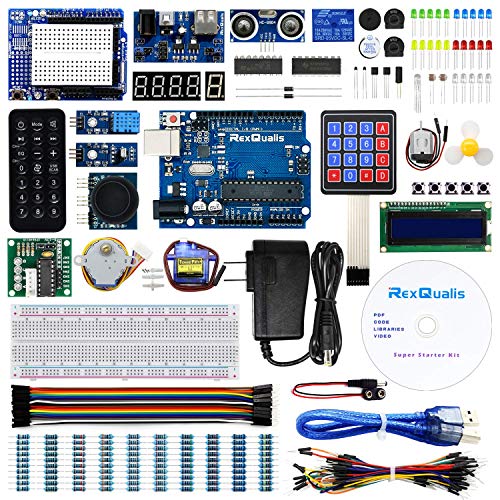
- 120 labeled components for Arduino-compatible projects
- Includes a 9V 1A power adapter
- Tutorial and datasheets available to download
Best For: Budget-conscious beginners learning Arduino basics
Best Guided Learning Kit
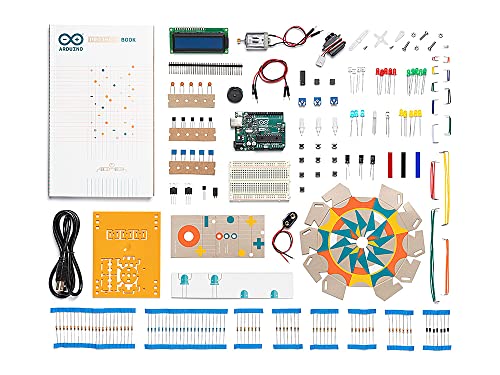
- Includes an English step-by-step projects book
- Covers 12 hands-on DIY electronics projects
- Uses original Arduino components
Best For: Structured beginner learning and classroom instruction
Best for Wireless IoT Projects
LAFVIN ESP32 Wi-Fi Starter Kit

- ESP32 board with Wi-Fi and Bluetooth
- Includes OLED, DHT11, PIR, and relay hardware
- Arduino IDE-compatible tutorial with code
Best For: Beginners exploring connected ESP32 projects
Best Overall Beginner Value – ELEGOO UNO R3 Super Starter Kit
For shoppers comparing microcontroller starter kits, the ELEGOO UNO R3 Project Super Starter Kit offers a straightforward introduction to Arduino electronics. Its 22+ guided lessons cover LEDs, sensors, displays, motors, and basic input devices, while the solderless breadboard and pre-soldered LCD help reduce setup friction.
Best For: Beginners, family weekend builds, homeschool lessons, coding clubs, and introductory STEM classrooms.
Pros:
- Includes 22+ guided projects with example code and a PDF tutorial.
- Offers broad project variety, including temperature, distance, motor, LCD, joystick, and IR experiments.
- Solderless setup and a pre-soldered LCD make it approachable for first-time builders.
- Includes a large selection of sensors, motors, LEDs, resistors, wires, and other prototyping parts.
Cons:
- The UNO R3 has comparatively limited memory and processing capability for larger projects.
- The power module should not be used with input above 9V.
- Younger learners may need experienced adult supervision during setup.
This is a practical entry-level choice when the priority is learning core Arduino concepts through many guided, hands-on exercises without soldering. It is less suited to advanced wireless or memory-intensive builds.
Best for IoT Learning – SunFounder Raspberry Pi Pico W Ultimate Kit
Among microcontroller starter kits, the SunFounder Raspberry Pi Pico W Ultimate Starter Kit stands out for wireless and multi-language learning. It combines a Pico W with more than 450 components, 117 projects, video instruction, and support for MicroPython, C/C++, and Piper Make.
Best For: Beginners aged 8 and up who want to explore Raspberry Pi Pico W projects, IoT concepts, and multiple programming languages.
Pros:
- Includes 450+ components and 117 projects for extensive experimentation.
- Built around the wireless Raspberry Pi Pico W with Wi-Fi and Bluetooth connectivity.
- Provides 27 video tutorials led by educator Paul McWhorter.
- Supports MicroPython, C/C++, and Piper Make, with Arduino IDE compatibility noted.
Cons:
- The large component count may feel overwhelming for someone seeking a small, focused kit.
- Its learning path centers on the Raspberry Pi Pico W rather than an Arduino-branded board.
- The supplied notes do not specify the individual component list in detail.
This kit is a strong fit when wireless experimentation and flexible programming options matter more than a narrowly curated parts list. Its online lessons and community support can help learners navigate the unusually broad scope.
Best for Larger Arduino Builds – ELEGOO Mega 2560 Complete Kit
For microcontroller starter kits intended to grow beyond basic LED exercises, the ELEGOO Mega 2560 Project Kit provides more I/O and memory than a typical UNO-based set. Its 35+ guided projects and 200+ components cover RFID, clocks, motion, environmental sensing, displays, and motor control.
Best For: Coding clubs, maker projects, STEM learners, and builders combining many sensors, controls, and displays.
Pros:
- Offers 54 digital I/O pins, 15 PWM outputs, 16 analog inputs, and four hardware serial ports.
- Includes 256 KB of flash memory for more substantial Arduino projects.
- Provides 35+ guided lessons and more than 200 components.
- Includes useful modules such as RFID, RTC, PIR, ultrasonic, water-level, GY-521, keypad, and motor parts.
Cons:
- The larger component selection may require more organization and setup time.
- It is more board capacity than many beginners need for simple LED and button exercises.
- The supplied notes do not identify wireless networking hardware for connected projects.
The Mega 2560 is the better choice when a project needs numerous connections or several modules operating together. Choose a smaller UNO kit instead if portability and a simpler first lesson are the main priorities.
Best Premium Arduino Wireless Kit – SunFounder UNO R4 WiFi Explorer
For shoppers seeking modern microcontroller starter kits, the SunFounder Elite Explorer Kit pairs an original Arduino UNO R4 WiFi with 300+ components and 50+ projects. Its combination of a 32-bit board, built-in Wi-Fi and Bluetooth, video courses, and IoT exercises creates a clear path from basic Arduino work to connected projects.
Best For: Beginners, students, teachers, and engineers who want Arduino fundamentals plus wireless and IoT experimentation.
Pros:
- Includes an original Arduino UNO R4 WiFi with built-in Wi-Fi and Bluetooth.
- Provides 50+ projects, including basic, fun, and IoT activities.
- Includes 300+ components and more than 100 free video lessons.
- Offers open-source code, Arduino C++ programming, technical support, and troubleshooting forums.
Cons:
- The expanded wireless features may be more than needed for simple introductory circuits.
- Its project and component breadth can create a steeper learning path than a compact UNO R3 kit.
- The supplied notes do not provide a detailed inventory of all 300+ components.
This kit makes the most sense for learners who want to start with conventional Arduino circuits but keep a path open for Wi-Fi, Bluetooth, and Arduino IoT Cloud projects. It offers more modern connectivity than the included UNO R3 alternatives.
Camera-Ready Powerhouse – ESP32 Camera Ultimate Kit
For shoppers comparing microcontroller starter kits, the Freenove ESP32 Camera Kit stands out as a broad, project-focused package. Its dual-core ESP32 board combines Wi-Fi, Bluetooth, a camera, a memory card slot, and support for MicroPython, C, and Processing, while the 122 guided projects help you build from basic circuits to more advanced applications.
Best For: Makers who want camera, wireless, and multi-language project options in one extensive kit.
Pros:
- ESP32 board includes dual-core processing, Wi-Fi, Bluetooth, camera, and memory card support.
- Supports MicroPython, C, and Processing for varied learning and project paths.
- Includes 240 items, a 1GB memory card, and 122 step-by-step projects.
- Provides a substantial 795-page downloadable or online tutorial.
Cons:
- The tutorial is digital rather than printed.
- Processing projects require a computer for graphical interfaces.
This is the most expansive choice of the three for learners who value project volume and built-in imaging features. Its large component assortment may be more than beginners need for simple introductory circuits, but it offers plenty of room to grow.
Connected Learning Pick – ELEGOO ESP-32 Super Starter Kit
Among microcontroller starter kits, the ELEGOO ESP-32 Super Starter Kit is a practical option for learning connected electronics with the Arduino IDE. It pairs a dual-core ESP-32 board with Wi-Fi and Bluetooth, more than 35 modules and components, and over 30 guided projects covering sensors, displays, motors, and input devices.
Best For: Beginners and hobbyists building Arduino-compatible IoT, automation, and interactive electronics projects.
Pros:
- Dual-core ESP-32 board includes integrated Wi-Fi and Bluetooth 4.2.
- Compatible with the Arduino IDE for a familiar programming workflow.
- Includes more than 35 module and component types, including an OLED, servo, and keypad.
- Online tutorial offers 30+ projects with code, circuit diagrams, and step-by-step guidance.
Cons:
- The supplied notes do not specify a camera or memory card feature.
- Its project count is smaller than the Freenove kit’s 122 projects.
Choose this kit if your priority is a focused ESP-32 introduction with Arduino IDE compatibility and common IoT components. It offers a balanced starting point without the larger project library or specialized camera hardware of the Freenove option.
STEM-Friendly Foundation – Raspberry Pi Pico Basic Kit
The LAFVIN Raspberry Pi Pico kit is a straightforward choice for anyone comparing microcontroller starter kits for STEM learning. Built around the RP2040 platform, it includes familiar modules such as an LCD1602 display, SG90 servo, motion sensor, WS2812 RGB LED strip, buzzer, and buttons, with support for MicroPython, C/C++, and Piper Make.
Best For: Electronics beginners, students, and school labs learning programming through hands-on Pico projects.
Pros:
- Uses the Raspberry Pi Pico and RP2040 development platform.
- Supports MicroPython, C/C++, and Piper Make graphical programming.
- Includes display, servo, motion-sensing, RGB lighting, buzzer, and button modules.
- Tutorials include project guidance and sample code for setup and verification.
Cons:
- It is centered on the Raspberry Pi Pico rather than an ESP32 wireless platform.
- The supplied notes do not specify Wi-Fi capability.
- The warranty is listed as six months.
This kit is a good fit when structured STEM practice matters more than wireless or camera features. Its mix of graphical and text-based programming gives learners an approachable path from basic experiments to more involved Pico projects.
Best Budget Pick – REXQualis Arduino UNO R3 Super Starter Kit
If you want an economical entry point into microcontroller starter kits, the REXQualis Super Starter Kit provides an Arduino UNO R3-compatible board, sensors, motors, an LCD module, and other components for introductory programming and robotics projects. The included 9V power adapter, labeled parts, storage box, and downloadable tutorial add practical convenience for beginners.
Best For: Beginners seeking a broad, budget-friendly Arduino-compatible component selection.
Pros:
- Includes 120 items, including sensors, servo and motor components, LCDs, and a ULN2003 driver board.
- Comes with a 9V 1A power adapter instead of requiring a 9V battery.
- Components and integrated circuits are individually packaged and labeled in a plastic storage box.
- Provides a downloadable PDF tutorial and datasheets.
Cons:
- The product is compatible with Arduino rather than identified as an official Arduino kit.
- The supplied notes point to downloadable documentation rather than a printed project book.
This is a practical value choice for learning basic Arduino programming and experimenting with many common components. Choose it if quantity, organization, and low entry cost matter more than official branding.
Best Guided Learning Kit – Official Arduino Starter Kit
The Official Arduino Starter Kit is a strong option among microcontroller starter kits for learners who prefer structured, hands-on instruction. It includes genuine Arduino components and an English project book covering guided electronics and programming activities, making it suitable for self-study, teaching, or classroom use.
Best For: Beginners and educators who want an official Arduino kit with guided projects.
Pros:
- Includes an English projects book with step-by-step guidance.
- Offers hands-on projects using a DC motor, servo motor, tilt sensor, LEDs, and other components.
- Uses original Arduino components sourced from Italy.
- Designed for learning and teaching across beginner and refresher use cases.
Cons:
- Its official components and guided format may make it less focused on maximizing part count.
- The listed manufacturer warranty is limited to 30-day defects coverage.
This kit is best when the learning path matters as much as the hardware. Its official components and project-based English book provide a more curated introduction than an unstructured parts bundle.
Best for Wireless IoT Projects – LAFVIN ESP32 Wi-Fi Starter Kit
For microcontroller starter kits focused on connected projects, the LAFVIN ESP32 Basic Starter Kit combines an ESP32 development board with Wi-Fi and Bluetooth, sensors, an OLED display, a breadboard, and relay hardware. Its Arduino IDE compatibility and tutorial with code and lessons make it approachable for introductory IoT experimentation.
Best For: Beginners building Wi-Fi, Bluetooth, sensor, and basic IoT projects with ESP32.
Pros:
- Uses an ESP32 board with built-in Wi-Fi and Bluetooth connectivity.
- Includes an OLED display, DHT11, PIR motion sensor, photosensitive resistor, and obstacle avoidance module.
- Provides a breadboard, jumper wires, resistors, buttons, LEDs, buzzer, and a two-channel relay.
- Includes a tutorial with code and lessons and supports the Arduino IDE.
Cons:
- The supplied notes direct users to download the tutorial after receiving the kit.
- It is centered on ESP32 rather than an Arduino UNO platform, so project examples may differ from UNO-based kits.
This is the most suitable choice here for exploring connected electronics and sensor-driven projects. Select it over a basic UNO kit if wireless capability and ESP32 experimentation are your priorities.
How We Picked These Microcontroller Starter Kits
We selected kits that offer a practical combination of a development board, useful electronic components, project documentation, and compatibility with beginner-friendly programming tools. The lineup includes Arduino UNO and Mega boards, Arduino UNO R4 WiFi, Raspberry Pi Pico and Pico W kits, and ESP32-based options.
We also considered the type and breadth of included parts. A kit with LEDs, resistors, buttons, sensors, displays, motors, and servos can support varied practice, while a wireless or camera-focused kit may be better for a specific project path. Tutorial quality, programming-language support, and the likelihood that beginners can keep using the kit after the first few projects were also important.
Component counts are not the only measure of value. A smaller kit with clear instructions may be more useful than a larger collection with limited guidance, so compare both the contents and the learning experience.
Quick Comparison
| Best For | Recommended Kit Type | Why It Stands Out |
|---|---|---|
| First Arduino projects | UNO R3 starter kit | Simple setup, broad beginner support, and familiar examples |
| More complex wired builds | Mega 2560 kit | More pins and room for larger projects |
| Wireless IoT | UNO R4 WiFi, Pico W, or ESP32 kit | Built-in or board-level wireless connectivity |
| Python learning | Raspberry Pi Pico kit | Supports MicroPython alongside C/C++ |
| Camera experiments | ESP32 camera kit | Designed around image and connected-device projects |
| Structured instruction | Official Arduino Starter Kit | Guided projects and an English project book |
Key Buying Factors for Microcontroller Starter Kits
Board and Programming Environment
Choose a board that matches the software you want to learn. Arduino UNO kits are often the easiest starting point for basic electronics and C/C++ sketches. Raspberry Pi Pico kits can support MicroPython as well as C/C++, while ESP32 boards are especially useful for Wi-Fi, Bluetooth, and IoT applications. Check operating-system support, IDE compatibility, and whether the included tutorial matches the board version.
Parts and Project Range
Look for the components needed for the projects you actually want to build. LEDs, buttons, potentiometers, sensors, buzzers, LCD or OLED displays, servos, motors, and breadboards provide a strong general foundation. If you want robotics, prioritize motor-control parts; for connected devices, prioritize wireless boards and sensors.
Documentation and Expandability
Clear wiring diagrams, sample code, online lessons, and troubleshooting guidance can significantly reduce frustration. Also check whether the board uses standard headers and whether replacement or expansion parts are easy to find. A kit is a better long-term purchase when its controller can support projects beyond the included examples.
Safety and Completeness
Confirm that the kit includes essentials such as a USB cable, resistors, jumper wires, and a suitable breadboard. Use the correct power supply, avoid short circuits, and treat motors and servos carefully. RoHS compliance may also matter if you are buying for classroom or institutional use.
Who Should Buy Which Microcontroller Starter Kits?
Absolute beginners: Start with an Arduino UNO R3 kit or the official Arduino Starter Kit if guided lessons and a structured project book are priorities.
Students and STEM learners: Choose a Raspberry Pi Pico kit when MicroPython, compact hardware, and hands-on experimentation are central goals.
Intermediate makers: Consider an Arduino Mega kit for projects needing more pins, or an ESP32 kit for Wi-Fi, Bluetooth, and connected sensors.
IoT and wireless builders: Select a Pico W, UNO R4 WiFi, or ESP32-based kit based on the ecosystem and libraries you plan to use.
Camera-project enthusiasts: An ESP32 camera kit is the most targeted choice for image capture, monitoring, and networked vision experiments.