Indoor electronics projects are easier to start when a kit combines a reliable controller board with the sensors, displays, motors, and wiring needed for hands-on experimentation. The right package can help beginners follow guided lessons while giving experienced makers room to build original projects.
We compared 10 microcontroller starter kits for indoor use across board type, component selection, programming support, tutorials, and project potential. This roundup includes Arduino, Raspberry Pi Pico, and ESP32 kits for learning, STEM activities, home automation prototypes, and general DIY use.
Best 10 Microcontroller Starter Kits for Indoor Use Picks for 2026
Best Connected Learning Kit
Raspberry Pi Pico W Ultimate Starter Kit

- 450+ components and 117 projects
- Wi-Fi and Bluetooth for IoT builds
- MicroPython, C/C++, and Piper Make support
Best For: Beginners exploring connected indoor IoT projects
Best Classic Arduino Starter
ELEGOO UNO R3 Project Super Kit

- 22+ guided beginner lessons
- Solderless breadboard and pre-soldered LCD
- Sensors, motors, displays, and input modules
Best For: First-time Arduino and STEM learners
Best Modern IoT Progression
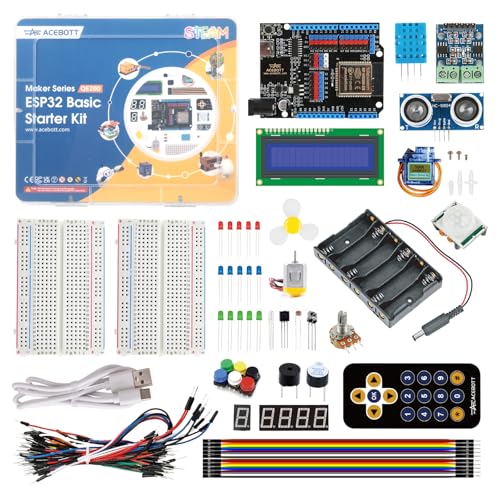
- ESP32 with Wi-Fi and Bluetooth
- 40+ structured tutorials
- Graphical coding, Arduino IDE, and Python
Best For: Beginners progressing toward indoor IoT projects
Best for Complex Builds

- 54 digital I/O pins and 16 analog inputs
- 35+ guided projects
- 200+ components with storage case
Best For: Larger multi-sensor and maker projects
Best All-Around Arduino Kit
Vilros Arduino Uno R3 Starter Kit

- Arduino Uno R3 with 190+ components
- Includes a 72-page color learning manual
- Motor, servo, relay, sensors, LEDs, and breadboard included
Best For: Beginners learning foundational Arduino circuits indoors
Best for Connected Projects
ELEGOO ESP-32 Super Starter Kit

- Dual-core ESP-32 with Wi-Fi and Bluetooth 4.2
- Arduino IDE compatible
- 30+ guided projects and 35+ modules
Best For: Indoor IoT, smart-home, and wireless electronics projects
Best for STEM Learning
LAFVIN Raspberry Pi Pico Starter Kit

- Raspberry Pi Pico with RP2040 platform
- Supports MicroPython, C/C++, and Piper Make
- Includes LCD, motion sensor, servo, RGB LED, buzzer, and buttons
Best For: STEM education, school labs, and guided beginner projects
Best Value Indoor Arduino Kit
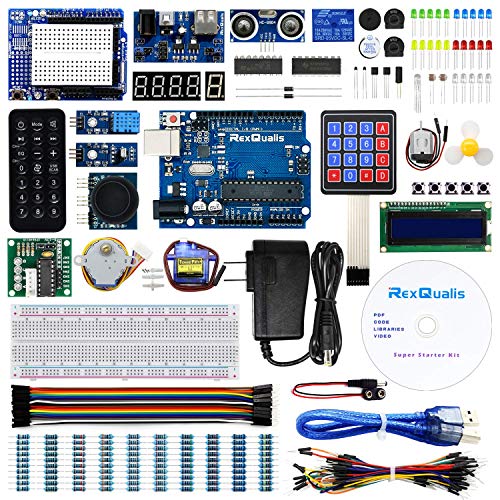
- 120 Arduino-compatible components
- Includes 9V 1A power adapter
- Labeled parts and downloadable tutorials
Best For: Beginners seeking broad indoor project coverage on a budget
Best Budget Sensor Kit

- Includes R3 CH340 controller and breadboard
- Features DHT11 and soil humidity sensors
- Organized in a plastic retail box
Best For: Entry-level indoor sensor and breadboard experiments
Best for Motor Projects
LAFVIN Project Super Starter Kit
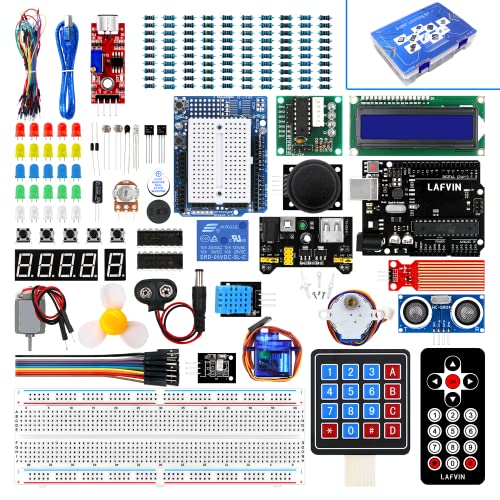
- Includes servo, stepper, and DC motors
- Supports Mega, Nano, and R3-compatible boards
- Includes 20-plus guided lessons
Best For: Indoor robotics and motion-control learning
Best Connected Learning Kit – Raspberry Pi Pico W Ultimate Starter Kit
For shoppers comparing microcontroller starter kits for indoor use, the SunFounder Raspberry Pi Pico W kit stands out as a broad, connectivity-focused option. It combines more than 450 components with 117 projects, Wi-Fi and Bluetooth, and support for MicroPython, C/C++, and Piper Make.
Best For: Beginners, IoT learners, and families or classrooms wanting a large project library with guided instruction.
Pros:
- Includes 450+ components and 117 projects for substantial variety.
- Provides Wi-Fi and Bluetooth connectivity for indoor IoT experiments.
- Offers 27 video tutorials plus community and technical support.
- Supports MicroPython, C/C++, Piper Make, and Arduino IDE compatibility.
Cons:
- The extensive component selection may feel overwhelming to complete beginners.
- Its wireless features are useful for connected projects but unnecessary for basic electronics practice.
This is a strong choice when connectivity and long-term project variety matter more than a minimal first kit. The guided videos and multiple programming options also give learners room to progress beyond introductory circuits.
Best Classic Arduino Starter – ELEGOO UNO R3 Project Super Kit
This ELEGOO UNO R3 kit is a practical entry point for microcontroller starter kits for indoor use, especially when the goal is learning core electronics through guided builds. Its solderless breadboard, pre-soldered LCD header, and 22+ lessons cover sensors, displays, motors, and basic controls.
Best For: First-time Arduino learners, homeschool projects, coding clubs, and family weekend builds.
Pros:
- Includes 22+ guided lessons with example code.
- Provides a wide mix of sensors, motors, displays, LEDs, and input modules.
- Solderless construction and a pre-soldered LCD help simplify setup.
- Supports common Arduino IDE projects involving sensing, timing, and motor control.
Cons:
- It uses a traditional UNO R3 platform without built-in Wi-Fi or Bluetooth.
- The power module should not be supplied with more than 9V.
Choose this kit for a straightforward, hands-on Arduino foundation. It offers enough variety for indoor experiments while keeping the learning path centered on familiar circuits and beginner-friendly projects.
Best Modern IoT Progression – ACEBOTT ESP32 Electronics Kit
The ACEBOTT ESP32 kit is a compelling option among microcontroller starter kits for indoor use when learners want to move from simple circuits into wireless and IoT projects. It pairs an ESP32 board with Wi-Fi and Bluetooth, 96 components, and more than 40 structured tutorials.
Best For: Beginners and teens who want a staged path from graphical coding to Arduino IDE and Python programming.
Pros:
- Built-in Wi-Fi and Bluetooth support modern IoT and smart-home experiments.
- Includes 40+ step-by-step lessons with a progressive learning structure.
- Offers graphical coding, Arduino IDE, and Python programming methods.
- Labeled, anti-static-packaged components help with organization and setup.
Cons:
- The kit is centered on the ACEBOTT ESP32 ecosystem, so learners should follow its listed compatibility options.
- Its broader programming path may require more time than a basic Arduino-only kit.
This kit makes the most sense for learners who want a modern board and a clear route toward connected projects. The structured tutorials can reduce the guesswork often associated with assembling an IoT learning setup.
Best for Complex Builds – ELEGOO Mega 2560 Complete Kit
For buyers seeking microcontroller starter kits for indoor use that can support larger experiments, the ELEGOO Mega 2560 kit offers substantial expansion room. Its MEGA board provides 54 digital I/O pins, 16 analog inputs, four hardware serial ports, and 256 KB of flash, alongside more than 200 components.
Best For: Advanced beginners, maker projects, coding clubs, and learners combining multiple sensors, displays, and motors.
Pros:
- Provides more I/O and memory than a typical beginner Arduino board.
- Includes 35+ guided projects covering RFID, clocks, sensing, monitoring, and motor control.
- Offers 200+ components, including displays, sensors, motors, and control modules.
- Pre-soldered modules, a storage case, and a parts box support repeatable builds.
Cons:
- The large component count and broader project scope may be excessive for basic LED and button exercises.
- It does not list built-in Wi-Fi or Bluetooth connectivity.
This is the strongest fit when a learner is likely to outgrow a small UNO-style setup. Its extra pins, memory, and hardware serial ports make it better suited to ambitious indoor prototypes with several modules operating together.
Best All-Around Arduino Kit – Vilros Arduino Uno R3 Starter Kit
For shoppers comparing microcontroller starter kits for indoor use, the Vilros Arduino Uno R3 kit is a broad, beginner-friendly option for learning circuit fundamentals. It includes more than 190 components, including a breadboard, jumper wires, LEDs, sensors, a motor, servo, and relay, plus a 72-page full-color manual.
Best For: Beginners who want a traditional Arduino platform and enough parts to try many hands-on indoor electronics projects.
Pros:
- Includes an Arduino Uno R3 board and more than 190 components.
- Offers a 72-page, step-by-step color manual for learning Arduino and circuit basics.
- Supports varied projects with a motor, servo, relay, temperature sensor, LEDs, buttons, and photocell.
- Compatible with Arduino Uno projects and other electronics platforms, including Raspberry Pi-based projects.
Cons:
- Uses the classic Arduino Uno platform rather than an integrated Wi-Fi or Bluetooth board.
- The large component assortment may feel more extensive than necessary for a first simple project.
This is a strong value-oriented choice if you want a substantial parts assortment and printed guidance in one box. Choose it over a connected board when your priority is learning core wiring, components, and Arduino programming indoors.
Best for Connected Projects – ELEGOO ESP-32 Super Starter Kit
If you are looking for microcontroller starter kits for indoor use with built-in connectivity, the ELEGOO ESP-32 Super Starter Kit is designed for IoT and smart-device experiments. Its dual-core ESP-32 board includes Wi-Fi and Bluetooth 4.2, and the kit provides more than 35 modules and components for projects involving sensors, displays, motors, and input devices.
Best For: Makers, students, and hobbyists building connected indoor projects such as smart-home controllers, weather stations, and remote devices.
Pros:
- ESP-32 board includes dual-core processing, Wi-Fi, and Bluetooth 4.2.
- Compatible with the Arduino IDE for a familiar programming workflow.
- Includes more than 35 modules and components, including an OLED screen, servo, sensors, motors, and keypad.
- Provides access to 30-plus guided projects with code, diagrams, and step-by-step instructions.
Cons:
- Its connected features and broader project scope may be more than needed for basic circuit practice.
- The kit includes fewer listed items than the 190-piece Arduino-focused alternative.
The ESP-32 makes this kit particularly appealing when wireless communication is central to your project plans. Its tutorial support can help beginners progress from simple circuits to more capable indoor IoT builds.
Best for STEM Learning – LAFVIN Raspberry Pi Pico Starter Kit
The LAFVIN Raspberry Pi Pico kit is a focused choice among microcontroller starter kits for indoor use, especially for classroom practice and beginner programming. It combines a Raspberry Pi Pico with an LCD1602 display, servo, motion-sensing module, WS2812 RGB LED strip, buzzer, and buttons, while supporting MicroPython, C/C++, and Piper Make graphical programming.
Best For: STEM learners, school labs, and beginners who want guided projects with multiple programming options.
Pros:
- Uses the Raspberry Pi Pico and RP2040 development platform.
- Supports MicroPython, C/C++, and Piper Make graphical programming.
- Includes display, motion sensing, RGB lighting, servo, buzzer, and button modules.
- Provides project tutorials and sample code for wiring and programming practice.
Cons:
- Does not offer the Wi-Fi capability highlighted for the ESP-32 kit.
- The listed package centers on a basic set of modules rather than a 190-plus-piece component assortment.
This kit is well suited to structured learning because it covers display, input, sensing, and motion-control experiments without requiring a single programming language. It is a practical pick for indoor STEM instruction and guided hands-on projects.
Best Value Indoor Arduino Kit – Super Starter Kit
For shoppers comparing microcontroller starter kits for indoor use, the REXQualis Super Starter Kit offers a broad Arduino UNO R3-compatible component selection at an economical price. It includes sensors, displays, motors, a servo, a ULN2003 driver board, a 9V 1A power adapter, and labeled storage packaging.
Best For: Beginners who want a well-stocked Arduino-compatible kit for indoor programming, electronics, and introductory robotics projects.
Pros:
- Includes 120 items, including sensors, servo, motors, LCD modules, and driver hardware.
- Comes with a 9V 1A power adapter instead of requiring a 9V battery.
- LCD1602 module includes a preinstalled pin header, and components are individually labeled.
- Free PDF tutorials and datasheets are available.
Cons:
- The included controller is Arduino UNO R3-compatible rather than an official Arduino board.
- The kit is aimed at beginners, so advanced users may want more specialized hardware.
This is a practical choice when value, component variety, and organized indoor storage matter most. The included power adapter and documentation make it especially convenient for getting started at a desk.
Best Budget Sensor Kit – LAFVIN Basic R3 Starter Kit
LAFVIN Basic Starter Kit with R3 CH340,Breadboard + Retail Box Compatible with Arduino IDE
Check Price On AmazonAmong microcontroller starter kits for indoor use, the LAFVIN Basic Starter Kit is a compact, inexpensive option centered on an R3 CH340 controller and breadboard experimentation. Its component mix includes a DHT11 module, soil humidity sensor, LEDs, sound and water-level modules, and common input and output parts.
Best For: New learners building straightforward sensor, LED, buzzer, and breadboard projects with Arduino IDE-compatible components.
Pros:
- Includes an R3 controller board, 400-tie-point breadboard, USB cable, and many common components.
- Provides both environmental sensors, such as DHT11 and soil humidity, and basic interface parts.
- Components can be used directly with Arduino IDE-compatible programming.
- Plastic packaging box helps keep the parts organized indoors.
Cons:
- The notes describe it as a basic kit, so it may offer less project hardware than larger super kits.
- The supplied details do not list a dedicated power adapter.
This kit makes sense for learners who want an affordable path into breadboard coding and sensor experiments. Its included soil and temperature-related hardware also suits small indoor monitoring projects.
Best for Motor Projects – LAFVIN Project Super Starter Kit
For indoor makers who want to move beyond basic LEDs and sensors, the LAFVIN Project Super Starter Kit combines Arduino-compatible boards and a broader selection of motors, displays, and sensors. Its tutorial manual includes more than 20 lessons with code, libraries, and datasheets to support guided learning.
Best For: Beginners exploring robotics, motion control, LCD projects, and multi-board Arduino-compatible programming.
Pros:
- Supports R3 Mega2560, Mega328, and Nano-compatible project work.
- Includes servo, stepper, and DC motors for hands-on motion projects.
- Offers LCD1602, a four-digit seven-segment display, sensors, buttons, LEDs, and other project parts.
- Manual provides more than 20 lessons plus code, libraries, and datasheets.
Cons:
- The larger component assortment may require more sorting and setup than a basic kit.
- The supplied details do not mention an included power adapter.
This is the strongest match of the three for indoor robotics and actuator-focused learning. Its multiple board formats and guided lessons provide room to progress from simple circuits to motorized builds.
How We Picked the Best Microcontroller Starter Kits for Indoor Use
We evaluated these kits based on the controller board, included component variety, documentation, programming compatibility, and suitability for indoor workspaces. Kits with displays, LEDs, buttons, sensors, servos, motors, and breadboards offer more ways to learn without buying additional parts immediately. We also considered whether the software ecosystem is approachable for beginners and useful enough to support more advanced projects.
Because starter-kit contents can vary by seller or revision, check the current listing for the exact board, accessory count, tutorial format, and included power or connectivity accessories before ordering.
Quick Comparison
| Kit type | Best suited to | Main strength |
|---|---|---|
| Arduino Uno | Beginners and classic electronics lessons | Simple ecosystem and extensive tutorials |
| Arduino Mega | Larger multi-component builds | More pins and expanded project capacity |
| Raspberry Pi Pico | Compact, low-cost learning projects | MicroPython and C/C++ support |
| ESP32 | Connected and IoT prototypes | Wireless-capable project potential |
Key Buying Factors for Microcontroller Starter Kits for Indoor Use
Board and Programming Environment
Arduino Uno kits are often the easiest starting point because examples, libraries, and troubleshooting resources are abundant. Raspberry Pi Pico kits are attractive for learners who want MicroPython or C/C++, while ESP32 boards are better suited to projects involving wireless connectivity or IoT concepts. Confirm that your computer supports the required USB connection and that the kit’s software instructions match your preferred operating system.
Components and Project Range
Look for a balanced selection rather than a large item count alone. A breadboard, jumper wires, LEDs, resistors, push buttons, an LCD or other display, a servo, and basic sensors cover many indoor exercises. Mega-based kits can be useful when a project needs numerous input and output connections. If you plan to build motorized projects, verify that the kit includes suitable driver components and does not expect the board to power motors directly.
Documentation and Room Setup
Clear tutorials can matter more than the number of parts. Prefer kits with wiring diagrams, example code, progressive projects, and explanations of why each component is used. For indoor use, also consider storage, breadboard size, cable organization, and whether the projects can be powered safely from a computer or an appropriate adapter. Keep exposed circuits away from liquids and use proper current-limiting resistors for LEDs.
Who Should Buy Which Microcontroller Starter Kits for Indoor Use?
- First-time learners: Choose an Arduino Uno kit with a structured PDF or online tutorial and a broad set of basic components.
- Students and STEM families: A Raspberry Pi Pico kit with MicroPython support can provide a gentle path from simple code to interactive builds.
- IoT hobbyists: Choose an ESP32 kit when wireless features, sensors, or connected indoor prototypes are central to your plans.
- Advanced Arduino builders: An Arduino Mega kit makes more sense for projects requiring many simultaneous components or connections.
- Value-focused makers: Compare the included board and essential parts carefully; a smaller, well-documented kit can be more useful than a larger kit with limited instructions.