The best beginner engineering building sets turn abstract STEM ideas into structures children can build, test, adjust, and rebuild. This lineup covers simple construction kits, gears and pulleys, bridges, hydraulics, and multi-model projects.
Use the guide below to match each set with the builder’s age, patience, interests, available space, and preferred learning style—not just the number of included pieces.
Best 10 Beginner Engineering Building Sets Picks for 2026
Creative Starter Pick

- 141 snap-fit pieces for repeat building
- Instructions for 40 models
- Portable case with STEM-focused play
Best For: Young beginners who want guided and open-ended construction
Structural Challenge Pick
Thames & Kosmos Bridges & Skyscrapers

- Build 20 structural models
- Explores compression, tension, and load
- Includes 285+ pieces and a 36-page manual
Best For: Ages 8–14 ready for guided structural-engineering projects
Mechanics Learning Pick

- Builds three lever or pulley models
- Covers effort, resistance, and mechanical advantage
- Includes a standards-aligned experiment guide
Best For: Grade 3–5 learners studying simple machines
Early Design Pick
Learning Resources City Engineering Set
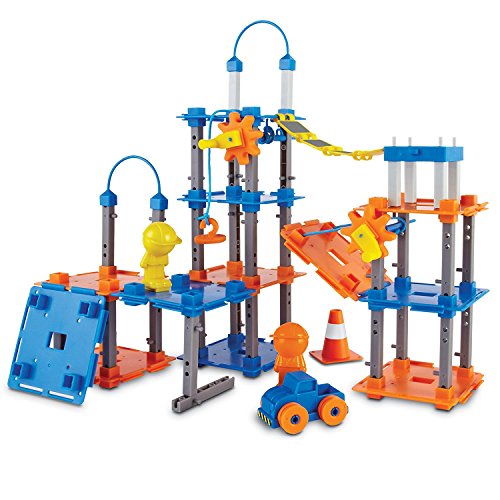
- 89-piece city-themed building kit
- Activity cards teach the design process
- Supports early problem solving and STEM skills
Best For: Preschool and early elementary engineering play
Most Versatile

- 863 rods and connectors
- 100 guided model ideas
- Moving-build possibilities
Best For: Kids ages 7+ who want open-ended construction
Best Beginner Mechanics
Learning Resources Gears Deluxe Building Set

- 100 colorful pieces
- Explores gears and motion
- No batteries required
Best For: Young learners ages 4+ and classroom STEM activities
Best Metal Vehicle Project

- 194 metal components
- Two guided vehicle designs
- Includes screwdriver and wrench
Best For: Ages 8–16 who enjoy hands-on vehicle assembly
Best Starter Build
10-in-1 Engineering Vehicle Kit

- 10 vehicle and machine models
- Guided instructions for beginners
- Storage box included
Best For: Younger builders ages 4–8 learning basic STEM construction
Best Hands-On Mechanics
Pathfinders Engineering Maker Set

- Working water-powered hydraulics
- 10 guided builds plus 15 challenges
- Durable wood construction
Best For: Ages 8+ exploring real mechanical systems
Best for Structures
Engino Buildings and Bridges Set
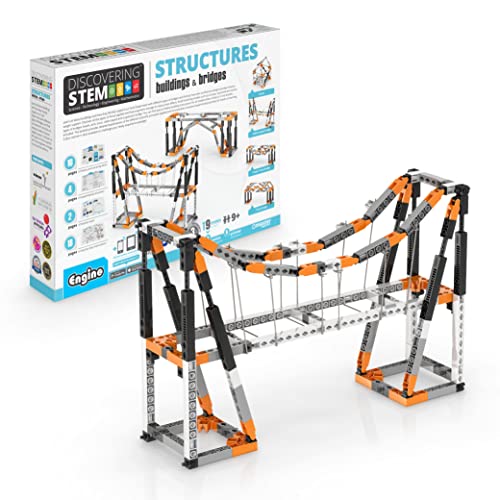
- Nine bridge and structure models
- Theory, experiments, and quiz included
- Multi-directional snap-fit system
Best For: Ages 9+ interested in architecture and structural engineering
Creative Starter Pick – K'NEX 40-Model Building Set
For families seeking beginner engineering building sets, this K’NEX kit offers an approachable mix of guided projects and open-ended construction. Its 141 snap-fit pieces can be assembled into 40 models, including vehicles, buildings, and moving creations.
Best For: Young beginners who want portable, reusable building play with clear instructions and lots of model variety.
Pros:
- Includes 141 rods and connectors for building and rebuilding.
- Instruction booklet guides builders through 40 models.
- Supports fine motor skills, spatial reasoning, and introductory STEM concepts.
- Suitcase-style storage box simplifies cleanup and portability.
Cons:
- The set may feel introductory for older or more advanced builders.
- Small pieces require organized storage and supervision appropriate to the child.
This is a practical entry point for children who benefit from step-by-step guidance but still want freedom to invent. The moving-model capability adds extra interest beyond static construction.
Structural Challenge Pick – Thames & Kosmos Bridges & Skyscrapers
This Thames & Kosmos kit is a strong choice among beginner engineering building sets for children ready to explore how structures handle forces. Builders can create 20 models while examining concepts such as load, compression, tension, and building materials.
Best For: Ages 8–14 who are ready for more structured construction and an introduction to mechanical physics.
Pros:
- Supports 20 different bridge and skyscraper models.
- Includes more than 285 interchangeable plastic building pieces.
- Comes with a 36-page illustrated experiment and assembly manual.
- Introduces practical structural-engineering concepts.
Cons:
- Listed as an intermediate-skill set rather than a very first building kit.
- The emphasis on structural models may offer less open-ended play than general construction sets.
Choose this set when the goal is to connect building projects with clear science lessons. Its manual and model range provide a more academic progression than a basic free-build kit.
Mechanics Learning Pick – K'NEX Levers & Pulleys
K'NEX Education - STEM Explorations: Levers & Pulleys Building Kit ‚ Kid Construction Play‚ Ages 8+
Check Price On AmazonFor beginner engineering building sets with a focused science theme, this K’NEX Education kit centers on levers and pulleys. Children can build a balance, wheelbarrow, and sailboat while learning about resistance, effort, lever classes, and mechanical advantage.
Best For: Grade 3–5 learners, individuals, or pairs working through standards-aligned STEM activities.
Pros:
- Provides projects for three lever or pulley models.
- Teaches mechanical advantage, resistance, effort, and lever classes.
- Designed for one child or a team of two.
- Includes an experiment guide aligned with National STEM standards.
Cons:
- Its focused theme offers fewer model types than a general-purpose building set.
- The learning activities may be more suitable for children comfortable with guided instruction.
This kit is best viewed as a hands-on lesson set rather than a broad construction collection. It gives young learners a concrete way to see how simple machines work through building and experimentation.
Early Design Pick – Learning Resources City Engineering Set
This Learning Resources kit makes beginner engineering building sets approachable for preschool and early elementary children. Its 89 pieces, activity cards, and city theme introduce towers, bridges, and other structures through a simple design cycle: ask, imagine, plan, create, and improve.
Best For: Young children who need accessible engineering challenges for home, classroom, or homeschool play.
Pros:
- Introduces basic engineering concepts through city-building activities.
- Activity cards provide guided design challenges.
- Open-ended play encourages problem solving and critical thinking.
- Designed for children ages 5–8 and indoor use.
Cons:
- With 89 pieces, it has a smaller component count than some advanced engineering kits.
- Its early-learning focus may be too simple for experienced builders.
This is a sensible starting point for children who are new to engineering ideas and benefit from short, clearly framed challenges. The city theme also gives free-build sessions an easy context and purpose.
Most Versatile – K'NEX 100 Model Building Set
For families seeking beginner engineering building sets with room to grow, this K’NEX kit combines 863 rods and connectors with instructions for 100 models. Its snap-fit pieces support both guided projects and original designs, including creations with moving wheels, rotors, wings, or tracks.
Best For: Children ages 7 and up who want a broad, reusable construction set with moving-model possibilities.
Pros:
- Includes 863 classic rods and connectors for extensive building options.
- Supports moving creations such as cars, rides, and transforming models.
- Includes a booklet with illustrated instructions for 100 models.
- Portable suitcase storage helps keep the many pieces together.
Cons:
- The large number of small pieces may require careful sorting and storage.
- Some projects may need adult help or patience for younger builders.
This is a strong choice when variety matters more than a single finished model. The included instructions provide a starting point, while the compatible rods and connectors leave plenty of space for creative engineering play.
Best Beginner Mechanics – Learning Resources Gears Deluxe Building Set
This 100-piece set is a practical introduction to beginner engineering building sets for younger children. Its colorful gears, axles, pillars, bases, and crank handle let kids experiment with motion, cause and effect, and simple mechanical arrangements without batteries.
Best For: Children ages 4 and up, classrooms, homeschool activities, and first explorations of gears and motion.
Pros:
- Includes 46 gears, 26 pillars, 21 axles, six bases, and a crank handle.
- Encourages hands-on exploration of motion and cause and effect.
- Easy-to-assemble pieces support fine motor skills and spatial reasoning.
- Activity guide and open-ended layouts suit home or classroom play.
Cons:
- Its focus on gears and manual motion is narrower than a general construction set.
- It is made of plastic, so it may not appeal to builders seeking metal models.
Choose this set when the goal is an accessible first step into mechanical thinking. The bright, interlocking components make experimentation approachable, while different base arrangements provide repeat-play value.
Best Metal Vehicle Project – 3D Metal Engineering Kit
For older children ready to move beyond snap-together parts, this 194-piece metal kit offers a more hands-on option among beginner engineering building sets. The illustrated instructions, screwdriver, and wrench guide assembly of two mechanical designs, one model at a time.
Best For: Builders ages 8 to 16 who enjoy vehicle projects, tool-based assembly, and developing spatial reasoning.
Pros:
- Uses 194 metal components for durable, detailed construction.
- Includes step-by-step illustrated instructions and basic assembly tools.
- Supports logic, concentration, spatial imagination, and hands-on skills.
- Offers two off-road vehicle designs for guided building and gifting.
Cons:
- Only one model can be built at a time.
- Tool-based metal assembly may be more demanding than plastic construction sets.
- The recommended starting age is 8 and up.
This kit is a good bridge to more realistic model engineering, especially for children interested in vehicles. It provides structured guidance while still delivering the satisfaction of assembling a working-looking metal project.
Best Starter Build – 10-in-1 Engineering Vehicle Kit
For families seeking beginner engineering building sets, this plastic STEM kit offers an approachable introduction to construction and moving mechanisms. Children can assemble 10 vehicle and machine models, including a bulldozer, crane, forklift, and windmill, using the included instructions.
Best For: Younger beginners ages 4–8 who enjoy building projects with clear guidance and multiple model options.
Pros:
- Offers 10 different engineering-themed builds from 112 pieces.
- Includes detailed assembly instructions for guided projects.
- Designed to support hands-on problem-solving and STEM learning.
- Comes with a storage box for cleanup and organization.
Cons:
- Made from plastic rather than metal.
- The recommended age range may be limiting for older or more experienced builders.
This is a practical entry-level choice for children who need structure while learning basic construction concepts. Its variety of models helps maintain interest, though builders looking for advanced mechanics may eventually want a more challenging set.
Best Hands-On Mechanics – Pathfinders Engineering Maker Set
Among beginner engineering building sets, the Pathfinders Engineering Maker Set stands out for introducing functional hydraulics, gears, levers, and pulleys. Its guided challenges provide structure, while the challenge cards encourage children to design and troubleshoot their own machines.
Best For: Curious builders ages 8 and up who want reusable projects and a deeper introduction to mechanical engineering.
Pros:
- Uses real water-powered hydraulics that operate lifts, arms, and launchers.
- Includes 10 step-by-step challenges and 15 open-ended challenge cards.
- Solid wood components are designed for repeated builds and experiments.
- Explores gear ratios, mechanical advantage, hydraulic pressure, and the engineering design process.
Cons:
- Recommended for ages 8 and up, so it may be too advanced for younger beginners.
- Hydraulic builds can require troubleshooting, including managing air bubbles.
This set offers more authentic mechanical experimentation than a simple snap-together kit. It is a strong choice when the goal is continued tinkering rather than completing a single finished model.
Best for Structures – Engino Buildings and Bridges Set
This Engino set is a focused option for beginner engineering building sets aimed at older children. Rather than concentrating on vehicles, it teaches structural principles through nine models, including beam, arch, truss, cable-stayed, and suspension bridges.
Best For: Builders ages 9 and up who are interested in architecture, bridges, structural design, or school STEM projects.
Pros:
- Builds nine models covering several real bridge and structure designs.
- Includes theory pages, experiments, facts, and a quiz for guided learning.
- Patented snap-fit pieces connect in multiple directions for 3D models.
- Includes an instruction manual, theory book, quiz book, experiments, and a free app.
Cons:
- Its 9+ age recommendation makes it less suitable for preschool beginners.
- It focuses primarily on structures and bridges rather than a broad range of machines.
For children ready to move beyond basic building blocks, this kit combines model-making with structural concepts and supporting educational material. Its specialized theme makes it especially useful for architecture-focused play or classroom projects.
How We Picked These Beginner Engineering Building Sets
We focused on sets that introduce core engineering concepts through hands-on construction rather than relying only on open-ended blocks. The selection includes beginner-friendly kits for younger children as well as more detailed projects for older builders. We considered age guidance, construction complexity, project variety, mechanical features, material quality, and how clearly each kit supports experimentation.
We also looked for useful progression: a child should be able to complete an approachable first model, understand what changed when a design fails, and apply that lesson to the next build. Sets with gears, levers, pulleys, bridges, or hydraulic elements can provide especially valuable cause-and-effect learning when instructions are clear.
Quick Comparison
| Best For | Look For | Recommended Set Type |
|---|---|---|
| First-time builders | Large parts, simple instructions, short projects | 40-model or city-building kits |
| Mechanical curiosity | Moving parts and visible motion | Gears, levers, and pulleys sets |
| Structures and stability | Load testing and strong framework designs | Bridges and skyscraper kits |
| Long-term value | Many models and a large parts inventory | 100-model or multi-project sets |
| Advanced hands-on projects | Detailed instructions and varied mechanisms | Metal, wood, or hydraulic kits |
Key Buying Factors for Beginner Engineering Building Sets
Age and Construction Difficulty
Age labels are useful starting points, but fine-motor skills and frustration tolerance matter just as much. Younger children generally benefit from larger connectors and fewer steps. Older beginners may enjoy smaller parts, denser instructions, and projects that require careful alignment.
Engineering Concepts
Choose the mechanism that matches the learner’s interests. Gears demonstrate speed and torque, pulleys show force and mechanical advantage, and bridge kits make balance, support, and load distribution tangible. A varied kit is preferable when the child has not yet identified a favorite area.
Project Variety and Replay Value
A high model count can extend play, but only if the instructions are understandable and the parts can be reused easily. Check whether models are built one at a time or whether the kit supports several simultaneous creations. Challenge cards and guided experiments can add value beyond simple assembly.
Parts, Storage, and Supervision
Small connectors are easy to lose, while metal and wood kits may require more patience or adult help. Consider a storage box, a clear work surface, and enough time for testing. For younger builders, adult supervision can help with reading instructions and troubleshooting without taking over the project.
Who Should Buy Which Beginner Engineering Building Sets?
For a child making a first step into engineering, choose a simpler construction set with accessible parts and short builds. For children fascinated by movement, a gears, levers, or pulleys kit offers immediate visual feedback. Bridge and skyscraper sets suit learners who enjoy testing strength and redesigning structures.
If you want the broadest range of activities, select a larger multi-model set or a kit combining several mechanisms. Builders who prefer realistic, tactile projects may appreciate metal or real-wood components, while families seeking guided STEM lessons should prioritize clear challenges and experiment prompts. The best choice is the set that offers an achievable starting point and enough room for the child to keep testing new ideas.