The best engineering building sets for elementary students turn abstract STEM ideas into hands-on challenges. Kids can test balance, motion, structures, and problem-solving while building projects they can see and revise.
This roundup compares 10 options ranging from guided bridge and energy kits to open-ended block, straw, wooden-model, and motorized construction sets. Use the buying guide below to match each format with your child’s age, skills, and learning goals.
Best 10 Engineering Building Sets for Elementary Students Picks for 2026
Best City-Building Starter
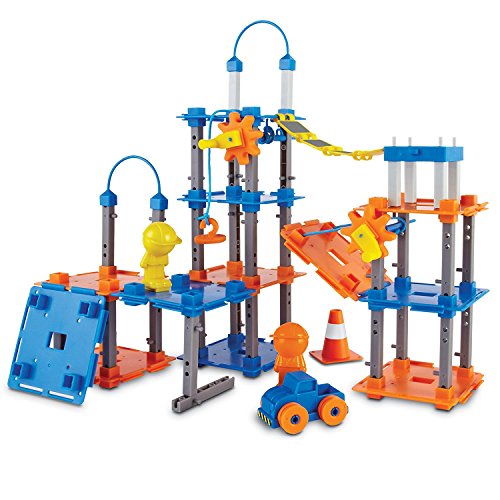
- 89-piece city-themed building kit
- Activity cards teach the design process
- Designed for ages 5–8
Best For: Young builders learning basic engineering through guided city challenges
Best Bridge-Building Classroom Set

- 207 classic K’NEX pieces
- Build 13 functioning bridge replicas
- Includes teacher guide and storage tray
Best For: Grades 3–5 bridge engineering lessons and small-group projects
Best Physics-Focused Engineering Kit

- Build eight working physics models
- Includes experiments, theory, and quizzes
- Recommended for ages 9+
Best For: Older elementary students exploring motion, energy, and Newton’s laws
Best Structural Engineering Challenge

- Build 20 structural models
- More than 285 interchangeable pieces
- Includes a 36-page experiment manual
Best For: Ages 8–14 exploring forces, loads, compression, and tension
Creative Construction Pick
600-Piece Interlocking Building Blocks

- 600 colorful pieces support open-ended building
- Develops spatial reasoning and fine motor skills
- Works for solo or group play from age 3+
Best For: Younger builders who enjoy free-form construction
Classroom Project Pick
24-Pack Wooden STEM Model Kits

- Provides 24 guided building projects
- Designed for ages 8 and up
- Supports engineering design and teamwork
Best For: Classrooms and structured group STEM activities
Large-Scale Builder Pick
600-Piece Straw Constructor Set

- Combines 300 connectors with 300 straws
- Supports large, open-ended structures
- Promotes logic, motor skills, and spatial reasoning
Best For: Children who enjoy experimenting with bigger builds
Motorized Maker Pick

- 107 parts with motor, tools, instructions, and storage box
- Builds 10 vehicle and robot designs, one at a time
- Encourages creative thinking and hands-on STEM skills
Best For: Kids who like moving vehicles and guided engineering builds
Classroom Collaboration Pick
1,200-Piece Straw Constructor Set

- 1,200 pieces support group building for three to five children
- Open-ended designs include vehicles, castles, robots, and animals
- Promotes teamwork, reasoning, structure, and imagination
Best For: Classrooms and groups needing a shared construction activity
Compact Group-Building Pick
600-Piece Straw Constructor Kit

- 600 pieces include wheels and multidirectional connectors
- Supports open-ended vehicle, animal, and structure builds
- Battery-free, collaborative play with a storage box
Best For: Small groups and families wanting manageable shared building
Best City-Building Starter – City Engineering & Design Set
For younger children seeking engineering building sets for elementary students, this 89-piece city-themed kit offers an approachable introduction to designing towers, bridges, and other structures. Activity cards organize play around asking, imagining, planning, creating, and improving.
Best For: Preschool and early elementary learners ages 5–8 who enjoy guided STEM challenges and open-ended city building.
Pros:
- Introduces basic engineering and problem-solving skills through hands-on construction.
- Includes activity cards, stickers, and 89 pieces for guided or imaginative builds.
- Works well at home, in classrooms, or in homeschool spaces.
Cons:
- Its introductory level may offer limited challenge for older elementary students.
- The set is designed for indoor, manual play and does not include a manufacturer warranty.
This is a practical first engineering set for children who benefit from clear prompts but still want freedom to create their own city structures.
Best Bridge-Building Classroom Set – Intro to Structures: Bridges
Among engineering building sets for elementary students, this K’NEX Education kit stands out for its focus on real-world bridge structures. Its 207 rods, stems, and connectors support 13 functioning bridge replicas while the included guide connects construction to science, technology, and design concepts.
Best For: Grades 3–5 students, small-group classroom work, and learners interested in real-world bridge types.
Pros:
- Builds 13 bridge models, including truss, arch, suspension, beam, and cable-stayed designs.
- Includes a teacher’s guide, building instructions, and standards-aligned educational materials.
- Secure snap-fit pieces can be reassembled into bridges, buildings, houses, and towers.
- Portable storage tray helps keep the 207 pieces organized.
Cons:
- The set may be more suitable for structured learning than casual free-form play.
- It is intended for collaborative use by approximately two to three students, so one set may not suit a large class.
This is a strong choice when bridge engineering and classroom-ready lessons matter more than a broad assortment of unrelated model types.
Best Physics-Focused Engineering Kit – Newton’s Laws STEM Set
For older elementary learners comparing engineering building sets for elementary students, this Engino kit adds a focused physics component to construction play. Children can build eight working models, including a catapult, crash-test car, and balloon-powered plane, while exploring motion, inertia, and kinetic and potential energy.
Best For: Children ages 9 and up who want hands-on physics projects with experiments, theory, quizzes, and optional virtual-reality app support.
Pros:
- Eight working models turn Newton’s laws and energy concepts into practical activities.
- Includes instructions, experiments, a theory book, a quiz section, and a free app.
- Targets critical thinking and problem-solving through discovery-based building.
- Includes a two-year manufacturer warranty.
Cons:
- The recommended age of 9 and up makes it less appropriate for younger elementary students.
- AA batteries are required, according to the supplied details.
- Its transportation and physics focus may feel narrower than a general construction set.
This kit is best when the goal is to connect model building with explainable physics principles rather than simply assembling decorative structures.
Best Structural Engineering Challenge – Bridges & Skyscrapers
This Thames & Kosmos set offers an intermediate option for families comparing engineering building sets for elementary students. With more than 285 interchangeable pieces and 20 models, it uses bridges and skyscrapers to introduce force, load, compression, tension, and related structural concepts.
Best For: Students ages 8–14 ready for more advanced structural models and mechanical-physics exploration.
Pros:
- Supports 20 different models covering bridges, skyscrapers, and structural principles.
- Includes more than 285 plastic building pieces for repeated configurations.
- Comes with a 36-page illustrated experiment manual and assembly guide.
- Its intermediate skill level provides a step up from basic construction play.
Cons:
- The intermediate rating may be demanding for beginners.
- The set focuses specifically on structural engineering and mechanical physics rather than broad STEM topics.
- The supplied details list a relatively small package size, so storage planning may still be useful for the many pieces.
Choose this set for learners who are ready to study how loads and forces affect structures through repeated model-building experiments.
Creative Construction Pick – 600-Piece Interlocking Building Blocks
For families looking for engineering building sets for elementary students, the FUBAODA 600-piece kit offers an open-ended way to practice building, spatial reasoning, and creative problem-solving. Its colorful interlocking pieces attach with light pressure and are designed for indoor individual or group play.
Best For: Younger builders who enjoy creating free-form structures with family or friends.
Pros:
- Includes 600 colorful interlocking pieces for varied designs.
- Supports spatial reasoning, hand-eye coordination, fine motor skills, and creative thinking.
- Pieces are sized for little fingers and lock firmly together.
- Suitable for one to four players and recommended for ages 3 and up.
Cons:
- It is an open-ended block set rather than a collection of specific engineering projects.
- The small pieces require supervision around children under three.
This is a flexible starter set for children who prefer inventing their own buildings and structures. Choose it when quantity, colorful parts, and collaborative play matter more than guided construction challenges.
Classroom Project Pick – 24-Pack Wooden STEM Model Kits
Among engineering building sets for elementary students, the kortes 24-pack stands out for structured, hands-on projects. It provides 24 different wooden model activities that let children practice assembly, engineering design, spatial reasoning, and problem-solving individually or in classroom groups.
Best For: Classrooms, after-school programs, party activities, and children ages 8 and up who benefit from guided projects.
Pros:
- Includes 24 distinct building projects with activity guides and instruction cards.
- Wooden parts are precisely cut, smooth-edged, and designed for hands-on assembly.
- Encourages critical thinking, engineering design, fine motor skills, and teamwork.
- Requires no batteries and includes a storage bag.
Cons:
- The manufacturer recommends the set for ages 8 and up, so it may be advanced for younger elementary students.
- Some projects may require patience and adult or classroom guidance during assembly.
- AA batteries are not included where a project may require them.
With 24 activities in one package, this is the strongest choice for repeated classroom use or group events. It offers more guided engineering practice than a standard block set, though younger children may need help with the project instructions.
Large-Scale Builder Pick – 600-Piece Straw Constructor Set
For children who like to plan, test, and rebuild large structures, this 600-piece straw constructor is a practical option among engineering building sets for elementary students. The mix of long straws, short straws, and connectors supports open-ended construction while reinforcing logic, spatial reasoning, and motor skills.
Best For: Individual or group building sessions focused on experimenting with larger, free-form structures.
Pros:
- Includes 80 long straws, 220 short straws, and 300 connectors.
- Large piece count allows children to build bigger and more varied creations.
- Encourages planning, design, problem-solving, hand-eye coordination, and spatial reasoning.
- Lab tested to meet CPSC regulations and listed as non-toxic.
Cons:
- It does not provide a set of detailed model-specific project instructions.
- The manufacturer’s recommended age range ends at 12, limiting its appeal for older students.
- Large creations may need a clear floor or table area for assembly.
This set is a good fit when the goal is experimentation rather than following a fixed design. Its balanced assortment of straws and connectors gives elementary-age children room to build expansive structures and revise them as they learn.
Motorized Maker Pick – 107-Piece Erector STEM Set
For families comparing engineering building sets for elementary students, this 107-piece erector kit adds motion to hands-on construction. Children can build one of 10 vehicle, robot, helicopter, or airplane designs at a time, then use the electric motor to make the model move.
Best For: Beginner through advanced builders who enjoy vehicles, moving models, and building with a parent or sibling.
Pros:
- Includes 107 parts, tools, instructions, a motor, and a storage box.
- Offers 10 suggested designs, including robots, cars, trucks, planes, and helicopters.
- Supports creative thinking, concentration, hand-eye coordination, and practical skills.
- Designed with non-toxic, lead-, BPA-, and phthalate-free materials.
Cons:
- Only one model can be built at a time.
- The motor requires batteries and should not be exposed to water.
This set is a versatile choice when you want traditional construction play with an added motorized feature. The included storage case also helps keep the many small components organized.
Classroom Collaboration Pick – 1,200-Piece Straw Constructor Set
This 1,200-piece straw construction kit is a strong option for classrooms and playgroups seeking engineering building sets for elementary students. Its large supply of interlocking tubes and connectors lets several children work together to create vehicles, castles, animals, robots, and other imaginative structures.
Best For: Preschool classrooms, activity centers, and families looking for a cooperative, open-ended building activity.
Pros:
- Includes 1,200 pieces, enough for approximately three to five children to share.
- Supports open-ended builds such as planes, ships, cars, castles, robots, and animals.
- Encourages teamwork, reasoning, math, structural thinking, and imagination.
- Comes with a storage box and has CPSIA and ASTM certifications listed.
Cons:
- Manual construction provides no motorized or electronic components.
- The large number of pieces may require a dedicated storage area.
Choose this set when group participation matters more than following a single finished model. The generous piece count makes it particularly practical for shared classroom or sibling play.
Compact Group-Building Pick – 600-Piece Straw Constructor Kit
For buyers who want engineering building sets for elementary students without the larger 1,200-piece count, this 600-piece straw constructor offers a manageable alternative. The interlocking tubes, connectors, wheels, and multidirectional pieces support open-ended builds for indoor or outdoor group play.
Best For: Preschool and early elementary learners, small groups, classrooms, and families wanting a storage-friendly collaborative kit.
Pros:
- Provides 600 colorful pieces with wheels and multidirectional connectors.
- Can be used to build planes, ships, cars, castles, robots, animals, and other shapes.
- Develops engineering, math, reasoning, imagination, construction, and coordination skills.
- Includes a storage box and requires no batteries.
Cons:
- Offers fewer pieces than the 1,200-piece version for larger groups.
- Manual assembly may be less appealing to children seeking motorized models.
This kit balances open-ended creativity with a more moderate piece count and footprint. It is a sensible pick for shared building sessions when easy storage and battery-free play are priorities.
How We Picked These Engineering Building Sets for Elementary Students
We focused on sets that encourage genuine building, testing, and redesign rather than simple assembly alone. Key considerations included stated age or grade guidance, project variety, piece count, construction format, STEM learning potential, and suitability for home or classroom use. We also considered whether each kit offers structured challenges for beginners, open-ended building for creative learners, or a balance of both.
Because elementary students have widely different abilities, the list includes approachable preschool-style construction systems alongside more advanced engineering sets for upper elementary grades. Always check the manufacturer’s recommended age, small-parts warnings, and whether batteries or additional tools are required.
Quick Comparison
| Best For | Look For | Typical Strength |
|---|---|---|
| Young beginners | Large, easy-to-connect pieces | Fine-motor practice and imaginative play |
| Grades 3–5 | Guided structural challenges | Planning, stability, and cause-and-effect learning |
| Creative builders | Open-ended connectors and varied parts | Flexible designs and repeated experimentation |
| Classrooms or groups | Many pieces or multiple project kits | Collaborative STEM activities |
| Mechanics-focused learners | Motors, moving parts, or physics concepts | Motion, energy, and mechanical reasoning |
Key Buying Factors
Age, Complexity, and Supervision
Choose a set that is challenging without being frustrating. Younger children generally benefit from larger parts and simple connection systems, while older elementary students may be ready for structural constraints, physics principles, or multi-step instructions. Adult guidance can make advanced kits more successful, especially during a first project.
Guided Projects Versus Open-Ended Play
Instruction-led kits are useful when a child is learning basic engineering vocabulary or needs a clear starting point. Open-ended straw, block, and connector systems offer more freedom and are often better for repeated building, group challenges, and creative redesign. If possible, choose a set that provides both example projects and room to experiment.
Parts, Durability, and Storage
A high piece count can increase possibilities, but only if the connectors are easy to use and the parts can withstand repeated assembly. Check whether the kit includes a storage solution, replacement availability, and specialized components such as wheels, motors, rods, or structural panels. Smaller parts require organized storage and closer supervision.
Learning Value and Project Variety
Look for activities that ask children to predict, build, test, observe, and improve. Bridges, towers, vehicles, and energy demonstrations naturally support lessons about balance, load, motion, and force. Sets with several project types tend to hold attention longer than kits limited to one finished model.
Who Should Buy Which Engineering Building Sets for Elementary Students?
For younger children or first-time builders, choose a large-piece block or straw-construction set with simple connectors. For grades 3–5 students who enjoy structured challenges, bridge, skyscraper, and introductory structures kits provide clearer engineering goals. Children interested in physics may prefer a set focused on motion, energy, or motorized mechanisms.
For classrooms, clubs, birthday activities, or sibling groups, prioritize high piece counts, multiple project options, and durable parts. For independent play at home, a kit with illustrated instructions and progressive challenges is usually the easiest choice. The best Engineering Building Sets for Elementary Students are the ones that fit the child’s current skill level while leaving enough room to build something new next time.