Distributing one 4K source to multiple displays is easier when you choose an amplifier that matches your resolution, bandwidth, distance, and control requirements. The right model can preserve HDR, HDCP compatibility, and stable audio-video sync across every output.
We selected 10 4K video distribution amplifiers spanning compact two-output splitters, multi-output HDMI units, SDI equipment, and installation-focused systems with scaling, extension, or audio-management features.
Best 10 4K Video Distribution Amplifiers Picks for 2026
Professional HDMI Pick
KD-DA1X2DC 4K 2-Output Splitter

- 18Gbps HDMI with HDR and HDCP 2.2
- Optional 4K-to-1080p down-conversion
- Includes mounting brackets and power supply
Best For: Two-display signage and surveillance installations
SDI Production Pick
Mini Converter SDI Distribution 4K

- One SDI input with eight outputs
- Compact 11.9-ounce distribution box
- Backed by a 2-year warranty
Best For: SDI systems needing eight-way signal distribution
Flexible HDMI Pick

- Four HDMI outputs with 18Gbps bandwidth
- Supports 4K60, HDR, and HDCP 2.2/1.4
- Cascadable with EDID and firmware management
Best For: Expandable four-display HDMI installations
Compact 4K Splitter

- Splits one HDMI source to two displays
- Supports 4K@30Hz and 3D video
- Includes HDCP 1.4 and 48-bit Deep Color
Best For: Two-display home entertainment setups
Eight-Display 4K Distribution

- Distributes one source to up to eight displays
- Supports 4K UHD and 1080p at 60Hz
- Adds HDCP 2.2 and HD lossless audio support
Best For: Multi-screen commercial or presentation systems
EDID-Managed 4K/HDR Distribution

- Distributes one HDMI source to two displays
- Designed for 4K/HDR signal distribution
- Manages EDID for audio and video compatibility
Best For: Residential or commercial two-display AV systems
Feature-Rich 4K Splitter
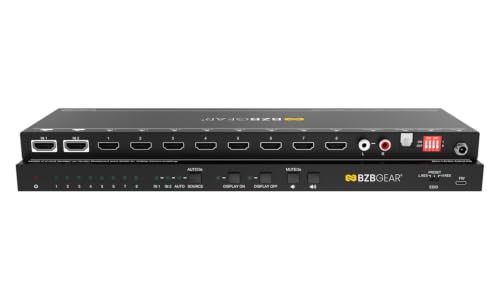
- Distributes HDMI to eight outputs
- Supports 4K/60 Hz with 4:4:4
- Includes audio de-embedding and scaling
Best For: Large multi-display HDMI installations
Compact HDMI Distribution

- Compact 7.38-inch-wide chassis
- Lightweight at 14.1 ounces
- Designed for HDMI audio/video distribution
Best For: Space-conscious basic HDMI installations
Long-Range 4K Distribution

- Sends one HDMI source to four outputs
- Extends 4K up to 230 feet
- Adds IR, RS-232, ARC, and Toslink
Best For: Extended-distance controlled AV installations
Professional HDMI Pick – KD-DA1X2DC 4K 2-Output Splitter
For compact 4k video distribution amplifiers in professional installations, the KD-DA1X2DC sends one HDMI source to two displays while supporting 18Gbps bandwidth, HDR, and HDCP 2.2. Its optional 4K-to-1080p down-conversion and included mounting brackets add flexibility for mixed-display setups.
Best For: Digital signage, surveillance monitoring, and other indoor installations feeding two HDMI displays.
Pros:
- Supports 4K, HDR, HDCP 2.2, and 18Gbps bandwidth.
- Offers optional 4K-to-1080p down-conversion.
- Includes a power supply and two L-shaped mounting brackets.
- Full Buffer System is designed for reliable signal distribution.
Cons:
- Provides only two HDMI outputs.
- Designed for indoor use.
The KD-DA1X2DC is a focused choice when two-output HDMI distribution and compatibility with mixed-resolution displays matter more than a larger output count.
SDI Production Pick – Mini Converter SDI Distribution 4K
The Blackmagic Design Mini Converter SDI Distribution 4K is an SDI-focused option among 4k video distribution amplifiers, with one input and eight outputs. Its compact distribution-box format suits setups that need to send an SDI signal to multiple compatible destinations.
Best For: SDI-based video systems requiring one input and eight outputs.
Pros:
- Provides eight SDI outputs from one input.
- Built specifically for SDI signal distribution.
- Compact unit weighs 11.9 ounces.
- Includes a 2-year warranty.
Cons:
- Uses SDI rather than HDMI connectivity.
- The supplied details do not specify supported resolutions or bandwidth.
If your installation is built around SDI cabling and needs a high output count, this converter is more appropriate than an HDMI splitter, though buyers should verify format compatibility for their workflow.
Flexible HDMI Pick – SIIG 1×4 4K HDR Splitter
The SIIG CE-H22Y11-S1 is a versatile choice for 4k video distribution amplifiers, distributing one HDMI source to four displays with 18Gbps bandwidth, 4K at 60Hz support, HDR compatibility, and HDCP 2.2/1.4 bypass. Auto scaling, EDID management, and cascading make it useful for more involved display systems.
Best For: Four-display HDMI installations that need broad format support, scaling, or expansion through cascading.
Pros:
- Supports up to 4K at 60Hz, HDR formats, 3D, and deep color.
- Handles stereo, 5.1, and 7.1-channel audio formats.
- Supports simultaneous 4K and 1080p output with auto video scaling.
- EDID management, firmware updates, and cascading up to 10 layers improve flexibility.
Cons:
- Does not downscale 4K at 60Hz 4:2:2 to 1080p.
- Its four-output design may be more than needed for smaller systems.
With strong format support and installation-oriented management features, the SIIG is a compelling fit for mixed-display or expandable HDMI deployments, provided the required downscaling mode is supported.
Audio Distribution Pick – Rolls DA134 4-Channel Amplifier
The Rolls DA134 is not a video splitter, but it can complement 4k video distribution amplifiers when a project also needs analog audio distribution. This four-channel unit supports mono or stereo operation, front-panel volume controls, stereo pass-through, and direct connection from devices such as an iPad, iPod, or laptop.
Best For: Compact audio distribution alongside a separate 4K video distribution system.
Pros:
- Offers four audio distribution channels.
- Supports mono and stereo operation.
- Includes front-panel volume controls and stereo pass-through.
- Compact metal design includes a power supply.
Cons:
- Does not distribute video or HDMI signals.
- Has a 90-day warranty.
- The supplied specifications do not identify HDMI or SDI connectivity.
Choose the DA134 only for the audio side of a broader AV setup. It is a practical companion component, not a replacement for a 4K video distribution amplifier.
Compact 4K Splitter – Monoprice Blackbird 1×2
Monoprice Blackbird 4K 1x2 HDMI Amplifier Splitter - 48-bit Deep Color, 3D Video Support, Black
Check Price On AmazonFor straightforward 4k video distribution amplifiers setups, the Monoprice Blackbird splits one HDMI source to two displays. It supports 4K at 30Hz, 3D video, and HDCP 1.4, making it suited to compatible home entertainment systems.
Best For: Home users connecting one HDMI source to two TVs, monitors, or other HDMI displays.
Pros:
- Splits one HDMI input to two sink devices.
- Supports 4K@30Hz, 1080p@120Hz, and 3D-1080p@60Hz.
- Handles 48-bit Deep Color and multiple digital audio formats, including Dolby TrueHD and 7.1-channel LPCM.
Cons:
- HDCP support is limited to version 1.4.
- 4K output is limited to 30Hz.
This is a compact, focused option when two-display distribution is enough. Its feature set is strongest for 4K/30Hz and 3D-compatible installations rather than newer high-refresh 4K systems.
Eight-Display 4K Distribution – KanexPro 1×8 HDMI Amplifier
The KanexPro 1×8 is designed for larger 4k video distribution amplifiers installations, sending one HDMI source to as many as eight displays. HDCP 2.2 compliance and support for 4K UHD make it a practical choice for compatible commercial or multi-screen systems.
Best For: Distributing one HDMI source across up to eight televisions, monitors, or presentation displays.
Pros:
- Routes one HDMI signal to up to eight displays.
- Supports 4K UHD and Full HD 1080p at 60Hz.
- HDCP 2.2 compliant and compatible with Dolby Digital, DTS-HD, and Dolby TrueHD audio.
- Supports HDMI features such as Deep Color, lossless audio, and Lip Sync.
Cons:
- Its eight-output design may be more capacity than smaller setups require.
- The supplied notes do not specify HDR support or output refresh rates for 4K UHD.
With eight outputs and HDCP 2.2, this model is the most suitable choice here for scaling a single source across many screens. Confirm the source, displays, and desired 4K format are compatible before installation.
EDID-Managed 4K/HDR Distribution – Atlona Rondo 442 1×2
The Atlona Rondo 442 is a 1×2 HDMI distribution amplifier for 4K/HDR installations that need dependable signal handling. Its EDID management helps coordinate the audio formats and video resolutions delivered to connected displays.
Best For: Residential or commercial AV systems using one HDMI source with two displays and requiring managed EDID communication.
Pros:
- Distributes an HDMI signal to two outputs.
- Designed for 4K/HDR signal distribution.
- Manages EDID communications to help provide desired audio and video formats.
- Compatible with sources and displays including gaming consoles, Blu-ray players, projectors, and televisions.
Cons:
- Provides only two HDMI outputs.
- The supplied notes do not specify HDCP version, audio formats, or detailed refresh-rate limits.
This is a sensible pick when installation reliability and EDID coordination matter more than a high output count. It fits both home and commercial deployments, provided its unspecified format details meet the rest of the AV system.
Feature-Rich 4K Splitter – BZBGEAR BG-UHD-DA2X8
BZBGEAR 2x8 4K UHD HDMI Splitter/Distribution Amplifier w/CEC Turn On/Off TV - BG-UHD-DA2X8
Check Price On AmazonFor installations that need to send one source to multiple displays, this BZBGEAR unit is a versatile choice among 4k video distribution amplifiers. It supports 4K at 60 Hz with 4:4:4 chroma sampling, offers eight outputs, and adds audio de-embedding, EDID customization, and 4K-to-1080p downscaling.
Best For: Home theater or commercial setups distributing one HDMI source to as many as eight televisions.
Pros:
- Supports 4K at 60 Hz with 4:4:4 chroma sampling.
- Provides RCA and Toslink audio outputs with volume control.
- Offers customizable EDID and 4K-to-1080p downscaling.
- Includes a three-year manufacturer warranty.
Cons:
- It is an eight-output device, which may be more capacity than smaller installations need.
- The supplied notes identify television compatibility but do not specify broader device support.
Choose this model when output count and audio flexibility matter as much as 4K performance. Its scaling and EDID features can also help accommodate mixed-display systems.
Compact HDMI Distribution – Kramer VM-2H2
The Kramer VM-2H2 is a compact HDMI distribution amplifier for straightforward audio/video signal distribution. Its supplied information confirms HDMI distribution functionality and a small footprint, making it a practical option to consider when comparing 4k video distribution amplifiers for space-constrained setups.
Best For: Buyers seeking a compact Kramer HDMI distribution amplifier for a basic audio/video installation.
Pros:
- Compact dimensions of approximately 7.38 by 4.53 by 1 inch.
- Lightweight design at 14.1 ounces.
- Purpose-built for HDMI audio/video distribution.
Cons:
- The supplied notes do not state a supported 4K resolution or refresh rate.
- They do not specify output count, EDID features, audio extraction, or cable distance.
This model is easiest to shortlist when a small Kramer distribution unit fits the installation. Because the available specifications are limited, verify resolution support and port configuration before purchase if your system requires specific 4K capabilities.
Long-Range 4K Distribution – BZBGEAR BG-UDAIC-E14
For longer cable runs, this BZBGEAR unit combines 4K HDMI distribution with transmission over category cable. It sends one HDMI input to four outputs, supports 4K at 60 Hz, and adds IR, RS-232, ARC, audio de-embedding, and up to 230 feet of transmission distance.
Best For: Multi-display installations that need extended HDMI transmission and centralized control features.
Pros:
- Distributes one HDMI input to four HDMI outputs.
- Supports 4K at 60 Hz, HDMI 2.0, and HDCP 2.2.
- Transmits signals up to 70 meters, or approximately 230 feet, over category cable.
- Includes bi-directional IR, RS-232 control, ARC, and Toslink audio de-embedding.
Cons:
- Its four-output capacity may not suit larger display networks.
- The extended setup requires category cable and the included transmitter/receiver arrangement.
This is a strong fit when distance and control are central requirements rather than just basic splitting. EDID passthrough or manual configuration, plus surge, lightning, and ESD protection, adds installation flexibility.
How We Picked the Best 4K Video Distribution Amplifiers
We evaluated these models by looking at the capabilities that most directly affect real-world distribution: supported resolution and refresh rate, HDMI bandwidth, HDR and HDCP compatibility, output count, signal-management features, installation flexibility, and overall use case. We also considered whether each unit is better suited to a simple home setup, a classroom or conference room, a broadcast workflow, or a larger commercial installation.
Because “4K” alone does not describe the full signal path, we prioritized products that clearly identify important specifications such as 18Gbps throughput, 4K at 60Hz, HDCP 2.2, down-conversion, cascading, or long-distance extension.
Quick Comparison
| Best For | What to Look For |
|---|---|
| Basic home theater splitting | 1 input, two outputs, 4K/60Hz, HDR, and HDCP support |
| Several displays | Four or eight outputs, stable EDID handling, and cascading support |
| Professional AV systems | Rack-friendly construction, control options, firmware updates, and reliable compatibility |
| Broadcast and production | SDI connectivity and format-specific distribution features |
| Long cable runs | Category-cable extension, IR or RS-232 control, and audio de-embedding |
Key Buying Factors for 4K Video Distribution Amplifiers
Resolution, Refresh Rate, and Bandwidth
For modern 4K sources, 18Gbps HDMI bandwidth generally supports 4K at 60Hz with 4:4:4 color, HDR, and common enhanced video formats. Confirm that both the amplifier and connected displays support the signal you intend to send. A device limited to lower bandwidth may force reduced color depth or refresh rates.
HDCP and HDR Compatibility
HDCP 2.2 support is important for protected 4K content from streaming devices and disc players. HDR support helps preserve expanded contrast and color, but compatibility can vary by format and display. Features such as automatic scaling or 4K-to-1080p down-conversion are useful when older and newer screens share one source.
Output Count and Installation Features
Choose an output count that fits the current system while leaving reasonable room for expansion. Cascadable designs can extend distribution, while EDID management helps prevent blank screens when displays have different capabilities. For commercial systems, RS-232, IR, CEC control, firmware updates, rack mounting, and audio extraction can be more valuable than a low purchase price.
Signal Distance and Cable Type
Standard HDMI cables are convenient for short runs but become less dependable over longer distances. If displays are far from the source, consider a model designed for category-cable extension or use certified active or fiber HDMI cables. Always verify the advertised distance at the desired resolution and refresh rate.
Who Should Buy Which 4K Video Distribution Amplifiers?
Choose a compact two-output HDMI amplifier for a television-and-projector setup or another straightforward home theater application. A four- or eight-output splitter is a better fit for classrooms, digital signage, showrooms, and conference rooms that need one source on several screens.
Professional installers should favor models with robust EDID handling, control integration, firmware support, and dependable HDCP behavior. Broadcast users should select an SDI distribution amplifier when the rest of the workflow is SDI rather than HDMI. For complex installations with long cable runs, remote control, or audio separation, prioritize extension and de-embedding features over a basic splitter’s lower cost.