Camera extension tubes offer an affordable way to explore macro photography without buying a dedicated macro lens. By moving a compatible lens farther from the sensor, they increase magnification for subjects such as flowers, products, insects, and small details.
This roundup includes autofocus and manual-compatible options for popular Sony, Nikon, Canon, and Fujifilm mounts. The right choice depends on your camera system, lens compatibility, desired magnification, and whether electronic aperture and autofocus control matter to you.
Best 10 Camera Extension Tubes Picks for 2026
Best Sony E-Mount Value
Meike S-AF3A Auto Focus Extension Tubes

- 10mm and 16mm tubes
- Autofocus support
- For Sony E/FE cameras
Best For: Sony photographers exploring close-up macro work
Best Simple Nikon F Option
Fotodiox Macro Extension Tube Set

- 7mm, 14mm, and 28mm sections
- No optical insert
- Manual-focus design
Best For: Nikon F users seeking an inexpensive macro setup
Best Canon DSLR Flexibility

- 12mm, 20mm, and 36mm tubes
- Autofocus and auto exposure support
- For Canon EF/EF-S lenses
Best For: Canon DSLR macro photographers wanting electronic communication
Best Nikon Z Autofocus Kit
Meike MK-Z-AF1 Macro Extension Tubes

- 11mm and 18mm tubes
- Autofocus support
- Metal, weather-resistant construction
Best For: Nikon Z users pursuing compact autofocus macro setups
Best Sony E-Mount Pick
JJC Auto-Focus Macro Extension Tubes

- 10mm and 16mm tubes can be used separately or together
- Supports autofocus and automatic exposure
- Designed for Sony E-mount mirrorless cameras
Best For: Sony photographers seeking flexible, affordable macro capability
Best Nikon F Flexibility
Mcoplus Auto-Focus Macro Tube Set

- Includes 12mm, 20mm, and 36mm tubes
- Works with Nikon AF, AF-S, DX, and FX SLR cameras
- Individual or combined tube configurations
Best For: Nikon DSLR users wanting several macro magnification options
Best Canon DSLR Option
VILTROX DG-C Macro Extension Tubes

- Includes 12mm, 20mm, and 36mm tubes
- Seven individual or combined configurations
- Metal bayonets with gold-plated signal contacts
Best For: Canon EF and EF-S DSLR photographers wanting setup flexibility
Best Fuji X-Mount Value
JJC Auto Focus Macro Extension Tubes

- 11mm and 16mm tubes
- Autofocus and auto exposure support
- Works with Fujifilm X-mount cameras and lenses
Best For: Fujifilm X-mount photographers exploring macro photography
Best Heavy-Duty Pick
JJC EF/EF-S Macro Extension Tube Set
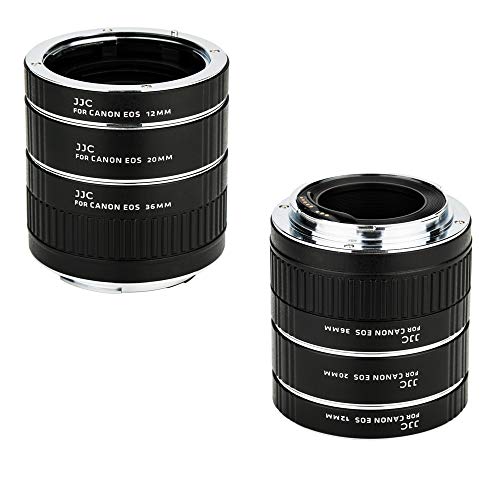
- 12mm, 20mm, and 36mm tubes
- Use individually or in combination
- Supports Canon EF and EF-S lenses
Best For: Canon EOS DSLR owners needing flexible magnification
Best Canon RF Option
JJC RF Auto Focus Macro Extension Tubes

- 11mm and 16mm tubes
- Autofocus and auto exposure support
- Made for Canon RF mirrorless systems
Best For: Canon RF users seeking an affordable macro setup
Best Sony E-Mount Value – Meike S-AF3A Auto Focus Extension Tubes
If you use a Sony E-mount camera and want an affordable way to explore macro photography, the Meike S-AF3A is a flexible camera extension tubes set. Its 10mm and 16mm tubes can be used separately or together to adjust working distance and magnification.
Best For: Sony E-mount APS-C and full-frame users photographing flowers, insects, and other small subjects.
Pros:
- Supports autofocus and camera shooting modes.
- 10mm, 16mm, and combined configurations provide flexibility.
- Compatible with Sony E, NEX, and FE-mount cameras.
- Compact design is easy to carry.
Cons:
- Manual exposure adjustment may be preferable for controlling exposure.
- No image stabilization.
- Plastic body construction may feel less substantial than an all-metal set.
This is a practical entry point for Sony users who want closer focusing without buying a dedicated macro lens. The interchangeable tube lengths make it useful for experimenting with different magnification levels.
Best Simple Nikon F Option – Fotodiox Macro Extension Tube Set
The Fotodiox Macro Extension Tube Set is a straightforward choice for Nikon F-mount users seeking camera extension tubes for closer focusing. It uses 7mm, 14mm, and 28mm sections that can be combined to create different reproduction ratios without adding optical glass.
Best For: Nikon F photographers who want a lightweight, inexpensive manual-focus route into macro photography.
Pros:
- 7mm, 14mm, and 28mm sections offer multiple configurations.
- No optical insert helps preserve the attached lens’s optical characteristics.
- Designed to let lenses focus closer than normal.
- Includes a two-year manufacturer warranty.
Cons:
- Uses manual focus.
- Requires Nikon F-mount compatibility.
- Extension tubes reduce the lens’s normal focusing range.
With its simple, modular design, this set is suited to photographers comfortable focusing manually. It is a useful budget-oriented option when flexibility and low weight matter more than electronic autofocus features.
Best Canon DSLR Flexibility – VILTROX DG-C Auto Focus Tubes
For Canon DSLR owners, the VILTROX DG-C provides camera extension tubes in three lengths—12mm, 20mm, and 36mm. The electronic contacts maintain communication between compatible EF or EF-S lenses and the camera, supporting autofocus and automatic exposure.
Best For: Canon EF and EF-S users who want adjustable macro magnification with electronic camera-lens communication.
Pros:
- Includes 12mm, 20mm, and 36mm tubes.
- Tubes can be used individually or in combination.
- Supports autofocus and automatic exposure functions.
- Metal mounts and electronic contacts are designed for reliable connections.
Cons:
- Designed for Canon EF and EF-S DSLR systems rather than other mounts.
- No image stabilization is specified.
- Extension tubes are intended for close-up work, not general-purpose shooting.
This set stands out for Canon DSLR users who want more automation than a basic manual tube set provides. Its three lengths make it easier to tailor the setup to different subjects and lenses.
Best Nikon Z Autofocus Kit – Meike MK-Z-AF1 Macro Extension Tubes
The Meike MK-Z-AF1 is a camera extension tubes kit for Nikon Z cameras, offering 11mm and 18mm sections for closer focusing and increased subject magnification. The tubes can be used alone or stacked, and autofocus support adds convenience for compatible setups.
Best For: Nikon Z photographers who want a compact autofocus-capable macro accessory for Z-mount cameras.
Pros:
- 11mm, 18mm, and combined configurations are available.
- Supports autofocus with compatible Nikon Z setups.
- Metal mount construction with a waterproof and dustproof structure.
- Can work with F-mount lenses when used with an FTZ adapter.
Cons:
- Exposure may require manual adjustment for best control.
- Requires an FTZ adapter for F-mount lenses.
- Compatible camera coverage is centered on Nikon Z models.
This is a well-targeted choice for Nikon Z owners who want to experiment with macro photography while retaining autofocus capability. The two tube lengths keep the kit compact, while stacking adds another close-focusing option.
Best Sony E-Mount Pick – JJC Auto-Focus Macro Extension Tubes
If you use a Sony E-mount mirrorless camera, these camera extension tubes provide a budget-friendly way to shorten your lens’s minimum focusing distance. The 10mm and 16mm tubes can be used separately or together, and electronic contacts support autofocus and automatic exposure.
Best For: Sony E-mount photographers who want flexible macro magnification without buying a dedicated macro lens.
Pros:
- Compatible with Sony E-mount mirrorless cameras and lenses.
- Includes 10mm and 16mm tubes for individual or combined use.
- Supports autofocus and automatic exposure.
- Uses aluminum and brass mount components for a durable connection.
Cons:
- Manual focus or a tripod and focusing rail is recommended for best results.
- Not water resistant.
This is a versatile choice for Sony users, particularly when you want to experiment with macro photography using lenses you already own. Although autofocus is supported, the product guidance favors a more controlled manual-focus setup for precise close-up work.
Best Nikon F Flexibility – Mcoplus Auto-Focus Macro Tube Set
For Nikon F users, this three-piece set of camera extension tubes offers 12mm, 20mm, and 36mm options for adjusting macro magnification. The tubes work with Nikon AF, AF-S, DX, and FX SLR cameras and can be used individually or in combinations.
Best For: Nikon DSLR owners who want multiple extension lengths and electronic autofocus support for close-up photography.
Pros:
- Compatible with a broad range of Nikon AF, AF-S, DX, and FX SLR cameras.
- Includes 12mm, 20mm, and 36mm tubes.
- Tubes can be used individually or combined.
- Designed to retain autofocus capability at an appropriate focusing distance.
Cons:
- Autofocus can become difficult when all three tubes are combined.
- The product recommends manual focus or a longer focal length to reduce blur.
The three lengths make this a flexible Nikon option for exploring different levels of magnification. For the most reliable results, plan to switch to manual focus when using several tubes together, especially for demanding close-up subjects.
Best Canon DSLR Option – VILTROX DG-C Macro Extension Tubes
These Canon-compatible camera extension tubes let EF and EF-S lenses focus closer for macro photography. The set includes 12mm, 20mm, and 36mm tubes, with seven possible configurations, while metal bayonets and gold-plated contacts help maintain a stable electronic connection.
Best For: Canon EF and EF-S DSLR users who want several tube combinations and electronic communication with compatible camera and lens systems.
Pros:
- Compatible with Canon EF and EF-S lenses and a wide range of DSLR bodies.
- Provides 12mm, 20mm, and 36mm extension lengths.
- Offers seven individual or combined tube configurations.
- Metal bayonets and gold-plated pins support durability and signal conductivity.
Cons:
- Manual focus is recommended when combining two or three tubes.
- Combining tubes is not recommended with focal lengths under 70mm.
This set stands out for Canon DSLR users who want fine control over extension length. Its broad compatibility and multiple configurations are useful, but the stated focusing limitations mean it is best suited to photographers comfortable with manual focus and deliberate setup.
Best Fuji X-Mount Value – JJC Auto Focus Macro Extension Tubes
For Fujifilm X-mount users, these camera extension tubes offer a practical way to reduce a lens’s minimum focusing distance without purchasing a dedicated macro lens. The 11mm and 16mm tubes can be used separately or together, while autofocus and auto exposure are supported.
Best For: Fujifilm X-mount mirrorless photographers who want an affordable introduction to close-up and macro photography.
Pros:
- 11mm and 16mm tubes provide flexible magnification options.
- Supports autofocus and automatic exposure.
- Aluminum camera mount, brass lens mount, and ABS plastic tube construction.
- Can convert almost any compatible lens into a macro setup.
Cons:
- Not compatible with the Fujifilm Fujinon XF 23mm f/2 R WR lens.
- The manufacturer recommends manual focus or a tripod with a focusing rail for best results.
This is a versatile, cost-conscious option for Fuji photographers, especially those who value interchangeable tube lengths. Confirm lens compatibility before buying and expect the most controlled focusing experience with manual focus.
Best Heavy-Duty Pick – JJC EF/EF-S Macro Extension Tube Set
This three-piece set is a flexible choice for Canon DSLR owners shopping for camera extension tubes. Its 12mm, 20mm, and 36mm sections can be used individually or combined to shorten minimum focusing distance and create macro effects with compatible EF and EF-S lenses.
Best For: Canon EOS DSLR users who want three magnification choices and compatibility with both EF and EF-S lenses.
Pros:
- Includes 12mm, 20mm, and 36mm extension tubes.
- Tubes can be used individually or in combinations.
- Supports autofocus and automatic exposure.
- Brass camera and lens mounts are paired with ABS plastic tubes.
Cons:
- Designed for Canon EOS DSLR cameras and EF or EF-S lenses, not other mounts.
- Manual focus or a tripod with a focusing rail is recommended after installation.
Among these options, this set offers the most tube-length flexibility, making it useful for experimenting with different working distances and magnification levels. It is a strong fit for Canon DSLR owners who already have compatible lenses.
Best Canon RF Option – JJC RF Auto Focus Macro Extension Tubes
Designed for Canon RF mirrorless systems, this set of camera extension tubes lets compatible lenses focus closer than their normal minimum distance. The 11mm and 16mm tubes work individually or together, and the electronic design supports autofocus and auto exposure.
Best For: Canon RF mirrorless users who want a compact, lower-cost route into macro photography.
Pros:
- Includes 11mm and 16mm tubes for adjustable magnification.
- Supports autofocus and automatic exposure.
- Compatible with Canon RF mirrorless cameras and RF lenses.
- Uses an aluminum camera mount, brass lens mount, and ABS plastic tube.
Cons:
- Not compatible with Canon RF teleconverters or extenders such as the RF 1.4x and RF 2x.
- Manual focus or a tripod with a focusing rail may be preferable to autofocus.
This is the dedicated RF choice in the lineup, combining two useful tube lengths with electronic camera functions. Check your equipment carefully, particularly if your setup includes an RF teleconverter or extender.
How We Picked the Best Camera Extension Tubes
We focused on mount-specific extension tube sets that match the camera and lens systems listed by their manufacturers or sellers. Priority went to kits offering useful tube combinations, electronic contacts for autofocus and aperture communication where advertised, and construction suited to repeated lens changes. We also considered whether each set supports full-frame or crop-sensor cameras, since image coverage and working distance can vary by setup.
Extension tubes are relatively simple accessories, but compatibility is critical. A tube designed for Sony E, Nikon Z, Canon RF, Fujifilm X, Nikon F, or Canon EF/EF-S should not be treated as interchangeable with another mount.
Quick Comparison
| Feature | Why It Matters |
|---|---|
| Mount | Must match both the camera body and the lens connection. |
| Tube lengths | Longer extension generally provides greater magnification but reduces focusing distance. |
| Electronic contacts | Can preserve autofocus, aperture control, and camera communication on compatible systems. |
| Sensor format | Full-frame and crop-sensor setups may produce different framing and effective magnification. |
| Build quality | Metal mounts and secure locking mechanisms help support heavier lenses. |
Key Buying Factors for Camera Extension Tubes
Match the Exact Lens Mount
Check the mount on the camera and the lens, not just the camera brand. Canon EF, EF-S, and RF are different systems; Nikon F and Z are also distinct. Sony E and FE lenses share the E-mount connection, while Fujifilm X requires its own tubes.
Choose the Right Extension Length
Many kits combine two or three tubes so you can adjust magnification. Shorter tubes are easier to use for larger subjects and provide more working distance. Longer combinations can reveal finer details but may make lighting and focusing more difficult.
Decide Whether Autofocus Matters
Autofocus can be helpful for casual shooting, but macro photographers often focus manually by moving the camera. Electronic tubes are worth considering if you want lens aperture control, EXIF communication, or a more convenient experience with electronically controlled lenses.
Consider Working Distance and Light
Extension reduces the minimum focusing distance, which can place the front of the lens close to the subject. This may complicate lighting, especially with insects or reflective objects. A tripod, focusing rail, or compact macro light can make longer extensions easier to manage.
Who Should Buy Which Camera Extension Tubes?
Sony E/FE users should compare the Meike and JJC sets, while Nikon Z owners need a Z-mount option such as the Meike MK-Z-AF1. Nikon F photographers can consider the Fotodiox or Extnp kits. Canon DSLR users should look at EF/EF-S options such as the VILTROX, DG-C, or JJC tubes; Canon RF mirrorless users need the dedicated JJC RF set. Fujifilm photographers should choose the JJC X-mount kit.
For beginners, a two- or three-tube autofocus set provides flexibility without committing to a macro lens. More experienced users may prefer the strongest mount construction and the tube lengths that best suit their subject matter. Always confirm current camera, lens, and electronic-function compatibility before ordering.