Soldering produces more than visible smoke: flux fumes can leave lingering odors and irritate your eyes, nose, and throat. A quality desktop extractor helps capture those emissions close to the work area before they spread through your workspace.
We selected 10 desktop solder fume extractors with different combinations of suction power, HEPA and activated-carbon filtration, adjustable airflow, filter reminders, and compact designs. Use the guide below to match the right unit to your soldering volume, bench space, and maintenance preferences.
Best 10 Desktop Solder Fume Extractors Picks for 2026
Best Budget Smoke Trap
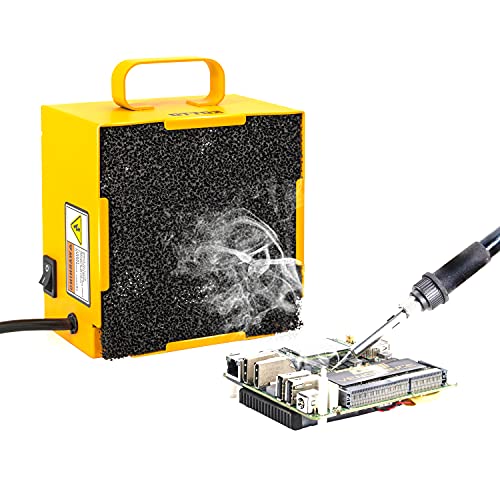
- Activated carbon filter for solder and flux fumes
- 3000 RPM fan with approximately 5–6 inch capture range
- Portable body with non-slip feet and replacement filter
Best For: Basic DIY soldering and portable bench use
Best Tiltable Design

- Dual front-and-rear filtration adsorbers
- 30-degree tiltable stand with side fenders
- Includes eight filtration adsorbers and a US-standard plug
Best For: Adjustable, compact soldering workstations
Best Smart Filtration
HEPA and Carbon Desktop Extractor

- H13 HEPA plus activated carbon composite filter
- 0–100 stepless speed control with digital display
- Gooseneck nozzle and 400-hour filter reminder
Best For: Multi-purpose maker spaces and adjustable source capture
Best Compact Hose Model
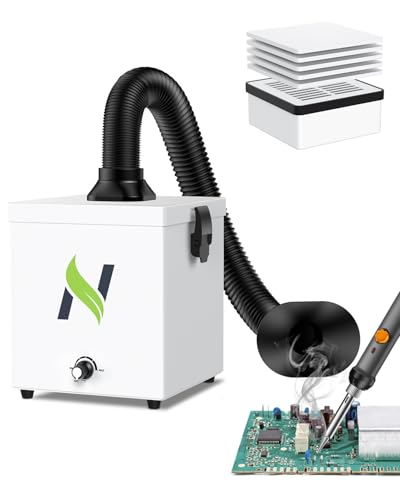
- 168 m³/h adjustable suction in a compact body
- H13 HEPA, carbon, and 10 mm pre-filter setup
- 25.6-inch, 360-degree flexible hose
Best For: Small benches and precise hobbyist fume capture
Best Helping-Hand Pick

- Includes eight filtration adsorbers and detachable helping hands
- 30° tiltable stand with side fenders
- Effective capture distance is specified at about 10 cm
Best For: Soldering and wire work needing adjustable positioning and helping hands
Best Heavy-Duty Filtration

- True H13 HEPA plus activated-carbon filtration
- 120–180 m³/h capacity with up to 15 cm working range
- Metal housing, three speeds, hood, and hose included
Best For: Frequent soldering at a dedicated workbench
Best Flexible Hose Design

- 43W brushless motor with suction up to 180 m³/h
- Three-stage filtration with H11 and activated carbon
- 360° flexible 1.8-foot hose and three airflow levels
Best For: Home studios and DIY workspaces needing directional capture
Best Overall Filtration
NT-P1 150CFM H13 HEPA Extractor

- 150 CFM brushless-motor airflow
- H13 HEPA plus activated carbon
- Compact, quiet, adjustable extraction
Best For: Multi-purpose bench users prioritizing layered filtration
Best for Adjustable Suction
DX50 3-Level Desktop Extractor

- 106 CFM airflow at three speeds
- HEPA plus activated-carbon filter
- Five pre-filters and 20-inch gooseneck
Best For: Light-duty soldering and PCB repair
Best Compact Option
KQZ B1 168m³/h H13 HEPA Extractor

- 168 m³/h airflow in a 4.05-pound body
- H13 HEPA and coal-based carbon filtration
- Includes five replacement pre-filters
Best For: Space-limited benches and portable light-duty use
Best Budget Smoke Trap – Compact Solder Fume Extractor
This compact desktop solder fume extractor is a straightforward option for hobbyists who need localized smoke capture without taking up much bench space. Its activated carbon filter and 3000 RPM fan are designed to draw fumes from roughly 5–6 inches away, while the rubber feet help keep the unit stable during use.
Best For: Basic DIY soldering stations and users who want a portable, easy-to-maintain smoke absorber.
Pros:
- Activated carbon filter helps capture solder, flux, chemical, and gas fumes.
- 3000 RPM fan provides localized suction from approximately 5–6 inches away.
- Compact design includes non-slip feet and a carrying handle.
- Includes a replacement filter and offers a 30-day satisfaction return period.
Cons:
- Uses a relatively small carbon filter, so replacement frequency depends on usage.
- Designed for nearby source capture rather than broad-room ventilation.
- The supplied notes list both 120V and 220V details, so buyers should confirm electrical compatibility.
This is a practical entry-level choice when you want simple, close-range fume absorption and easy portability. It is best suited to occasional or light-duty bench work rather than demanding professional extraction.
Best Tiltable Design – YIHUA 948DQ-I Fume Extractor
The YIHUA 948DQ-I is a compact desktop solder fume extractor with dual filtration and an adjustable stand. Its 30-degree tilt, side fenders, and 10 cm effective straight-line capture distance make it useful when you want to position the intake area around a specific soldering task.
Best For: Electronics hobbyists who value adjustable positioning, included filter media, and a compact 110–127V setup.
Pros:
- Front and rear filtration adsorbers help reduce particles and odors.
- 30-degree tiltable stand allows adjustment of the filtering area.
- Side fenders help reduce disruptive airflow around the intake.
- Includes eight filtration adsorbers, two fenders, and the tiltable stand.
Cons:
- Its effective fume capture distance is limited to approximately 10 cm in a straight line.
- Designed for 110–127V operation with a US-standard plug.
- The basic-style unit does not include a flexible hose for remote positioning.
The 948DQ-I stands out for its adjustable angle and bundled filtration components. Choose it when a small, directional extractor fits your workspace better than a hose-based or higher-capacity system.
Best Smart Filtration – HEPA and Carbon Desktop Extractor
This desktop solder fume extractor combines a true H13 HEPA layer with activated carbon filtration for solder smoke, fine dust, odors, and selected chemical vapors. Its 0–100 stepless speed control, digital display, flexible gooseneck nozzle, and filter reminder provide more control than a basic fixed-intake absorber.
Best For: Makers and small workspaces that need adjustable source capture for soldering, resin work, nail dust, or other craft applications.
Pros:
- Two-stage H13 HEPA and activated carbon filter targets fine particles, smoke, odors, and VOCs.
- Stepless speed control provides adjustable airflow with a real-time digital display.
- 400-hour filter replacement reminder helps track maintenance.
- Flexible gooseneck nozzle enables targeted capture at the fume source.
Cons:
- Its 4.41-pound body is less lightweight than simpler compact absorbers.
- The 400-hour reminder is a usage prompt, not a guarantee of actual filter life in every application.
- Supplied notes do not specify airflow volume or electrical voltage.
This is the most feature-rich option in the group for users who want filtration beyond basic carbon absorption. Its adjustable nozzle and speed control are especially useful when different projects produce varying amounts of smoke or dust.
Best Compact Hose Model – NT-M1 Desktop Fume Extractor
The NT-M1 is a small desktop solder fume extractor that pairs 168 m³/h airflow with H13 HEPA filtration and a flexible hose. Its 360-degree bendable hose can extend to 25.6 inches, allowing the suction head to sit close to the soldering point while a rotary knob adjusts fan speed and noise.
Best For: Hobbyists, apartment users, and compact workstations that need flexible positioning without a large industrial extractor.
Pros:
- Compact 5.1-by-5.1-by-6.3-inch design suits crowded benches.
- 168 m³/h adjustable airflow provides targeted fume capture.
- H13 HEPA filtration, carbon powder, and a 10 mm pre-filter address smoke, odors, and larger particles.
- 25.6-inch flexible hose can be bent 360 degrees for precise positioning.
Cons:
- At 3.61 pounds, it is not the lightest unit in this roundup.
- The supplied information does not specify a filter replacement reminder or included spare filters.
- Its compact capacity is aimed at hobby and everyday DIY work rather than large-scale extraction.
The NT-M1 is a strong fit when hose positioning matters but bench space is limited. Its adjustable airflow and layered filtration offer a useful balance for soldering, PCB repair, and related maker projects.
Best Helping-Hand Pick – YIHUA 948DQ-I
The YIHUA 948DQ-I is a compact option for desktop solder fume extractors, combining front-and-rear filtration with a tiltable stand and detachable helping hands. Its 30° adjustment and side fenders help position the unit near the work area, though effective capture is specified within about 10 cm.
Best For: Soldering and wire work where adjustable positioning and built-in helping hands are useful.
Pros:
- Includes eight filtration adsorbers, two fenders, and detachable helping hands.
- Dual-filtering design helps reduce harmful particles and odors.
- Compact 2.59-pound body with a 30°-tiltable stand.
Cons:
- Its stated effective capture distance is limited to about 10 cm.
- Designed for 110–127V operation with a US-standard plug.
This is a practical choice for small desktop workstations, especially if you frequently need a third hand while soldering. Choose it when compactness and included accessories matter more than longer-range extraction.
Best Heavy-Duty Filtration – FC-2001A
The FC-2001A is a larger desktop solder fume extractor built around an all-metal housing, True H13 HEPA filtration, and activated carbon. Its brushless motor provides a stated 120–180 m³/h purification capacity and an effective working range of up to 15 cm, making it suited to users who want stronger filtration than a basic exhaust fan.
Best For: Frequent soldering where HEPA and activated-carbon filtration, odor reduction, and higher airflow are priorities.
Pros:
- Uses a 2-in-1 H13 HEPA and activated-carbon filtration system.
- Three-speed adjustment and a high-speed brushless motor.
- Includes five pre-filters, a main filter, hose, and hood.
- Supports 110V and 220V operation according to the supplied specifications.
Cons:
- At 9.03 pounds, it is less portable than compact desktop units.
- Larger 11.8 × 10.37 × 12.8-inch footprint may require more bench space.
With its metal construction, multi-stage filtration, and included hood and hose, the FC-2001A is the most substantial option in this group. It makes the most sense for a dedicated workbench where filtration performance outweighs portability.
Best Flexible Hose Design – VEVOR DX50
The VEVOR DX50 is a compact desktop solder fume extractor with a 43W brushless motor, three airflow levels, and suction up to 180 m³/h. Its 360° flexible hose and large hood make it easier to direct capture toward different work positions, while the three-stage filter combines particle and odor filtration.
Best For: Home studios and DIY workspaces needing adjustable hose placement and selectable airflow.
Pros:
- 43W brushless motor delivers stated suction up to 180 m³/h.
- Three-stage filtration uses quartz cotton, an H11 filter, and activated carbon cloth.
- 360° rotating 1.8-foot hose supports flexible positioning.
- Metal body and anti-slip feet provide a stable desktop setup.
Cons:
- The included hose is only 1.8 feet long.
- Replacement filters may be needed as the installed filter is used.
- Specified for 110V operation.
The DX50 balances strong stated airflow with a relatively compact footprint and flexible hose placement. It is a good fit when you want more directional control than a simple front-facing absorber provides without moving to a larger extractor.
Best Overall Filtration – NT-P1 150CFM H13 HEPA Extractor
For desktop solder fume extractors that prioritize layered filtration, the NT-P1 combines 150 CFM airflow with a pre-filter, H13 HEPA filter, and high-iodine activated carbon. Its compact footprint and adjustable tube make it suitable for positioning beside a busy electronics workbench.
Best For: Users who want strong multi-stage filtration, odor reduction, and a flexible extraction point for soldering or other small workshop tasks.
Pros:
- 150 CFM airflow from a brushless motor
- H13 HEPA and honeycomb activated-carbon filtration
- 360-degree flexible tube and compact desktop design
- Low-noise operation rated below 50 dB
Cons:
- At 18.86 pounds, it is less portable than the smaller options
- Replacement intervals vary with usage conditions
The NT-P1 is a strong choice when filtration depth and quieter operation matter more than minimum size. Its included design features also extend beyond soldering to resin or ABS 3D printing, laser engraving under 10W, and similar small-workshop applications.
Best for Adjustable Suction – DX50 3-Level Desktop Extractor
The DX50 is a practical pick among desktop solder fume extractors for light-duty bench work. It provides 106 CFM airflow, three adjustable speeds, and a combined HEPA-and-carbon filter, while its metal housing and side exhaust support a stable desktop setup.
Best For: PCB repair, desktop soldering, jewelry soldering, and DIY users who want selectable airflow and several included pre-filters.
Pros:
- Three airflow levels for task-specific control
- HEPA filter captures 99.97% of fine particulates, according to the supplied specifications
- Includes five pre-filters
- 20-inch 360-degree gooseneck hose holds its position
Cons:
- Designed for light-duty tasks rather than high-volume laser engraving
- Its 106 CFM airflow is lower than the other listed models
Choose the DX50 if controllable suction and straightforward maintenance are more useful than maximum airflow. The side-exhaust design and heat-resistant flexible hose make it especially well suited to a dedicated soldering station.
Best Compact Option – KQZ B1 168m³/h H13 HEPA Extractor
For shoppers seeking compact desktop solder fume extractors, the KQZ B1 delivers 168 m³/h airflow in a small 4.05-pound metal body. Its thicker pre-filter, H13 HEPA filter, and coal-based activated carbon are designed to capture fine particles, dust, fumes, and odors.
Best For: Small workbenches and users who need a lightweight extractor for soldering, 3D printing, nail studios, or other light-duty applications.
Pros:
- 168 m³/h airflow from a centrifugal motor
- 9 mm pre-filter paired with H13 HEPA and activated carbon
- Small, portable metal housing
- Includes five pre-filters and an efficiency filter
Cons:
- The supplied notes do not specify a noise rating
- Its compact design may suit smaller tasks better than larger-volume work
The B1 stands out for portability and a generous included filter kit. Its 360-degree adjustable gooseneck lets you aim the hood close to the source, making it a convenient option when bench space is limited.
How We Picked These Desktop Solder Fume Extractors
We focused on the features that matter most at a soldering bench: airflow capacity, filtration design, capture position, adjustment controls, replacement-filter availability, and overall usability. Models with H13 HEPA filters can help capture fine particles, while activated carbon is useful for reducing odors and some gaseous contaminants. We also considered compactness, flexible positioning, included accessories, and whether the extractor is practical for electronics repair, hobby projects, or frequent workshop use.
Airflow figures are useful for comparison, but they do not tell the whole story. Capture distance, filter loading, fan noise, and the way a unit directs air can affect real-world performance. These extractors are intended to supplement sensible ventilation and should not be treated as a substitute for safe soldering practices.
Quick Comparison
| Feature | What to compare | Why it matters |
|---|---|---|
| Filtration | Pre-filter, H13 HEPA, activated carbon | Balances particle capture, odor reduction, and filter life |
| Airflow | Rated m³/h or CFM | Indicates fan capacity, though actual capture depends on placement |
| Controls | Multiple speeds, reminders, or fixed operation | Helps tailor suction and monitor maintenance |
| Positioning | Tiltable housing, flexible arm, or helping hands | Keeps the intake closer to the smoke source |
| Replacement parts | Availability and cost of filters | Affects long-term ownership value |
Key Buying Factors for Desktop Solder Fume Extractors
Filtration and Filter Replacement
Choose a multi-stage design if you want both particle and odor control. A pre-filter can protect the main filter from larger debris, while activated carbon helps with smells. Check how often filters need replacement and whether compatible replacements are easy to purchase.
Suction, Coverage, and Noise
Higher airflow can be helpful for larger benches or frequent work, but positioning is equally important. A tilting intake or flexible capture arm may outperform a stronger fan placed too far away. If you work beside a microphone, shared desk, or quiet room, look for adjustable speeds and manageable noise.
Size and Controls
Measure the available bench space before buying. Compact units suit occasional repair work, while larger models may provide stronger airflow or longer filter life. Smart filter reminders and clearly marked speed controls are useful conveniences for regular users.
Who Should Buy Which Desktop Solder Fume Extractors?
Occasional hobbyists: Choose a compact, straightforward model with replaceable filtration and enough airflow for a small bench.
Frequent electronics builders: Prioritize adjustable suction, a multi-stage filter, good capture positioning, and readily available replacement filters.
Repair technicians and busy workbenches: Look for higher airflow, H13 HEPA filtration, durable controls, and a design that can run comfortably for extended sessions.
Shared or noise-sensitive spaces: Favor adjustable fan speeds, compact placement, and a capture angle that lets you use effective suction without running the fan at maximum power.