Choosing lighting control for a small venue is about balancing hands-on simplicity, fixture capacity, programming flexibility, and budget. The right DMX controller can make a compact bar, club, wedding space, church, or mobile DJ setup easier to operate without overwhelming the person running the show.
We’ve gathered 10 options ranging from basic 12-channel dimming consoles to 192-channel boards, wireless DMX systems, and software-focused controllers. Use the guide below to match the controller’s workflow and connectivity with your venue and lighting rig.
Best 10 Dmx Controllers for Small Venues Picks for 2026
Best Expandable Console

- Controls 192 DMX channels
- Stores 240 scenes
- Includes fog, strobe, and MIDI control
Best For: Growing small-venue lighting rigs
Best Compact Starter Console

- Controls eight intelligent lights
- Offers 96 DMX channels
- Supports six long-step chases
Best For: Straightforward small lighting rigs
Best Software-Integrated Controller

- Provides two DMX universes
- Integrates with DJ platforms and software
- Adds BPM-synced tactile lighting control
Best For: DJ-led and live-audio lighting setups
Simple 12-Channel Control

- 12 channel faders and a master fader
- Portable, lightweight design with wall-mount option
- 3-pin and 5-pin DMX outputs
Best For: Basic lighting control, demos, and compact venue rigs
Wireless DMX Flexibility
Lixada DMX 512 Wireless Controller

- Wireless standard DMX512 transmission
- 126 frequency channels and 16 group IDs
- Four adjustable output power levels
Best For: DJ, party, and stage setups needing fewer DMX cables
Programmable 192-Channel Control
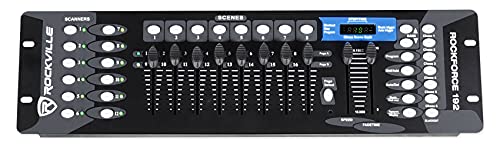
- Controls 192 channels across 12 scanners
- Stores scenes and programmable chases
- Includes sound activation and fog compatibility
Best For: DJs and small productions with multi-fixture lighting rigs
Best Wireless Link

- Wireless transmission of standard DMX512 data
- Up to 400 m stated line-of-sight range
- 126 frequency-hopping channels and 7 IDs
Best For: Adding wireless DMX connectivity to an existing console setup
Best Compact Console
48-Channel Mini DMX Controller

- 48 channels controlled by 24 two-page faders
- Blackout and master-dimmer buttons
- Compact design for clubs, bars, and parties
Best For: Beginner-friendly manual control in space-conscious venues
Best Programmable Value
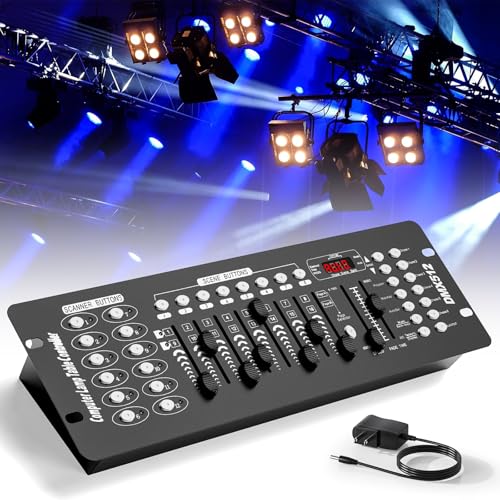
- 192 channels across up to 12 devices
- Up to 240 scenes and six programmable chases
- Manual sliders plus speed and fade controls
Best For: Small shows needing repeatable scenes and lighting chases
Best Expandable Console – CHAUVET DJ OBEY40
For small venues planning a more involved lighting rig, the CHAUVET DJ OBEY40 is a practical choice among DMX controllers for small venues. It controls up to 12 fixtures with up to 16 channels each, giving operators room to manage intelligent lights, fog, and strobe effects from one console.
Best For: Small venues with multiple intelligent fixtures and programmed scene or chase needs.
Pros:
- Controls up to 192 DMX channels across as many as 12 fixtures.
- Stores up to 240 scenes in 30 banks.
- Provides six chase sets plus fog, strobe, MIDI, and reversible-slider controls.
Cons:
- Its broader feature set may be more than a very small setup requires.
- At 6.7 pounds, it is less lightweight than compact alternatives.
The OBEY40 makes the most sense when scalability and organized playback matter more than minimal size. Its scene, bank, and chase capacity can help a small venue grow without immediately replacing the controller.
Best Value 192-Channel Console – MINGJIE DMX512 Controller
The MINGJIE DMX512 Controller combines 192-channel control with automatic and programmable operating modes, making it a flexible option among DMX controllers for small venues. Its layout is divided into clearly identified control areas, and the included 3-pin DMX cable helps get compatible equipment connected quickly.
Best For: DJs, event operators, clubs, and small stages needing broad fixture control and sound-activated operation.
Pros:
- Controls up to 12 fixtures and 192 DMX channels.
- Stores 240 scenes in 30 banks and supports six chases.
- Offers sound activation, a rugged alloy chassis, a 3-pin DMX cable, and 100–240V input.
Cons:
- The supplied cable is only 4 feet long.
- Its many controls may take time for beginners to master.
With both sound-activated and fully programmable modes, this controller can cover casual parties and more structured shows. It is a compelling fit when a small venue wants substantial channel capacity without moving to a larger lighting console.
Best Compact Starter Console – CHAUVET DJ Obey 10
The CHAUVET DJ Obey 10 keeps operation straightforward for smaller rigs. As one of the more compact DMX controllers for small venues, it controls up to eight intelligent lights with 96 DMX channels and supports sequential chase linking for programmed effects.
Best For: Small venues with up to eight intelligent lights and a need for basic chase playback.
Pros:
- Controls up to eight intelligent lights.
- Provides 96 DMX channels of control.
- Supports six chase sets with up to 999 steps each.
Cons:
- Has less fixture and channel capacity than the OBEY40.
- The supplied notes do not list fog, strobe, MIDI, or scene-bank features.
The Obey 10 is a sensible fit when the lighting system is modest and chase sequencing is the priority. Its lower capacity can also make it easier to match with a straightforward small-venue setup.
Best Software-Integrated Controller – SoundSwitch Control One
The SoundSwitch Control One takes a software-centered approach to DMX control, pairing tactile hardware with SoundSwitch software. For small venues using DJ or live-audio workflows, it stands out among DMX controllers for small venues with two DMX universes, responsive performance controls, and music-synced lighting features.
Best For: DJs and live performers who want software-driven, music-synchronized lighting control.
Pros:
- Provides two DMX universe inputs and outputs with a thru option for installations.
- Supports Engine DJ devices, compatible AlphaTheta workflows, and SoundSwitch software.
- Offers BPM detection, touch-strip intensity control, encoders, RGB pads, and lighting FX control.
Cons:
- Several workflows require SoundSwitch software, and some require a computer.
- Its software integration may be unnecessary for venues seeking a standalone console.
Control One is best viewed as a performance interface rather than a traditional standalone scene console. Its compact 1.76-pound design and direct DJ-oriented controls make it attractive when lighting is expected to follow music in real time.
Simple 12-Channel Control – ADJ SDC12
ADJ Products SDC12, 12 Channel Basic DMX Controller, Easily Fade and Dim Multiple Lights
Check Price On AmazonFor small venues seeking straightforward DMX controllers for small venues, the ADJ SDC12 offers hands-on control without a complicated programming workflow. Its 12 channel faders and master fader are suited to basic dimming, fading, demonstrations, and compact lighting setups.
Best For: Small venues, demos, and portable or permanently mounted basic lighting control.
Pros:
- Provides 12 individual channel faders plus a master fader.
- Compact, lightweight design can be used portably with a 9V battery, sold separately.
- Includes standard 3-pin and 5-pin DMX outputs for compatible fixtures.
- Can be wall mounted and uses a 12V DC power supply.
Cons:
- Its basic 12-channel layout may be limiting for larger or highly programmed shows.
- Battery operation requires a separate 9V battery.
The SDC12 is a practical choice when direct, manual adjustments matter more than elaborate scene programming. It fits small, uncomplicated rigs where quick setup and portability are priorities.
Wireless DMX Flexibility – Lixada DMX 512 Wireless Controller
The Lixada DMX 512 controller is aimed at small venues that want to reduce cable runs while maintaining real-time DMX communication. Its wireless transmitter and receiver system supports adjustable power, LCD-based operation, and multiple selectable wireless groups.
Best For: Disco, DJ, party, and stage-lighting setups where wireless DMX links can simplify installation.
Pros:
- Transmits standard DMX512 data wirelessly between compatible lighting equipment.
- Offers 126 frequency channels and 16 group IDs to help manage multiple wireless networks.
- Provides four selectable power levels.
- Designed for real-time transmission with high anti-interference capability.
Cons:
- Wireless operation depends on compatible transmitter and receiver equipment.
- The supplied notes do not specify the controller’s physical channel-fader layout or programming capacity.
This Lixada unit is most compelling when flexible placement and fewer DMX cables are central to the setup. Confirm compatibility and wireless coverage for your particular fixtures before committing to a cable-free configuration.
Programmable 192-Channel Control – Rockville ROCKFORCE 192
For small venues with multiple fixtures or fog effects, the Rockville ROCKFORCE 192 provides substantially more programming capacity than a basic manual controller. It manages 192 DMX channels across 12 scanners and supports scenes, chases, music triggering, and power-failure memory.
Best For: DJs, event spaces, and small productions requiring repeatable lighting sequences and fog control.
Pros:
- Controls 192 channels across 12 scanners, with 16 channels per scanner.
- Stores 23 banks of eight scenes and six chases of up to 240 scenes.
- Built-in microphone enables sound-activated effects.
- Rack-mountable 3U metal-and-plastic design includes power-failure memory.
Cons:
- Its 22-inch rack-style form factor is less portable than compact controllers.
- May offer more programming capacity than needed for a very small, simple rig.
- The supplied specifications list a 240V AC voltage requirement, which should be checked against the venue’s power system.
The ROCKFORCE 192 is a stronger fit when a venue has enough fixtures to justify scene and chase programming. Its sound activation and fog compatibility also make it useful for DJs and event productions that need more dynamic control.
Best Wireless Link – 2.4G DMX Transmitter
CHINLY DMX 512 DMX Dfi DJ 2.4G Wireless 1 Transmitter Controller for LED Stage Par Party Light
Check Price On AmazonFor small venues that already use a DMX console, the CHINLY wireless transmitter offers a way to send standard DMX512 data without running a cable between the controller and lighting equipment. Its long stated range and frequency-hopping design make it a practical option for reducing cable runs.
Best For: Small venues needing wireless DMX transmission from an existing console to compatible lighting equipment.
Pros:
- Transmits standard DMX512 data wirelessly in real time with no stated signal delay.
- Offers a stated communication distance of up to 400 meters with a clear line of sight.
- Uses 126 automatically changing frequencies and provides seven selectable wireless network IDs for interference resistance.
Cons:
- This product is a transmitter rather than a complete lighting control console.
- The supplied unit uses a 3-pin male DMX connector, so system compatibility should be checked before purchase.
- The stated range depends on visible, unobstructed distance.
The CHINLY is best viewed as a wireless expansion accessory, not a standalone solution for programming lights. It makes the most sense when your small-venue setup already has a DMX controller and you want a cleaner connection path.
Best Compact Console – 48-Channel Mini DMX Controller
For small venues seeking a straightforward console, this 48-channel DMX controller combines physical faders with essential blackout and master-dimmer controls. Its compact size and beginner-friendly layout suit clubs, bars, home parties, and other space-conscious setups.
Best For: Beginners who need direct control of DMX512 fixtures in a small club, bar, party, or event space.
Pros:
- Provides 48 channels through 24 precision faders across two 24-channel pages.
- Blackout and master-dimmer controls simplify emergency shutoff and overall brightness changes.
- Compact 430 × 90 × 50 mm design and 1,200 g weight make it easy to carry and place.
- Supports standard DMX512 devices such as moving heads and par lights.
Cons:
- It has no stated warranty.
- Channel access is divided between two pages rather than provided by 48 dedicated faders.
- Operation requires the included 12V DC power adapter and a corded power source.
This controller is a practical fit when hands-on fader control matters more than advanced automation. Its simple controls and small footprint make it an accessible starting point for basic DMX lighting in a smaller room.
Best Programmable Value – 192-Channel DMX Console
For small venues that need more room for programmed looks, this 192-channel DMX console supports up to 12 devices with 16 channels each. Its scene, chase, speed, and fade controls provide more programming capacity than a basic manual controller while keeping the layout approachable for beginners.
Best For: Small gatherings, parties, and shows that need programmable scenes and chases for multiple DMX fixtures.
Pros:
- Controls up to 12 smart devices across 192 total channels.
- Supports up to 240 scenes, 23 banks of programmable scenes, and six programmable chases.
- Includes manual channel sliders plus speed, fade, and timing controls for automatic programs.
- Works with 3-pin DMX stage equipment and includes a 3-pin cable.
Cons:
- The control layout may take practice despite its beginner-oriented design.
- Its 12-device limit and 16-channel-per-device structure may not suit larger or highly complex rigs.
- Warranty information is inconsistent in the supplied notes, which cite both 360-day repair coverage and a 90-day manufacturer warranty.
This model offers a useful middle ground for operators who want programmed scenes and chases without moving to a larger console. It is particularly appealing when a small-venue rig has several fixtures and needs repeatable lighting looks.
How We Picked These Dmx Controllers for Small Venues
We focused on the features that matter most in compact performance spaces: channel capacity, scene and chase programming, blackout and master-dimmer controls, fixture compatibility, portability, and ease of operation. We also included several control styles so you can compare traditional fader boards with wireless and computer-assisted options.
Because small venues often have limited setup time and staff, practical usability matters as much as technical specifications. A controller that supports more channels is not automatically the better choice if it takes too long to program or is difficult to operate during a live event.
Quick Comparison
| Controller type | Best suited to | Main advantage |
|---|---|---|
| Basic 12-channel board | Simple dimming setups | Fast, straightforward control |
| Compact 48-channel controller | Small DJ and event rigs | Portable control with useful essentials |
| 192-channel console | Multiple LED fixtures and moving lights | More programming capacity |
| Wireless DMX controller | Temporary or cable-sensitive setups | Less signal cabling |
| Software-based controller | Automated, music-driven shows | Advanced programming and integration |
Key Buying Factors for Dmx Controllers for Small Venues
Channel Count and Fixture Growth
Count the DMX channels used by every fixture, then leave room for expansion. A 12-channel controller may suit a few dimmers, while a 192-channel board is more appropriate for several LED pars, moving heads, strobes, or fog machines. Remember that a fixture’s channel mode can change its DMX requirements.
Programming and Live Operation
Look for scene storage, chase programming, speed and fade controls, blackout, and a master dimmer. Physical faders are useful when an operator needs immediate manual changes. Software or more advanced consoles may offer deeper automation but can require additional setup and a computer.
Wired Versus Wireless DMX
Wireless DMX can simplify installations and reduce cable runs, especially in event spaces where fixtures are frequently moved. However, verify transmitter and receiver compatibility, operating range, power requirements, and whether your venue has potential radio interference. Wired DMX remains the predictable choice for permanent or critical installations.
Size, Durability, and Connectivity
Check whether the controller fits your table, rack, or flight case. Confirm its DMX input or output arrangement, power supply, rack format, and compatibility with your fixtures. A compact board is easier to transport, while a rackmount design may be better for a fixed booth.
Who Should Buy Which Dmx Controllers for Small Venues?
Choose a basic 12-channel unit if your setup uses a small number of conventional dimmer channels and you value the simplest possible operation. A 48-channel controller is a sensible middle ground for mobile DJs, bars, and small parties that need compact control with blackout and master-dimmer functions.
Choose a 192-channel console when you operate several intelligent fixtures or expect your rig to grow. Wireless options are best when quick deployment and reduced cabling are priorities, provided the transmitters and receivers match your system. For venues that want music synchronization, repeatable show programming, or integration with a computer, a software-oriented controller such as the SoundSwitch approach may offer the most flexibility.
Before buying, list your fixtures, total their maximum channel requirements, and decide whether an operator will run the show manually or trigger programmed scenes. That simple check will help you select among the best Dmx Controllers for Small Venues without paying for capacity or complexity you will not use.