Choosing an electronic speed controller is easier when you match it to your motor, battery, vehicle scale, and connector setup. The wrong ESC can cause poor throttle response, overheating, or an incompatible installation.
We selected 10 brushed and brushless options for common RC cars, crawlers, boats, drones, airplanes, and helicopters, with practical choices for beginners who want dependable control without unnecessary complexity.
Best 10 Rc Electronic Speed Controllers for Beginners Picks for 2026
Best All-Around Brushed Pick

- Broad 1/10-scale compatibility
- Three selectable drive modes
- Low-voltage and temperature protection
Best For: Beginners running versatile brushed RC vehicles
Best High-Current Upgrade
Radiolink CL9030 90A Brushed ESC

- 90A continuous current rating
- Supports 2S–4S and 6–18V input
- IP66 water- and dust-resistant design
Best For: Higher-demand 1/10 brushed cars, crawlers, and boats
Best Twin-Pack Value
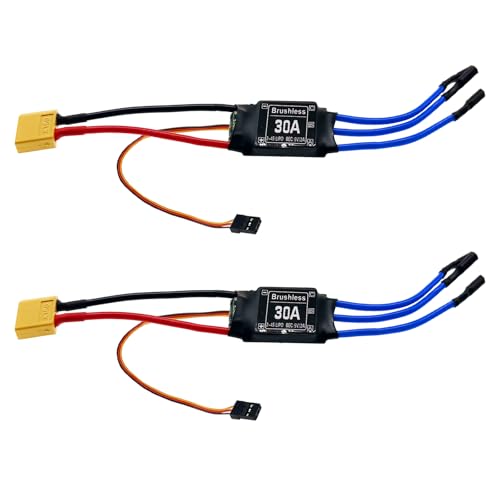
- Two ESCs included
- XT60 and 3.5mm bullet connectors
- 30A continuous, 40A peak rating
Best For: Beginner aircraft and FPV brushless projects
Best Simple Tamiya Replacement

- Made for 1/10 brushed crawlers
- Supports 2S–3S LiPo batteries
- Tamiya plug and switch-mode BEC
Best For: Straightforward 1/10 crawler upgrades
Easy Brushed Control

- Forward, reverse, and brake functions
- Supports 4–8V input and 2S lithium
- Compact design for tight installations
Best For: Beginner 1/10 brushed RC builds
Brushless Aircraft Power

- 40A continuous and 55A short-time current
- 5V/3A BEC with XT60 plug
- Protection against low voltage, heat, and signal loss
Best For: Beginner brushless aircraft and drone builds
Weather-Ready Crawling

- Waterproof and dust-proof for all-weather use
- Automatic throttle-range detection
- Protection for low voltage, heat, and signal loss
Best For: 1/10 brushed crawlers, boats, and trucks
Compact 20A Brushed ESC Pair

- Two-pack for small RC builds
- Forward, reverse, and braking
- 4.8–8.4V; supports 2S Li-Po
Best For: Small 1/16–1/24 brushed RC vehicles
30A DIY Brushed ESC Pair
Mini RC Car and Boat Controller

- Two ESCs with brake function
- 4–8V operating support
- 30A forward; 40A peak
Best For: DIY brushed cars, boats, crawlers, and tanks
RC-30A Brushed ESC 2-Pack

- Two brushed ESC controllers
- Forward, reverse, and braking
- 3.0–9.4V; 30A rating
Best For: RC cars and boats with compatible brushed motors
Best All-Around Brushed Pick – Waterproof 60A Multi-Mode ESC
For beginners comparing rc electronic speed controllers for beginners, this 60A brushed ESC offers broad 1/10-scale compatibility, simple plug-and-play installation, and selectable driving modes. It supports 2S–3S LiPo or 5–9-cell NiMH batteries, but motor-turn limits should be checked carefully before use.
Best For: Beginners running 1/10 brushed trucks, buggies, short-course trucks, or crawlers who want flexible drive modes.
Pros:
- Works with 1/10, 1/12, and 1/16 models using standard 540/550 brushed motors.
- Offers Forward/Brake/Reverse, Crawler, and Boat modes.
- Includes a 3A switching BEC, low-voltage cutoff, and temperature protection.
Cons:
- Motor limits apply: at least 12T on 2S and 18T on 3S.
- Designed for brushed motors, not brushless systems.
This is a practical starter ESC when versatility and protection matter. Its jumper-based modes are useful as skills develop, while the motor restrictions make setup verification essential.
Best High-Current Upgrade – Radiolink CL9030 90A Brushed ESC
Among rc electronic speed controllers for beginners, the Radiolink CL9030 stands out for its 90A continuous rating, wide 6–18V input range, and smooth throttle control. Its jumper configuration supports lithium and non-lithium batteries, so beginners should confirm the battery setting before driving.
Best For: 1/10 crawlers, trucks, buggies, tanks, boats, and bait boats needing higher current capacity.
Pros:
- Provides 90A continuous and 100A peak current capability.
- Supports 2S–4S operation across a 6–18V input range.
- Includes 5A BEC output options, protection features, and IP66 water- and dust-resistant construction.
Cons:
- The lithium-battery jumper must be set correctly to avoid battery damage.
- Its broader configuration may be more involved for a first-time user.
The CL9030 is a capable choice for beginners who expect to move into larger or more demanding brushed setups. Its battery-type jumper deserves special attention during installation.
Best Twin-Pack Value – 30A Brushless ESC Set
For beginners exploring rc electronic speed controllers for beginners in drones, helicopters, and airplanes, this two-pack provides a straightforward brushless setup with pre-fitted XT60 and 3.5mm bullet connectors. Each controller is rated for 30A continuous and 40A peak operation.
Best For: RC drone, helicopter, airplane, or FPV projects using brushless motors and compatible connectors.
Pros:
- Includes two brushless ESCs for a backup or multi-motor configuration.
- XT60 and 3.5mm bullet plugs simplify installation.
- Independent heat sinks and a low-impedance capacitor support heat control and interference reduction.
Cons:
- Rated at 30A continuous, making it less suited to higher-current applications.
- Its stated applications focus on aircraft and FPV models rather than typical RC cars.
- Compatibility with the specific motor and battery setup still needs to be confirmed.
This set is convenient when a beginner needs two compact brushless controllers or wants a spare on hand. It is best matched to the aircraft applications and current range listed by the manufacturer.
Best Simple Tamiya Replacement – Waterproof 60A Brushed ESC
This 60A brushed ESC is a focused option for beginners shopping for rc electronic speed controllers for beginners and upgrading a 1/10 RC car or crawler. It supports 2S–3S LiPo batteries, uses a Tamiya plug, and includes a switch-mode BEC for receiver and servo power.
Best For: 1/10 brushed RC crawlers and cars requiring a Tamiya-plug replacement or upgrade.
Pros:
- Designed specifically for 1/10-scale brushed RC crawlers.
- Supports 2S–3S LiPo batteries with a 60A current capacity.
- Waterproof construction and switch-mode BEC suit outdoor operation.
Cons:
- Its compatibility notes are narrower than more multi-mode ESCs.
- Uses a Tamiya plug, which may require an adapter for other battery connectors.
- Only brushed-motor operation is specified.
This is a sensible pick when the goal is a basic, weather-resistant brushed upgrade rather than extensive programming. Check the vehicle’s connector and battery arrangement before ordering.
Easy Brushed Control – YoungRC 30A Brushed ESC
For beginners comparing rc electronic speed controllers for beginners, the YoungRC 30A ESC is a compact brushed option with straightforward forward, reverse, and brake functions. It supports 4–8V input, including a 2S lithium battery, and is sized for many 1/10 on-road or off-road applications.
Best For: Beginner 1/10 RC car, truck, SCT, boat, or tank projects using a brushed motor and 2S power.
Pros:
- Provides forward, reverse, and brake operation.
- Supports 30A forward current, with a 40A instantaneous peak.
- Compact 40 x 19 x 10mm design suits tight DIY installations.
- Includes PPM signal support and a 2KHz operating frequency.
Cons:
- Designed for brushed motors rather than brushless systems.
- Voltage support is limited to 4–8V, so compatibility should be checked before purchase.
This is a practical entry-level ESC when you need basic brushed-motor control in a compact package. Its 2S compatibility and brake function make it a sensible choice for casual sport or normal racing setups.
Brushless Aircraft Power – 40A 2–4S Brushless ESC
Among rc electronic speed controllers for beginners, this 40A brushless ESC offers a useful starting point for aircraft and multi-axis models. It accepts 2–4S lithium batteries, includes an XT60 plug, and provides a 5V/3A BEC for compatible electronics.
Best For: Beginner drone, airplane, helicopter, or multi-axis aircraft builds using a compatible brushless motor and 2–4S battery.
Pros:
- Provides 40A continuous current and 55A short-time current.
- Includes a 5V/3A linear BEC output.
- Supports timing changes for different brushless motors.
- Offers low-voltage, overheat, and throttle-signal-loss protection.
Cons:
- Designed for brushless applications, not brushed motors.
- Battery is not included.
- Motor and model compatibility should be confirmed before installation.
With its broad 2–4S input range, safety protections, and adjustable timing, this ESC is a versatile option for beginners moving into brushless aircraft projects. The included XT60 plug can also simplify power connections when it matches the rest of the build.
Weather-Ready Crawling – Waterproof 60A Brushed ESC
For beginners choosing rc electronic speed controllers for beginners, this waterproof 60A brushed ESC is aimed at 1/10 crawlers, boats, and similar models that may see demanding conditions. Its automatic throttle-range detection and protective features are designed to simplify setup and support all-weather operation.
Best For: 1/10 RC rock crawlers, boats, and trucks such as SCX10, TRX4, CC01, TF2, D90, MST CFX, and EX86100 platforms.
Pros:
- Waterproof and dust-proof construction supports all-weather use.
- Offers low-voltage, overheat, and signal-loss protection.
- Automatic throttle-range detection can simplify setup.
- Uses high-current MOS components and an aluminum alloy heat sink.
Cons:
- This is a brushed ESC, so it is not intended for brushless motors.
- Its larger listed dimensions may require more installation space than compact ESCs.
- The supplied notes do not specify its supported battery voltage or continuous current rating.
This ESC makes the most sense for a brushed crawler or boat where water and dust resistance matter more than a minimal footprint. Its automatic throttle detection and multiple protections are helpful features for a beginner-focused installation.
Compact 20A Brushed ESC Pair – Mini RC Speed Controller
For shoppers comparing rc electronic speed controllers for beginners, this two-pack offers a compact brushed setup for smaller RC vehicles. It supports 4.8–8.4V systems, including 2S Li-Po and 4–7-cell Ni-MH/Ni-Cd packs, with forward, reverse, and braking functions.
Best For: 1/16, 1/18, and 1/24 RC cars, boats, tanks, and other small brushed-motor projects using compatible 130–380 motors.
Pros:
- Two ESCs are included in the package.
- Provides forward, reverse, and brake functions.
- Supports 130/180/260/280/380 brushed motors.
- Compact 35 x 22 x 6 mm design suits small builds.
Cons:
- Designed for brushed motors rather than brushless systems.
- Its 20A rating is aimed at smaller vehicles and moderate power demands.
This is a practical beginner option when compact size and a spare controller matter. Verify your vehicle’s motor, connector, and battery requirements before ordering.
30A DIY Brushed ESC Pair – Mini RC Car and Boat Controller
For beginners choosing rc electronic speed controllers, this two-pack is a straightforward brushed ESC option with braking and support for 4–8V systems. It can connect to a receiver and steering servo and is specified for use with 2S lithium batteries at 7.4V.
Best For: DIY mini RC cars, boats, crawler vehicles, and tanks that use a compatible brushed setup.
Pros:
- Includes two brushed ESCs with brake function.
- Supports forward current up to 30A and instantaneous peak current up to 40A.
- Works with 4–8V systems and directly supports 2S lithium at 7.4V.
- Designed for receiver and steering-servo setups.
Cons:
- The supplied notes do not specify compatible brushed motor sizes.
- It is not identified as a brushless ESC.
With two units and a higher stated forward-current rating than the smaller 20A option, this model suits simple DIY brushed projects. Confirm the vehicle scale, motor requirements, and wiring before installation.
RC-30A Brushed ESC 2-Pack – FainWan Speed Controller
FainWan 2PCS RC-30A Brushed ESC Electronic Speed Controller w/Brake for RC Car Boat Tank
Check Price On AmazonThis FainWan two-piece unit is a beginner-friendly choice among rc electronic speed controllers for brushed RC cars and boats. It provides forward, backward, and braking functions and operates across a stated 3.0–9.4V working-voltage range.
Best For: RC cars and boats using compatible 130, 180, 260, 280, or 380 brushed motors.
Pros:
- Includes two brushed ESC controllers.
- Offers forward, reverse, and braking functions.
- Supports several common brushed motor sizes from 130 through 380.
- Specified 30A current rating and 3.0–9.4V working range.
Cons:
- Compatibility is listed for brushed RC cars and boats, not brushless applications.
- The supplied notes do not identify a battery chemistry or connector type.
This pair is worth considering when you need two controllers and want broad compatibility with common small brushed motors. Check your motor, battery voltage, and connectors against the ESC specifications before buying.
How We Picked These Rc Electronic Speed Controllers for Beginners
We compared the listed ESCs by motor compatibility, continuous current rating, battery range, BEC output, connector style, braking support, waterproofing, and intended vehicle type. Since beginners often need a straightforward upgrade or replacement, we also considered installation practicality and whether the controller suits common 1/10, 1/16, 1/18, and 1/24 platforms.
The most important distinction is motor type. Brushed ESCs work with brushed motors, while brushless ESCs require a compatible brushless motor and usually include three motor wires. These systems are not interchangeable.
Quick Comparison
- Best for common 1/10 brushed vehicles: Choose a 60A brushed ESC with the correct battery plug and receiver connection.
- Best for higher-current brushed setups: A 90A controller offers more headroom for demanding crawlers, trucks, and boats.
- Best for small RC models: Compact 20A or 30A brushed ESCs suit many 1/16 to 1/24 vehicles.
- Best for aircraft and drones: Select a brushless ESC with the correct cell count, motor wiring, and BEC output.
- Best for multi-model value: Two-piece packs can be useful for repairs, builds, or keeping a spare available.
Key Buying Factors for Rc Electronic Speed Controllers for Beginners
Motor and Battery Compatibility
Confirm whether your motor is brushed or brushless, then check the ESC’s supported battery voltage. A 2S–4S brushless controller cannot automatically replace a brushed 2S–3S unit. Exceeding the stated cell range may damage the ESC or motor.
Current Rating and Cooling
Amperage indicates how much electrical load the ESC is designed to handle, but real demands vary with gearing, terrain, vehicle weight, propeller size, and driving style. Leave some headroom rather than selecting a controller that operates at its maximum rating continuously. Good airflow or a suitable heatsink also helps control temperature.
Connectors and BEC Output
Check whether the ESC includes an XT60, Tamiya-style, or another connector. Matching plugs simplify installation, while mismatched connectors may require safe soldering. The BEC powers the receiver and servos, so verify its voltage and current are suitable for your electronics.
Waterproofing and Braking
Waterproof protection is useful for crawlers, boats, and wet outdoor conditions, but it does not make every component waterproof. Braking and reverse functions are valuable for cars and boats, whereas aircraft ESCs may prioritize throttle response and low weight.
Who Should Buy Which Rc Electronic Speed Controllers for Beginners?
New RC car and crawler owners should start with a waterproof 60A brushed ESC if it matches their motor, battery, and vehicle connector. It is a practical balance for many 1/10 platforms.
Drivers of small cars, tanks, or boats should consider a 20A or 30A brushed model, especially when space and electrical demand are limited. A two-pack is worthwhile if you maintain several small vehicles.
Owners of demanding brushed builds may prefer the 90A option, provided the wiring, motor, battery, and servo requirements are compatible.
Drone, airplane, and helicopter builders should choose a brushless ESC based on cell count, motor specifications, BEC requirements, connector type, and aircraft weight. Before installation, inspect polarity, secure all solder joints, and test throttle calibration with the propeller removed where applicable.