Small businesses need resin 3D printers that deliver consistent detail without creating unnecessary downtime, wasted material, or difficult maintenance. The right model can support prototypes, miniatures, dental-style models, jewelry patterns, and other small-batch products.
We compared these 10 resin printers across resolution, print speed, build volume, ease of use, reliability features, and overall workflow value so you can choose a machine that fits your business goals and budget.
Best 10 Resin Printers for Small Businesses Picks for 2026
Best Overall Detail

- 16K resolution for intricate models
- Heated resin tank supports print consistency
- AI monitoring and automatic leveling
Best For: Detailed production work with a streamlined workflow
Best for Production Control

- High-contrast amber screen
- One-click slicing with model repair
- Force sensing and diagnostic reports
Best For: Repeatable production with detailed monitoring
Best Easy-Use Workflow

- Factory pre-leveling simplifies setup
- Built-in heating supports cold environments
- Remote monitoring and smart resin handling
Best For: Small teams seeking a guided printing workflow
Best High-Speed Value

- Up to 170 mm/h with high-speed resin
- 14K optics for detailed output
- Large build volume with temperature control
Best For: Higher-throughput production and larger print batches
Precision Production Pick
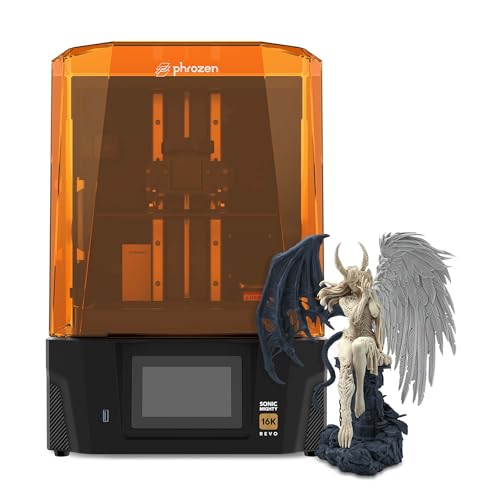
- 16K detail with 14×19 µm XY resolution
- Large build area for bigger or batch prints
- Remote monitoring through Phrozen GO
Best For: Professional models and detail-intensive batch production
Dual-Material Workflow Pick

- Supports dual-color or dual-material creations
- 14K system with stable motion components
- Automated leveling and AI-assisted inspections
Best For: Small models and complex assembled designs
Fast Networked Production Pick

- Printing speeds up to 150 mm/h
- AI camera monitors plates and model warping
- WiFi cluster printing supports multiple printers
Best For: Fast turnaround and remotely managed production
Precision Pro

- 566:1 contrast ratio and up to 4.5s-per-layer printing
- Industrial C5 Z-axis with stated ±2 μm repeat accuracy
- Automated leveling, diagnostics, and resin-residue detection
Best For: Detail-focused shops that need repeatable, monitored production
High-Resolution Value

- 7-inch 10K screen with 17×17 μm XY pixels
- Up to 120 mm/h maximum print speed
- Intelligent inspections for resin, print, and printer issues
Best For: Compact workspaces producing highly detailed models
Production Capacity Pick

- 16K resolution with a 211.68 × 118.37 × 200 mm build volume
- Claimed print speeds up to 170 mm/h
- Automated resin heating, RFID setup, and weight monitoring
Best For: Higher-throughput shops printing larger models
Best Overall Detail – Saturn 4 Ultra 16K
For small businesses seeking resin printers for small businesses that prioritize fine detail and a streamlined workflow, the ELEGOO Saturn 4 Ultra 16K combines high resolution with useful automation. Its heated resin tank, automatic leveling, AI monitoring, and tilt-release system are designed to support consistent production with less hands-on intervention.
Best For: Small businesses producing highly detailed models, figurines, and prototypes.
Pros:
- 16K resolution captures smooth surfaces and fine textures.
- Smart tank heating maintains resin at approximately 30°C for improved fluidity and layer adhesion.
- Automatic leveling, residue detection, and resin-level alerts can reduce workflow interruptions.
- AI camera supports monitoring, alerts, chamber lighting, and time-lapse recording.
Cons:
- At 35.5 pounds, it is not especially portable.
- AI detection performance may vary with the environment, model, and resin type.
- Its 24 x 17 x 15-inch footprint requires dedicated workspace.
The Saturn 4 Ultra 16K is a strong fit when output detail and print oversight matter more than minimizing equipment size. Its automated features can make repeat production more manageable for a growing shop.
Best for Production Control – Reflex RS Turbo
Businesses comparing resin printers for small businesses may value the Reflex RS Turbo for its emphasis on repeatable, controlled production. Its high-contrast amber screen, automated model preparation, force sensing, and precision motion components are aimed at improving detail, reliability, and process efficiency.
Best For: Production-focused users who want automated preparation and detailed print diagnostics.
Pros:
- High-contrast amber screen is designed for crisp details and faster curing.
- One-click slicing can repair several model defects and generate supports.
- Force sensors can detect fine resin residue, pause prints, and produce diagnostic reports.
- Industrial-grade Z-axis positioning and calibrated light distribution support consistent tolerances.
Cons:
- At 50.6 pounds, it is one of the heavier options in this roundup.
- The 15 x 23 x 15-inch dimensions call for substantial bench space.
- Its advanced systems may be more complexity than occasional users need.
The Reflex RS Turbo stands out for shops that care about process monitoring and repeatability. Its feature set is particularly relevant when minimizing failed jobs and checking production data are important.
Best Easy-Use Workflow – UniFormation GK3T 16K
The UniFormation GK3T is a practical choice for small businesses wanting resin printers for small businesses with fewer setup and handling steps. Factory pre-leveling, smart resin feeding, temperature control, remote monitoring, and compatibility with wash-and-cure equipment create a workflow geared toward convenience.
Best For: Small teams and first-time operators who want a guided, low-mess printing process.
Pros:
- 16K resolution and 14 x 19μm pixel size support fine model detail.
- Factory pre-leveling helps simplify setup.
- Heating can maintain resin fluidity in environments as cold as 0°C/32°F.
- Remote control, resin feeding, draining, and a quick-release build plate support efficient operation.
Cons:
- At 52.8 pounds, it is relatively heavy to relocate.
- Its 20.47-inch height may limit placement options.
- The complete workflow depends on compatible wash-and-cure equipment for post-processing integration.
The GK3T is appealing when operator convenience and workflow organization are priorities. It offers detailed output while addressing common small-business concerns such as setup, resin handling, temperature changes, and remote oversight.
Best High-Speed Value – ANYCUBIC Photon Mono M7 Pro
For small businesses evaluating resin printers for small businesses around throughput, the ANYCUBIC Photon Mono M7 Pro pairs 14K detail with speeds up to 170 mm/h when used with high-speed 2.0 resin. Its large build volume, temperature-controlled vat, automatic refill support, and odor filtration add practical production features.
Best For: Businesses that want faster output and room to print larger or multiple models.
Pros:
- Print speeds can reach up to 170 mm/h with high-speed 2.0 resin.
- 14K LighTurbo 3.0 optics are designed to reveal fine details.
- 223 x 126 x 230 mm build volume accommodates larger or multiple prints.
- Temperature control, auto-refill support, and Airpure odor filtration improve convenience.
Cons:
- The 25 x 25 x 28-inch dimensions require considerable workspace.
- The stated maximum speed depends on using high-speed 2.0 resin.
- Temperature control and automated refill features add system components to manage.
The Photon Mono M7 Pro is a sensible option for a small operation where throughput and build capacity are central concerns. It balances detailed output with features intended to reduce interruptions during longer production runs.
Precision Production Pick – Phrozen Sonic Mighty Revo 16K
For small businesses that need highly detailed models or efficient batch production, the Phrozen Sonic Mighty Revo 16K is one of the more precision-focused resin printers for small businesses. Its 16K LCD, 14×19 µm XY resolution, and spacious build area support finely detailed parts and multiple models in one job.
Best For: Professional-grade models, intricate detail work, and larger or batch prints.
Pros:
- 16K resolution and 14×19 µm XY resolution capture fine facial features, textures, and structures.
- Expanded 211.68 × 118.37 × 235 mm build volume supports larger models and batch printing.
- Dual linear rails and an aerospace-grade aluminum frame promote stable, repeatable results.
- Phrozen GO enables remote monitoring and control of multiple printers.
Cons:
- The 39.6-pound printer has a relatively substantial footprint.
- Minor manual calibration adjustments may still be needed depending on setup and experience.
The Mighty Revo 16K is a strong fit when detail consistency and production capacity matter more than minimizing equipment size. Its assisted calibration and failure-detection features can also help reduce setup guesswork and wasted resin.
Dual-Material Workflow Pick – ANYCUBIC Photon P1 14K
The ANYCUBIC Photon P1 is an appealing option for small businesses that want to produce complex assembled creations with a dual-color or dual-material platform. Its 14K printing system, automated checks, and stable motion components are designed to support efficient, repeatable workflows.
Best For: Small models, dual-color or dual-material creations, and businesses seeking assisted setup.
Pros:
- Dual kits can reduce resin costs for small models and print assembled creations in one go.
- Industrial-grade ball screws, precision guide rails, and a platform with less than 80 µm flatness tolerance support stability.
- Wave Release Technology reduces release force by over 60% compared with smooth NFEP release films.
- Intelligent leveling, resin detection, residue detection, and AI-assisted inspections help identify potential problems.
Cons:
- Its listed dimensions—33.07 × 17.72 × 18.11 inches—require considerable workspace.
- The dual-color/-material capability may be more specialized than some businesses need.
The Photon P1 stands out for businesses prioritizing workflow efficiency and multi-material creativity. Its leveling assistance and inspection features are useful for reducing avoidable setup and print failures.
Fast Networked Production Pick – ELEGOO Mars 5 Ultra
The ELEGOO Mars 5 Ultra is a practical choice for small businesses that value fast turnaround and connected printer management. Its 9K monochrome LCD, printing speeds up to 150 mm/h, built-in AI camera, and WiFi cluster printing support a more streamlined production routine.
Best For: Fast detailed prints, remote file transfer, and teams managing multiple printers.
Pros:
- Tilt Release Innovation and speeds up to 150 mm/h can reduce model-separation and Z-axis movement time.
- Smart mechanical sensing provides one-click calibration and alerts for low resin, foreign objects, or high light-board temperature.
- AI camera monitoring can detect empty build plates and model warping while recording time-lapse footage.
- WiFi cluster printing supports simultaneous printing across multiple printers on the same LAN.
Cons:
- The build volume and other capacity details are not provided in the supplied specifications.
- Its 9K resolution is lower than the 14K and 16K options in this roundup.
For growing operations, the Mars 5 Ultra’s networking and monitoring features may be more valuable than maximum screen resolution. It is especially well suited to businesses that want remote control, interruption recovery, and printer-to-printer coordination.
Precision Pro – Reflex RS Resin 3D Printer
For small businesses that need dependable detail and repeatability, the Reflex RS is one of the more precision-focused resin printers for small businesses. Its high-contrast screen, industrial-grade Z-axis, automated leveling, and print-monitoring features are designed to reduce setup and failure-related downtime.
Best For: Small businesses producing detail-sensitive prototypes, parts, or repeatable production models.
Pros:
- High-contrast 566:1 screen supports sharp details and faster curing, with claimed speeds of up to 4.5 seconds per layer.
- C5 ball-screw Z-axis delivers stated repeat positioning accuracy of up to ±2 μm.
- Auto-leveling, one-click slicing, defect repair, and automated support generation simplify workflow.
- Force sensing can detect resin residue, pause prints, and generate a post-job diagnostic report.
Cons:
- At 50.6 pounds, it is substantially less portable than compact desktop options.
- The feature set and industrial-oriented design may be more than a low-volume shop needs.
The Reflex RS stands out when accuracy, monitoring, and repeatable operation matter more than minimizing the printer’s footprint or upfront complexity. Its professional support and integrated diagnostics may also appeal to businesses where failed prints are costly.
High-Resolution Value – ANYCUBIC Photon Mono 4 Ultra
The ANYCUBIC Photon Mono 4 Ultra is a practical choice among resin printers for small businesses that want high detail without moving to a larger industrial-style machine. Its 7-inch 10K screen, intelligent inspections, and claimed 120 mm/h maximum speed support a streamlined desktop workflow.
Best For: Small teams making highly detailed models, prototypes, and short-run parts in a compact workspace.
Pros:
- 10K resolution and 17×17 μm XY pixel size support fine model detail.
- ACF film and the Intelligent Release Algorithm are designed to improve release stability and surface smoothness.
- COB lighting with Fresnel lenses and light-uniformity control helps maintain consistent exposure.
- Five intelligent inspections monitor issues such as residual resin, failed prints, and printer condition.
Cons:
- The supplied notes do not specify the printer’s build volume, making capacity comparisons harder.
- Its maximum 120 mm/h speed may be less competitive than newer high-speed models.
With an 8.8-pound footprint and a straightforward multilingual interface, the Photon Mono 4 Ultra is suited to businesses that value fine resolution and accessible operation. It is especially attractive when detailed output matters more than large-format production.
Production Capacity Pick – Creality Halot-X1 Combo
The Creality Halot-X1 Combo targets small businesses that need a larger build area and automated material handling. With a 16K screen, 211.68 × 118.37 × 200 mm build volume, resin heating, RFID parameter recognition, and a claimed 170 mm/h speed, it is built for efficient repeat work.
Best For: Small businesses running larger models or multiple jobs that benefit from resin-management automation.
Pros:
- 10.1-inch 16K LCD with 14×19 μm pixels supports professional-grade detail.
- Large build volume and claimed speeds up to 170 mm/h improve production flexibility.
- AFU system heats resin, recognizes RFID parameters, monitors weight, and handles leftover resin.
- Fixed build plate design eliminates leveling, while dual rails and lead screws provide stated 0.01 mm Z positioning precision.
Cons:
- Its 38-pound, 16.93 × 16.54 × 21.06-inch body requires substantial workspace.
- The combination of advanced automation and a larger format may be excessive for occasional users.
The Halot-X1 Combo is the strongest capacity-oriented option in this group. Its automated resin workflow and large, high-resolution print area can reduce hands-on intervention, making it a compelling fit for shops where throughput and repeatability are central concerns.
How We Picked the Best Resin Printers for Small Businesses
We focused on the factors that matter most in a working business environment rather than judging printers by resolution alone. Our comparison considers LCD resolution and pixel size for surface detail, build volume for batch capacity, curing speed for throughput, and features that reduce failed prints or simplify daily operation.
We also looked at usability, including automatic leveling, mechanical sensors, resin-handling features, remote monitoring, and software support. A printer that is slightly slower but easier to run consistently may be a better investment than a faster model that demands frequent adjustments.
Quick Comparison
- Best overall balance: ELEGOO Saturn 4 Ultra 16K offers a strong combination of high detail, automation, and productivity.
- Best for speed-focused workflows: ANYCUBIC Photon Mono M7 Pro emphasizes fast printing and a generous build height.
- Best for maximum detail: Phrozen Sonic Mighty Revo 16K and other 16K models suit intricate miniatures, molds, and presentation-quality prototypes.
- Best compact option: ELEGOO Mars 5 Ultra provides high resolution in a smaller desktop footprint.
- Best for flexible production: ANYCUBIC Photon P1’s dual-color or dual-material platform may suit businesses experimenting with more varied output.
Key Buying Factors for Resin Printers for Small Businesses
Resolution and Print Quality
Higher resolution can reveal finer text, facial features, edges, and small mechanical details, but it does not guarantee better results by itself. Screen quality, light uniformity, resin choice, exposure settings, and post-processing all affect the finished part. Choose 9K or 10K models for general commercial work, and consider 14K or 16K models when fine detail directly affects product value.
Build Volume and Throughput
Measure the parts you expect to produce and decide whether you need to print one large item or several smaller items in a batch. A larger printer can improve capacity, while a compact model may be more economical for prototypes and limited production. Claimed layer speeds are useful for comparison, but real output also depends on layer height, exposure, supports, and washing and curing time.
Reliability and Operating Costs
Features such as automatic leveling, smart sensors, stable platforms, and high-contrast screens can reduce failed prints. Budget for resin, release film, replacement screens, gloves, ventilation, washing supplies, and curing equipment. Resin printing also requires safe handling and a dedicated, well-ventilated workspace.
Ease of Use and Support
For a small team, straightforward setup and dependable slicer software can save more time than a minor specification advantage. Check replacement-part availability, firmware support, warranty coverage, and whether the printer fits your existing workflow.
Who Should Buy Which Resin Printers for Small Businesses?
Choose a compact 9K or 10K printer if you are starting with prototypes, models, or low-volume custom orders. Move to a 14K or 16K machine when fine detail, larger parts, or batch production justify the added cost. Speed-oriented models are best for businesses with predictable repeat jobs, while feature-rich machines with sensors and automation are preferable when multiple employees will share the equipment.
Before buying, confirm the printer’s dimensions, power requirements, software compatibility, resin requirements, and ventilation needs. The best Resin Printers for Small Businesses are not necessarily the most expensive; they are the ones that provide the detail, capacity, reliability, and operating simplicity your specific jobs demand.