The right solar system model can turn abstract lessons about planetary order, rotation, orbit, and scale into something students can see and explore. These 10 options cover classroom demonstrations, guided activities, hands-on crafts, and independent learning.
We compare model type, educational features, construction demands, and classroom practicality so you can choose a teaching aid that fits your students, lesson plans, and available space.
Best 10 Solar System Models for Geography Lessons Picks for 2026
Best Magnetic Classroom Display

- 12-piece magnetic set with planets, Sun, Moon, asteroid belt, and Pluto
- Large pieces support whiteboard demonstrations and size comparisons
- Flexible construction suits repeated classroom handling
Best For: Whiteboard-based STEM lessons for ages 4–10
Best Build-and-Paint Project
Glow-in-the-Dark Solar System Model

- Build and paint the Sun and eight planets
- Movable arms support rearranging the display
- Includes paints, decals, brush, palette, and fact poster
Best For: Creative STEM projects for ages 8 and up
Best Orbital Motion Demonstration
EISCO 13-Inch Solar System Model

- Movable rods demonstrate relative planetary motion
- Month-labeled base supports position-based activities
- Includes an experiment guide and planet location table
Best For: Teacher-led demonstrations and structured experiments
Best Large-Scale Hanging Display

- Includes nine inflatable planets, pump, strings, and 10 fact cards
- Built-in loops create a hanging solar system mobile
- Deflates for compact storage after classroom use
Best For: High-visibility group displays for ages 6–12
Best Wall-Mounted DIY Kit

- Paint-and-build format encourages active learning
- Includes felt backdrop and hanging hardware
- Suitable for ages 8 and up
Best For: Classrooms and compact spaces needing a student-made display
Best Interactive Learning Model
Talking Solar System Projector
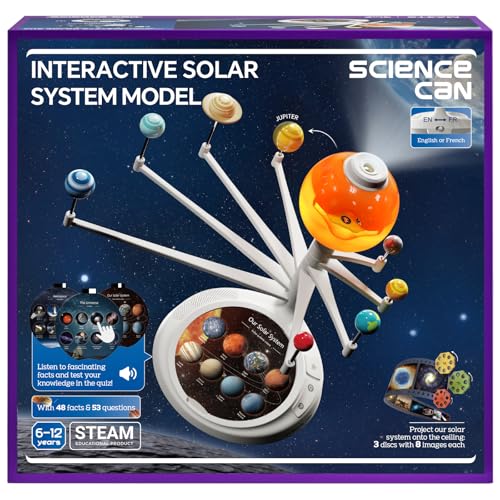
- Offers 48 facts and 53 quiz questions
- Projects 24 colorful space images
- Bilingual English/French operation
Best For: Interactive lessons for children ages 6 to 12
Best Budget Craft Set
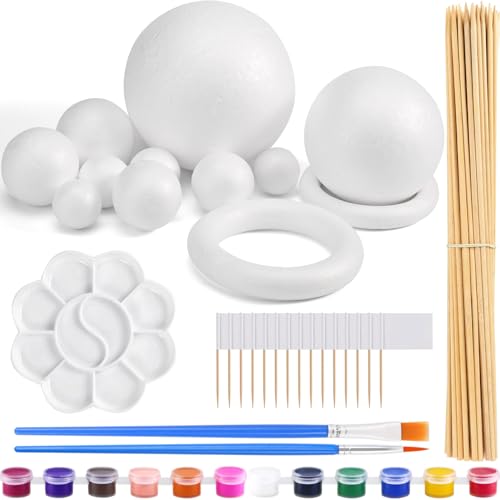
- Includes 10 foam ball sizes for scale comparison
- Provides paints, brushes, flags, and bamboo sticks
- Glue-free assembly supports classroom projects
Best For: Craft-based lessons on planetary size and arrangement
Hands-On Wooden Pick

- Includes eight planets, rods, a rotating base, and learning cards
- Smooth wooden pieces support tactile, screen-free learning
- Useful for home, homeschool, classroom, and display activities
Best For: Young learners and hands-on planet-order activities
Creative DIY Pick
Solar System Foam Ball Craft Kit

- Includes foam balls, paints, brushes, and bamboo sticks
- Lets students paint and assemble a custom planet model
- Designed for classroom, homeschool, and science projects
Best For: Craft-based lessons and student-built science displays
Orbital Demonstration Pick

- Demonstrates seasons, moon phases, and eclipses
- Shows Earth and Moon orbital relationships
- Includes a seasonal plate and tabletop teaching format
Best For: Earth science and geography demonstrations for learners over six
Best Magnetic Classroom Display – Giant Magnetic Solar System
For teachers seeking solar system models for geography lessons, this magnetic set offers a practical way to demonstrate planetary order and compare relative planet and Sun sizes on a whiteboard or other metal surface. Its large, flexible pieces support hands-on classroom exploration.
Best For: Whiteboard demonstrations, tactile STEM activities, and learners ages 4–10.
Pros:
- Includes the Sun, Moon, eight planets, asteroid belt, and Pluto in a 12-piece set.
- Large magnets work on whiteboards, metal doors, and other magnetic surfaces.
- Flexible magnetic material is designed for repeated classroom handling.
- Includes an educational guide with space facts.
Cons:
- Requires a magnetic surface for display.
- The set is intended for visual comparisons rather than a movable orbital demonstration.
This is a strong classroom-focused choice when visibility, quick setup, and student interaction matter more than a freestanding 3D display.
Best Build-and-Paint Project – Glow-in-the-Dark Solar System Model
Among solar system models for geography lessons, this kit stands out as a creative construction activity. Students build and paint the Sun and eight planets, then use the movable arms to adjust the display and reinforce planet identification through hands-on work.
Best For: Project-based learning, creative STEM activities, and children ages 8 and up.
Pros:
- Includes the parts and supplies needed to build a 3D solar system.
- Six paint colors, glow-in-the-dark accent paint, decals, brush, and palette are included.
- Movable arms allow students to rearrange the planets.
- Comes with a poster containing solar system facts.
Cons:
- Assembly and painting require more time and preparation than a ready-to-use model.
- The supplied notes do not indicate that the model represents accurate orbital scale or motion.
This model works particularly well when the lesson goal includes construction skills, creative expression, and repeated interaction with a finished display.
Best Orbital Motion Demonstration – EISCO 13-Inch Solar System Model
For solar system models for geography lessons that need a visible motion component, this three-dimensional EISCO model uses manually movable planets on metal rods. Its labeled base and experiment guide can support discussions about planetary positions and movement around the Sun.
Best For: Instructor-led demonstrations of relative planetary position and motion.
Pros:
- Shows the relative position and movement of the planets around the Sun.
- Features the Sun and all eight planets on movable metal rods.
- The base is labeled with the months of the year for position-based exploration.
- Includes an experiment guide with activities, exploration topics, a grading rubric, and a planet location table.
Cons:
- Listed with an adult recommended age, so it may need teacher-led use with younger students.
- Manual movement does not indicate an automated or continuously operating mechanism.
- Its 8.5-by-18.25-by-13-inch dimensions require dedicated display space.
This is the most demonstration-oriented option in the group for lessons connecting planetary motion with changing positions throughout the year.
Best Large-Scale Hanging Display – Inflatable Planet Set
This inflatable set offers an engaging, room-sized approach to solar system models for geography lessons. The nine inflatable planets can be hung from the ceiling, while the included fact cards help students review planet names, order, and sizes through a visible classroom display.
Best For: Interactive classroom decor, group activities, and learners ages 6–12.
Pros:
- Includes nine inflatable planets, an air pump, hanging string, and 10 educational cards.
- Built-in loops allow the planets to be suspended as a mobile-style display.
- Large hanging pieces create a touchable, high-visibility learning environment.
- Planets deflate for compact storage.
Cons:
- Ceiling hanging requires suitable space and secure attachment points.
- Inflatable planets need setup and may require occasional reinflation.
- The supplied notes do not describe a rigid orbital-motion mechanism.
Choose this set when classroom impact and movement around a shared display are priorities, especially for introducing planet order and basic comparative features.
Best Wall-Mounted DIY Kit – Hands-On Solar System Display
For shoppers comparing solar system models for geography lessons, this foam-and-felt kit offers a creative way to build and display the planets. Students can paint the pieces, label them, and arrange their orbital positions using the included instructions.
Best For: Classrooms, compact learning spaces, and hands-on projects for children ages 8 and up.
Pros:
- Includes a felt backdrop, foam hemispheres, stars, paints, brushes, labels, and hanging hardware.
- Wall-mountable design saves desk and shelf space after assembly.
- Supports hands-on practice with planet names, orbital positions, color recognition, and coordination.
- Includes 12 color pigments for a customizable project.
Cons:
- Painting and assembly require adult guidance or student preparation.
- The foam-and-felt construction is primarily a craft display rather than an interactive electronic model.
This is a practical choice when the lesson benefits from student-made visuals and a permanent wall display. Its 63-piece format provides plenty of project materials without requiring a large tabletop footprint.
Best Interactive Learning Model – Talking Solar System Projector
Among solar system models for geography lessons, this interactive unit adds spoken facts, quizzes, lighting, and projection to a lesson about planetary positions and space. It requires no assembly and offers English and French language options.
Best For: Interactive classroom demonstrations and home learning for children roughly ages 6 to 12.
Pros:
- Provides 48 space facts through three knowledge cards.
- Includes 53 quiz questions for reinforcing astronomy concepts.
- Projects 24 full-color space images from three included disks.
- Shows a lit sun and teaches about planetary orbits, sizes, and positions.
Cons:
- Requires three AA batteries, which are not included.
- Its electronic features may be less suitable for lessons focused primarily on student construction.
This model suits educators who want a ready-to-use teaching aid with multiple learning modes. The combination of bilingual audio, quizzes, and projection can make a short geography or astronomy lesson more engaging.
Best Budget Craft Set – Scale-Based Foam Planet Kit
For hands-on solar system models for geography lessons, this foam ball kit emphasizes visual comparison and student construction. Its 10 ball sizes help learners see relative scale, while paints, sticks, and flags support a labeled planetary display.
Best For: School science projects and craft-based lessons introducing planetary size and arrangement.
Pros:
- Includes 10 differently sized foam balls to illustrate relative planetary scale.
- Supplies 12 paint colors, two brushes, a palette, bamboo sticks, and toothpick flags.
- Labels can be written on the flags and inserted into the foam balls.
- Assembly uses bamboo skewers and does not require glue.
Cons:
- Students must paint and assemble the model before it can be used.
- The supplied notes list a manufacturer age range of 0–8 years, so older students may need additional guidance.
- Foam components may be less durable than a finished plastic teaching model.
This kit is a straightforward option for lessons where making the model is part of the learning objective. The variety of sizes and included labels makes planetary relationships easy to discuss while keeping the activity open-ended.
Hands-On Wooden Pick – Wooden Solar System Model Kit
For younger learners who benefit from tactile materials, this wooden set is a practical choice among solar system models for geography lessons. It includes the sun, eight planets, connecting rods, a rotating base, and learning cards for exploring planet names, order, and relative distance.
Best For: Preschool and elementary learners, homeschool activities, classroom displays, and screen-free planet-naming or sorting games.
Pros:
- Includes eight planets, a rotating base, rods, and learning cards.
- Chunky wooden pieces with smooth edges are easy for young children to handle.
- Supports hands-on STEM learning, role play, and planet-order activities.
- Works as a display piece for classrooms, playrooms, or desks.
Cons:
- Adult supervision is recommended because the set includes small parts.
- The notes describe a general rotating model rather than detailed demonstrations of seasons or eclipses.
This is a strong all-purpose option when durability, simple planet identification, and display appeal matter more than advanced orbital demonstrations. Its cards and movable pieces also let the activity grow with a child’s interest.
Creative DIY Pick – Solar System Foam Ball Craft Kit
This craft-focused kit suits buyers looking for solar system models for geography lessons that students can paint and assemble themselves. With mixed-size foam balls, paint colors, brushes, and bamboo sticks, it turns a planet lesson into a customizable school or homeschool project.
Best For: Classroom crafts, science fairs, homeschool projects, and children who learn well through painting and making.
Pros:
- Provides foam balls, 12 paint colors, brushes, and bamboo sticks in one kit.
- Encourages creativity, fine motor practice, and hands-on STEM learning.
- Lightweight materials are easy for children to handle and customize.
- Suitable for classroom activities, school projects, and science fairs.
Cons:
- Students must paint and assemble the model, so it is not ready for immediate display.
- Foam and bamboo construction may be less durable than a finished wooden model.
- The supplied notes do not specify planet labels or instructional learning cards.
Choose this kit when the making process is part of the lesson. It offers broad craft supplies for a student-built model, though educators should plan the activity and provide any additional labeling or reference material they need.
Orbital Demonstration Pick – Sun Earth Moon Orbital Model
For lessons that connect geography with Earth science, this Sun-Earth-Moon model offers more than a static planet display. It is designed to demonstrate Earth’s orbit, moon phases, seasons, and solar and lunar eclipses, making it a focused choice among solar system models for geography lessons.
Best For: Learners over six, geography and Earth science teaching, school projects, and demonstrations of seasonal and eclipse relationships.
Pros:
- Shows Earth orbiting the Sun and the Moon orbiting Earth.
- Supports demonstrations of seasons, moon phases, solar eclipses, and lunar eclipses.
- Includes a seasonal plate with season names, dates, and traditional Chinese solar terms.
- Offers a substantial tabletop size of approximately 38 × 20 × 28 cm.
Cons:
- Assembly requires several steps involving screws, gears, a lever, and alignment.
- Its focus is the Sun-Earth-Moon relationship rather than all eight planets.
- The seasonal plate may be less relevant for lessons that do not cover the traditional Chinese calendar.
This is the most lesson-specific option in the group for explaining motion and Earth-related phenomena. It requires more setup than a simple planet model, but the moving relationships make it particularly useful for guided demonstrations.
How We Picked These Solar System Models for Geography Lessons
We focused on models that support visual and hands-on learning rather than decoration alone. The selection includes magnetic and movable displays, illuminated and talking models, inflatable planets, ready-to-use demonstrations, and craft kits that let students build their own systems.
We also considered the age range, clarity of planetary arrangement, included accessories, setup effort, durability, storage, and whether each option can support lessons on the Sun, Earth, Moon, planetary motion, and relative position. Because classroom needs vary, the list includes both teacher-led tools and project-friendly kits.
Quick Comparison
- Best for flexible classroom display: Learning Resources Giant Magnetic Solar System
- Best for visual engagement: National Geographic Glow in the Dark Solar System Model
- Best for demonstrating motion: EISCO Three-Dimensional Solar System Model
- Best for large-group activities: Inflatable Solar System Planet set
- Best for student projects: Pllieay, wooden, and foam-ball model kits
- Best for interactive learning: Science Can Interactive Talking Solar System
- Best for Earth-Moon-Sun lessons: English Solar System Orbital Model
Key Buying Factors for Solar System Models for Geography Lessons
Accuracy and Lesson Alignment
Look for clearly labeled planets and an arrangement that supports the concepts you teach. A model showing orbital relationships is especially useful for explaining rotation, revolution, day and night, and seasonal patterns. Remember that most tabletop models are not to scale, so use them to explain relationships rather than exact distances.
Age and Participation
Choose sturdy, simple components for younger learners and more detailed kits for older students. Build-your-own sets can reinforce observation and sequencing, but they require supervision, drying time, and access to craft supplies. Interactive or glow-in-the-dark features may help maintain attention during demonstrations.
Size, Durability, and Storage
Large inflatable or magnetic models work well for group instruction but need more storage space. Small tabletop units are easier to keep ready for lessons. For frequent handling, prioritize secure connections, durable materials, and replacement-friendly parts.
Included Materials
Check whether the package includes stands, rods, paint, brushes, labels, pumps, batteries, or an experiment guide. A low-cost kit may become less convenient if essential supplies must be purchased separately.
Who Should Buy Which Solar System Models for Geography Lessons?
Teachers who need a reusable visual aid should consider a magnetic or three-dimensional model. Choose an inflatable option when students need to handle large planets or participate in movement-based activities. Glow-in-the-dark and talking models suit engagement-focused lessons or learning centers.
For science fairs, homework, and group assignments, foam-ball, wooden, and paintable kits offer more student ownership. If the lesson centers specifically on Earth, the Moon, and the Sun, an orbital model with those bodies may communicate the relevant relationships more clearly than a full planetary display. Before buying, match the model’s complexity and size to your classroom, curriculum goals, and storage limitations.