If you’re shopping for stereo microscopes for children, the best choice is usually the one that balances simplicity, durability, and a magnification range that matches their age and interests.
This roundup focuses on kid-friendly models and science kits that make observation approachable, whether your child is exploring insects, rocks, slides, or basic biology at home.
Best 10 Stereo Microscopes for Children Picks for 2026
Portable Binocular Pick

- 20X max magnification for larger specimens
- Binocular head with 10x widefield eyepieces
- LED reflected light and contrast stage plate
Best For: Beginners inspecting rocks, stamps, jewelry, and other bigger samples
Screen-Based STEM Pick

- 4.3-inch screen for easy shared viewing
- Photo, video, WiFi, and USB connectivity
- Beginner-friendly controls for young users
Best For: Kids who want a digital microscope for shared STEM learning
Specimen Kit Choice
Aomekie Stereo Microscope with Slides

- 20X and 50X viewing with binocular eyepieces
- Includes slides, insect specimen, and minerals
- Battery-powered LED lighting for portability
Best For: Children who want a ready-to-use microscope kit with samples included
High-Power Digital Pick
HEWEIMEI 1600X Kids Microscope
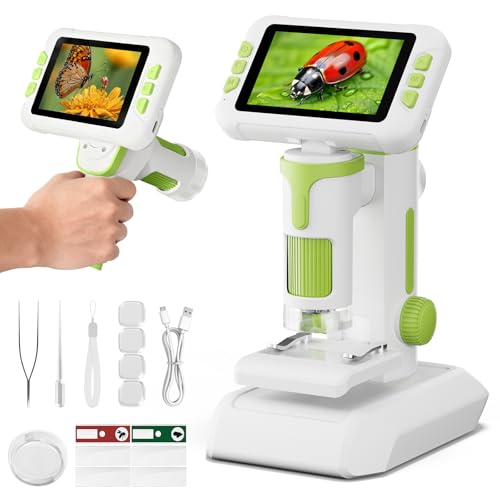
- 100x to 1600x zoom range
- 4.0-inch IPS screen with 1080P camera
- 3-in-1 desktop, handheld, and portable modes
Best For: Older kids who want a high-magnification digital microscope
Advanced Compound Kit
PALOBIL Kids Microscope 100X-2000X with Slides

- 100X to 2000X magnification with WF25X eyepiece
- Adjustable top and bottom LED lighting
- Includes slides, tools, and a phone adapter
Best For: Older kids and homeschoolers wanting more magnification and control
Complete Science Kit
Uarzt 58-Piece Kids Microscope Kit Blue

- 100X to 1200X magnification for beginner use
- 58-piece set with prepared and blank slides
- Compact metal-and-plastic design with LED light
Best For: Young beginners who want a compact, ready-to-use kit
Dual LED Learning Kit
National Geographic Microscope Science Kit

- Dual LEDs support both slide viewing and 3D specimens
- 50+ accessories include prepared slides, blank slides, and tools
- Includes a mini geode and color learning guide
Best For: Children ages 8-12 who want an easy, well-equipped starter kit
High-Power Starter Microscope
National Geographic Kids Microscope 400x

- Up to 400x magnification for more detailed viewing
- Large focus knobs and adjustable platform help kids use it
- Includes slides, minerals, and a lab guide with activities
Best For: Kids who want more magnification in a still-easy-to-use starter kit
Portable Binocular Pick – AmScope SE100-LED for Kids
AmScope SE100-LED Portable Binocular Stereo Microscope, 20X Magnification | LED Ring Light
Check Price On AmazonIf you want stereo microscopes for children that are simple to use at home or in a classroom, the AmScope SE100-LED is built around easy viewing and low magnification. Its binocular head, fixed vertical inclination, and 20X maximum power make it a practical choice for inspecting rocks, stamps, jewelry, and other larger specimens without fuss.
Best For: Young users who need an easy-to-view stereo microscope for everyday hands-on observation.
Pros:
- Binocular viewing head with 10x widefield eyepieces helps young users look comfortably with both eyes.
- 2X objective and 20X maximum magnification are well suited to larger specimens and close inspection.
- Reflected upper LED illumination lights specimens from above.
- Reversible black-and-white stage plate and stage clips help with contrast and stability.
Cons:
- Battery-powered lighting means you will need to manage batteries.
- Low magnification is better for larger objects than tiny slide-style detail.
Overall, this is a straightforward elementary stereo microscope that favors simplicity, portability, and comfortable viewing over advanced imaging. It fits well in a child-friendly science setup where the goal is to explore real objects up close.
Screen-Based STEM Pick – TOMLOV DM302K Kids Microscope
For families comparing stereo microscopes for children with a more modern, screen-first design, the TOMLOV DM302K focuses on easy sharing and simple exploration. The 4.3-inch display, photo and video capture, WiFi phone viewing, and USB connection make it a flexible option for kids who want to see specimens clearly without using eyepieces.
Best For: Kids and parents who want a shared digital microscope experience with a built-in screen.
Pros:
- 4.3-inch screen makes viewing easier for children and family observation.
- Photo and video recording lets kids save discoveries.
- WiFi phone viewing and USB connection add sharing and classroom flexibility.
- Beginner-friendly controls are designed for young scientists.
Cons:
- It is a digital microscope, not a traditional binocular stereo design.
- Screen-based viewing may not appeal to buyers who prefer eyepieces.
This model stands out when the goal is interactive STEM learning and easy group viewing. If you want a child-friendly microscope that emphasizes discovery, sharing, and simple operation, it offers a strong digital-first approach.
Specimen Kit Choice – Aomekie Stereo Microscope with Slides
If you are shopping for stereo microscopes for children and want a bundle that includes specimens to explore right away, the Aomekie model is a strong practical pick. It offers 20X and 50X magnification, binocular viewing, LED lighting, and a long working distance that helps with rocks, stamps, jewelry, insects, and slides.
Best For: Kids and beginners who want a stereo microscope kit with included specimen materials.
Pros:
- Includes 1 insect specimen, 10 slides, and 12 mineral specimens for immediate use.
- 20X and 50X magnification with WF10X and WF25X eyepieces.
- Adjustable working range and binocular viewing suit younger users.
- Battery-powered LED light keeps it portable and easy to move.
Cons:
- Batteries are not included.
- It is geared toward larger specimens and general observation rather than ultra-high magnification.
This is a useful starter microscope when you want both the viewing tool and the sample materials in one box. The included specimens make it easier for children to begin exploring without having to assemble a separate kit.
High-Power Digital Pick – HEWEIMEI 1600X Kids Microscope
Among stereo microscopes for children, this HEWEIMEI model takes a digital, high-power approach with a 4.0-inch IPS screen and a 100x to 1600x zoom range. It is designed for kids who want to observe everything from plant cells and insects to fabric fibers and grains of sand while recording photos and videos as they go.
Best For: Older children and students who want a high-magnification digital microscope with a screen.
Pros:
- 100x to 1600x zoom range covers a wide variety of tiny subjects.
- 4.0-inch IPS screen and 1080P camera support clear real-time viewing.
- Built-in photo and video capture helps save discoveries.
- 3-in-1 design supports desktop, handheld, and portable use.
Cons:
- It is a digital microscope, not a traditional binocular stereo scope.
- Higher magnification can be more than younger children need for casual viewing.
This model is best when the focus is detailed digital observation rather than classic stereo viewing. The screen, camera, and flexible form factor make it a versatile educational tool for children who are ready for more advanced exploration.
Beginner STEM Kit – AmScope M30-ABS-KT2-W White Beginner Microscope Kit
If you’re comparing stereo microscopes for children, this AmScope beginner kit is a practical pick for introducing kids to microscopy in a structured way. It offers 120X to 1200X magnification, LED lighting, a rotating color filter wheel, and a full 52-piece set that supports hands-on learning at home or in a classroom.
Best For: Kids who want a complete beginner microscope kit with lots of accessories and guided STEM exploration.
Pros:
- Six magnification settings from 120X to 1200X for detailed viewing
- LED light and rotating color filter wheel help make specimens easier to see
- 52-piece kit includes sample slides and a hard ABS carrying case
- Portable design is built for beginner science learning
Cons:
- Monocular viewing is less advanced than binocular setups
- Best suited to guided beginner use rather than advanced lab work
For families who want an all-in-one starter option, this kit stands out for its accessories and approachable design. It is less about specialized features and more about making early microscopy easy to start and easy to store.
Advanced Compound Kit – PALOBIL Kids Microscope 100X-2000X with Slides
When shopping for stereo microscopes for children, this PALOBIL kit leans toward a more advanced compound-microscope setup with a wider magnification range and more lighting control. It includes 100X to 2000X viewing options, a WF25X eyepiece, multiple objective lenses, dual LED lighting, and a full accessory set for observation and practice.
Best For: Older kids, beginners, and homeschool users who want higher magnification and more complete observation tools.
Pros:
- Wide 100X to 2000X magnification range with multiple viewing combinations
- Adjustable top and bottom LED lighting supports different specimen types
- Includes a phone adapter plus prepared and blank slides with tools
- Metal frame is described as sturdy and durable
Cons:
- Requires 3 AA batteries or an AC power adapter
- More complex than the simplest child-focused beginner models
This is a strong choice if you want more flexibility than a basic starter microscope. The broader magnification and lighting setup make it better suited to kids who are ready to explore more seriously.
Complete Science Kit – Uarzt 58-Piece Kids Microscope Kit Blue
If your priority is finding stereo microscopes for children that are easy to start with, this Uarzt kit delivers a straightforward beginner setup. It combines 100X to 1200X magnification, LED lighting, a compact metal-and-plastic body, and a 58-piece accessory bundle for guided science experiments.
Best For: Younger kids and first-time users who want a compact, ready-to-use science kit.
Pros:
- 100X to 1200X magnification covers a practical beginner range
- 58-piece kit includes prepared specimens, blank slides, and lab tools
- Compact size makes it easier to store and handle
- LED light and achromatic objective lens support clearer viewing
Cons:
- Batteries are required and not included
- Single-purpose beginner design may not satisfy advanced users
This kit is a solid choice for families who want a simple science toy that still feels complete. It balances portability, accessories, and beginner-friendly magnification without adding unnecessary complexity.
Dual-Light Science Kit – ESAKO Kids Microscope with Specimens
For families shopping for stereo microscopes for children, this ESAKO kit is a practical entry point because it combines dual LED lighting, prepared slides, and hands-on extras in one package. The upper light helps kids inspect opaque objects, while the lower light is suited to slide viewing, making it easier to switch between different types of specimens.
Best For: Kids who want a beginner-friendly microscope kit with lots of accessories and guided experiments.
Pros:
- Dual upper and lower LED lights support both 3D objects and slide viewing.
- Comes with 50+ accessories, including prepared slides, blank slides, mineral specimens, and an insect specimen.
- Includes a brine shrimp experiment kit for more hands-on science learning.
- Dual eyepieces offer 20x and 50x magnification for flexible observation.
Cons:
- Maximum magnification is lower than some other kids’ microscope options.
- Plastic construction may feel less substantial than metal-bodied models.
This is a well-rounded science kit for children who learn best by doing. It leans more toward exploration and guided activities than advanced microscopy, which makes it especially appealing for younger beginners.
Dual LED Learning Kit – National Geographic Microscope Science Kit
When comparing stereo microscopes for children, this National Geographic kit stands out for its easy two-light setup and large accessory bundle. Kids can use the lower LED lights for slides or the upper lights for viewing 3D specimens, which makes it useful for a variety of beginner science activities.
Best For: Children ages 8-12 who want a simple, well-equipped microscope kit for mixed specimen viewing.
Pros:
- Two illumination modes make it easier to view both slides and 3D objects.
- Includes 50+ accessories, with 10 prepared slides, blank slides, tweezers, and an eye-dropper.
- Comes with a mini geode and a full-color learning guide for added variety.
- 20x and 50x magnification keeps the kit approachable for young users.
Cons:
- The listed maximum magnification is modest compared with higher-power kids’ microscopes.
- Best suited to beginner exploration rather than detailed advanced study.
This kit is a strong all-around pick for families who want a straightforward science set with enough pieces to keep kids engaged. The included guide and accessories help make the learning experience feel complete without adding complexity.
High-Power Starter Microscope – National Geographic Kids Microscope 400x
For parents comparing stereo microscopes for children, this National Geographic model is the strongest pick here if higher magnification is a priority. It still keeps the setup kid-friendly with large focus knobs, a soft-touch eyepiece, and an adjustable platform, but it also offers up to 400x magnification for more detailed viewing.
Best For: Kids who want a more powerful beginner microscope with extra magnification and classroom-style features.
Pros:
- Up to 400x magnification gives it more reach than the other kits in this roundup.
- Large focus knobs and an adjustable platform make it easier for kids to use.
- Includes prepared plant slides, rocks and minerals, and blank slides for home prep.
- Comes with a lab guide, viewing activities, and merit badge stickers.
Cons:
- More focused on magnification than on large accessory counts.
- The higher-power setup may be more than some very young beginners need.
This is the best choice for families who want a kid-friendly microscope with a stronger emphasis on detail. It balances ease of use with a more ambitious magnification range, making it a good step up for curious young scientists.
How We Picked the Best Stereo Microscopes for Children
We focused on models that are easy for young users to operate, sturdy enough for home use, and practical for real learning rather than just novelty. For stereo-style viewing, we looked for comfortable eyepieces, stable stands, usable lighting, and magnification that helps kids inspect larger subjects like insects, leaves, coins, and small household objects.
Quick Comparison: What Matters Most
Not every kids’ microscope serves the same purpose. Some are better for low-power, three-dimensional viewing, while others are digital or compound microscopes built for slides. If you want Stereo Microscopes for Children specifically, prioritize wide viewing, simple focus controls, and a forgiving setup. Digital screens can be helpful for shared viewing, but they may trade away some of the tactile experience.
Key Buying Factors for Stereo Microscopes for Children
Magnification and Subject Type
Lower magnification is often better for beginners because it gives a wider field of view and makes it easier to find subjects. For insects, rocks, plants, and craft details, stereo-style magnification in the 20X to 50X range is usually more practical than very high-power compound setups.
Lighting and Image Clarity
Good LED lighting makes a major difference. Look for bright, even illumination that reduces shadows and helps kids see texture and surface details clearly. Dual lighting is especially useful if the microscope will be used on different materials.
Durability and Ease of Use
A child-friendly microscope should have a stable base, smooth focus controls, and parts that can handle regular handling. If younger children will use it, simple assembly and minimal fragile accessories are big pluses.
Included Accessories
Kits with prepared slides, specimen samples, blanks, and simple tools can add value by making it easier to start exploring right away. Just make sure the extras support learning rather than overwhelming the child with too many tiny pieces.
Who Should Buy Which Stereo Microscopes for Children?
Choose a stereo microscope for younger children or hands-on explorers who want to inspect real-world objects in 3D and don’t need advanced slide work. Choose a digital or compound microscope if the goal is to study cells, prepared slides, or higher-magnification biology samples. For mixed-age families, a kit with both easy viewing and educational accessories is often the best all-around pick.
In short, the best option depends on whether your child wants broad, interactive exploration or more detailed slide-based science. Matching the microscope to the child’s age, patience, and interests will usually lead to the most satisfying purchase.