The right lighting controller can make a mobile DJ setup faster to program, easier to transport, and more reliable during live events. This roundup compares compact consoles, wireless interfaces, and higher-capacity DMX boards for different lighting rigs and budgets.
Whether you run a simple LED wash setup or control moving heads, fog machines, and multiple fixtures, focus on channel capacity, scene access, portability, and control flexibility before buying.
Best 10 Dmx Controllers for Mobile Djs Picks for 2026
Best App-Based Pick

- 256-channel tablet-based DMX control
- 15,000+ fixture library
- 50 presets and 21 automatic effects
Best For: Mobile DJs who prefer wireless app control
Best Traditional Console

- 384 DMX channels
- 240 programmable scenes
- Six chase sets
Best For: DJs who prefer dedicated hardware controls
Best Scene-Programming Value

- 384 DMX channels
- 30 banks of eight scenes
- Compact housing with gooseneck light
Best For: DJs needing hands-on scene programming
Best Wireless Interface
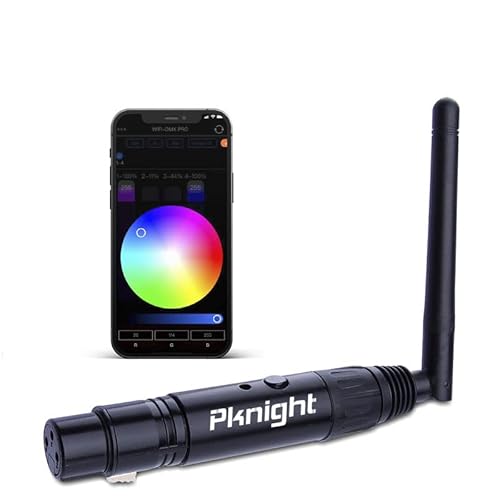
- Wireless ArtNet/sACN control
- Three operating modes
- Up to 1,500-foot open-line range
Best For: DJs wanting a compact cable-reduction solution
Best High-Capacity Pick

- Controls up to 24 intelligent lights
- Stores scenes and programmable chases
- Adds MIDI and music-triggered control
Best For: Mobile DJs with larger, expandable lighting rigs
Best Compact Chase Controller

- Controls up to eight intelligent lights
- Offers 96 DMX channels
- Supports six chase sets with 999 steps each
Best For: Mobile DJs with smaller lighting systems
Best Rack-Friendly Midrange Pick
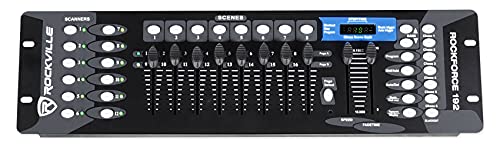
- Controls 192 channels across 12 scanners
- Programs scenes and six chases
- Includes sound-activated operation for lighting and fog
Best For: Mobile DJs running medium-sized lighting and fog systems
Best for Straightforward Show Control

- Controls up to 12 fixtures
- Stores up to 240 scenes
- Voice control and three-pin connection
Best For: Amateur DJs and small event lighting rigs
Best for Programmable Chase Sequences
192-Channel DMX Board with Cable
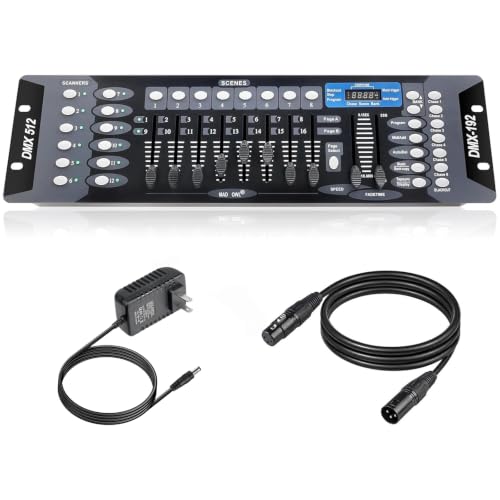
- Controls 12 fixtures
- Stores 240-step scenes
- Includes a 6.6-foot DMX cable
Best For: DJs and venues building repeatable chase-based shows
Best for Beat-Synced Mobile Lighting
Wireless 192-Channel DMX Controller
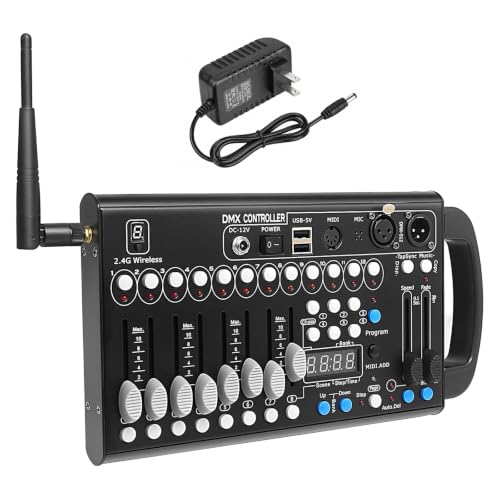
- Built-in microphone and MIDI beat activation
- Supports tap sync and automatic operation
- Compact 192-channel aluminum console
Best For: Mobile DJs wanting beat-responsive lighting control
Best App-Based Pick – MyDMX Go Wireless Controller
For mobile DJs who want fast setup and tablet-based control, the ADJ MyDMX Go combines a 256-channel DMX app with Wi-Fi and USB connectivity. Its fixture library and no-programming workflow make it practical for varied lighting rigs.
Best For: Mobile DJs using iPad or Android tablets who want wireless, app-based lighting control.
Pros:
- Supports iPad and Android tablets with Wi-Fi and USB control.
- Works with a library of more than 15,000 fixtures.
- Offers 50 user presets and 21 automatic effects.
- Includes mounting brackets and supports up to two lighting universes.
Cons:
- Requires a compatible tablet for app-based operation.
- Its 256-channel capacity may be limiting for larger lighting systems.
- Additional upgrades are available separately.
The MyDMX Go is a strong choice when portability, quick operation, and wireless flexibility matter more than traditional hardware controls.
Best Traditional Console – Chauvet DJ Obey 70
The Chauvet DJ Obey 70 is a conventional DMX console for mobile DJs who prefer dedicated physical controls. It provides 384 channels, scene storage, chases, and programmable fade and speed times for repeatable shows.
Best For: DJs who want a rack-mountable hardware controller for programmed lighting scenes.
Pros:
- Provides 384 DMX channels of control.
- Stores up to 240 scenes across 30 banks of eight.
- Controls up to 12 intelligent lights with up to 32 channels each.
- Supports six sets of chases and programmable fade and speed times.
Cons:
- Uses corded electric power rather than wireless operation.
- Its physical-console workflow is less tablet-oriented than app-based options.
- Rack-mount design may be less convenient for ultra-light mobile setups.
Choose the Obey 70 if you value dedicated controls and structured scene programming for recurring DJ events.
Best Scene-Programming Value – 384CH DMX Controller
This 384-channel DMX512 controller gives mobile DJs a straightforward console for building scenes and sequencing live lighting shows. Its 30 banks of eight scenes and compact, lightweight design suit DJs who want hands-on programming without a larger console.
Best For: Budget-conscious mobile DJs who need extensive scene storage and 384-channel control.
Pros:
- Offers 384 DMX channels for detailed fixture control.
- Includes 30 programmable banks with eight scenes each.
- Supports 110–240V AC, 50–60Hz power input.
- Features a lightweight housing, side handles, and an LED gooseneck light.
Cons:
- The supplied notes do not specify fixture-library or app support.
- Its scene-programming approach may require more preparation than automatic effects.
- Product dimensions vary between the listed specifications.
This controller is worth considering for mobile DJs who prioritize channel count and programmable scenes over wireless or app-based operation.
Best Wireless Interface – Pknight Wi-Fi DMX Controller
The Pknight Wi-Fi ArtNet/sACN controller is a compact option for mobile DJs who want to control DMX fixtures wirelessly through compatible apps. It supports direct, router, and EasyLink modes, helping adapt the setup to different venues.
Best For: Mobile DJs seeking a small wireless interface that reduces reliance on physical DMX cables.
Pros:
- Supports wireless control through multiple apps.
- Offers direct, router, and EasyLink operating modes.
- Router mode can reach up to 1,500 wireless feet in open line of sight with a suitable router.
- Compact 8.8-ounce design suits portable setups.
Cons:
- Requires a compatible app and network setup.
- Maximum range depends on a powerful wireless router and open line of sight.
- The supplied notes do not state a DMX channel capacity.
The Pknight is a practical cable-reduction solution for DJs comfortable configuring wireless networks and controlling lights from an app.
Best High-Capacity Pick – Rockforce 384 DMX Controller
For mobile DJs running larger lighting rigs, the Rockville ROCKFORCE 384 offers 384 channels for controlling up to 24 intelligent lights. Its programmable scenes, chases, MIDI support, and music mode make it a flexible choice among DMX controllers for mobile DJs.
Best For: Mobile DJs and event operators who need extensive fixture capacity, programmable shows, and MIDI or music-triggered control.
Pros:
- Controls up to 24 fixtures with 16 channels each.
- Stores 30 banks of eight scenes and six programmable chases.
- Includes MIDI control, a built-in microphone, manual override, and power-failure memory.
- Durable metal housing, LED display, and included gooseneck lamp suit dark venues.
Cons:
- Its 20.71-inch length may require more table or case space.
- The feature-rich layout may take time to configure for simpler setups.
This is the strongest option here for DJs who expect to expand their lighting system. It combines the highest channel count in the group with useful show-programming and connectivity features.
Best Compact Chase Controller – Chauvet DJ Obey 10
The CHAUVET DJ Obey 10 is a compact DMX-512 controller for mobile DJs who need straightforward control over smaller lighting systems. It supports up to eight intelligent lights, with 96 DMX channels and extensive chase sequencing.
Best For: Mobile DJs using up to eight intelligent lights who want compact hardware and programmable chase sequences.
Pros:
- Controls up to eight intelligent lights with up to 12 channels each.
- Provides 96 DMX channels of control.
- Supports sequential chase linking with six chase sets and up to 999 steps each.
Cons:
- Supports fewer fixtures than the Rockville 192- and 384-channel controllers.
- The supplied notes do not list MIDI, built-in microphone, or music-mode features.
Choose this model when chase programming matters more than maximum fixture capacity. Its compact design and 96-channel layout can fit mobile setups that do not need extensive expansion.
Best Rack-Friendly Midrange Pick – Rockforce 192 DMX Controller
The Rockville ROCKFORCE 192 is a practical middle-ground option for mobile DJs controlling lighting and fog effects. It manages 192 channels across 12 scanners and adds programmable scenes, chases, and sound-activated operation.
Best For: DJs and event planners who need control for a medium-sized DMX lighting and fog setup with music-triggered effects.
Pros:
- Controls 12 scanners with 16 channels each.
- Programs 23 banks of eight scenes and six chases of up to 240 scenes.
- Built-in microphone enables sound-activated lighting effects.
- Metal and plastic construction, LED display, and power-failure memory support regular event use.
Cons:
- Offers less fixture capacity than the 384-channel Rockforce.
- Provides fewer manual sliders than the 384-channel model.
- The supplied notes do not specify MIDI control.
This controller balances capacity and programming without moving up to the largest model. Its microphone and compatibility with DMX-512 lighting and fog systems make it especially useful for sound-reactive event effects.
Best for Straightforward Show Control – CO-Z 192 DMX Controller
For mobile DJs looking for dmx controllers for mobile djs, the CO-Z 192 DMX controller combines 192 channels with a layout designed for hands-on operation. It can control up to 12 fixtures with up to 16 channels each and supports up to 240 scenes, giving you room to build varied lighting setups.
Best For: Amateur DJs, weddings, parties, churches, and small event lighting rigs that need accessible manual and voice-controlled operation.
Pros:
- Controls up to 12 intelligent lights with up to 16 channels each.
- Supports up to 240 scenes for more complex shows.
- Includes a three-pin connection and voice-control functionality.
- Dedicated sections, faders, buttons, and LED display simplify operation.
Cons:
- Its 19.1-inch width may be less convenient for highly portable setups.
- It is a corded controller rather than a battery-powered unit.
The CO-Z is a practical choice when you want broad fixture and scene capacity without an especially complicated control layout. Its added voice-control feature may also help during events where quick scene changes matter.
Best for Programmable Chase Sequences – 192-Channel DMX Board with Cable
This 192-channel console is a useful option among dmx controllers for mobile djs when you want programmable scenes and chase effects. It controls up to 12 fixtures with up to 16 channels each, while the included 6.6-foot DMX cable helps simplify connection to compatible lighting equipment.
Best For: DJs, clubs, stages, and performance venues that need programmable lighting banks, scenes, and chases.
Pros:
- Controls up to 12 lighting fixtures with up to 16 channels each.
- Offers 23 banks of eight programmable scenes.
- Supports 240-step scenes across six programmable chases.
- Includes a 6.6-foot DMX cable.
Cons:
- The 22.44-inch width may take more transport and setup space.
- The notes identify rack mounting, which may be less convenient for casual tabletop use.
Choose this model if your priority is structured programming rather than the smallest possible controller. Its scene banks, chase support, faders, and included cable make it suited to repeatable venue or event shows.
Best for Beat-Synced Mobile Lighting – Wireless 192-Channel DMX Controller
For mobile DJs comparing dmx controllers for mobile djs, this compact 192-channel console emphasizes automatic and beat-responsive operation. It can control up to 12 smart lights with up to 16 channels each, and its built-in microphone, MIDI beat activation, and tap synchronization offer several ways to coordinate lighting with music.
Best For: DJs, bands, bars, clubs, house parties, and weddings that want portable control with beat-activated lighting options.
Pros:
- Controls up to 12 fixtures with up to 16 channels each.
- Provides 23 banks with 240 total scenarios and six chase sets.
- Supports microphone activation, MIDI beat control, tap sync, and automatic operation.
- Compact 11.42-inch-wide aluminum housing is suited to mobile setups.
Cons:
- The controller still requires corded power.
- Its feature set may be more than needed for users who only want manual scene changes.
- The supplied notes specify a three-pin DMX cable but do not describe wireless fixture transmission.
This is the strongest fit of the three for DJs who want lighting to react to music with minimal manual intervention. Its compact housing and multiple synchronization modes are particularly useful when transport space and quick setup matter.
How We Picked These Dmx Controllers for Mobile Djs
We selected these models to cover the most common mobile-DJ requirements: compact size, practical channel counts, fixture compatibility, scene and chase programming, wireless control, MIDI support, and rack-friendly construction. The list includes controllers suited to beginners as well as operators managing larger event lighting systems.
Because product specifications and included accessories can vary, confirm the current listing for fixture-library support, power requirements, wireless protocol compatibility, and whether cables or software are included.
Quick Comparison
| Controller Type | Best For | What to Check |
|---|---|---|
| App or wireless controller | Fast setup and flexible placement | Network reliability and device compatibility |
| 192-channel console | Small to medium mobile rigs | Fixture count and programming workflow |
| 384-channel console | Larger mixed-lighting systems | Desk space, scene capacity, and portability |
| Compact entry-level controller | Basic LED fixtures and simple shows | Limited channels and manual programming |
| MIDI-capable controller | Integrated DJ and lighting control | MIDI mapping and software compatibility |
Key Buying Factors for Dmx Controllers for Mobile Djs
Channel Capacity
Count the DMX channels used by each fixture, then leave room for future additions. A 192-channel controller may be sufficient for a few pars, bars, and effects, while moving heads or several fixture groups can justify a 384-channel model.
Programming and Live Access
Look for direct fixture buttons, faders, blackout controls, scene storage, and chase playback that match your workflow. A controller with more channels is not automatically better if programming takes too long between events.
Portability and Setup
Mobile DJs should consider weight, dimensions, protective storage, power connections, and whether the controller fits a standard rack or tabletop case. Wireless and app-based options can reduce cable runs, but wired DMX remains a dependable choice in crowded venues.
Connectivity
Check for standard 3-pin or 5-pin DMX connections, MIDI input or output, Art-Net or sACN support, and compatibility with your existing fixtures. Wireless systems may require matching transmitters, receivers, or a stable local network.
Who Should Buy Which Dmx Controllers for Mobile Djs?
Choose a compact controller if you operate a small rig and want straightforward manual control without a laptop. Choose a 192-channel board for common wedding, party, and small-venue setups using several conventional fixtures. Choose a 384-channel model when you need more fixture groups, effects, or programming headroom.
Choose a wireless or app-based option when quick setup and remote placement matter most, especially for minimalist mobile rigs. Choose a MIDI-ready controller if you want lighting cues to work alongside a DJ performance system. Before purchasing, match the controller’s channel count and connection type to your fixtures, then prioritize the interface you can operate confidently in a live show.