The best logic analyzers for SPI and I2C make it easier to inspect bus traffic, find timing problems, and confirm that embedded hardware and firmware are communicating correctly.
This roundup compares 10 options across channel count, sampling speed, storage, software support, portability, and overall value so you can choose a tool suited to your projects.
Best 10 Logic Analyzers for Spi and I2c Picks for 2026
Best Overall
LA2016 16-Channel Logic Analyzer

- 16 channels with 200MHz sampling
- 1Gbit memory for deep captures
- Decodes I2C, SPI, and 20+ protocols
Best For: Complex digital debugging across multiple platforms
Best High-Speed Option
32-Channel 1GHz USB3.0 Analyzer

- 32 channels with 1GHz sampling
- 4Gb DRAM and buffer or stream modes
- Decodes 170+ protocols including SPI and I2C
Best For: High-speed designs and large waveform captures
Best Value
LA1010 16-Channel Logic Analyzer

- 16 channels at 100MHz
- Decodes 30+ protocols
- Compatible with Windows, macOS, and Linux
Best For: Everyday embedded debugging and learning
Best Portable Pick

- Built-in 500mAh battery and color display
- Supports SPI, I2C, UART, and custom modes
- 100Msa/s acquisition with 8MB storage
Best For: On-the-go bus troubleshooting and quick measurements
High-Speed Deep-Capture Pick
16-Channel 1GHz USB Logic Analyzer

- Up to 1GHz on 8 channels or 500MHz on 16
- Up to 16G streaming storage depth
- Supports Windows, macOS, and Linux
Best For: High-speed, multi-channel debugging and long captures
Professional Workflow Pick

- 16 multi-use digital and analog inputs
- Decodes SPI, I2C, and 23+ protocols
- Up to 500MS/s digital sampling
Best For: Cross-platform embedded and mixed-signal debugging
Budget Debugging Pick
HiLetgo 8-Channel 24MHz Analyzer

- Eight channels sampling up to 24MHz
- Supports UART, IIC, and SPI debugging
- Selectable rates from 25kHz to 24MHz
Best For: Basic embedded and hobbyist bus troubleshooting
High-Capacity Pick
LA5032 32-Channel Logic Analyzer
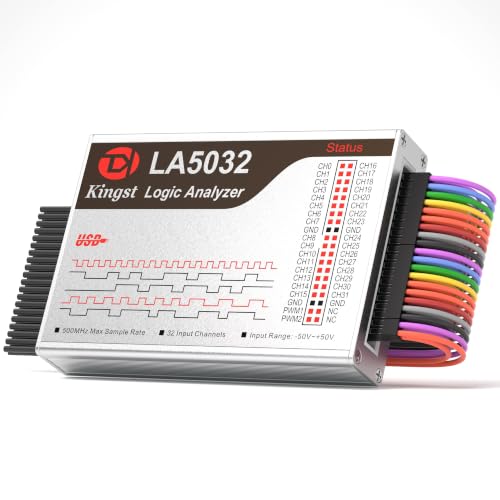
- 32 channels with up to 500MHz sampling
- Decodes SPI, I2C, UART, JTAG, and more
- Deep memory plus built-in two-channel PWM
Best For: Advanced MCU, FPGA, and long-duration capture work
Best Breadboard Kit
LONELY BINARY 8-Channel Analyzer

- Eight channels at up to 24MHz
- Includes breadboard and breakout adapters
- USB-A, USB-C, clips, wires, and case included
Best For: Hands-on Arduino, ESP32, and IoT prototyping
Simple Software-Compatible Pick

- Eight channels with up to 24MHz sampling
- Decodes SPI, IIC, UART, and more
- Supports Saleae software and PulseView
Best For: Budget-friendly Arduino and embedded debugging
Best Overall – LA2016 16-Channel Logic Analyzer
For buyers comparing logic analyzers for SPI and I2C, the LA2016 offers a broad feature set with 16 channels, a 200MHz sampling rate, and 1Gbit memory. Its software supports automated decoding for both protocols alongside many others, making it practical for complex digital debugging.
Best For: Engineers and advanced hobbyists who need many channels, deep capture memory, and cross-platform protocol analysis.
Pros:
- Captures 16 digital signals at up to 200MHz.
- Decodes I2C, SPI, UART, CAN, and more than 20 protocols.
- Includes waveform compression, data export, and a PWM generator.
- Supports Windows, macOS, and Linux with USB-powered operation.
Cons:
- Its larger feature set may be more than beginners need.
- Software compatibility details are listed primarily for older Windows versions.
The LA2016 is a strong all-around choice when SPI and I2C work is part of broader embedded-system troubleshooting. Its channel count and memory depth are especially useful for longer or more involved captures.
Best High-Speed Option – 32-Channel 1GHz USB3.0 Analyzer
This 32-channel analyzer is aimed at demanding captures where speed and storage matter. For logic analyzers for SPI and I2C, its 1GHz real-time sampling, 4Gb DRAM, and USB 3.0 connection provide substantial capacity for high-speed or extended waveform work.
Best For: Advanced hardware developers analyzing high-speed digital designs or large amounts of captured data.
Pros:
- Provides 32 input channels and a 1GHz real-time sampling rate.
- Offers 4Gb DRAM with buffer and stream modes.
- Supports more than 170 protocols, including SPI, I2C, UART, and CAN.
- Shielded ribbon cables are designed to reduce electromagnetic interference.
Cons:
- The advanced specifications may be unnecessary for basic bus troubleshooting.
- The supplied notes do not identify a specific operating-system software platform.
Choose this model when capture density, sampling speed, and storage are higher priorities than simplicity. Its extensive protocol support also gives it room to grow beyond SPI and I2C projects.
Best Value – LA1010 16-Channel Logic Analyzer
The LA1010 is a practical entry point for logic analyzers for SPI and I2C, combining 16 input channels with a 100MHz sampling rate. Its KingstVIS software can decode more than 30 protocols, while its low 0.5-watt power consumption suits routine debugging and monitoring.
Best For: Students, makers, and embedded developers who want broad protocol coverage in a portable USB instrument.
Pros:
- Captures 16 signals simultaneously at 100MHz.
- Decodes I2C, SPI, UART, CAN, and more than 30 protocols.
- Supports Windows, macOS, and Linux.
- Uses low power and has a portable design.
Cons:
- Its 100MHz sampling rate is lower than the faster models in this roundup.
- It uses USB 2.0 rather than USB 3.0.
The LA1010 balances channel count, portability, and protocol support without focusing on extreme sampling performance. It is a sensible choice for common SPI and I2C debugging tasks and general digital signal monitoring.
Best Portable Pick – LA104 Pocket SPI/I2C Analyzer
The LA104 stands apart from computer-dependent USB models with a pocket-sized design, built-in display, and rechargeable 500mAh battery. For logic analyzers for SPI and I2C, it offers direct support for SPI, I2C, UART, and user-defined protocol modes, along with up to 100Msa/s acquisition.
Best For: Field troubleshooting and users who want a self-contained analyzer with onboard viewing and storage.
Pros:
- Compact portable design with a built-in 500mAh battery.
- Supports SPI, I2C, UART, and user-defined protocol modes.
- Captures signals at up to 100Msa/s.
- Includes 8MB storage and a 2.8-inch color LCD.
Cons:
- Its 8MB storage is smaller than the deep memory offered by the other listed models.
- The supplied notes do not specify its channel count or computer software support.
The LA104 is the most convenient option for quick measurements away from a workbench. Its onboard screen and battery reduce dependence on a computer, though users needing extensive channel counts or large captures may prefer a USB model.
High-Speed Deep-Capture Pick – 16-Channel 1GHz USB Logic Analyzer
For demanding logic analyzers for SPI and I2C work, this 16-channel model emphasizes high sampling rates, adjustable thresholds, and deep streaming storage. It supports up to 1GHz on eight channels and 500MHz on all 16, making it suited to detailed waveform inspection and longer captures.
Best For: Engineers and developers debugging complex digital systems, including ARM and FPGA projects, who need many channels and extensive data logging.
Pros:
- Up to 1GHz sampling on 8 channels or 500MHz on 16 channels
- Up to 16G of streaming-mode storage depth
- Adjustable thresholds and masking lines help improve waveform clarity
- Compatible with Windows 10, macOS, and Linux, with numerous protocol decoders available
Cons:
- The advanced specifications may be more than needed for basic SPI or I2C troubleshooting
- Streaming rates vary by channel count, reaching 20MHz across 16 channels
This is the strongest choice here for high-speed, multi-channel captures and extended logging. Its broad software compatibility and decoder support add flexibility, while the memory architecture is designed for varied buffering needs.
Professional Workflow Pick – Saleae Logic Pro 16
The Saleae Logic Pro 16 is a polished option among logic analyzers for SPI and I2C, combining 16 multi-use digital/analog inputs with cross-platform software. It can decode SPI, I2C, and more than 23 additional protocols, helping streamline everyday embedded debugging.
Best For: Developers who want a versatile, portable analyzer with digital and analog capture for Windows, Mac, or Linux workflows.
Pros:
- 16 inputs support both digital and analog use
- Decodes SPI, I2C, and 23+ other protocols
- Digital sampling reaches 500MS/s, while analog sampling reaches 50MS/s
- Supports captures exceeding 10 billion digital samples using PC memory
Cons:
- Large captures use the connected computer’s memory
- Analog sampling is lower than the maximum digital sampling rate
This model is a strong all-around pick when software convenience and protocol decoding matter as much as channel count. Its combination of analog and digital inputs makes it more flexible than a digital-only analyzer for mixed-signal troubleshooting.
Budget Debugging Pick – HiLetgo 8-Channel 24MHz Analyzer
For basic logic analyzers for SPI and I2C tasks, the HiLetgo USB analyzer offers eight channels and sampling up to 24MHz. Its selectable rates and included EMI ferrite ring cable make it a practical low-cost tool for common digital signal analysis and embedded debugging.
Best For: Hobbyists, students, and developers handling typical UART, IIC, or SPI checks at modest speeds.
Pros:
- Eight channels with sampling up to 24MHz
- Multiple selectable rates from 25kHz to 24MHz
- Input range spans -0.5V to 5.25V
- Designed for digital signal analysis, embedded debugging, and hardware testing
Cons:
- Its 24MHz maximum is aimed at general applications rather than high-speed analysis
- It has fewer channels than the other products in this roundup
This analyzer is best viewed as an accessible entry point for routine bus debugging. It covers common digital protocols and voltage levels, but users working with faster buses or larger captures should consider a higher-performance model.
High-Capacity Pick – LA5032 32-Channel Logic Analyzer
For demanding logic analyzers for SPI and I2C work, the LA5032 stands out with 32 synchronous channels, a 500MHz maximum sampling rate, and protocol decoding for both buses. Its deep memory is useful when a brief trigger is not enough and you need to inspect a longer embedded-system capture.
Best For: FPGA, ARM, MCU, and other advanced debugging tasks that require many channels or long-duration captures.
Pros:
- 32 channels and a 500MHz maximum sampling rate support complex timing analysis.
- Decodes more than 20 protocols, including SPI, I2C, UART, CAN, and JTAG.
- Offers 4Gbits of hardware memory, advertised as up to 10G samples per channel with compression.
- Includes a two-channel PWM generator for test-signal output.
Cons:
- Its advanced feature set may be more than needed for simple two-wire bus checks.
- The supplied notes do not specify the included analysis software beyond operating-system support.
Choose this model when capture depth, channel count, and high-speed timing matter more than a minimal setup. Windows, Mac, and Linux compatibility also makes it flexible for mixed development environments.
Best Breadboard Kit – LONELY BINARY 8-Channel Analyzer
This LONELY BINARY kit is a practical starting point for logic analyzers for SPI and I2C, pairing eight-channel, 24MHz capture with adapters made for breadboards and microcontroller projects. The included clips, jumper wires, and dual USB cables reduce the extra parts needed to begin testing.
Best For: Students, hobbyists, and embedded developers debugging Arduino, ESP32, Raspberry Pi, IoT, or other breadboard-based projects.
Pros:
- Eight channels can capture SPI, I2C, UART, and other digital signals together.
- Includes a breakout board and breadboard adapter with 2.54mm connections.
- Comes with USB-A and USB-C cables for older and newer computers.
- Accessory kit includes test clips, alligator clips, jumper wires, and a storage case.
Cons:
- The 24MHz sampling rate is less suited to higher-speed signals than advanced analyzers.
- Eight channels may be limiting for large multi-bus captures.
Its value is in convenience: the connection hardware and accessories make quick, solder-free prototyping easier. It is a sensible choice when portability and straightforward bus debugging matter more than maximum capture performance.
Simple Software-Compatible Pick – CP317 8-Channel USB Analyzer
The CP317 is a compact option for logic analyzers for SPI and I2C, with eight digital channels and sampling up to 24MHz. It is designed to work with Saleae Logic Analyzer software and PulseView, while automatic decoding supports UART, IIC, SPI, and other standard protocols.
Best For: Affordable Arduino, ARM, FPGA, robotics, and general digital-communication troubleshooting.
Pros:
- Supports up to 24MHz sampling across eight digital channels.
- Automatically analyzes UART, IIC, SPI, and other standard protocols.
- Works with Saleae Logic Analyzer software and PulseView-compatible workflows.
- Accepts signals from 0V to 5.5V with a stated 1.5V logic threshold.
Cons:
- It has fewer channels and lower maximum sampling speed than high-end analyzers.
- The supplied package lists only the analyzer, USB cable, and Dupont wires, so additional probing hardware may be needed.
- The notes specify Windows and Linux support but do not list Mac compatibility.
For basic SPI and I2C inspection, the CP317 covers the core functions without a large hardware footprint. Its software compatibility and selectable sampling rates make it particularly useful for common DIY and embedded debugging setups.
How We Picked the Best Logic Analyzers for Spi and I2c
We focused on analyzers that support SPI and I2C, while also considering UART, CAN, JTAG, and other common digital protocols. The selection covers entry-level 8-channel USB devices, portable handheld instruments, high-channel-count models, and premium analyzers such as the Saleae Logic Pro 16.
We also compared advertised channel counts, maximum sampling rates, memory depth, operating-system compatibility, included cables or breakout boards, and the availability of protocol-decoding software. Specifications can vary by operating mode, so treat maximum rates as peak figures rather than guaranteed performance on every channel.
Quick Comparison
- Best for professional use: Saleae Logic Pro 16, with polished software and broad workflow support.
- Best for many signals: 32-channel models, which suit FPGA, JTAG, and larger embedded systems.
- Best for portability: LA104, a pocket-style analyzer for field troubleshooting.
- Best for basic debugging: 8-channel, 24MHz USB analyzers for Arduino, UART, I2C, and slower SPI work.
- Best for demanding timing work: High-speed 500MHz to 1GHz models with deeper memory.
Key Buying Factors for Logic Analyzers for Spi and I2c
Sampling Rate and Signal Speed
Choose a sampling rate comfortably above the fastest clock you need to capture. I2C is typically slower and easier to monitor, while SPI can require substantially more speed, especially with fast processors or displays. A higher rate also improves visibility into short glitches and setup or hold-time problems.
Channels and Memory Depth
Four to eight channels may be enough for a simple bus, but 16 or 32 channels are more useful when capturing chip select lines, interrupts, parallel data, JTAG, or several buses at once. Deeper memory lets you record longer transactions without stopping the capture.
Protocol Decoding and Software
Confirm that the software can decode your required SPI and I2C modes, including clock polarity, bit order, addressing, and repeated starts. Good search, filtering, export, and waveform tools can save more time than headline hardware specifications.
Compatibility and Connectivity
Check support for Windows, macOS, Linux, or ARM systems before buying. Also verify whether the analyzer uses USB 2.0 or USB 3.0, requires special drivers, or includes suitable probes, ground leads, and breakout boards.
Voltage and Electrical Safety
Verify the supported input-voltage range and ground arrangement. A logic analyzer is not automatically a level shifter or isolated instrument; use appropriate voltage translation and avoid connecting inputs beyond their ratings.
Who Should Buy Which Logic Analyzers for Spi and I2c?
Choose an inexpensive 8-channel analyzer if you are learning digital debugging or mainly inspect Arduino-class I2C, SPI, and UART projects. Move to a 16-channel model when you need more control signals, multiple buses, or longer captures. A 32-channel analyzer is better for FPGA, JTAG, and complex boards with many simultaneous signals.
For frequent professional development, prioritize reliable software, accurate triggering, strong documentation, and cross-platform support over the highest advertised sampling rate. If you troubleshoot away from a workbench, a handheld unit offers convenience, while a high-speed USB model is usually the better choice for detailed timing analysis at a desk.