The right bench power supply makes electronics testing more predictable, from basic repairs and battery work to precision prototyping. This roundup compares 10 linear and linear-type models across output capacity, control features, and lab-friendly usability.
Use the guide below to match voltage and current requirements with the resolution, outputs, protection, and convenience features your workspace actually needs.
Best 10 Linear Bench Power Supplies Picks for 2026
Best Compact Choice
Pyramid PS9KX 5A Linear Bench Power Supply

- Fixed 13.8V DC output at 5A
- Screw terminals and 12V lighter socket
- Overload and short-circuit protection
Best For: 12V electronics, radios, scanners, and basic desktop testing
Best Multi-Output Pick
Siglent SPD3303X-E Triple Output Supply
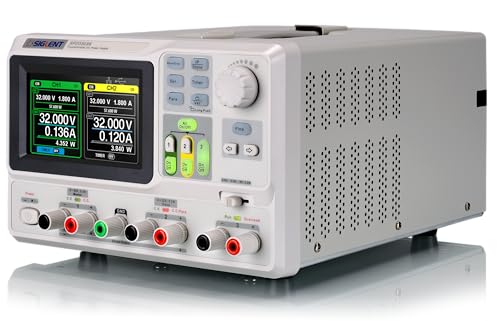
- Three isolated controlled outputs
- Independent, series, and parallel modes
- 220W total output capacity
Best For: Multi-rail electronics development and testing
Best Adjustable Value
KORAD KD3005D 30V 5A Linear Supply

- Adjustable 0–30V and 0–5A output
- Dual four-digit LED displays
- 110/220V input and circuit protection
Best For: General electronics testing and prototyping
Best Low-Noise Option
UNI-T UTP3315TFL-II 30V 5A Supply

- 0–30V output with up to 5A current
- ≤2mVrms ripple and noise
- 10mV/1mA display precision
Best For: Sensitive electronics and precision bench testing
Best Straightforward Workbench Value

- 0–30V and 0–5A adjustable output
- Constant-voltage and constant-current modes
- Back-lit display with automatic fan cooling
Best For: Everyday hobbyist testing and repair work
Best Programmable Multi-Channel Pick

- Four channels with up to 328W total power
- Programmable lists, delays, and cycle testing
- USB, RS232, LAN, and digital I/O interfaces
Best For: Laboratory automation and repeatable multi-output testing
Best Fine-Adjustment Manual Supply

- 0–30V and 0–5A adjustable output
- 0.001V and 0.001A display resolution
- Four memory buttons plus load and lock controls
Best For: Precision manual bench work and repeatable setups
Precision Triple-Output Pick

- Three adjustable outputs up to 30V and 5A
- Constant-voltage and constant-current modes
- Back-lit LCD with fine voltage and current resolution
Best For: Multi-output electronics testing and hobbyist benches
Compact Radio Bench Pick

- 13.8V DC output rated up to 12A
- USB, screw-terminal, and cigarette-lighter connections
- Overload and short-circuit protection
Best For: 12V radios and desktop electronics equipment
High-Current 12V Pick

- 50A linear-regulated AC-to-DC output
- Adjustable DC voltage with analog meters
- Dual USB ports and screw terminals
Best For: High-current 12V radios and electronics
Best Compact Choice – Pyramid PS9KX 5A Linear Bench Power Supply
The Pyramid PS9KX is a straightforward option among linear bench power supplies when you need a constant 13.8V DC source for radios, scanners, phones, or basic component testing. Its 5A continuous output, screw terminals, and plug-in operation make it practical for desktop use.
Best For: Home labs, CB and HAM radio equipment, scanners, and general 12V device testing.
Pros:
- Provides regulated 13.8V DC output at 5A, with 7A surge capacity.
- Includes screw-type terminals and a 12V car cigarette-lighter connection.
- Has electronic overload, short-circuit, fuse, and auto-reset protection.
- Built-in cooling fan and metal enclosure support tabletop operation.
Cons:
- Voltage is fixed at 13.8V rather than adjustable.
- Its 5A output is less suitable for higher-power laboratory applications.
The PS9KX is best viewed as a compact fixed-voltage converter rather than a precision adjustable laboratory supply. Choose it when dependable 12V-class power and simple connections matter more than variable output control.
Best Multi-Output Pick – Siglent SPD3303X-E Triple Output Supply
The Siglent SPD3303X-E stands out among linear bench power supplies for projects that need several isolated outputs. It provides two 32V/3.2A channels plus a selectable 2.5V, 3.3V, or 5V output, with independent, series, and parallel operating modes.
Best For: Electronics development and testing that requires multiple controlled outputs or combined series and parallel configurations.
Pros:
- Offers three independent, controlled, and isolated outputs.
- Supports independent, series, and parallel output modes.
- Provides up to 220W total output power.
- Includes a timing output function and trending graphs.
Cons:
- Its 17.6-pound weight and listed tower form factor make it less portable.
- The supplied details do not specify front-panel voltage and current display resolution.
This is the most versatile choice of the group for multi-rail work. Its higher capacity and flexible output modes are useful for complex setups, though a smaller single-channel supply may be simpler for basic bench tasks.
Best Adjustable Value – KORAD KD3005D 30V 5A Linear Supply
The KORAD KD3005D is a practical adjustable option among linear bench power supplies, combining a 0–30V range with 0–5A output. Dual four-digit LED displays and digital controls make it easier to monitor and set voltage and current during lab work.
Best For: General electronics testing, prototyping, and users who need adjustable voltage up to 30V.
Pros:
- Adjustable 0–30V DC output with up to 5A current.
- Dual four-digit LED displays show voltage and current.
- Supports switchable 110/220V input.
- Includes overload, short-circuit, and over-temperature protection.
Cons:
- It is a standalone 9-pound unit rather than a particularly compact supply.
- The supplied details do not provide ripple or load-regulation specifications.
With adjustable output, digital readouts, and broad protection features, the KD3005D is a well-rounded general-purpose bench supply. It is a strong fit for routine experimentation where simple digital control is more important than specialized multi-output operation.
Best Low-Noise Option – UNI-T UTP3315TFL-II 30V 5A Supply
The UNI-T UTP3315TFL-II is designed for sensitive work where clean, stable output matters. This linear bench power supply offers 0–30V adjustment, 0–5A output, a four-digit display, and stated ripple and noise of no more than 2mVrms.
Best For: Sensitive electronics and precision bench testing requiring low ripple, accurate readouts, and stable regulation.
Pros:
- Provides 0–30V output with up to 5A current.
- Lists low ripple and noise of ≤2mVrms.
- Offers 10mV voltage and 1mA current display precision.
- Includes automatic CV/CC mode switching and current limiting protection.
Cons:
- Its rack form factor and listed dimensions may require dedicated bench space.
- The supplied details do not indicate multiple output channels.
The UTP3315TFL-II is the strongest match here for users prioritizing clean power and regulation specifications. Its single-channel design keeps the focus on controlled, low-noise output for demanding electronics work.
Best Straightforward Workbench Value – Tekpower TP3005T
Tekpower TP3005T Variable Linear DC Power Supply, 0-30V @ 0-5A with Alligator Test Leads
Check Price On AmazonThe Tekpower TP3005T is a practical choice among linear bench power supplies for users who need adjustable 0–30V and 0–5A DC output without programmable controls. Its constant-voltage and constant-current modes, readable back-lit display, and included alligator test leads make it ready for everyday bench work.
Best For: Hobbyists, repair work, and general electronics testing that requires up to 150W of adjustable DC power.
Pros:
- Adjustable 0–30V and 0–5A output.
- Supports constant-voltage and constant-current operation.
- Back-lit display provides 0.1V and 0.01A resolution.
- Automatic cooling-fan activation and a metal body.
Cons:
- Offers a single output channel.
- Its display resolution is less fine than the KA3005D’s specified resolution.
- At 12 pounds, it is not especially lightweight for a benchtop unit.
The TP3005T keeps operation simple while covering common voltage and current requirements. Choose it when straightforward manual control and included leads matter more than multi-channel or remote-control features.
Best Programmable Multi-Channel Pick – UNI-T UDP3305S-E
The UNI-T UDP3305S-E stands out among linear bench power supplies when a project needs multiple outputs, repeatable test sequences, or computer connectivity. It combines four channels with a 328W maximum output, a high-definition display, built-in series and parallel operation for CH1 and CH2, and USB, RS232, and LAN interfaces.
Best For: Laboratories, production testing, and users running repeated cycle or aging tests across multiple channels.
Pros:
- Four channels: dual 0–30V/0–5A channels, a 0–6V/0–3A channel, and a 5V/2A channel.
- 10mV/1mA resolution with real-time set and actual output readings.
- Supports list and delay programming with up to 2,048 data sets and 99,999 cycles.
- Includes USB, RS232, LAN, and digital I/O connectivity.
Cons:
- At 12.5 kg, it is considerably heavier than the other listed supplies.
- Its advanced controls may be more than needed for simple manual bench tasks.
- The supplied notes do not specify included test leads.
With its channel flexibility and extensive programming features, the UDP3305S-E is the most capable option here for automated or repeatable testing. It is a strong fit when connectivity and test-sequence control justify a larger desktop instrument.
Best Fine-Adjustment Manual Supply – KORAD KA3005D
The KORAD KA3005D is a precision-oriented option among linear bench power supplies, offering adjustable 0–30V and 0–5A output with 0.001V and 0.001A display resolution. Its rapid-adjustment knob, memory recall buttons, load switch, and protective features make it useful for repeatable manual setup.
Best For: Hobbyists, small labs, and bench users who want fine readout resolution and convenient saved settings.
Pros:
- Provides 0–30V and 0–5A adjustable output.
- Displays voltage and current with 0.001V and 0.001A resolution.
- Four memory recall buttons speed up repeated setups.
- Includes thermal, overload, short-circuit, grounding, load-switch, and lock features.
Cons:
- Provides a single output channel.
- Its 150W maximum power is lower than the UNI-T’s 328W rating.
- The supplied specifications list 220V input, while the product notes also describe switchable 110/220V input; verify the configuration before purchase.
The KA3005D balances fine adjustment with practical safeguards and memory functions. It is a compelling manual-control choice for users who value precise readouts and repeatable settings over multi-channel operation.
Precision Triple-Output Pick – Tekpower TP-3005D-3
For electronics work requiring adjustable output, the Tekpower TP-3005D-3 is one of the more versatile linear bench power supplies in this roundup. It provides three outputs with adjustable ranges up to 30 volts and 5 amps, plus a back-lit LCD for monitoring voltage and current.
Best For: Electronics hobbyists and lab users who need triple outputs, adjustable voltage, and constant-voltage or constant-current operation.
Pros:
- Triple-output design with up to 0–30 volts and 0–5 amps.
- Supports constant-voltage and constant-current modes.
- LCD resolution shows 0.1V and 0.01A increments.
- Automatic fan activation helps manage cooling.
Cons:
- Its desktop form factor is relatively large.
- Output is limited to 5 amps per the supplied specifications.
The Tekpower stands out when precise readouts and multiple outputs matter more than compactness. Its 150-watt capacity and included one-year warranty make it a practical choice for general benchtop testing.
Compact Radio Bench Pick – Pyramid PSV150 12A
The Pyramid PSV150 is a straightforward option for users seeking linear bench power supplies for radios and other 12-volt equipment. It delivers 13.8V DC at up to 12 amps and adds USB, screw-terminal, and cigarette-lighter connectivity for flexible bench or desktop use.
Best For: CB radio, scanner, HAM radio, and general 12-volt equipment users who want convenient connections and moderate current capacity.
Pros:
- Provides up to 12 amps at 13.8V DC.
- Includes USB charging and screw-type terminals.
- Built-in overload and short-circuit protection.
- 115/230V AC switchable input supports different power setups.
Cons:
- Its listed output is fixed at 13.8V rather than a broad adjustable range.
- The supplied notes do not specify a detailed display or metering system.
Choose the PSV150 for dependable 13.8V service and connection convenience rather than laboratory-style voltage adjustment. The cooling fan and rugged housing are useful for extended benchtop operation.
High-Current 12V Pick – Pyramid PSV500.5 50A
For applications that demand substantially more current, the Pyramid PSV500.5 offers a 50-amp linear-regulated AC-to-DC design. This compact benchtop unit includes adjustable DC voltage control, analog voltage and amperage meters, dual USB ports, and screw terminals.
Best For: High-current 12V electronics, radio equipment, and users who need real-time analog voltage and amperage monitoring.
Pros:
- High 50-amp output capacity for demanding equipment.
- Rotary control allows DC voltage adjustment.
- Analog voltmeter and ammeter provide operating feedback.
- Dual USB ports and screw terminals expand connectivity.
Cons:
- The supplied specifications list a 12V output but do not provide an adjustment range.
- At 50 amps, it is better suited to high-current work than delicate low-power testing.
The PSV500.5 is the strongest choice here for current capacity. Its protective circuitry, metal-and-plastic enclosure, and built-in meters make it a practical high-output supply for a dedicated bench.
How We Picked These Linear Bench Power Supplies
We selected models that cover the most common bench applications, including electronics repair, hobby projects, education, radio work, prototyping, and higher-current testing. The lineup includes compact fixed-output units, single-output adjustable supplies, triple-output instruments, and programmable laboratory models.
Our comparison emphasizes adjustable voltage and current range, output configuration, display and control precision, rated wattage, linear regulation, and practical extras such as USB ports or included leads. Before buying, verify the exact specifications for the model and revision you plan to order, since listings can vary.
Quick Comparison
| Best For | What to Prioritize | Models to Consider |
|---|---|---|
| Basic home-lab use | Simple controls, compact size, dependable regulation | Pyramid PS9KX, Tekpower TP3005T |
| General adjustable testing | 0–30V range, 0–5A output, clear digital display | KD3005D, KA3005D, Tekpower TP-3005D-3 |
| Multi-rail projects | Independent outputs and programmable control | Siglent SPD3303X-E, UNI-T UDP3305S-E |
| Higher-current applications | Ample amperage, cooling, and suitable wiring | Pyramid 12A and 50A models |
Key Buying Factors for Linear Bench Power Supplies
Voltage and Current Range
Choose a supply that exceeds your project’s normal requirements without operating continuously at its limit. A 0–30V, 0–5A supply handles many small electronics tasks, while 12A or 50A models are intended for substantially higher-current loads. Confirm whether the listed current is continuous and check the maximum power rating.
Output Count and Isolation
A single output is usually sufficient for one circuit. Multiple outputs are more useful when a project needs separate positive and negative rails, an auxiliary voltage, or simultaneous independent loads. Check whether channels are isolated, tracking, or internally connected.
Regulation, Resolution, and Displays
Fine voltage and current resolution helps when powering sensitive circuits or reproducing test conditions. Digital meters make readings easier to monitor, but displayed precision is not the same as accuracy. Look for stated regulation, ripple, accuracy, and resolution specifications when those details matter.
Protection and Usability
Over-voltage, over-current, and short-circuit protection can help protect both the supply and your circuit. Also consider knob response, preset or memory functions, fan noise, cooling clearance, terminal style, included leads, and the available bench space.
Who Should Buy Which Linear Bench Power Supplies?
Choose a compact Pyramid unit if you want straightforward home-lab or accessory power with minimal setup. For general electronics repair and experimentation, a 30V/5A single-output model from KD, KA, UNI-T, or Tekpower is a practical starting point. Choose the Siglent or UNI-T programmable unit when you need multiple rails, finer control, repeatable settings, or more advanced test workflows.
High-current Pyramid supplies make sense for applications such as automotive accessories, communications equipment, battery-related work, and other loads that exceed typical 5A supplies. They are less suitable when laboratory-grade precision, low ripple, or compact size is the primary goal. Whichever model you select, use appropriately rated cables, allow ventilation, and confirm polarity before connecting a load.