Soldering indoors is more comfortable when smoke and flux fumes are captured close to the work area instead of drifting across your bench. The right extractor can help keep your workspace cleaner while making long repair and electronics projects more pleasant.
We compared 10 solder fume extractors for indoor use across filtration, airflow, adjustability, portability, and useful bench features. This roundup helps you narrow the choices based on how and where you solder.
Best 10 Solder Fume Extractors for Indoor Use Picks for 2026
Compact Carbon Filter
Portable Solder Smoke Absorber
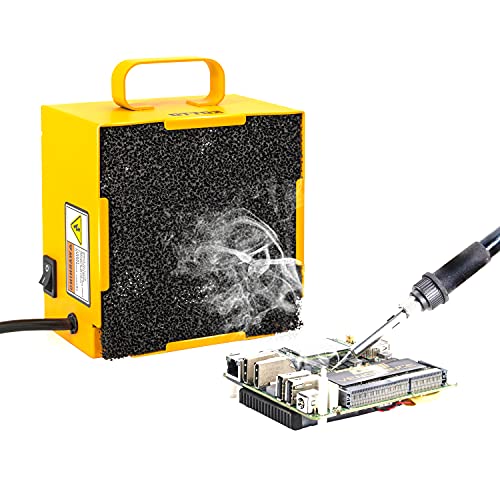
- Activated carbon filter targets solder, flux, and chemical fumes.
- 3000 RPM fan works from about 5–6 inches away.
- Portable body includes rubber feet and a carrying handle.
Best For: DIY soldering stations and small indoor workspaces
Adjustable Coverage
ToolBud Magnetic-Flap Fume Extractor
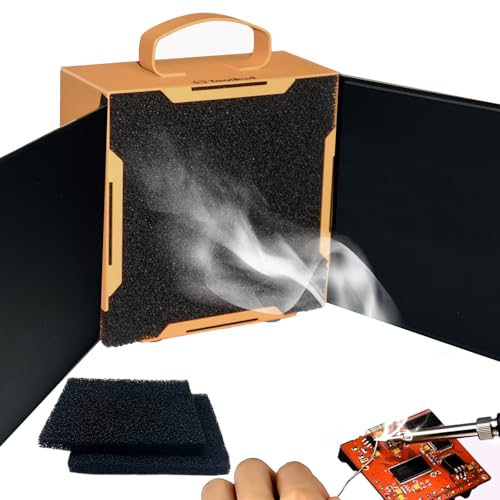
- Magnetic wings widen the smoke extraction area.
- Includes two carbon filters.
- Compact, portable, and designed for low-noise operation.
Best For: Home soldering and small workspaces needing flexible coverage
Multi-Use Filtration
MUIN Three-Stage Solder Fume Extractor

- Three-stage filtration targets solder and other workshop fumes.
- 115 CFM airflow and 45 dB sound level are listed.
- Compact ABS design suits soldering and craft work.
Best For: Hobbyists using one extractor across multiple indoor projects
Heavy-Duty HEPA System
FC-2001A H13 HEPA Fume Extractor

- Combines True H13 HEPA with activated-carbon filtration.
- Provides 120–180 m³/h capacity and up to 15 cm stated reach.
- Includes a hood, pipe, pre-filters, and two-in-one main filter.
Best For: Frequent soldering and larger indoor work areas
Flexible Bench Pick
YIHUA 948DQ-I with Helping Hands

- Eight filtration adsorbers with dual filtering
- 30-degree tilt and side fenders
- Detachable helping hands included
Best For: Indoor soldering with hands-free part positioning
Filtration Upgrade

- Three-stage pre-filter, H12 HEPA, and carbon system
- Up to 128–168 m³/h airflow
- Extendable hose and universal-voltage operation
Best For: Precision soldering in compact workspaces
Simple Compact Pick
YIHUA 948DQ-I Dual-Filter Extractor

- Eight filtration adsorbers included
- 30-degree tiltable stand with side fenders
- Compact dual-filter design with five-blade fan
Best For: Straightforward indoor soldering and wood burning
Compact Smoke Trap
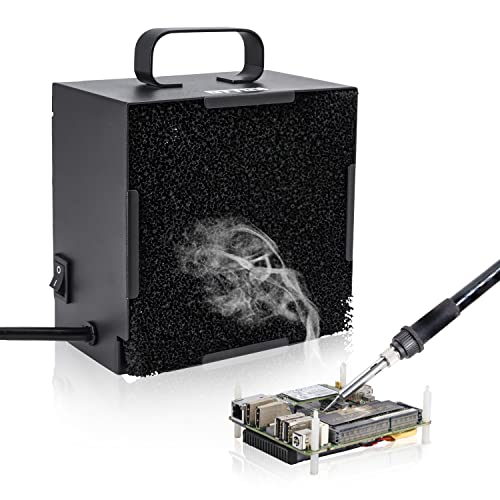
- 3000 RPM fan targets fumes from 5–6 inches away
- 0.4-inch activated carbon filter
- Portable body with non-slip feet and handle
Best For: DIY soldering stations needing a simple, portable extractor
Guided Soldering Station
LED and Helping Hands Extractor

- Dual-side filtration creates a wider capture zone
- Adjustable suction bracket and helping hands
- Integrated LED light for dim work areas
Best For: DIY bench work requiring lighting and component support
Multi-Stage Desktop Purifier

- 106 CFM airflow with three speed levels
- HEPA, activated carbon, and five pre-filters
- 20-inch, 360-degree flexible gooseneck
Best For: Desktop soldering and PCB repair needing deeper filtration
Compact Carbon Filter – Portable Solder Smoke Absorber
For shoppers comparing solder fume extractors for indoor use, this compact smoke absorber offers a straightforward setup for soldering stations and DIY workspaces. Its activated carbon filter is designed to capture fumes from solder, flux, chemicals, and gases, while the 3000 RPM fan provides suction from approximately 5–6 inches away.
Best For: DIY soldering stations and small indoor workspaces that need a portable, carbon-filtered fume absorber.
Pros:
- 0.4-inch activated carbon filter helps absorb solder, flux, chemical, and gas fumes.
- 3000 RPM fan provides a stated working distance of about 5–6 inches.
- Non-slip rubber feet, a carrying handle, and a replacement filter support convenient use and maintenance.
Cons:
- The compact design may provide less coverage than larger filtration systems.
- The supplied specifications list both 120V/30W and 220V details, so buyers should verify compatibility before ordering.
This is a practical, space-saving option when you want basic fume capture close to the work area. Its replaceable filter and portable design are useful for occasional indoor soldering, though larger projects may benefit from a unit with broader coverage.
Adjustable Coverage – ToolBud Magnetic-Flap Fume Extractor
This ToolBud model is a flexible choice among solder fume extractors for indoor use, especially when smoke can spread beyond a narrow extraction point. Its detachable magnetic wings expand the capture area, while the compact AC-powered design fits small workspaces, labs, and home setups.
Best For: Home users and compact workspaces that want wider smoke coverage without a bulky extractor.
Pros:
- Detachable magnetic wings expand the extraction coverage area.
- Includes two carbon filters for replacement convenience.
- Compact, lightweight construction and a low-noise motor suit indoor use.
Cons:
- The notes do not specify airflow capacity or an exact effective extraction distance.
- Its compact format may be less suitable for high-volume or widely dispersed fumes.
The magnetic panels are the standout feature because they let you adjust the smoke-catching area around the task. With two filters included and a detachable filter system, this is a convenient pick for routine soldering where portability and adaptable coverage matter.
Multi-Use Filtration – MUIN Three-Stage Solder Fume Extractor
For buyers seeking solder fume extractors for indoor use beyond electronics work, the MUIN combines three-stage filtration with a compact ABS body. The manufacturer positions it for soldering, wood burning, 3D printing, stained glass, crafting, and other activities where odors and airborne fumes can be distracting.
Best For: Hobbyists who need one compact extractor for soldering and several craft or workshop applications.
Pros:
- Three-stage filtration is designed to absorb fumes from solder, flux, chemicals, and gases.
- Listed 115 CFM airflow and 45 dB sound level provide useful performance specifications.
- Compact, lightweight design takes up limited desktop space.
Cons:
- The stated effective extraction distance is approximately 4–5 inches, which requires relatively close positioning.
- The notes do not identify the replacement-filter contents or replacement interval.
MUIN is a versatile desktop unit for hobby rooms where several activities produce odors or fumes. Its published airflow and sound figures make comparison easier, but the short working distance means positioning it near the source will be important.
Heavy-Duty HEPA System – FC-2001A H13 HEPA Fume Extractor
The FC-2001A is the most substantial option here for solder fume extractors for indoor use, combining an all-metal housing with True H13 HEPA and activated-carbon filtration. Its higher airflow, hood, bamboo pipe, and three-speed adjustment are intended for more controlled indoor fume purification than a small desktop absorber.
Best For: Frequent soldering or larger indoor work areas where stronger airflow and layered filtration are priorities.
Pros:
- Uses True H13 HEPA filtration with activated carbon for particle and odor reduction.
- 120–180 m³/h purification capacity and a stated effective range of up to 15 cm offer stronger reach.
- Includes a hood, bamboo pipe, five pre-filters, and a two-in-one main filter.
- All-metal housing and three-speed adjustment support a more robust setup.
Cons:
- At 9.03 pounds and roughly 11.8 × 10.37 × 12.8 inches, it is less portable than compact units.
- Its larger filtration system may be more equipment than occasional hobby users need.
- The supplied details list 110V while also describing wide-voltage support, so buyers should confirm the intended electrical configuration.
This model makes the strongest case when filtration depth, reach, and included ducting accessories matter more than desktop simplicity. The replaceable pre-filters and layered main filter may also appeal to frequent users, provided they have room for its larger footprint.
Flexible Bench Pick – YIHUA 948DQ-I with Helping Hands
For solder fume extractors for indoor use, the YIHUA 948DQ-I is a compact option that combines dual filtration with adjustable positioning and detachable helping hands. Its 110–127V design suits standard US outlets, while the 30-degree tilting stand helps direct the intake toward the work area.
Best For: Indoor soldering, electronics repair, and small projects where hands-free part positioning is useful.
Pros:
- Includes eight filtration adsorbers for front and rear filtering.
- 30-degree tiltable stand and side fenders help focus extraction.
- Detachable 30 cm helping hands can hold PCBs and wires.
- Includes 12-month US manufacturer technical coverage and 24/7 assistance.
Cons:
- Effective fume capture is limited to a straight-line distance of about 10 cm.
- Designed for 110–127V US-standard power rather than universal voltage.
This is a practical choice when you want a small extractor with built-in workholding support. Position the intake close to the smoke source for the most effective removal.
Filtration Upgrade – FC-2001S Portable Extractor
The FC-2001S is a strong contender among solder fume extractors for indoor use when you want a portable unit with a multi-stage filter system. It combines a pre-filter, H12 HEPA filter, and high-iodine activated carbon filter with an extendable hose for more flexible placement.
Best For: Compact workspaces and precision soldering tasks that benefit from hose-based source targeting.
Pros:
- Three-stage filtration uses a pre-filter, H12 HEPA filter, and activated carbon.
- Airflow is listed at up to 128–168 m³/h.
- Extendable hose supports flexible positioning near the smoke source.
- Universal-voltage design supports both 110V and 220V environments.
Cons:
- At 55 dB, it may be more noticeable than quieter low-power extractors.
- The nozzle should be aligned directly with the smoke source for best results.
With its HEPA and high-iodine carbon stages, this model offers a more comprehensive filtration setup than basic fan-style units. Its hose makes close placement easier, but careful nozzle positioning remains important.
Simple Compact Pick – YIHUA 948DQ-I Dual-Filter Extractor
If you need solder fume extractors for indoor use without the added helping-hands attachment, this basic YIHUA 948DQ-I focuses on compact dual-filter extraction. Its tiltable stand and side fenders help adjust the filtering area and reduce disruptive airflow around the intake.
Best For: Basic indoor soldering and wood-burning tasks where a small, straightforward extractor is sufficient.
Pros:
- Includes eight front-and-rear filtration adsorbers.
- 30-degree tiltable stand allows adjustment of the intake angle.
- Five-blade fan is designed for effective extraction and relatively lower noise.
- Compact 3.54 x 5.71 x 6.46-inch footprint saves bench space.
Cons:
- Does not include the detachable helping hands supplied with the upgraded version.
- Effective capture is specified within about 10 cm in a straight line.
- Uses a 110–127V US-standard plug rather than universal voltage.
This version is a sensible space-saving choice for users who already have their own workholding tools. Keep the extractor close to the fumes and use the tilt and fenders to optimize the intake position.
Compact Smoke Trap – Basic Carbon-Filter Extractor
For shoppers comparing solder fume extractors for indoor use, this compact smoke absorber offers a straightforward desktop setup. Its 3000 RPM fan is designed to draw fumes from about 5–6 inches away, while the 0.4-inch activated carbon filter helps capture solder, flux, chemical, and gas fumes.
Best For: DIY soldering stations that need a compact, portable extractor with simple filter replacement.
Pros:
- Activated carbon filter helps absorb solder and flux fumes.
- 3000 RPM fan provides targeted suction from a 5–6-inch range.
- Non-slip feet and a carrying handle support stable, portable use.
- Includes one replacement smoke-trap filter.
Cons:
- Its compact capture range requires positioning the unit close to the work area.
- Uses a basic activated-carbon filtration setup rather than a HEPA system.
This is a practical entry-level choice for occasional indoor soldering, especially when portability and uncomplicated maintenance matter more than advanced filtration or a large capture area.
Guided Soldering Station – LED and Helping Hands Extractor
Among solder fume extractors for indoor use, this model adds useful workstation features alongside smoke removal. Its dual-side filtration design creates a wider capture zone, while the 2400–2700 RPM motor is intended to pull fumes from roughly 5–6 inches away.
Best For: DIY solderers who want integrated lighting and component-holding assistance in addition to fume extraction.
Pros:
- Dual-side filtration is designed to provide a wider capture zone.
- Adjustable-angle bracket helps position the suction head.
- Includes a bright LED light and two flexible helping hands with alligator clips.
- Uses standard 110V AC power for plug-and-play operation.
Cons:
- The supplied notes do not specify the filter material or replacement-filter details.
- Its 5–6-inch capture range still calls for close placement near the soldering point.
This all-in-one design is appealing for bench work where illumination, hands-free positioning, and fume capture are equally useful. It is particularly convenient for small DIY projects and component assembly.
Multi-Stage Desktop Purifier – DX50 HEPA Extractor
For more demanding indoor soldering setups, the DX50 combines a 20-inch flexible gooseneck with three airflow levels and multi-stage filtration. It delivers a stated 106 CFM airflow through pre-filters, activated carbon, and HEPA filtration, making it a more comprehensive desktop option than a fan-only smoke absorber.
Best For: Desktop soldering and PCB repair users seeking adjustable airflow and HEPA-plus-carbon filtration.
Pros:
- Three adjustable speeds provide control over suction.
- HEPA and activated-carbon filtration are paired with five pre-filters.
- 20-inch gooseneck adjusts 360 degrees and holds its position.
- Metal housing, side exhaust, and a stated 106 CFM airflow support desktop use.
Cons:
- At 9.15 pounds, it is less portable than compact fan-style extractors.
- The manufacturer notes it is intended for light-duty desktop work, not high-volume laser engraving.
- Replacement-filter costs and intervals are not specified in the supplied notes.
The DX50 is the strongest fit here for buyers prioritizing filtration depth and precise hood placement. Its size and light-duty focus make it better suited to a dedicated workbench than occasional, grab-and-go soldering.
How We Picked the Best Solder Fume Extractors for Indoor Use
We focused on desktop extractors designed for electronics soldering, hobby work, repair benches, and similar indoor tasks. The comparison considers the features that most affect practical use: filter type, fan performance, airflow control, working angle, footprint, replacement-filter availability, and included accessories such as helping hands, magnetic flaps, lights, or spare filters.
Because product specifications and included accessories can vary by listing, confirm the current details before buying. A small bench fan can be useful for light-duty work, while frequent soldering may justify stronger airflow and multi-stage filtration.
Quick Comparison
Compact carbon-filter absorbers are generally the simplest choice for occasional soldering and limited bench space. Models with HEPA and activated-carbon filtration offer a more comprehensive filtration setup, while three-stage designs may appeal to users who want additional pre-filtration. Adjustable-angle units help position the intake near the joint, and versions with helping hands or LED lighting can reduce the need for separate accessories.
Key Buying Factors for Solder Fume Extractors for Indoor Use
Filtration
Activated carbon is commonly used to help adsorb odors and some gaseous compounds. HEPA filtration is intended to capture fine airborne particles. A pre-filter can extend the life of the main filter by catching larger debris first. Check whether replacement filters are readily available and how often the manufacturer recommends changing them.
Airflow and Capture Position
Extraction works best when the intake is close to the soldering point without obstructing your hands. Look for adjustable brackets, tilting housings, or flexible positioning. Higher stated airflow can be useful, but real-world capture also depends on distance, fan design, filter condition, and room ventilation.
Controls, Noise, and Footprint
Variable speed or multiple airflow levels let you balance capture against noise. A compact unit suits a crowded desk, while a larger housing may provide more filter area or stronger airflow. Consider power-cord placement, stability, and whether the extractor can be stored easily between projects.
Useful Accessories
Helping hands can hold circuit boards or wires, while an LED light improves visibility. Magnetic flaps may help guide smoke toward the intake. These extras are convenient, but they should not outweigh effective filtration and suitable airflow.
Who Should Buy Which Solder Fume Extractors for Indoor Use?
Occasional hobbyists: Choose a compact carbon-filter model that is easy to place and store. Regular electronics users: Look for adjustable airflow, a close-positioned intake, and filters that are simple to replace. Users prioritizing filtration: Consider a HEPA-and-carbon or multi-stage unit, especially for frequent bench work. Small repair benches: An extractor with helping hands, an LED, or a tiltable design can consolidate useful tools without taking much additional space.
An extractor is not a substitute for good ventilation or sensible soldering practices. Keep the intake near the source, replace filters when saturated or dirty, and follow the manufacturer’s operating and maintenance instructions.