Choosing the right stereo soldering microscope can make fine-pitch rework, inspection, and component placement faster and more comfortable. This roundup compares optical trinocular systems with camera-equipped digital alternatives.
We focus on magnification range, working distance, illumination, imaging, ergonomics, and the accessories that matter at a soldering bench.
Best 10 Stereo Soldering Microscopes Picks for 2026
Professional Boom-Stand Pick

- Long working distance for circuit boards and larger items
- Trinocular 3.5X-90X setup with auxiliary lenses
- Four-zone adjustable 144-LED ring light
Best For: Optical soldering and inspection work requiring flexible boom positioning
Feature-Packed Digital Station

- 2160P HDMI output with 7-inch monitor
- Three lenses for soldering and general inspection
- Helping hands, tool holder, mat, and storage included
Best For: Digital repair benches needing an organized, versatile station
Camera-Ready Optical Value
ZTEEERS Trinocular Stereo Microscope

- 3.5X-90X range with two auxiliary lenses
- Two trinocular adapter configurations included
- Heavy-duty base and adjustable 56S LED ring light
Best For: Optical bench work with optional camera connectivity
All-Around PCB Repair Station

- UV-filtered metal lens for soldering environments
- 10.1-inch display with 2160P and multiple outputs
- Large station with endoscope and repair accessories
Best For: Large-bench PCB repair with digital and endoscopic viewing
Professional Optical Choice
SWIFT Trinocular Stereo Zoom Microscope
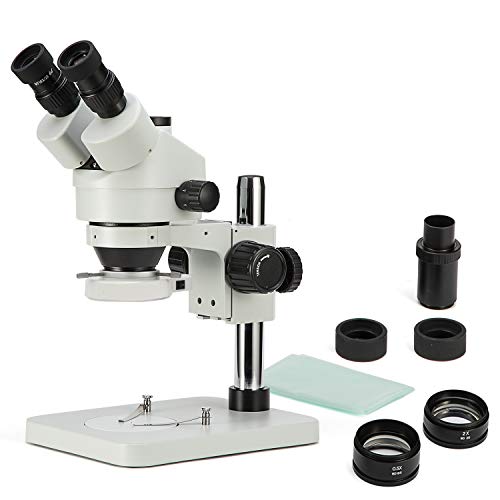
- 3.5X-90X range with additional objectives
- Trinocular port for camera attachment
- 56-bulb cool LED ring light
Best For: Optical electronics, gemology, and precision bench work
Complete Digital Workstation
Andonstar AD249S-M Plus Digital Microscope

- 10.1-inch display with 2160P HDMI output
- Three lenses for soldering and varied inspection
- Helping hands, tool holder, mat, and storage included
Best For: Digital soldering stations and all-purpose inspection
Ergonomic Soldering Setup
Kaisi TX Trinocular Stereo Microscope

- Continuous 7X-50X zoom with wide-field eyepieces
- Soldering exhaust fan and LED ring light included
- Large work floor with mat and parts trays
Best For: Electronics repair and organized soldering benches
Best Traditional Trinocular Value
Kaisi TX350E Soldering Microscope

- 7x-50x continuous stereo zoom magnification
- Wide WF10x23 eyepieces for a broader field of view
- Includes LED ring light and solder exhaust fan
Best For: Eyepiece-based electronics repair and soldering on a roomy work floor
Best Camera-Ready Stereo Setup
TX-350E 4K Trinocular Microscope

- Included 4K camera records 4K at 30fps
- 7x-50x zoom with WF10x/23 eyepieces
- Includes smoke extractor and touch LED illuminator
Best For: Repair work requiring stereo viewing plus high-resolution recording
Professional Boom-Stand Pick – AmScope SM-4TZ-144A
For hands-on stereo soldering microscopes work, the AmScope SM-4TZ-144A emphasizes optical viewing, long working distance, and flexible positioning. Its trinocular head and continuous zoom make it suited to circuit boards and other larger workpieces.
Best For: Soldering and inspection tasks that benefit from a boom stand, optical stereo viewing, and camera or eyepiece sharing.
Pros:
- Long-working-distance double-arm boom stand supports manipulation of large items.
- 0.7X-4.5X zoom objective offers continuous magnification, with included auxiliary lenses extending the range to 3.5X-90X.
- Four-zone, rheostat-controlled 144-bulb LED ring light allows separate intensity and direction control.
- Trinocular head has 10X super-widefield eyepieces, 360-degree rotation, and a fixed 45-degree viewing angle.
Cons:
- Its corded, full-size boom-stand design requires substantial workspace.
- The optical setup does not provide the built-in screen and recording workflow of a digital microscope.
This is a strong choice when comfortable optical viewing and generous positioning range matter more than an integrated display. The 5-year manufacturer warranty is also useful for a professional-oriented setup.
Feature-Packed Digital Station – Andonstar AD246S-M Plus
The Andonstar AD246S-M Plus is a versatile digital option among stereo soldering microscopes, combining a 7-inch monitor, HDMI output, multiple lenses, and a built-out soldering station. It is designed for users who want magnified viewing alongside organized repair tools.
Best For: Repair benches that need digital viewing, recording, interchangeable lenses, helping hands, and included workspace accessories.
Pros:
- 2160P HDMI microscope includes a 7-inch monitor and supports larger-screen viewing.
- Three lenses cover soldering, general objects, and biological slides, with listed magnification up to 2040X.
- Expanded station includes a tool holder, rotatable helping hands, storage boxes, and soldering mat.
- Remote control, adjustable eight-level LED lighting, Windows measurement software, and a 32GB SD card support practical documentation.
Cons:
- The digital station has more components and setup requirements than a basic optical microscope.
- Its highest listed magnification applies to the specialized lens and digital viewing configuration rather than every soldering task.
This model is compelling for makers and repair users who want an all-in-one digital station rather than a microscope alone. The included accessories and 24-month warranty add convenience, while the interchangeable lenses broaden its use beyond soldering.
Camera-Ready Optical Value – ZTEEERS Trinocular Stereo Microscope
This ZTEEERS trinocular model is a practical optical choice for stereo soldering microscopes buyers who want camera connectivity without giving up eyepiece viewing. Its boom stand, auxiliary lenses, and adjustable illumination support detailed bench work.
Best For: Optical inspection and soldering setups that need trinocular camera access, long working distance, and a stable heavy-duty base.
Pros:
- 0.7X-4.5X continuous zoom expands to a listed 3.5X-90X range with the included 0.5X and 2X auxiliary lenses.
- Trinocular head includes adjustable interpupillary distance, diopters, and two adapter configurations.
- Heavy-duty 18-pound steel base and ball-bearing boom arm provide a stable, flexible platform.
- 56S LED ring light offers focused, shadow-free illumination with dimming control.
Cons:
- It includes camera adapter configurations but not a built-in monitor or recording system.
- The one-year warranty is shorter than the five-year warranty listed for the AmScope alternative.
This microscope suits users who prefer a traditional optical workflow but may add an electronic eyepiece or camera. Its stable base and flexible boom arm are particularly useful when positioning the workpiece is as important as magnification.
All-Around PCB Repair Station – Andonstar AD409 Max
The Andonstar AD409 Max combines a digital microscope with an oversized soldering station and endoscope, making it a practical alternative for stereo soldering microscopes shoppers who need broad component access. Its UV-filtered metal lens is specifically designed for demanding repair environments.
Best For: Professional-style PCB repair requiring a large workspace, side or internal component views, and flexible digital output.
Pros:
- UV filter helps protect the metal lens from soldering heat, smoke, and dust.
- 10.1-inch IPS display supports 2160P video recording, HDMI output, PC connection, and Wi-Fi.
- Oversized Max station increases the soldering area by 370% and includes helping hands, tool holder, and repair mat.
- Endoscope adds side and internal views for a stated 360-degree inspection approach.
Cons:
- The endoscope is not supported when using the PC output.
- The large 18.1-by-14.6-by-18.7-inch station requires considerable bench space.
- It is a digital system rather than a conventional binocular stereo microscope with eyepieces.
This is the strongest fit for repairers who value workspace and viewing flexibility over a compact footprint. The protected lens, large display, endoscope, and multiple output methods make it especially capable for PCB maintenance and demonstrations.
Professional Optical Choice – SWIFT Trinocular Stereo Zoom Microscope
For buyers comparing stereo soldering microscopes, the SWIFT offers a traditional optical setup with a trinocular head, broad magnification range, and a generous working distance. Its metal construction and ring illumination make it suited to detailed bench work where stable, shadow-free viewing matters.
Best For: Electronics professionals, gemologists, engravers, collectors, and lab users who want optical viewing with camera connectivity.
Pros:
- Trinocular head supports comfortable observation and camera attachment.
- Included objectives expand magnification from 3.5X to 90X.
- 56-bulb LED ring light provides bright, shadow-free illumination with low heat.
- 100 mm working distance and sturdy metal stand support hands-on work.
Cons:
- It requires a separate camera for image capture through the trinocular port.
- Its corded 230-volt power specification may require compatibility checking.
This is a strong fit if you prefer the depth and familiar handling of an optical stereo microscope. The included 0.5X and 2.0X objectives add flexibility, while the angled, rotating head helps make longer inspection sessions more manageable.
Complete Digital Workstation – Andonstar AD249S-M Plus Digital Microscope
The Andonstar AD249S-M Plus is a versatile digital option among stereo soldering microscopes, combining a 10.1-inch display with three interchangeable lenses and a dedicated soldering setup. It is designed for users who want live HDMI viewing, recording, measurement software, and workspace accessories in one package.
Best For: Electronics repair, soldering demonstrations, hobby work, and users who need multiple lenses for inspection, general viewing, and biological slides.
Pros:
- Includes soldering helping hands, tool holder, anti-static mat, and extension base.
- Three lenses cover soldering, general objects, and biological slides.
- Supports 2160P video, HDMI output, photos, and video storage on a 32GB card.
- Adjustable LED lighting and remote control simplify operation.
Cons:
- Digital magnification and image quality depend on the selected lens and display setup.
- The large accessory package may take more bench space than a basic microscope.
This model stands out as a ready-to-use soldering station rather than just a microscope. Its built-in screen and included tools reduce the need for separate equipment, while Windows software adds measurement and capture capabilities.
Ergonomic Soldering Setup – Kaisi TX Trinocular Stereo Microscope
The Kaisi TX is a practical choice among stereo soldering microscopes for electronics repair, pairing continuous 7X-50X zoom with wide-field eyepieces and a work-focused stand. Its included soldering exhaust fan, LED ring light, mat, and parts trays make it especially oriented toward hands-on repair.
Best For: Electronics repair and soldering users who want a wide work surface, smoke extraction, and trinocular viewing for a computer, camera, or mobile device.
Pros:
- 0.7X-5X zoom objective provides continuous 7X-50X magnification.
- WF10x23 eyepieces offer a wider field of view and adjustable eye distance.
- Included exhaust fan helps draw away soldering smoke.
- Large work floor, silicone mat, and parts trays support organized repairs.
Cons:
- Focus depends on installing the standard or Barlow lens at the correct position.
- Maximum magnification is 50X, lower than some digital alternatives.
- The 120-volt specification should be checked against the intended workspace.
For repair benches, the Kaisi emphasizes comfort and workflow rather than extreme magnification. The wide eyepieces, smoke fan, and integrated work area make it a focused option for repeated soldering tasks and electronic component handling.
Best Flexible Digital Pick – Andonstar AD109 Arm Microscope
Among stereo soldering microscopes, the Andonstar AD109 stands out as a flexible digital option with a large 10.1-inch IPS display. Its extended boom arm and adjustable lighting make it practical for PCB work, electronics inspection, coins, and other projects where workspace and viewing angle matter.
Best For: Soldering and electronics work that benefits from a large screen, long reach, and digital photo or video capture.
Pros:
- 10.1-inch 1080p IPS screen with 12MP photo capability.
- 27.56-inch boom arm with 360-degree rotation and a 170-degree tilt range.
- Adjustable 8-LED and 56-LED lighting system for detailed viewing.
- USB-C compatibility with Mac and Windows, plus a 32GB SD card and wireless remote.
Cons:
- It is a digital microscope rather than a traditional binocular or trinocular stereo design.
- The remote requires batteries, which are not included.
The AD109 is a strong choice when a spacious setup and screen-based inspection are more important than eyepiece viewing. Its long arm is especially useful for large PCBs and multi-tool soldering benches.
Best Traditional Trinocular Value – Kaisi TX350E Soldering Microscope
The Kaisi TX350E is a traditional trinocular stereo microscope for users who prefer eyepiece-based depth perception while keeping camera compatibility available. Its continuous 7x-50x zoom range, wide-field eyepieces, fume extractor, and generous work floor suit detailed electronics repair and soldering.
Best For: Electronics repairers who want wide-field stereo viewing, adjustable magnification, and built-in solder-fume management.
Pros:
- Continuous 7x-50x magnification from a 0.7x-5x zoom objective.
- WF10x23 wide-field eyepieces with adjustable interpupillary distance.
- Includes an LED ring light and soldering exhaust fan.
- 14.7-by-9.6-inch work floor provides room for larger repair projects.
Cons:
- The included setup does not list a camera, unlike the camera-equipped version.
- Its 10 cm working distance may require careful height adjustment for tools and components.
For hands-on bench work, the TX350E offers the familiar control and depth perception of stereo eyepieces with useful soldering accessories. It is a practical fit for repair stations where a broad working surface and fume extraction are priorities.
Best Camera-Ready Stereo Setup – TX-350E 4K Trinocular Microscope
This TX-350E configuration combines traditional stereo eyepieces with a supplied 4K camera, making it one of the more complete stereo soldering microscopes for repair documentation and screen-based viewing. The 7x-50x zoom, wide-field eyepieces, large work floor, ring illumination, and smoke extractor cover the main needs of a busy repair bench.
Best For: Soldering and watch or electronics repair where high-resolution camera output and direct eyepiece viewing are both useful.
Pros:
- Includes a 4K, 40-million-pixel smart camera with 4K at 30fps and 1080p at 60fps recording.
- 7x-50x variable magnification with WF10x/23 eyepieces.
- 14.7-by-9.6-inch work floor accommodates larger repair items.
- Comes with a smoke exhaust fan and touch LED illuminator.
Cons:
- The camera is recommended for use through HDMI, which may limit preferred connection setups.
- The complete metal setup weighs 5.78 kg, so it is less convenient to move frequently.
The camera-equipped TX-350E is a compelling choice when inspection needs to be shared, recorded, or displayed on a larger screen without giving up stereo eyepiece viewing. Its included accessories also reduce the need to assemble a soldering setup separately.
How We Picked These Stereo Soldering Microscopes
We selected models that suit electronics assembly, PCB repair, inspection, and precision soldering. The comparison includes traditional stereo zoom microscopes, trinocular systems for camera integration, and digital microscopes with built-in screens or 4K and 2160P video. We considered useful magnification ranges, working distance, lighting, viewing comfort, camera capability, included lenses, and overall bench practicality.
Specifications can vary by configuration, so verify the included eyepieces, auxiliary lenses, stand, camera, and lighting before ordering. A microscope’s advertised maximum magnification is less important than its usable image quality and working clearance at the bench.
Quick Comparison
| Type | Best suited to | Main advantage | Potential trade-off |
|---|---|---|---|
| Trinocular stereo zoom | Frequent soldering and inspection | Natural depth perception and camera expansion | Usually requires a separate monitor or camera setup |
| Digital HDMI microscope | Shared viewing and documentation | Large display and easy recording | Less natural depth perception than optical stereo viewing |
| 4K or high-resolution digital model | Detailed inspection and demonstrations | Sharp on-screen image and video output | Screen, camera, and software features add complexity |
| Microscope with soldering accessories | Compact repair benches | Convenient all-in-one setup | Accessory quality and adjustability may vary |
Key Buying Factors for Stereo Soldering Microscopes
Magnification and Working Distance
For most electronics work, a broad zoom range is more useful than extreme maximum power. Lower magnification helps you locate parts and position tools, while higher settings reveal solder joints and small defects. A generous working distance gives your iron, tweezers, and cutters room to move beneath the objective.
Optical Stereo Versus Digital Viewing
Optical stereo systems provide real depth perception and typically feel more natural during hands-on soldering. Digital microscopes offer convenient displays, recording, HDMI output, and group viewing, but latency, perspective, and screen positioning can affect precision. A trinocular model is a strong compromise when you want direct optical viewing plus a camera.
Lighting, Stand, and Ergonomics
Look for an adjustable LED ring light or other even illumination, especially when inspecting reflective solder joints. A stable boom or stand, smooth focus, comfortable eyepieces, and controls that remain clear of your work area are equally important. Check whether the stand provides enough clearance for the boards and fixtures you use.
Camera and Expansion Options
If you document repairs, teach, or share a bench view, check camera resolution, HDMI or USB connectivity, recording support, and whether the optical path allows simultaneous eyepiece and camera use. Auxiliary lenses can change working distance and field of view, so confirm compatibility before adding one.
Who Should Buy Which Stereo Soldering Microscopes?
Choose a trinocular stereo zoom microscope if you solder frequently and prioritize depth perception, control, and future camera upgrades. Select a digital HDMI model if several people need to watch the work or you want a straightforward display and recording setup. A high-resolution 4K or 2160P option suits inspection, documentation, and demonstrations where screen detail matters most. Buyers with limited space may prefer an integrated digital unit, while demanding repair professionals should prioritize a rigid stand, smooth optics, ample working distance, and adjustable illumination over headline magnification.