Choosing among trinocular soldering microscopes is easier when you compare the features that affect real bench work: zoom range, working distance, illumination, camera connectivity, and stand stability.
This roundup covers 10 options for electronics repair, PCB inspection, jewelry work, and other detailed tasks, from compact setups to professional systems with auxiliary lenses and 4K imaging.
Best 10 Trinocular Soldering Microscopes Picks for 2026
Professional Boom-Stand Pick

- 3.5X-90X magnification range
- Double-arm, three-axis boom stand
- Four-zone 144-bulb LED ring light
Best For: Large circuit boards and flexible bench positioning
Integrated Soldering Station
Kaisi TX Trinocular Microscope

- 7X-50X magnification range
- Built-in soldering exhaust fan
- Work floor with mat and parts trays
Best For: Organized electronics repair benches
Wide-Range Optics Pick
SWIFT S7-TP520 Trinocular Microscope
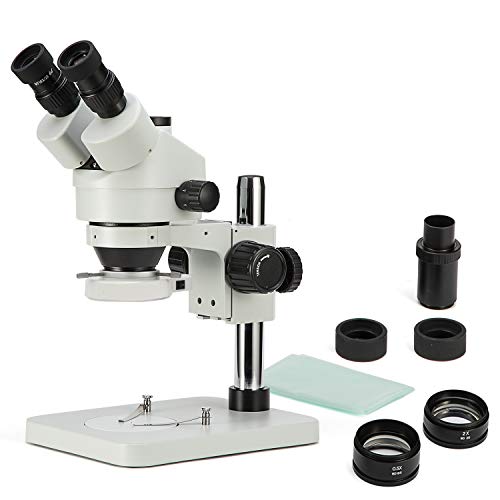
- 3.5X-90X expanded magnification
- 56-bulb cool LED ring light
- Includes 0.5X and 2.0X objectives
Best For: Flexible electronics and precision inspection
Large Work-Floor Choice
Kaisi TX350E Soldering Microscope

- 7X-50X magnification range
- 14.7-by-9.6-inch adjustable work floor
- Integrated exhaust fan and LED ring light
Best For: Roomy electronics repair and soldering setups
Top All-Rounder
SWIFT S7 7X-45X Trinocular Stereo Microscope
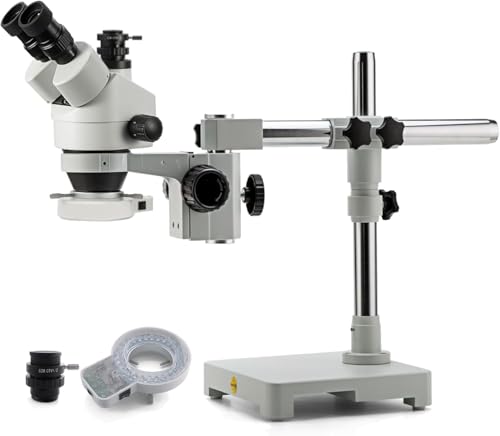
- 7X-45X continuous zoom
- 45-degree trinocular head with camera port
- 56-LED ring light and boom stand
Best For: Versatile electronics repair, inspection, and hobby work
Best for Extended Reach
SENZHIYI 3.5X-90X Trinocular Stereo Microscope

- 3.5X-90X stated total magnification
- 15.5-28-inch adjustable boom arm
- 18-pound steel base and 56-LED ring light
Best For: Large workpieces, industrial inspection, and teaching
Best for Soldering Workstations
KAISI S6 6.8X-68X Trinocular Microscope

- 6.8X-68X continuous magnification
- Built-in fume extractor and 144-LED light
- Work surface with heat-resistant soldering mat
Best For: PCB soldering and integrated electronics repair benches
Best High-Magnification Option
Professional Trinocular Stereo Zoom Microscope

- 3.5X-90X range with two auxiliary lenses
- Heavy-duty base and flexible boom stand
- Dimmable LED ring light and dual adapter options
Best For: Buyers needing broad magnification and a stable, camera-ready workbench setup
Best Complete Repair Setup
TX-350E Trinocular Stereo Zoom Microscope

- Included 4K smart camera with multiple recording modes
- 7X-50X zoom for repair and watch work
- Smoke extractor, LED light, and roomy work area
Best For: Repair benches that want imaging and fume management included
Best Compact Basic Choice
Trinocular Stereo Microscope 6X-45X

- 6X-45X continuous zoom with 0.5X CTV adapter
- 56-bulb LED ring light for even illumination
- Compact aluminum-alloy stand with camera-ready head
Best For: Routine inspection in a smaller bench workspace
Professional Boom-Stand Pick – AmScope SM-4TZ-144A
For demanding trinocular soldering microscopes setups, the AmScope SM-4TZ-144A emphasizes reach, positioning flexibility, and a broad magnification range. Its double-arm boom stand is particularly useful when circuit boards or other large items need room for hands-on work.
Best For: Electronics technicians and other users who need a long-reach microscope for larger workpieces.
Pros:
- 0.7X-4.5X continuous zoom with 3.5X-90X total magnification range.
- Double-arm boom stand provides three-axis positioning with 20-inch arms and a 17-inch pillar.
- Four-zone, rheostat-controlled 144-bulb LED ring light allows separate intensity and direction control.
- 0.5X and 2.0X Barlow lenses expand working distance and magnification options.
Cons:
- The boom-stand footprint may be more substantial than a compact bench setup.
- It uses corded electric power rather than a portable power source.
This is a versatile choice when working distance and stand adjustability matter as much as optical range. The rotating trinocular head and included lighting controls also support shared viewing and detailed inspection.
Integrated Soldering Station – Kaisi TX Trinocular Microscope
Among trinocular soldering microscopes, the Kaisi TX stands out for pairing a trinocular viewing system with a soldering exhaust fan and a dedicated work floor. That combination is aimed directly at electronics repair, where smoke control and organized parts handling can simplify bench work.
Best For: Electronics repair users who want integrated fume extraction, lighting, and small-parts storage.
Pros:
- 0.7X-5X zoom objective supports a 7X-50X magnification range.
- WF10x23 eyepieces provide a wide field of view with adjustable interpupillary distance.
- Included soldering exhaust fan helps remove smoke from the work area.
- 14.9-by-10-inch work floor includes a silicone soldering mat and three small parts trays.
Cons:
- The standard, 0.7X, and 0.5X lens positions require correct setup for clear focusing.
- The listed warranty coverage is more limited than some professional alternatives.
The TX is a practical all-in-one option for repair benches. Its work surface and exhaust fan reduce the need to assemble separate accessories, while the wide eyepieces are designed for extended observation.
Wide-Range Optics Pick – SWIFT S7-TP520 Trinocular Microscope
The SWIFT S7-TP520 is a flexible choice among trinocular soldering microscopes, offering a 7X-45X operating range with additional objectives that extend total magnification from 3.5X to 90X. Its sturdy table-pillar stand and cool LED illumination suit detailed electronics and precision inspection work.
Best For: Users who want broad magnification flexibility and a stable stand for electronics, engraving, or specimen work.
Pros:
- 0.7X-4.5X zoom objective provides a 7X-45X range with 10X eyepieces.
- Included 0.5X and 2.0X objectives expand the range to 3.5X-90X.
- 56-bulb LED ring light provides cool, shadow-free illumination.
- Rotating 45-degree trinocular head and vertical camera port support documentation.
Cons:
- The table-pillar stand offers less reach than a boom stand for oversized workpieces.
- The supplied specifications list 230-volt power, so compatibility should be checked before purchase.
With its extra objectives and vertical trinocular port, the SWIFT is well suited to users who expect to switch between overview inspection and high-magnification detail. The metal construction adds stability for precision tasks.
Large Work-Floor Choice – Kaisi TX350E Soldering Microscope
The Kaisi TX350E is one of the more electronics-focused trinocular soldering microscopes in this roundup. It combines a 7X-50X zoom range with a large adjustable work floor, an exhaust fan, and a ring light for hands-on soldering and repair.
Best For: Repair technicians who need a roomy, adjustable surface for larger electronics projects.
Pros:
- 0.7X-5X zoom objective delivers a 7X-50X magnification range.
- WF10x23 wide-field eyepieces are designed to reduce eye and neck fatigue.
- Built-in soldering exhaust fan and LED ring light address smoke and illumination needs.
- 14.7-by-9.6-inch work floor has three hole positions for setup adjustment.
Cons:
- The supplied configuration has a 10 cm primary working distance, which may limit clearance for some tasks.
- Its 12-volt corded setup may require attention to power arrangements at the bench.
The TX350E is a sensible fit when the work surface is a priority. Its adjustable floor, integrated smoke extraction, and wide-field eyepieces make it purpose-built for repetitive electronics repair rather than general microscopy alone.
Top All-Rounder – SWIFT S7 7X-45X Trinocular Stereo Microscope
For buyers comparing trinocular soldering microscopes, the SWIFT S7 is a versatile stereo system with continuous 7X-45X magnification, a 45-degree viewing angle, and a camera-ready third port. Its boom stand and included ring light make it suitable for detailed bench work beyond electronics repair.
Best For: Electronics repair, PCB work, gemology, engraving, and other applications requiring flexible surface magnification.
Pros:
- Continuous 7X-45X zoom range with wide-field 10X eyepieces.
- Ergonomic 45-degree trinocular head can help reduce eye and neck strain.
- 56-bulb LED ring light provides bright, shadow-free illumination.
- Single-arm boom stand accommodates larger objects, while the included 0.5X C-mount adapter supports camera use.
Cons:
- The 17.45 kg metal construction is substantial and not especially portable.
- The camera itself is not included.
The S7 is a strong general-purpose choice when you want a sturdy trinocular microscope with a broad zoom range and room for larger workpieces. Its included optics and lighting make it a practical starting point for inspection and repair setups.
Best for Extended Reach – SENZHIYI 3.5X-90X Trinocular Stereo Microscope
This trinocular stereo microscope is designed for users who need broad magnification flexibility and generous access around the specimen. Its 0.7X-4.5X zoom system, auxiliary lenses, adjustable boom arm, and heavy steel base support detailed inspection, assembly, and recording tasks.
Best For: Industrial inspection, product assembly, biological dissection, jewelry identification, and teaching or research environments.
Pros:
- Offers a stated total magnification range of 3.5X-90X with auxiliary lenses.
- Fully adjustable boom arm extends from 15.5 to 28 inches, with 360-degree rotation.
- 18-pound steel base is designed for stable, low-vibration observation.
- Includes 10X eyepieces, 0.5X and 2X auxiliary lenses, a 56-LED ring light, and an electronic eyepiece interface.
Cons:
- The many included components may require more setup and adjustment than a simpler microscope.
- The product notes do not specify a camera or electronic eyepiece model.
Choose this model if reach, stability, and magnification range matter more than a compact footprint. The long boom arm and solid base make it well suited to larger or awkwardly positioned workpieces, while the trinocular design supports simultaneous viewing and imaging.
Best for Soldering Workstations – KAISI S6 6.8X-68X Trinocular Microscope
Among trinocular soldering microscopes, the KAISI S6 stands out as a workstation-oriented option. It combines 6.8X-68X continuous magnification with a solder fume extractor, 144-LED ring light, spacious work surface, and heat-resistant silicone mat for electronics repair.
Best For: PCB soldering, electronic repair, PCB restoration, and users who want an integrated bench setup.
Pros:
- 0.68X-6.8X zoom objective provides a stated total range of 6.8X-68X.
- WF10X/23 wide-field, high-eye-point eyepieces are suitable for users who wear glasses.
- Integrated fume extractor helps clear solder smoke from the workspace.
- Includes a 144-LED ring light, 14.9-by-10-inch work surface, and heat-resistant silicone soldering mat.
Cons:
- The integrated workstation design occupies more bench space than a microscope-only setup.
- The maximum 68X magnification is lower than some models offering auxiliary-lens ranges up to 90X.
The S6 is the most purpose-built choice here for soldering and electronics benches. Its lighting, fume extraction, mat, and dedicated work surface reduce the need to assemble those accessories separately, while the trinocular port supports imaging alongside direct observation.
Best High-Magnification Option – Professional Trinocular Stereo Zoom Microscope
For buyers comparing trinocular soldering microscopes, this ZTEEERS model stands out for its exceptionally broad 3.5X-90X range, flexible boom stand, and dual camera-adapter configurations. Its stereo viewing head, adjustable illumination, and auxiliary lenses make it adaptable to both detailed work and larger specimens.
Best For: Users who need extensive magnification flexibility, a long working distance, and camera or electronic-eyepiece connectivity.
Pros:
- Expansive 3.5X-90X magnification range using the included 0.5X and 2X auxiliary lenses
- Heavy-duty steel base and ball-bearing boom arm provide a stable, flexible setup
- 56S dimmable LED ring light delivers cool, focused, shadow-free illumination
- Trinocular port supports two adapter configurations for cameras and electronic eyepieces
Cons:
- The large 19.5-inch dimensions and 18-pound base require substantial bench space
- Camera and electronic-eyepiece devices are not included with the microscope
This is the most versatile choice of the three for buyers who value maximum magnification and stand flexibility. Its larger footprint is best suited to a dedicated workbench rather than a compact repair station.
Best Complete Repair Setup – TX-350E Trinocular Stereo Zoom Microscope
Among trinocular soldering microscopes, the HengTianMei TX-350E is the most complete out-of-the-box repair package. It combines 7X-50X zoom magnification with a 4K camera, LED illumination, a smoke exhaust fan, and a generous 14.7-by-9.6-inch working area.
Best For: Electronics repair and watch work where built-in imaging, fume extraction, and a roomy operating surface are priorities.
Pros:
- Included 4K, 40-megapixel smart camera supports 4K at 30 fps and 1080p at 60 fps recording
- 7X-50X variable magnification suits a range of repair tasks
- Includes a smoke exhaust fan and touch LED illuminator
- 14.7-by-9.6-inch working floor accommodates larger repair items
Cons:
- Maximum magnification is lower than the first microscope’s 90X maximum
- The camera’s recommended HDMI connection may require a compatible display setup
The TX-350E offers the strongest all-in-one value for repair benches because imaging and fume extraction are included. Choose it over a more basic trinocular scope if documenting work or managing solder fumes matters to your workflow.
Best Compact Basic Choice – Trinocular Stereo Microscope 6X-45X
This compact ZTEEERS model is a straightforward option for buyers seeking trinocular soldering microscopes with camera connectivity, continuous zoom, and integrated lighting. Its 6X-45X range, 0.5X CTV adapter, and aluminum-alloy stand provide a practical foundation for detailed bench inspection.
Best For: Users who want a smaller, simpler trinocular microscope for routine inspection and documentation.
Pros:
- 6X-45X continuous zoom range supports general detailed observation
- Trinocular head allows binocular viewing while attaching a camera
- 56-bulb LED ring light provides bright, even illumination
- Included 0.5X CTV adapter offers a larger field of view
Cons:
- It does not include a camera, so imaging hardware must be added separately
- Its 45X maximum is below the magnification offered by the other two models
With its compact dimensions and lighter 4.5-kilogram build, this is an appealing fit for workspaces where bench size matters. It is a sensible basic option, but buyers needing high magnification or a bundled camera may prefer the alternatives.
How We Picked These Trinocular Soldering Microscopes
We focused on the specifications that matter during extended soldering and inspection sessions: usable stereo depth, smooth zoom control, broad working distance, eyepiece quality, stand design, illumination, and camera compatibility. Models with published magnification ranges, trinocular ports, and soldering-oriented configurations received priority.
Because included accessories vary, check the exact listing before purchase. A camera, boom stand, auxiliary lens, or ring light may be included with one configuration but sold separately with another.
Quick Comparison
| Feature | What to compare | Why it matters |
|---|---|---|
| Magnification | About 3.5X–90X, 6.8X–68X, or 7X–50X ranges | Determines whether the microscope suits broad inspection, fine soldering, or both |
| Optical system | Zoom objective, wide-field eyepieces, auxiliary lenses | Affects image clarity, field of view, and working distance |
| Lighting | LED ring light or compatible external illumination | Reduces shadows on reflective components and solder joints |
| Imaging | Trinocular port, C-mount adapter, or included 4K camera | Supports documentation, teaching, streaming, and shared viewing |
| Stand | Single-arm boom, fixed stand, or heavy professional base | Controls reach, vibration, and usable workspace |
Key Buying Factors for Trinocular Soldering Microscopes
Magnification and Working Distance
Do not choose by maximum magnification alone. A wide zoom range is useful for locating components at lower power and examining joints at higher power, while a 0.5X auxiliary lens can increase working distance for tools and larger boards. Higher-power accessories may provide more detail but reduce the working area.
Optics and Ergonomics
Wide-field 10X eyepieces can make long sessions more comfortable, but optical quality and alignment matter more than the label. Look for smooth zoom movement, stable focus, and an eyepiece angle that keeps your neck in a neutral position.
Lighting and Camera Setup
An LED ring light is a practical starting point, especially when brightness is adjustable. For imaging, confirm the trinocular port size, C-mount compatibility, camera resolution, software support, and whether the camera can display a live view without blocking the eyepieces.
Stand Stability and Workspace
Choose a heavy base for a fixed bench setup or a boom arm when you need to reach across larger PCBs. Verify clearance beneath the objective and the stand’s adjustment range before buying.
Who Should Buy Which Trinocular Soldering Microscopes?
- Occasional repair users: Choose a straightforward trinocular model with a ring light and moderate zoom range.
- Frequent PCB technicians: Prioritize smooth optics, generous working distance, a stable stand, and comfortable wide-field eyepieces.
- Documentation and teaching: Select a model with a reliable camera port or included 4K camera, then confirm software and adapter details.
- Large boards or crowded benches: Consider a boom stand and a 0.5X auxiliary lens for extra reach.
- Fine-detail specialists: Look for higher maximum magnification and optional 2.0X auxiliary optics, while accepting a smaller field of view.
Before ordering, compare the complete package rather than the microscope head alone. Included lenses, lighting, camera hardware, adapters, and stand type can substantially change the system’s value.