The best drone camera for filmmaking combines stable footage, dependable flight controls, and enough battery life to capture shots without constant interruptions. The right choice depends on your production style, travel needs, and comfort with manual flying.
We selected 10 camera drones spanning compact beginner models, GPS-equipped aircraft, gimbal-stabilized systems, and feature-rich options for creators who want more control over aerial storytelling.
Best 10 Drone Camera for Filmmaking Picks for 2026
Best Lightweight Pick

- 4K video with 3-axis gimbal stabilization
- Under 249 g with beginner-friendly flight controls
- Two-battery combo rated for up to 62 minutes
Best For: Traveling beginners seeking stabilized 4K aerial footage
Best Assisted Flight

- 4K camera with 3-axis gimbal and electronic stabilization
- 360-degree LiDAR obstacle avoidance
- Screen controller and up to 47 minutes of stated flight time
Best For: Beginners wanting automated flight assistance and collision awareness
Best Long-Flight Features

- 4K video and stated 6K photo capture
- 3-axis brushless gimbal with GPS smart modes
- Up to 70 minutes total flight time across two flights
Best For: Outdoor creators needing extended shooting sessions and GPS automation
Best Screen-Controller Value

- 4.5-inch controller screen works without a smartphone
- 4K camera with 90-degree adjustable lens
- Two batteries provide approximately 60 minutes
Best For: Beginners wanting simple phone-free aerial filming
Best Beginner Value

- 4K camera with wide-angle lens and 2-axis gimbal
- Three batteries provide up to 60–70 minutes of flight
- GPS Follow, Route Planning, and Fly Around modes
Best For: Beginners filming landscapes, travel, and outdoor activities
GPS Filmmaking Pick

- 4K adjustable camera with 5G FPV transmission
- GPS auto return and hands-free creative flight modes
- Up to 32 minutes with two batteries
Best For: Outdoor creators seeking automated 4K aerial footage
Screen-Control Pick
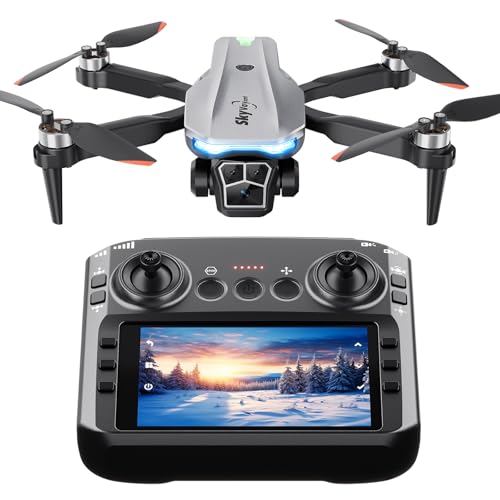
- 4.5-inch controller screen requires no phone
- 2K adjustable camera with stabilized video
- Two batteries provide up to 24 minutes
Best For: Beginners wanting simple, travel-friendly aerial filming
Beginner Practice Pick

- 2K adjustable camera with built-in FPV screen
- Simple controls plus trajectory flight and gesture selfie
- Up to 30 minutes with two batteries
Best For: Beginners learning basic aerial filming and flight control
Best Lightweight Pick – DJI Mini 4K
The DJI Mini 4K is a practical drone camera for filmmaking when portability, stabilized footage, and beginner-friendly controls matter. Its under-249-gram design, 4K video, 3-axis gimbal, and included two-battery setup make it well suited to travel and outdoor shooting.
Best For: Beginners and travelers who want compact 4K aerial footage with strong stabilization.
Pros:
- 4K video capture with a 3-axis gimbal for smoother cinematic footage.
- Under 249 g and regulation-friendly for recreational use, subject to applicable FAA requirements.
- Two batteries provide up to 62 minutes of stated total flight time.
- GPS Return to Home, one-tap takeoff and landing, and QuickShots simplify operation.
Cons:
- The DJI Fly app must be downloaded from DJI’s website rather than Google Play.
- The included controller does not have a built-in screen, so a compatible mobile device is needed for the app experience.
For filmmakers who prioritize a lightweight kit and dependable gimbal footage over advanced subject tracking, the Mini 4K offers a balanced entry point with useful automated shooting modes.
Best Assisted Flight – DCX Volo X EZ AI
The DCX Volo X EZ AI is a drone camera for filmmaking aimed at pilots who want automated assistance and collision awareness. AI-assisted flight modes, 360-degree LiDAR obstacle detection, a 3-axis gimbal, and a screen-equipped controller create a convenient shooting setup.
Best For: Beginners who value obstacle avoidance, automated flight features, and a controller with an integrated screen.
Pros:
- 4K camera paired with a 3-axis gimbal and electronic image stabilization.
- 360-degree obstacle detection uses LiDAR sensors to help avoid collisions.
- AI-assisted Follow Me and Precision Return-to-Home support easier operation.
- Up to 47 minutes of stated flight time and a built-in controller screen reduce setup friction.
Cons:
- The product notes give a 4-mile maximum range, while the upgraded battery is described as 6000mAh in the feature copy and 5000mAh in the details.
- Users must remove the foam padding beneath the camera before first use to avoid restricting the gimbal.
This model stands out for assisted piloting rather than extreme portability. Its obstacle sensing and integrated display make it appealing for newer filmmakers who want more confidence while framing aerial shots.
Best Long-Flight Features – Bwine F7GIM
The Bwine F7GIM is a drone camera for filmmaking that emphasizes extended sessions, camera stability, and programmable flight modes. It records 4K video, captures stated 18MP photos, and combines a 3-axis brushless gimbal with GPS features such as orbit, follow, cruise control, and waypoint planning.
Best For: Outdoor shooters who want long total flight time, smart GPS modes, and higher-resolution still photos.
Pros:
- 4K video, stated 6K photo capability, and an 18MP effective still resolution.
- 3-axis brushless gimbal is designed to keep footage steady during wind and faster flight.
- Two stated 35-minute flights provide up to 70 minutes of total flight time.
- Includes GPS smart modes, 5X digital zoom, Night Mode 2.0, and a supplied carrying case.
Cons:
- The digital transmission system requires the correct wired data cable and compatible app setup.
- A Micro SD card is recommended, and Mac users may need to format it as MS-DOS (FAT).
- The product is heavier and less minimal than an under-249-gram travel drone.
With its long stated endurance and broad set of GPS shooting modes, the F7GIM is a feature-rich option for landscape work, inspections, and outdoor projects where changing batteries frequently is inconvenient.
Best Screen-Controller Value – GPS 4K Foldable Drone
This foldable GPS model is a practical drone camera for filmmaking when you want a built-in viewing screen without relying on a smartphone. Its 4K camera, adjustable lens, GPS return functions, and dual-battery package make it suitable for casual aerial filming, travel, and basic inspection work.
Best For: Beginners who prefer an all-in-one controller and straightforward GPS-assisted shooting.
Pros:
- Built-in 4.5-inch controller screen provides live viewing without a phone or app.
- 4K camera includes a 90-degree adjustable lens and FPV transmission.
- Dual batteries provide approximately 60 minutes of stated total flight time.
- Under 249 g, foldable, and equipped with GPS return-to-home functions for signal loss and low battery.
Cons:
- The notes do not specify a 3-axis gimbal, so stabilization is less clearly defined than on gimbal-equipped alternatives.
- Its Wi-Fi connectivity and stated feature set are oriented toward beginner use rather than advanced cinematic workflows.
The built-in screen is this drone’s main convenience advantage. It removes phone distractions and simplifies setup, while the adjustable camera and GPS safety modes provide a useful foundation for learning aerial filming.
Best Long-Range Pick – Ruko U11MINI 4K
For shoppers seeking a drone camera for filmmaking, the Ruko U11MINI 4K stands out with a 1/2-inch 48MP sensor, 3-axis gimbal, and electronic stabilization. It records 4K video at 30fps and captures 8K photos, while its lightweight design and extended battery bundle suit travel and longer shooting sessions.
Best For: Travel filmmakers and beginners who want stabilized footage, long range, and extended flight time.
Pros:
- 1/2-inch 48MP CMOS sensor supports detailed 8K photos and 4K/30fps video.
- 3-axis brushless gimbal and EIS help produce smooth cinematic footage.
- Three batteries provide up to 96 minutes of total flight time.
- Under-249g foldable design, GPS return-to-home, and up to 20,000 feet of transmission range.
Cons:
- Its advanced features may be more than casual users need.
- Video capture is limited to 4K/30fps rather than higher frame rates.
The U11MINI 4K is a strong all-around choice when stabilization, image detail, portability, and flight endurance matter more than a minimal feature set.
Best Beginner Value – REDRIE HK33 4K
The REDRIE HK33 is a practical entry-level drone camera for filmmaking, combining 4K capture with GPS flight assistance and automatic shooting modes. Its 2-axis gimbal, wide-angle lens, and three-battery package make it useful for learning aerial composition without a complicated setup.
Best For: Beginners and hobbyists capturing travel, landscapes, and outdoor activities.
Pros:
- 4K camera with an F2.15 aperture, 110-degree lens, and adjustable camera angle.
- Three batteries offer up to 60–70 minutes of combined flight time.
- GPS Follow, Route Planning, Fly Around, and automatic return add creative and safety options.
- Foldable under-249g design with beginner-friendly controls and a carrying case.
Cons:
- The 2-axis gimbal provides less stabilization than a 3-axis design.
- Video transmission range is shorter than the product’s maximum control range.
- Its 8MP still-photo resolution is lower than some competing models.
The HK33 offers a useful mix of automated flight modes and approachable controls, making it a sensible starting point for aerial video practice and casual creative projects.
Best Stabilized Family Filmmaker – Ruko F11PRO 2
The Ruko F11PRO 2 is a capable drone camera for filmmaking when smooth footage and simple operation are priorities. Its 3-axis mechanical gimbal supports 4K/30fps video and 6K photos, while beginner mode, GPS return-to-home, and automated flight paths make aerial shooting easier to manage.
Best For: Families, beginners, and property owners who want steady footage with guided flight modes.
Pros:
- 3-axis mechanical gimbal helps reduce shake and vibration in 4K/30fps footage.
- Two batteries provide up to 70 minutes of combined flight time.
- GPS Follow, Waypoint Flight, Cruise Control, and Orbit Mode support creative shots.
- GPS automatic return and a 10,000-foot transmission range support confident operation.
Cons:
- It is not described as an under-249g model, so buyers should review applicable requirements.
- The remote has separate charging and data ports, which requires careful setup.
- Its video resolution is capped at 4K/30fps.
The F11PRO 2 is a compelling option for users who value mechanical stabilization and smart flight assistance, particularly for family events, travel, and property footage.
GPS Filmmaking Pick – BLINORY 4K GPS Drone
For shoppers seeking a drone camera for filmmaking, this foldable BLINORY model stands out for its 4K camera, adjustable 90-degree angle, shock absorption, and 5G FPV transmission. GPS positioning and creative flight modes make it suitable for capturing moving subjects and planned aerial sequences.
Best For: Outdoor creators who want hands-free filming modes, GPS safety features, and 4K footage in a sub-250g drone.
Pros:
- 4K camera with adjustable angle and 5G real-time transmission.
- Follow Me, Waypoint Flight, Point of Interest, and Gesture Selfie modes support creative shots.
- GPS auto return, Optical Flow hovering, and brushless motors add stability and convenience.
- Two batteries provide up to 32 minutes of stated flight time.
Cons:
- The supplied details do not specify professional camera controls or frame-rate options.
- Phone app use is required to save footage directly to a phone.
This is the most filmmaking-oriented option in the group, combining higher stated resolution with GPS-assisted automation. It is a strong fit for travel, sports, and adventure footage, while serious productions may still want to verify image-format and control specifications.
Screen-Control Pick – Skyvoyant 2K Drone
This Skyvoyant model is a practical drone camera for filmmaking beginners who want to monitor flights without attaching a phone. Its dedicated 4.5-inch controller screen, adjustable 2K camera, and stabilized video make it convenient for casual aerial clips and travel footage.
Best For: Beginners and travelers who want an all-in-one controller, stabilized 2K video, and a lightweight setup.
Pros:
- Built-in 4.5-inch LCD screen eliminates the need for a phone during flight.
- Adjustable wide-angle camera records up to 2560×1440 resolution.
- Brushless motors and altitude hold support smoother outdoor flying.
- Two batteries provide up to 24 minutes of stated flight time.
Cons:
- Its 2K camera has less stated resolution than the 4K option in this roundup.
- The supplied details do not identify advanced filmmaking controls or GPS positioning.
The integrated screen is the main advantage here: it simplifies setup and leaves your phone available for other tasks. Choose it for accessible, stabilized footage rather than advanced production workflows.
Beginner Practice Pick – YGFBQE SY11 2K Drone
The YGFBQE SY11 is a beginner-friendly drone camera for filmmaking practice, offering a 2K adjustable camera and a remote with a built-in FPV screen. Its simple controls, trajectory flight, and two batteries make it useful for learning aerial composition and basic movement shots.
Best For: New pilots, families, and casual creators who want an easy-to-fly drone with screen-based FPV viewing.
Pros:
- 2K camera has a 90-degree adjustable lens for different viewing angles.
- Built-in 2.8-inch FPV screen displays live footage on the remote.
- Trajectory Flight, Gravity Control, and 360-degree flips provide varied practice options.
- Two batteries offer up to 30 minutes of stated total flight time.
Cons:
- The 2K camera is more suited to casual footage than high-resolution production.
- The smaller 2.8-inch screen may be less comfortable for detailed framing.
- The supplied details do not mention GPS or automated return-to-home functionality.
This model prioritizes approachable flying and built-in viewing over advanced filmmaking features. It is a sensible entry point for practicing framing, trajectory shots, and basic aerial storytelling before moving to a more capable camera platform.
How We Picked the Best Drone Camera for Filmmaking
We focused on the features that have the greatest effect on usable footage and reliable production days: camera resolution, stabilization, flight time, transmission range, GPS functions, obstacle avoidance, portability, and included accessories. We also considered whether each drone is approachable for beginners while still offering practical value for content creators.
Specifications such as “4K” or “8K photo” do not guarantee cinematic results by themselves. Lens quality, gimbal performance, lighting, wind resistance, and the pilot’s ability to maintain smooth movement all matter. Product listings can also vary by bundle, so verify the included batteries, controller, charger, and storage requirements before ordering.
Quick Comparison
For the simplest travel setup, prioritize a foldable drone weighing under 249 g. Models with a three-axis gimbal are generally better suited to smooth moving shots than drones relying only on electronic or optical stabilization. GPS adds useful features such as return-to-home, position holding, follow modes, and waypoint flight.
Longer advertised flight times can be useful, but real-world endurance is usually lower because of wind, payload, temperature, and safety reserves. A bundle with two or more batteries may be more valuable than a higher headline flight-time figure.
Key Buying Factors for a Drone Camera for Filmmaking
Camera and Stabilization
Look for genuine 4K video support, adjustable camera angles, and a mechanical gimbal when smooth cinematic footage is the priority. Check frame-rate options as well as resolution, since 4K at 30 frames per second is more useful for many projects than an inflated still-photo specification.
Flight Reliability and Safety
GPS, return-to-home, altitude hold, and low-battery alerts make repeatable shots easier and reduce the risk of losing the aircraft. Obstacle avoidance can add confidence, but it is not a substitute for visual line of sight or careful preflight checks.
Portability, Batteries, and Control
A compact foldable design is valuable for travel and location scouting. Evaluate the controller’s screen, app requirements, transmission distance, spare-battery availability, charging time, and whether the drone can maintain a stable connection in your typical shooting environment.
Rules and Workflow
Before filming, check current aviation rules, registration requirements, privacy laws, and local restrictions. Plan shots around safe launch areas, weather, lighting, and available storage. Always confirm that the drone’s footage format works with your editing workflow.
Who Should Buy Which Drone Camera for Filmmaking?
Travel creators: Choose a lightweight, foldable model with a stabilized camera and a convenient carrying setup. New pilots: GPS, automated takeoff and landing, return-to-home, and obstacle sensing can shorten the learning curve.
Filmmakers prioritizing smooth motion: Favor a three-axis gimbal, dependable position holding, and responsive controls over headline resolution alone. Long-shoot users: Look for multi-battery bundles, efficient charging, and a controller that provides clear flight information.
Families and casual users: A lower-cost screen-controller drone can be easier to share and operate, provided expectations remain realistic about stabilization, wind performance, and image quality. Whichever model you choose, practice in an open area before attempting complex tracking, orbit, or waypoint shots.