Servo robot arms make it easier to explore programming, motion control, robotics, and AI through hands-on projects. The 10 options in this roundup range from beginner-friendly Arduino kits to advanced six-axis platforms for imitation learning and vision experiments.
Before choosing, consider the arm’s degrees of freedom, servo torque, controller compatibility, assembly requirements, software support, and whether the kit includes electronics, grippers, or printed parts.
Best 10 Servo Robot Arms Picks for 2026
Open-Source Starter Pick

- ESP32 controller with Wi-Fi and Bluetooth
- Python and Arduino programming support
- Inverse kinematics and sensor expansion
Best For: STEM learners and wireless robotics projects
High-Torque Component Pack

- Four 20KG-class digital servos
- Includes U-brackets and screw sets
- 180-degree rotation with metal gears
Best For: DIY arm builds and RC mechanical projects
Arduino Learning Kit

- Five-axis educational robot arm
- Open-source Arduino programming
- Bluetooth, knob, app, and sensor expansion
Best For: Arduino learners and STEM experimentation
Wireless Expansion Pick
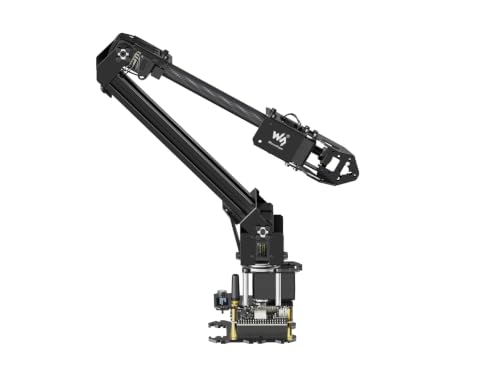
- Four-DOF arm with 360-degree base
- ESP32 wireless and wired control
- Open-source interfaces and expansion plate
Best For: ROS2 prototyping and mobile robotics
Best DIY Learning Kit
ROT3U 6DOF Aluminium Robot Arm

- 6DOF aluminum DIY construction
- Includes MG996R metal-gear servos
- 180° rotation and 98mm claw opening
Best For: Students and hobbyists learning robotics
Best Advanced AI Platform

- 12 high-torque bus servos
- Dual-camera vision system
- LeRobot-compatible imitation learning
Best For: AI robotics research and advanced development
Best Budget Frame Project
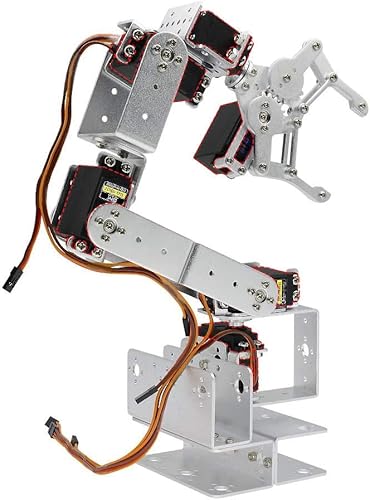
- Aluminum 6DOF mechanical frame
- Servos sold separately
- 180° rotation with 98mm holder opening
Best For: Makers building a customized servo arm
Best Open-Source AI Pick
LeRobot SO-ARM101 Servo Robot Arm Kit

- 6-DOF platform for LeRobot and Hugging Face projects
- Supports imitation and reinforcement learning workflows
- 3D-printed parts are not included
Best For: AI robotics development and Jetson-based experimentation
Best Ready-to-Use STEM Model
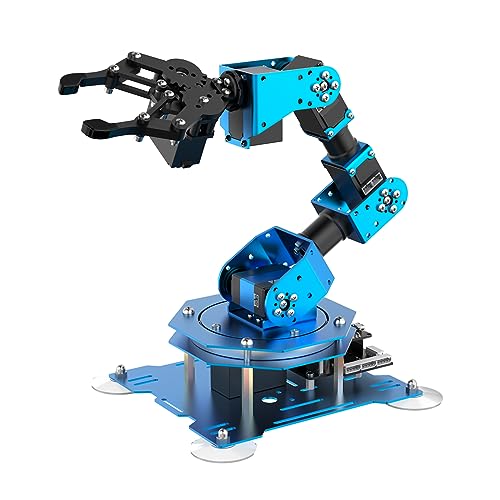
- Assembled 6-axis aluminum robot arm
- Multiple PC, app, wireless, and manual controls
- Intelligent servos support feedback and 500g grasping
Best For: STEM education and introductory coding projects
Best Embodied AI Platform
Hiwonder NexArm AI Servo Robot Arm

- 6-axis metal arm with magnetic encoder bus servos
- Supports LeRobot, imitation learning, and VLA models
- K230 vision and voice features expand AI experiments
Best For: Embodied AI labs and advanced robotics education
Open-Source Starter Pick – MaxArm Arduino Robot Arm
For learners comparing servo robot arms, the MaxArm is a versatile starter kit built around an ESP32 open-source controller. Its link mechanism, inverse-kinematics support, and multiple control options make it suitable for hands-on programming and robotics practice.
Best For: Arduino and Python learners, STEM education, and wireless robotics experiments.
Pros:
- Supports Python and Arduino programming, app, PC, mouse, and wireless-controller operation.
- Uses inverse kinematics for programmed movement across the X, Y, and Z axes.
- Includes Wi-Fi, Bluetooth, sensor ports, and expansion interfaces for secondary development.
- Aluminum construction and smart bus servos support accurate movement and heavier payloads.
Cons:
- Recommended for users aged 16 and up, so it may be advanced for younger beginners.
- The starter kit is designed for indoor tabletop use rather than mobile deployment.
Choose MaxArm when programming flexibility and expansion potential matter more than a simple plug-and-play setup. It offers a broad introduction to servo robot arms while leaving room for sensor and wireless projects.
High-Torque Component Pack – RDS3218 Dual-Shaft Servos
This four-pack is aimed at builders who need replacement or project-ready actuators for servo robot arms. Each RDS3218 digital servo includes mounting brackets, metal gearing, and controlled 180-degree rotation for mechanical-arm and other DIY applications.
Best For: DIY robot-arm builders, RC projects, and multi-servo mechanical assemblies.
Pros:
- Four servos are supplied with long and short U-shaped brackets and screw sets.
- Rated for up to 21.5 kg/cm of maximum torque at 6.8V.
- Dual-shaft design and 180-degree rotation allow flexible mounting and movement.
- Copper and aluminum gears plus a CNC aluminum middle shell support a durable build.
Cons:
- This is a servo component pack, not a complete robotic arm kit.
- The notes do not specify programming, controller, or wireless-control features.
Consider this pack when your project already has a controller and structure but needs multiple high-torque servos. The included brackets simplify mechanical integration, although electronics and programming components must be sourced separately.
Arduino Learning Kit – miniArm 5DOF Robot Arm
The miniArm is a five-axis educational platform for shoppers seeking servo robot arms with an emphasis on Arduino development. Its open-source programs, knob controller, Bluetooth module, and sensor expansion ports support both guided learning and custom robotics projects.
Best For: Arduino programming practice, STEM education, and sensor-based arm experiments.
Pros:
- Built on the Atmega328 platform and compatible with Arduino programming.
- Open-source programs, tutorials, and secondary-development examples help learners get started.
- Offers app control, six-channel knob control, and offline action editing.
- Provides expansion ports for components such as an ESP32 Cam, accelerometer, touch sensor, and ultrasonic sensor.
Cons:
- Recommended for users aged 16 and up.
- The supplied notes do not list a payload capacity or detailed workspace specifications.
miniArm is a strong choice for users who want an approachable Arduino-centered learning platform with room to add sensors. Its five-axis design and multiple control methods make it more flexible than a basic fixed-function teaching model.
Wireless Expansion Pick – Waveshare RoArm-M2-S
For buyers wanting compact servo robot arms with a broader workspace, the Waveshare RoArm-M2-S combines an ESP32 controller with four degrees of freedom and a 360-degree base. Its open-source interface and expansion plate also make it suited to custom end-of-arm tooling and secondary development.
Best For: Wireless prototyping, ROS2-compatible projects, and lightweight mobile-platform integration.
Pros:
- Provides a 360-degree omnidirectional base and a workspace with a stated 1-meter diameter.
- ESP32 control supports multiple wireless modes and wired communication options.
- Open-source control code and communication documents support development across languages and devices.
- Lightweight design weighs under 850g and lists a 0.5kg payload at 0.5m.
Cons:
- With four degrees of freedom, it offers fewer axes than some five-axis educational arms.
- Its advanced expansion and ROS2 support may be more than a beginner needs.
The RoArm-M2-S stands out when workspace, wireless control, and integration flexibility are priorities. Its expansion plate and documented interfaces make it particularly appealing for experimental tools and mobile robotics platforms.
Best DIY Learning Kit – ROT3U 6DOF Aluminium Robot Arm
The diymore ROT3U is a hands-on choice for anyone comparing servo robot arms for introductory robotics, programming, and science projects. It is a 6DOF aluminum DIY kit with a 180-degree rotation angle, a 98mm maximum claw opening, and included MG996R metal-gear servos. Assembly is required.
Best For: Students, hobbyists, and families seeking an educational tabletop robot arm to assemble and explore.
Pros:
- Includes MG996R servos designed for joints carrying larger forces.
- Aluminum construction with six degrees of freedom.
- Includes six 25T metal horn mounts and 45 total pieces.
- Suitable for learning robotics, programming, and science.
Cons:
- Requires self-assembly.
- Manufacturer recommends it for ages 10 and up.
- The listed 98mm claw opening limits the size of objects it can grip.
This kit balances a substantial aluminum frame with an accessible DIY format. It is a practical starting point for learning-focused projects rather than a ready-to-run professional automation system.
Best Advanced AI Platform – SO-ARM101 6-Axis Robot Arm
The Hiwonder SO-ARM101 is an advanced option among servo robot arms, combining a 6-axis design with imitation-learning tools and dual-camera vision. This assembled kit includes 12 high-torque bus servos, 3D-printed parts, and compatibility with the LeRobot open-source framework.
Best For: Adult researchers, developers, and experienced hobbyists exploring AI vision, imitation learning, and open-source robotics.
Pros:
- Supports end-to-end imitation learning through the LeRobot framework.
- Dual-camera system provides gripper-mounted and external visual input.
- 12 bus servos feature high torque and magnetic feedback.
- BusLinker V3.0 supports servo scanning, status monitoring, and trajectory control.
Cons:
- Recommended for ages 16 and up, making it less suitable for young beginners.
- Its AI and software features may require more setup knowledge than a basic educational arm.
- The supplied dimensions indicate a relatively substantial 20 x 9 x 9-inch form factor.
With the servos, cameras, debugging board, and assembled format included, this is the most feature-rich choice in the group. Its strengths are directed toward experimentation and development rather than simple mechanical assembly.
Best Budget Frame Project – ROT3U 6DOF Arm Without Servos
This silver ROT3U frame is a component-focused option for shoppers comparing servo robot arms and planning to supply their own electronics. The unassembled aluminum kit provides a 6DOF mechanical arm with a 355mm radius of gyration, 180-degree rotation, and a 98mm maximum holder opening, but servos are not included.
Best For: Makers who already have compatible servos and want to build or customize an aluminum robot-arm project.
Pros:
- Aluminum construction for a sturdy mechanical frame.
- Offers six degrees of freedom and 180-degree rotation.
- Includes a 98mm maximum holder opening and 355mm radius of gyration.
- No soldering is required during the listed kit assembly.
Cons:
- Servos are not included.
- Parts arrive unassembled.
- The manufacturer recommends MG996R servos for higher-force joints and MG995 servos for lower-force joints.
This kit can be a flexible foundation for a custom build, but the final cost and complexity depend on the servos and other components you choose. Confirm compatibility before ordering, especially if you do not already have MG996R or MG995 motors.
Best Open-Source AI Pick – LeRobot SO-ARM101 Servo Robot Arm Kit
For developers building AI-focused servo robot arms, the LeRobot SO-ARM101 is a flexible 6-DOF platform designed for imitation learning, reinforcement learning, and hands-on robotics experimentation. It works with LeRobot, Hugging Face, PyTorch-based tools, and compatible NVIDIA Jetson devices. Note that 3D-printed parts are not included.
Best For: AI robotics developers, researchers, and DIY builders working with LeRobot or NVIDIA Jetson.
Pros:
- Open-source design supports simulation, training, datasets, and deployment.
- Improved wiring and joint range of motion address limitations of the SO-ARM100.
- Leader-follower tracking supports real-time human intervention during reinforcement learning.
- Includes assembly, calibration, testing, and deployment resources.
Cons:
- 3D-printed structural parts are not included.
- Its AI development focus may be more complex than needed for basic tabletop control.
The SO-ARM101 is a strong choice when software compatibility and trainable behavior matter more than a ready-to-use educational setup. Budget separately for the missing printed parts and plan for assembly and calibration.
Best Ready-to-Use STEM Model – Hiwonder xArm1S Assembled Arm
This assembled 6-axis servo robot arm is aimed at coding practice, remote-control projects, and classroom-style STEM exploration. Its aluminum construction, intelligent serial bus servos, and multiple control options make it a practical tabletop platform for learning and demonstrations.
Best For: STEM learners and makers who want an assembled arm with PC, app, mouse, PS2, and manual control.
Pros:
- Arrives assembled, reducing setup time.
- Six intelligent servos provide position, voltage, and temperature feedback.
- Supports PC, phone app, mouse, PS2 wireless, and other control methods.
- Rated to grasp objects weighing up to 500g.
Cons:
- Its educational and manual-control orientation may be less suitable for advanced AI training.
- It requires a DC power supply.
The xArm1S is a straightforward choice for learners who want to start experimenting quickly without assembling the mechanism. Its action-editing tools and varied controls also make it useful for demonstrations and introductory programming projects.
Best Embodied AI Platform – Hiwonder NexArm AI Servo Robot Arm
The NexArm is an advanced servo robot arm for embodied AI development, combining a metal 6-axis structure with magnetic encoder bus servos, inverse kinematics, and an ESP32 plus AT32 architecture. Its LeRobot integration, optional vision capabilities, and support for imitation learning make it suited to more ambitious research and education projects.
Best For: University labs, AI developers, and educators exploring VLA models, vision-guided grasping, and multimodal robotics.
Pros:
- Offers a 500mm reach, 500g payload, and stated ±2mm repeatability.
- Integrates with LeRobot, community models, datasets, and simulations.
- K230 vision module provides built-in AI vision features and voice interaction.
- Includes open-source code, schematics, tutorials, and several control modes.
Cons:
- Its broad AI feature set may be excessive for simple servo-arm projects.
- The standard kit’s listed included component is the NexArm robot arm, so expansion hardware may be needed for larger scenarios.
Choose the NexArm when you need a development platform rather than a basic programmable arm. Its vision, voice, and multimodal capabilities create room for complex experiments, while the open-source ecosystem supports deeper customization.
How We Picked These Servo Robot Arms
We selected these kits and components for their usefulness across education, prototyping, programming, and AI robotics. The lineup includes Arduino- and ESP32-compatible arms, serial bus servo platforms, complete STEM kits, replacement or upgrade servos, and open-source six-axis systems. We prioritized documented control interfaces, practical expandability, metal or reinforced construction where available, and clear differences in skill level and intended use.
Because these products vary considerably, compare what is actually included. Some are ready-to-build kits with motors and control boards, while others require additional servos, 3D-printed components, a power supply, or separate programming hardware.
Quick Comparison
- Best for beginner coding: Arduino and ESP32 kits with guided projects and straightforward programming interfaces.
- Best for STEM classrooms: 4DOF or 5DOF educational arms that emphasize assembly, wiring, and motion basics.
- Best for mechanical upgrades: High-torque digital servos with compatible mounting brackets.
- Best for AI experimentation: Open-source six-axis arms designed for imitation learning, computer vision, or embodied-AI development.
- Best for customization: Unassembled aluminum kits that let you choose the controller, gripper, and software stack.
Key Buying Factors for Servo Robot Arms
Degrees of Freedom and Reach
More axes provide greater positioning flexibility but usually increase setup complexity, cost, and calibration work. A 4DOF or 5DOF arm is often sufficient for pick-and-place demonstrations, while 6DOF models are better suited to orientation-sensitive tasks and advanced experimentation. Check the stated reach and payload rather than judging capacity by appearance alone.
Servo Torque and Construction
Torque determines how reliably the arm can lift a load, especially when the object is far from the base. Metal gears and aluminum frames generally withstand repeated use better than lightweight plastic parts, but they also require a stronger power supply. Avoid running high-torque servos from an underpowered USB connection.
Controller, Software, and Expansion
Arduino and ESP32 support is valuable for learners who want accessible coding examples, wireless control, or sensor integration. Bus servos can simplify wiring and provide position feedback, while conventional PWM servos may be cheaper and easier to replace. For AI-focused projects, verify compatibility with the required libraries, cameras, datasets, and operating system.
Assembly and Included Parts
Confirm whether the kit arrives assembled, partially assembled, or as unassembled mechanical parts. Check for included brackets, grippers, cables, batteries or power adapters, controller boards, and 3D-printed pieces. Missing components can significantly change the final cost.
Who Should Buy Which Servo Robot Arms?
Choose an Arduino or ESP32 kit if you are learning robotics, teaching programming, or want a flexible platform for sensors and wireless control. Choose a dedicated STEM arm if guided construction and classroom-friendly experimentation matter most. Choose a high-torque servo upgrade when you already own a compatible arm and need stronger, more durable actuators.
Choose a six-axis open-source AI arm if your goal is imitation learning, computer vision, or embodied-AI research. These systems offer more capability but demand more setup, calibration, software knowledge, and reliable power. For hands-on mechanical customization, an aluminum unassembled kit is the better fit.